Why Professional Agility Is the New Career Superpower (And How to Build It)
Professional agility is the new career superpower. With AI reshaping work faster than ever, here's the research-backed framework for building it — for yourself and your team.

Professional agility is the capacity to continuously learn, adapt your career identity, and design environments where your team can do the same. In a 2026 global survey of 35,000 workers, Adecco found that professional agility has become the single top priority for employees worldwide — above salary or title (Adecco Workforce Trends 2026). With only 22% of workers confident their job is safe from AI elimination, the ability to stay agile is no longer optional — it is the new definition of career security (ADP Research, March 2026).
Key Takeaways
- Professional agility combines individual learning with the organizational conditions leaders create for others.
- Only 22% of workers feel AI-safe (ADP, 2026); professional agility is the primary career protection strategy for the year ahead.
- Organizations with adaptive cultures are 11× more likely to outperform peers in times of disruption (WorldatWork/Cornerstone OnDemand, 2026).
- The EY All In framework identifies three specific leader behaviors — visible learning, psychological safety, and role redefinition — that build genuinely agile teams.
- Career identity redefinition, not just skill-building, is the most underused and highest-leverage agility move available to you right now.
What Is Professional Agility — and How Is It Different from Adaptability?
Most people use "adaptability" and "professional agility" interchangeably. They are related, but not the same. Adaptability is typically measured at the individual level — it describes how well a single person responds to change, often called the individual adaptability quotient. Professional agility goes further: it includes how you design your environment, your team's culture, and your career narrative to handle ongoing uncertainty.
A 2026 peer-reviewed systematic review in PMC covering 25 years of employee agility research found that two factors consistently predicted long-term career success: learning agility and contextual adaptability. Learning agility is the speed at which you acquire new knowledge; contextual adaptability is the ability to apply it across shifting conditions. Professional agility is the deliberate cultivation of both — combined with the choices you make to build those conditions for people around you.
This distinction matters because individual resilience alone is not enough. When AI is rewriting job descriptions faster than any one person can reskill, the people who thrive are those who also shape the systems, teams, and environments they work within.
Why Professional Agility Has Become a Career Superpower in 2026
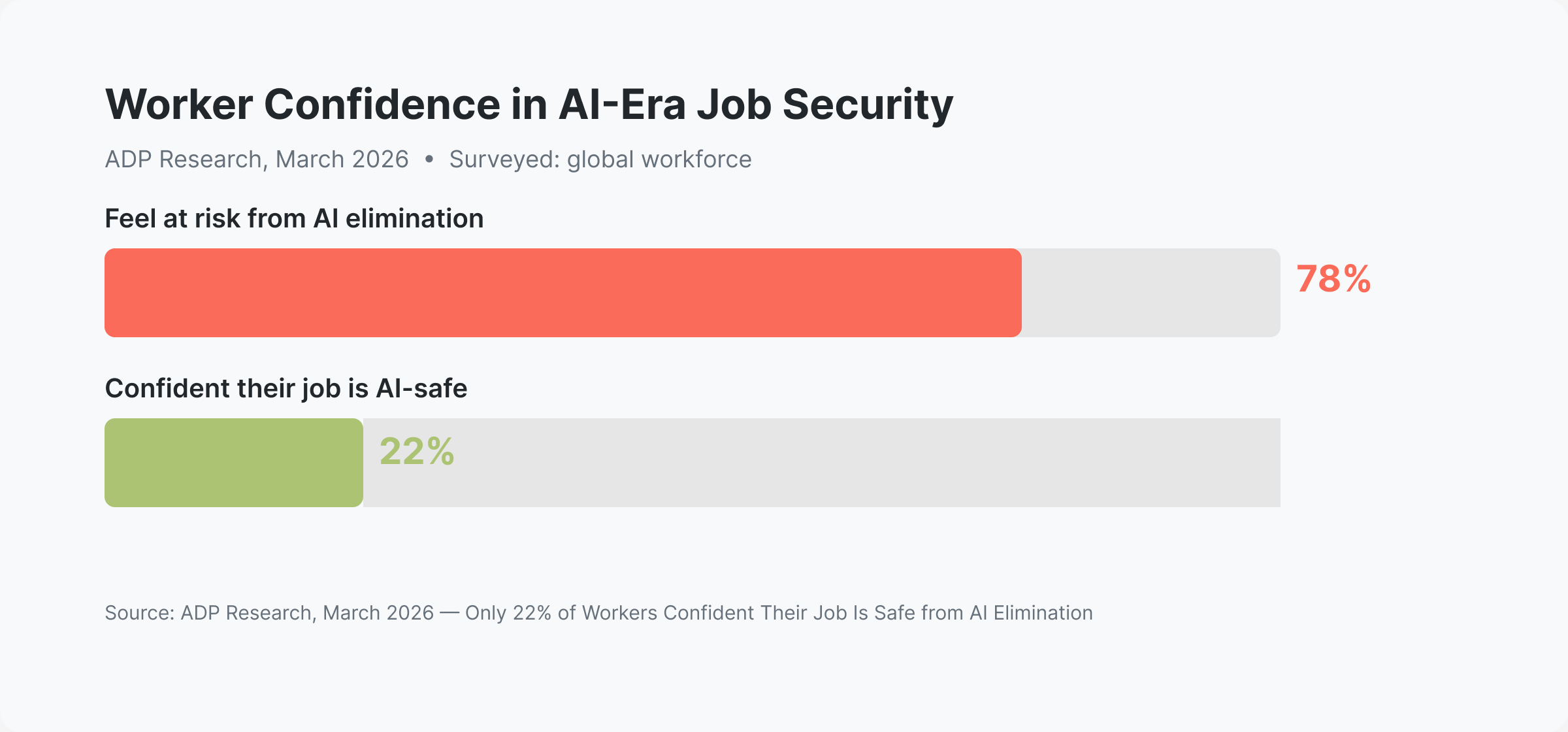
The numbers make the case clearly. ADP Research (March 2026) surveyed a broad cross-section of the global workforce and found that only 22% of workers are confident their job will not be eliminated by AI — meaning nearly four in five workers are operating under real uncertainty about their career futures. An EY survey of 2,500 knowledge workers found that 46% are frustrated that AI is now replicating skills they spent years developing.
This is the core of how AI is intensifying workloads and identity pressure simultaneously: it automates tasks while making people question which of their competencies still belong to them. The ETS Human Progress Report 2026 called adaptability "the new foundation of job security in the AI age" — a statement that would have sounded dramatic five years ago and now reads as obvious.
MuchSkills 2026 data confirmed adaptability as a top-5 most demanded skill by employers globally. But employer demand for agility doesn't tell you how to develop it. That's where the EY All In framework, the 5 human skills AI cannot replace, and a proactive approach to your career identity come together into a practical system.
The 3 Leader Behaviors That Build an Agile Team (EY All In Framework)
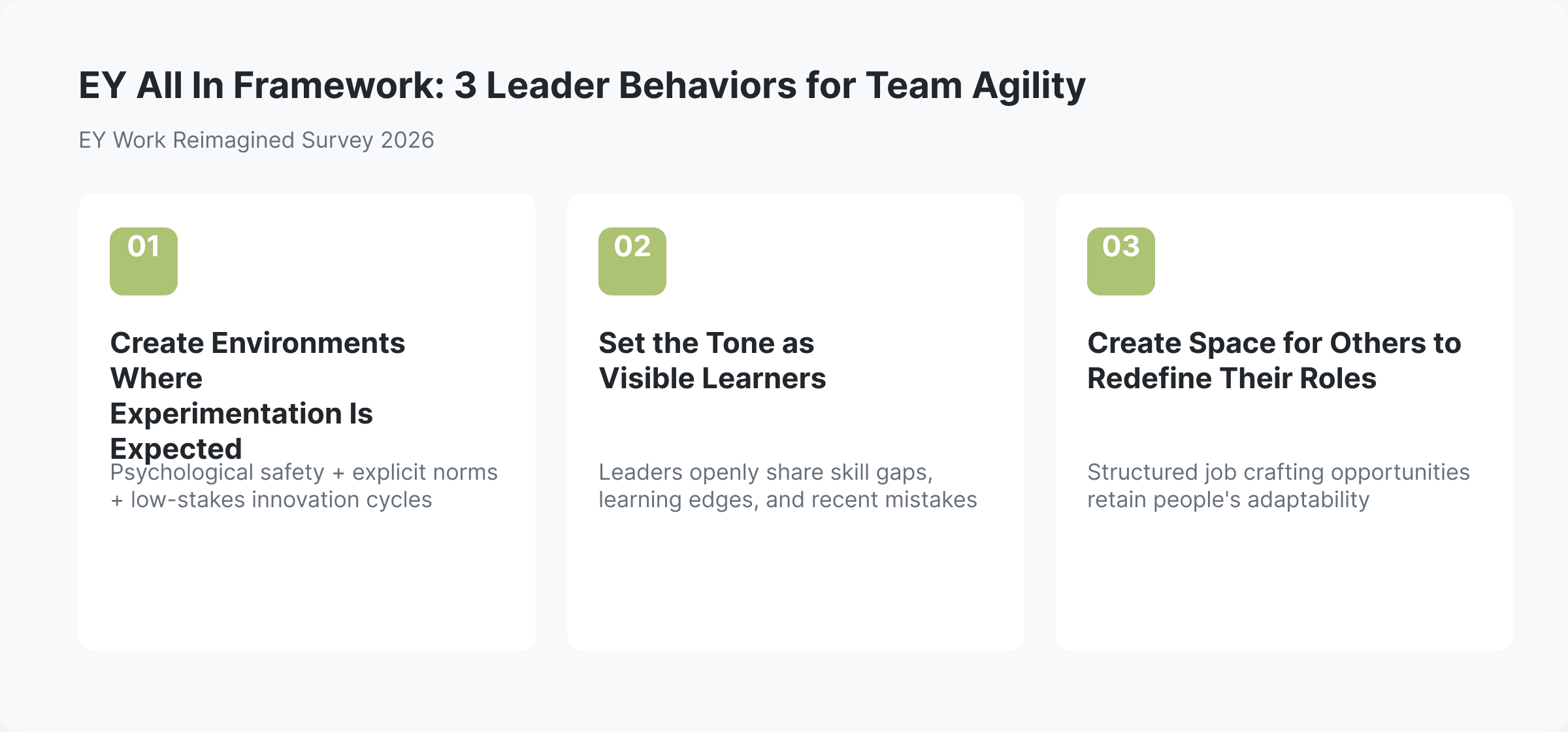
The EY Work Reimagined Survey 2026 identified "workforce tensions with AI" as one of the top barriers to actually realizing AI's value inside organizations. In response, EY developed the All In framework, grounded in the idea that agility is not a character trait you hire for — it is a set of conditions leaders actively create. Three behaviors define it.
1. Create Environments Where Experimentation Is Expected
Psychological safety is the foundation of agility. Teams cannot adapt quickly if they fear that trying something new and failing will cost them their standing. Leaders who make experimentation structurally expected — through explicit norms, shared retrospectives, and low-stakes innovation cycles — build the soil in which agility grows. This is not about being permissive; it is about making learning fast enough to outpace disruption.
2. Set the Tone as Visible Learners
This is the most underused behavior in the framework. When leaders openly discuss their own skill gaps, learning edges, and what they recently got wrong, they remove the shame from not-knowing for everyone on their team. Knowing what followers need most from leaders — including honesty and humility — is inseparable from building agile organizations. A team where only junior employees are expected to keep learning is a team that will calcify under pressure.
3. Create Space for Others to Redefine Their Roles
Job crafting — the practice of allowing people to reshape their responsibilities to better match their evolving strengths and interests — is a proven team-level agility tool. When leaders create structured opportunities for role redefinition (not just promotions), they retain the adaptability of their people rather than losing it to turnover. This behavior links directly to the highest-leverage individual agility move: career identity redefinition.
Redefine Your Career, Not Just Your Skills
Skill-building is necessary but reactive. It responds to what the market demands right now. Career identity redefinition is proactive: it asks who you are becoming, not just what you can currently do. The WorldatWork and Cornerstone OnDemand 2026 study found that companies acting on workforce data are 11× more adaptable than those that don't — but the same principle applies to individuals who actively rewrite their career narratives rather than waiting for a job title to tell them who they are.
Redefining your career identity means moving from "I am a project manager" to "I am someone who brings order to complexity — right now that looks like project management, and tomorrow it might look like something that doesn't have a job title yet." This reframe creates enormous freedom. It unties your sense of professional worth from a specific role or tool, which is exactly the kind of psychological flexibility that lets you pivot when conditions change.
For anyone feeling the weight of when high ambition becomes unsustainable, career identity redefinition is often the missing piece — the move that reconnects ambition with adaptability rather than pitting them against each other.
Agility in Practice — Self-Assessment Checklist
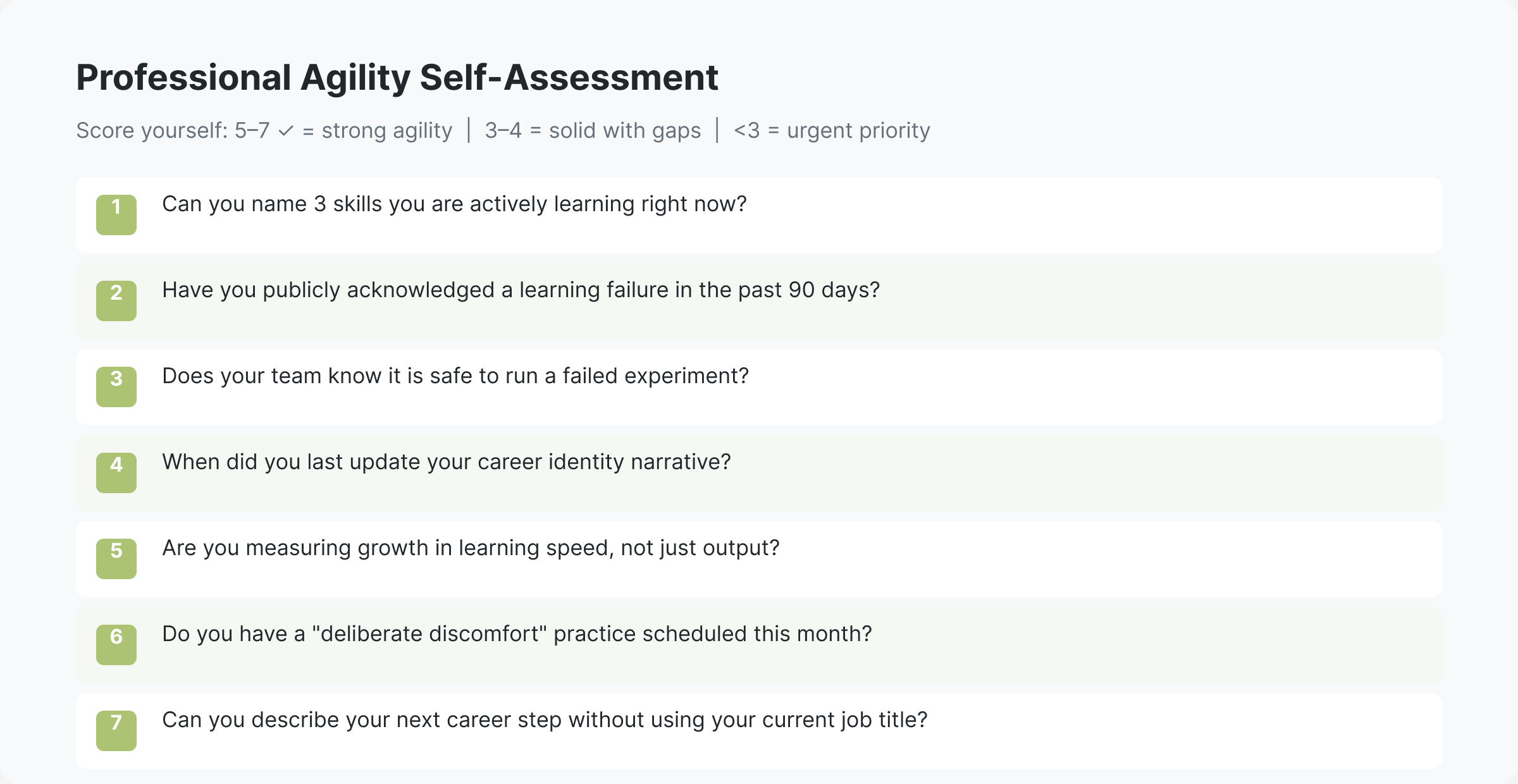
Use this checklist to gauge where you stand — and where your team stands — on professional agility. It applies to both individual contributors and people in leadership roles.
- Can you name 3 skills you are actively learning right now — not just planning to learn?
- Have you publicly acknowledged a learning failure or misstep in the past 90 days?
- Does your team know, without doubt, that it is safe to run a failed experiment?
- When did you last update the narrative you use to describe your career identity?
- Are you measuring your growth in learning speed, not just output or delivery?
- Do you have a "deliberate discomfort" practice — a situation where you are intentionally a beginner — scheduled in your calendar this month?
- Can you describe the next version of your career in one sentence, without using your current job title?
If you answered yes to five or more: you are operating with strong professional agility. Three to four: you have a solid foundation with specific gaps to close. Fewer than three: treat this as an urgent development area, not a soft goal.
Professional Agility vs. Traditional Career Mindset
| Dimension | Traditional Mindset | Professional Agility Approach | Why It Matters |
|---|---|---|---|
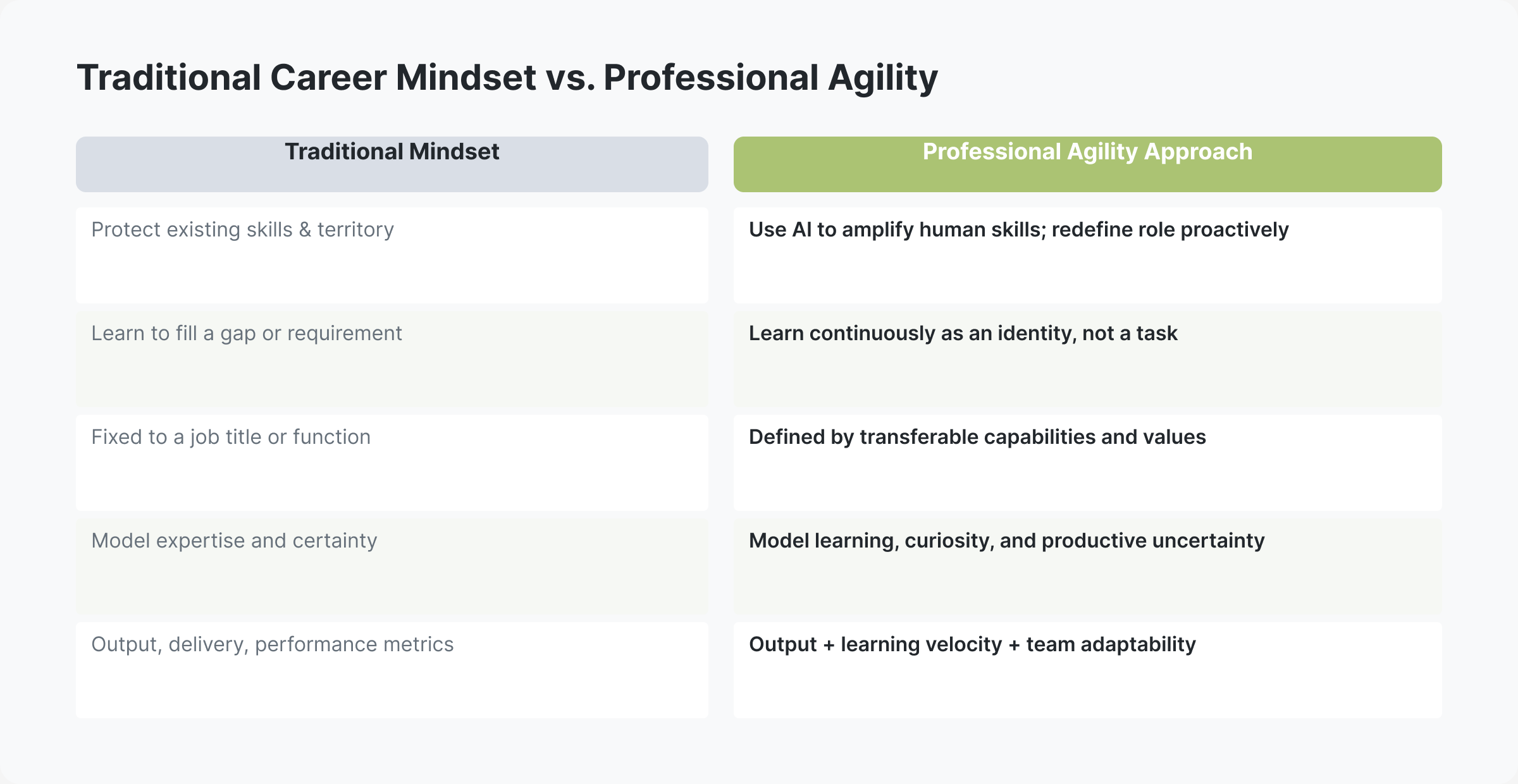
| Response to AI disruption | Protect existing skills and territory | Use AI to amplify human skills; redefine role proactively | Reactive protection stalls; proactive redefinition opens new paths |
| Relationship with learning | Learn to fill a gap or meet a requirement | Learn continuously as an identity, not a task | Identity-level learning is self-sustaining; gap-filling stops when the gap closes |
| Career identity | Fixed to a job title or function | Defined by transferable capabilities and values | Title-based identity collapses when titles change; capability identity travels |
| Leadership behavior | Model expertise and certainty | Model learning, curiosity, and productive uncertainty | Visible learning creates permission for teams to stay agile |
| Measurement of success | Output, delivery, and performance metrics | Output + learning velocity + team adaptability | Performance alone is a lagging indicator in fast-changing environments |
| Team environment | Stability, role clarity, risk management | Psychological safety, experimentation, role evolution | Stable environments calcify; adaptive environments outperform 11× (WorldatWork, 2026) |
FAQ — Professional Agility in the AI Era
What is professional agility and how is it different from adaptability?
Adaptability describes how well an individual responds to change as a personal trait. Professional agility is broader: it includes how you design your environment and career narrative to handle ongoing uncertainty. Where adaptability is reactive, professional agility is both reactive and proactive — it involves deliberate systems, not just resilience.
How can I become more professionally agile in an AI-driven workplace?
Start with two moves: redefine your career identity from a job title to a set of transferable capabilities, and begin publicly learning in front of your team. These two behaviors unlock everything else — they build psychological safety, model agility for others, and shift your internal relationship with change from threat to opportunity.
What skills make someone professionally agile?
The 2026 PMC systematic review (25 years of research) identifies learning agility and contextual adaptability as the most consistent predictors of career success. Beyond those: comfort with ambiguity, the ability to reframe setbacks as data, and skill in building the team cultures where fast learning is structurally possible.
How do leaders create a culture of professional agility?
The EY All In framework gives three specific behaviors: create environments where experimentation is expected, set the tone as a visible learner yourself, and create structural space for team members to redefine their roles. All three require deliberate action and repetition, not just permission.
Is professional agility more important than technical skills in 2026?
Both matter, but the ROI is shifting. Technical skills decay faster as AI accelerates; professional agility compounds over time. The most effective 2026 career strategy is to maintain relevant technical skills while investing heavily in the agility that determines how fast you can acquire the next set when the current ones expire.
Conclusion — Agility Is Built, Not Born
Professional agility is not a personality type you either have or don't. It is a set of practices — for yourself and for the people around you — that can be developed, measured, and improved. The data from 2026 is clear: workers who treat their career as a fixed identity tied to current skills are exposed; those who continuously learn, redefine their narrative, and build adaptive environments around them are protected. The gap between those two groups will widen as AI continues to accelerate.
Start with the self-assessment checklist above. Pick one gap to close this month. If you lead others, introduce one EY All In behavior in your next team interaction. Agility compounds — and VitaWell's Career section has everything you need to keep building it.
Related on VitaWell
- Can AI Really Be Your Career Coach? — Discover 3 science-informed ways to use AI as a career development tool without losing the human edge that still matters most.
- How to Get Unstuck in Your Career — If the agility checklist revealed you are stuck, this article gives you the frameworks to identify exactly where and why — and what to do next.
- What Workplace Jealousy Is Really Telling You — Professional jealousy is often a signal about your unarticulated career identity — learn how to use it as an agility tool rather than a source of shame.
Sources
- Fast Company, Nov 2026 — Why Professional Agility Is the New Career Superpower
- ADP Research, March 2026 — Only 22% of Workers Confident Their Job Is Safe from AI Elimination
- Adecco Workforce Trends 2026 (via HR Dive) — Workers Want Job Security, Professional Agility
- WorldatWork / Cornerstone OnDemand, 2026 — Workforce Adaptability Fuels Organizational Performance
- Fast Company / EY AI Now Survey 2026 — Workers in AI-Heavy Jobs Are Having an Identity Crisis
- ETS Human Progress Report 2026 — Adaptability: New Foundation of Job Security in the AI Age
- EY Work Reimagined Survey 2026
- PMC Systematic Review, 2026 — 25 Years of Employee Agility Research
- MuchSkills 2026 — Why Skills Should Be Top Priority