Why You Trust Your Future Self More Than Your Past Self
A landmark 11,416-person study reveals that most adults feel significantly closer to their future self than their past self — and the gap shapes how we decide, invest, and grow.

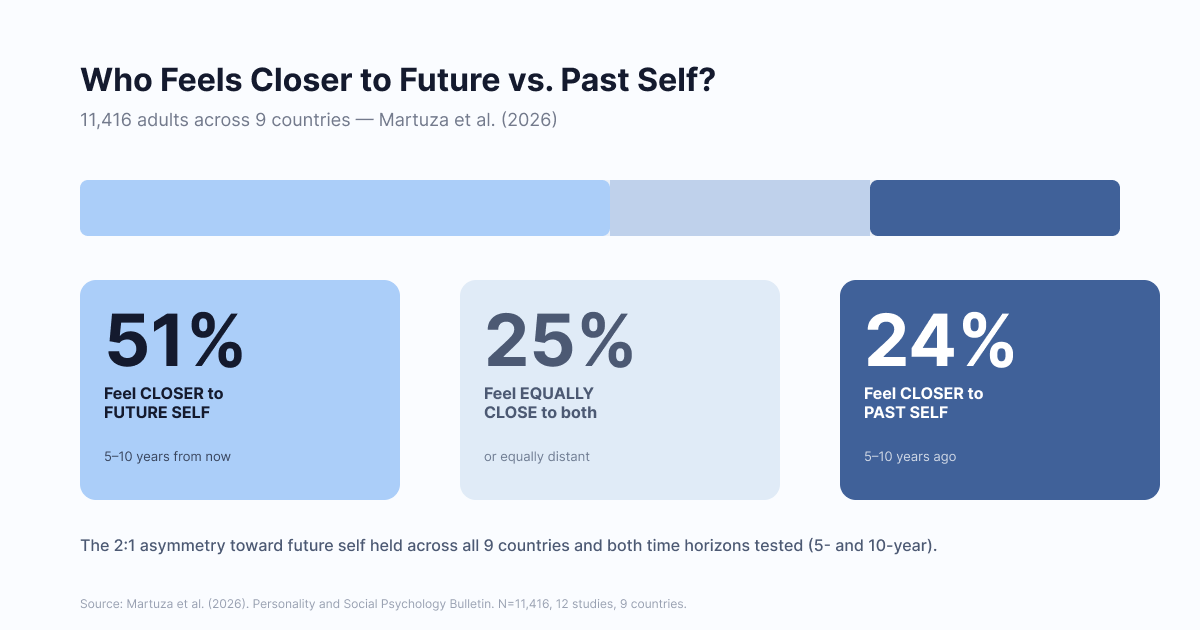
Most people feel significantly closer to their future self than to who they used to be. A 2026 study of 11,416 adults across 9 countries confirms it: 51% say they feel more connected to their future self, while only 24% say the same about their past self. The asymmetry is not a quirk — it is a systematic cognitive pattern that shapes how you save money, schedule your time, and decide what to pursue. Understanding it makes you a better decision-maker.
Key Takeaways
- 51% of adults feel closer to their future self vs. only 24% to their past self, in a 12-study analysis of 11,416 people across 9 countries (Martuza et al., 2026)
- The gap is driven by "projection bias" — people extend their current mental state further into the future than into the past
- When people treat their future self like a stranger, they underfund retirement, over-schedule future time, and shift effort to "later" at high personal cost
- Mentally simulating a "day in the life" 20 years from now measurably improves self-continuity and valued living across 10 life domains (Blom et al., 2026)
- Past self offers calibration data that future self lacks — ignoring it is a correctable, systematic error
The Study — 11,416 People Asked a Simple Question
What Researchers Measured
Martuza, Hepper, and colleagues pooled data across 12 studies and 11,416 participants from the United States, United Kingdom, Canada, Australia, Germany, Italy, Poland, Portugal, and South Africa, publishing the results in Personality and Social Psychology Bulletin (Martuza et al., 2026). The core question was straightforward: do you feel psychologically closer to who you will be (5 or 10 years from now) or to who you were (5 or 10 years ago)?
What the Numbers Showed
The result was striking. Fifty-one percent of adults reported feeling closer to their future self. Only 24% said they felt closer to their past self. The remaining 25% reported feeling equally close — or equally distant — from both. The pattern held across all 9 countries and both time horizons, which makes this something other than a cultural artifact or a local quirk of one nationality or decade.
Why the Future Self Feels Closer — The Science of Projection Bias
We Project Our Current State Outward
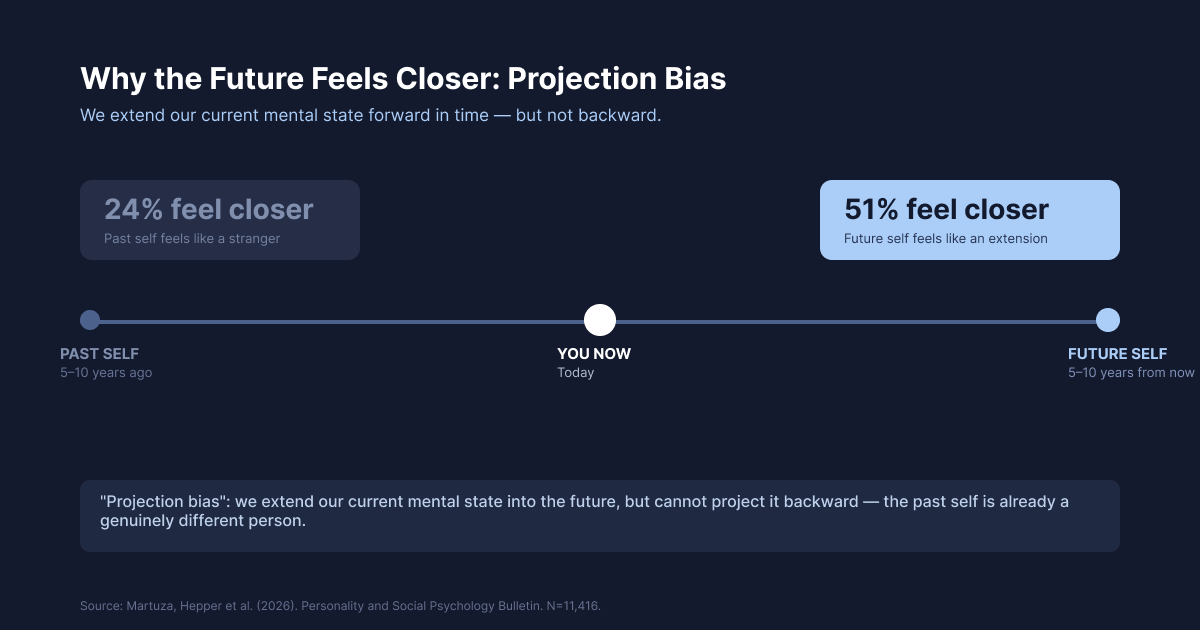
The mechanism behind the asymmetry is a cognitive phenomenon called projection bias: the tendency to project one's current mental and emotional state into estimates of the future, while failing to apply the same projection backward into the past. When you think about your future self, you are partly imagining a version of yourself right now, extended forward in time. When you think about your past self, that mapping does not work in the same way — you are recalling a genuinely different person, one whose specific experiences and perspectives are largely inaccessible.
This creates an asymmetry in felt closeness. The future self feels like an extension of the current self; the past self feels more like a stranger. Research on how our Stone-Age cognitive architecture mismatches modern environments helps explain why this forward-projection exists: our minds evolved to simulate possible futures more readily than to retrieve past mental states with accuracy.
The Stranger Experiment
Psychologists Elizabeth Pronin and colleagues demonstrated just how far the stranger-effect extends in a 2008 study published in the Journal of Experimental Psychology: General. Participants were given an unpleasant "health drink" and asked to assign amounts of it to: themselves right now, their future self in several weeks, and a stranger. They assigned the future self nearly four times as much of the drink as themselves — and critically, the amount assigned to future self was statistically identical to the amount assigned to the stranger (Pronin et al., 2008).
The implication is sobering: in certain contexts, we are as willing to impose burden on our future self as we are on someone we have never met.
The Hidden Costs of Future Self Favoritism
Retirement Savings
The stranger-effect has measurable financial consequences. In a landmark study by Hershfield and colleagues, participants exposed to digitally-aged photographs of themselves made significantly higher retirement savings allocations in simulated decisions compared to participants who saw an un-aged version of their face (Hershfield et al., 2011). Making the future self feel real changes what you do for it. The inverse holds too: when the future self feels like a stranger, present-you tends to underfund it — just as you would not sacrifice heavily for a stranger's comfort.
The Over-Scheduling Trap
Projection bias operates in the opposite direction for time commitments. Because people assume their future self will have more energy, more bandwidth, and more enthusiasm than their current self, they systematically over-commit to future obligations. Research on how we underestimate cognitive load in advance is consistent with this pattern: people expect their future self to handle complexity that their current self finds draining. The practical result is a calendar that looks manageable three months out and crushing when those months arrive.
The Expected vs. Actual Satisfaction Gap
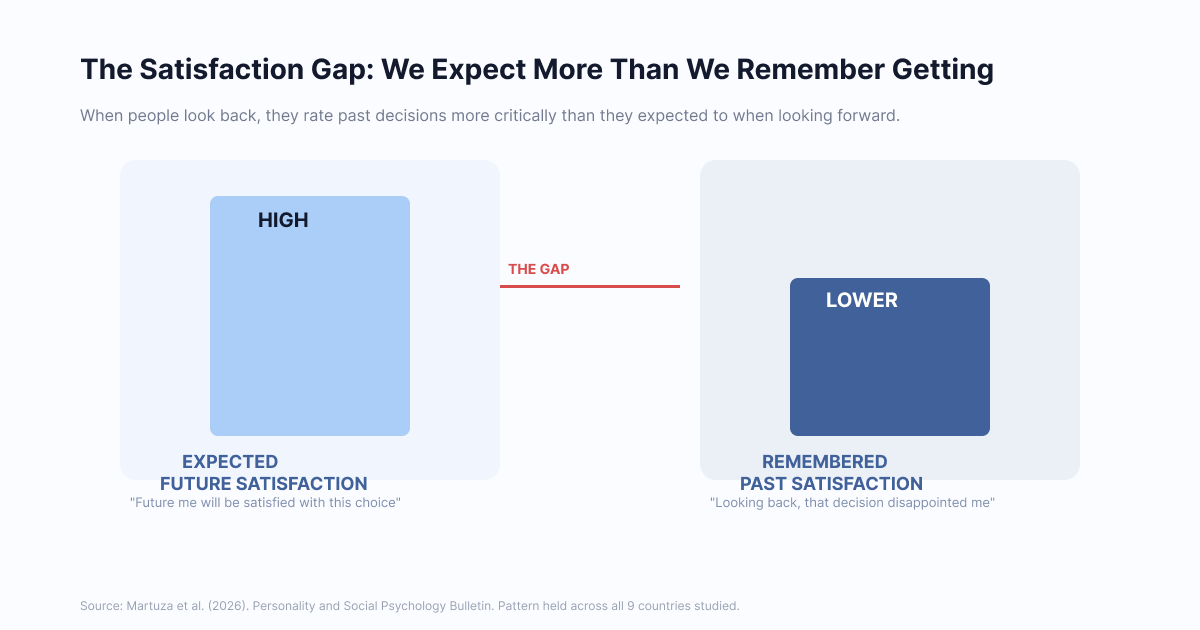
One of the most revealing findings from the Martuza et al. (2026) research (Personality and Social Psychology Bulletin) is the asymmetry in anticipated versus remembered satisfaction. Participants expected their future self to be more satisfied with current decisions than their past self actually turned out to be. In other words: when we look back, we tend to judge our past decisions more critically than we expected to when looking forward. Future self is extended the benefit of the doubt; past self is not.
The Asymmetry Across 7 Decision Domains
The table below synthesizes findings from Martuza et al. (2026), Pronin et al. (2008), Hershfield et al. (2011), and Blom et al. (2026) into a practical reference for the decisions where temporal self-perception most reliably leads people astray.
| Decision Domain | What Past Self Evidence Shows | What Future Self Expects | Common Error | Decision Rule |
|---|---|---|---|---|
| Retirement / investing | Consistency and sacrifice required; past sacrifices taken for granted | Future self will handle it; plenty of time later | Underfunding now; treating future self as a stranger | Automate contributions today; use the Hershfield face exercise before major funding decisions |
| Time commitments | Past "yes" to future obligations reliably caused overwhelm | Future self will have more time and energy | Over-scheduling 3–6 months out | Add a 30% friction tax to any future commitment; ask past-self what happened last time |
| Health habits | Small daily choices compound; past adherence data exists | Future self will be more disciplined and motivated | Delaying starts; binging then planning to "reset" | Use past adherence rate as the forecast, not aspirations |
| Learning / skills | Past estimate of time-on-task is calibrated | Future self will learn faster; the topic will become interesting later | Underestimating time required; dropping studies mid-way | Use past-self's time-on-task data, not future-self's optimism |
| Relationship decisions | Past patterns repeat unless specifically addressed | Future circumstances will change the dynamic | Staying or leaving based on imagined future change | Weight past behavior more heavily than future intentions |
| Work projects | Past-self underestimated scope the majority of the time (planning fallacy) | This project is different; future self will be faster | Underestimating timelines; under-resourcing | Multiply past time estimates by 1.5–2x as a default |
| Creative commitments | Past-self abandoned or finished similar projects under known conditions | Future self will be inspired and disciplined | Committing to projects that prior data says will stall | Complete small versions first; treat past finished work as prior probability |
Source: Synthesized from Martuza et al. (2026), Pronin et al. (2008), Hershfield et al. (2011), Blom et al. (2026). Decision rules are practical frameworks, not individual prescriptions.
One Exercise That Actually Closes the Gap
The Day Preconstruction Method
Blom and colleagues tested a specific intervention in a 2026 study published in the Journal of Experimental Psychology: Applied: asking participants to mentally simulate a detailed "day in the life" of themselves 20 years in the future (Blom et al., 2026). The exercise — which they call the "day preconstruction method" — involved imagining a full 24 hours of this future day in granular detail: waking up, morning routines, work or activities, meals, relationships, evenings.
What the Research Showed
Participants who completed the exercise showed measurable improvements in self-continuity (feeling connected to their future self) and in valued living — a composite measure of how well current decisions align with one's own stated values — across 10 distinct life domains. The effect held across domains as different as physical health, relationships, career, finances, and recreation. The mechanism appears to be that the specificity of the simulation forces the mind to populate the future self with concrete, familiar details rather than leaving it abstract and stranger-like.
The Temporal Asymmetry Decision Test — A 3-Question Framework
This framework synthesizes the research above into an applied tool for major decisions. Before making a significant commitment, ask three questions in sequence:
- Does past-self have a track record here? If you have made similar decisions before — same domain, similar stakes — your past outcomes are a stronger predictor than your future-self expectations. Use the data.
- Is this a domain where projection bias typically costs most? Time commitments, retirement funding, health habit initiation, and project timelines are the high-cost domains. Flag extra caution in these areas.
- Have you concretized your future self? If you are relying on an abstract future self ("I'll be more disciplined then"), do the day preconstruction exercise first. Decisions made after the exercise are better calibrated than decisions made before it.
If past-self has no track record, the domain is low-stakes, and you've concretized the future self, forward-looking optimism is a reasonable guide. Otherwise, weight past-self data more heavily than feels natural.
5 Practical Techniques to Recalibrate
Five evidence-based actions grounded in the research above:
- Run the day preconstruction exercise before major decisions. Spend 10–15 minutes simulating a full 24-hour day in your life 20 years from now, in as much sensory and behavioral detail as possible. Research from Blom et al. (2026) shows this single exercise improves self-continuity and decision alignment across 10 life domains.
- Write a letter from your past self to your current self. Most people write to their future self, but the reverse is more revealing: what does your past self know about your patterns, your capacity, and your tendencies that your current self is discounting? Use it as calibration. The science-backed habits of confident people show that behavioral patterns are more predictive than intentions.
- Apply a 1.5x multiplier to all time estimates for future obligations. This corrects for the planning fallacy — the systematic underestimation of how long tasks take — which is amplified by future-self optimism. If you estimate a project will take two weeks, budget three.
- Use digitally-aged imagery before financial decisions. The Hershfield et al. (2011) study demonstrated that seeing your aged face increased retirement allocations significantly. Apps that age your photo are free; spending two minutes with an aged version of yourself before funding decisions is cheap, evidence-based, and effective.
- Ask one calibration question before any new commitment: "What happened the last time I made a similar commitment?" If the answer is "I dropped it," "I burned out," or "I regretted it," that is prior data, not pessimism. Research on the three elements of meaningful living shows that alignment between commitments and core values is what makes the difference — not aspirational projections about future self.
When to Seek Support
This article describes population-level cognitive research, not individual psychological assessment. Consider speaking with a therapist or counselor if:
- You find yourself repeatedly making commitments you cannot keep, despite efforts to change the pattern
- Future-self optimism consistently leads to decisions that damage your finances, relationships, or health
- You feel unable to relate to or access your past experiences in a way that feels meaningful
- Disconnection from your past or future self is contributing to identity confusion or persistent unhappiness
FAQ — Your Questions Answered
Do people really see their future self as a stranger?
Pronin et al. (2008) demonstrated this directly: when participants assigned an unpleasant task burden to themselves now, their future self, and an actual stranger, the amount assigned to their future self was statistically indistinguishable from what they assigned to the stranger. The effect is real and measurable, though it varies by domain and individual.
Why do we feel closer to our future self than our past self?
The 2026 Martuza et al. study (11,416 participants, 9 countries) attributes this to projection bias: people project their current mental state outward into the future more readily than backward into the past. The past self is experienced as genuinely different and partially inaccessible; the future self is partly experienced as an extension of the present.
Can you change how close you feel to your future self?
Yes, and the effect is measurable. Blom et al. (2026) tested a "day preconstruction method" — simulating a full future day in vivid detail — and found it significantly improved self-continuity and valued-living scores across 10 domains. Hershfield et al. (2011) showed that digitally-aged photos produced the same effect in financial decision contexts.
How does the future-self bias affect financial decisions?
It reliably leads to retirement under-saving (treating future self like a stranger), over-spending now on the assumption that future self will compensate, and underestimating what financial commitments feel like to live through. The Hershfield aged-face intervention was specifically designed to — and did — correct this distortion.
Is this effect the same across cultures?
The Martuza et al. (2026) study covered 9 countries across 4 continents (United States, United Kingdom, Canada, Australia, Germany, Italy, Poland, Portugal, South Africa). The 51% future / 24% past asymmetry held across all of them, suggesting the bias is not specific to any one cultural context.
Conclusion — Use Your Past Self More
Fifty-one percent of adults feel closer to their future self than to who they used to be. The figure sounds intuitive, but the mechanism behind it has real costs: when the future self is felt as an extension of the present while the past self is experienced as a stranger, we systematically ignore the best data we have — our own track record — in favor of optimism that the research consistently shows is miscalibrated.
The most practically useful insight from this body of research is not that optimism about the future is wrong. It is that the past self carries calibration data that future self by definition cannot have. Using both — the future self's forward orientation and the past self's evidence — produces better decisions than either alone. Run the day preconstruction exercise. Apply the Temporal Asymmetry Decision Test before major commitments. And write a letter from your past self before your next big decision. These are not abstract recommendations: they are what the research shows works.
Related on VitaWell
- Science-Backed Habits of Confident People — The behavioral patterns that past self can confirm and future self tends to overestimate.
- Three Elements of Meaning and Happiness — How aligned your commitments are with your core values matters more than future-self projections.
- Money Can't Buy Purpose — Why financial decisions grounded in present values, not future-self fantasies, produce more lasting satisfaction.
This article is for informational purposes only and does not constitute psychological or medical advice. Consult a qualified professional for guidance specific to your circumstances.
Sources
- Martuza et al. (2026) — Temporal Self-Perception: Feeling Closer to Future vs. Past Self, Personality and Social Psychology Bulletin
- Pronin, E. et al. (2008) — Doing Unto Future Selves As You Would Do Unto Others, Journal of Experimental Psychology: General
- Hershfield et al. (2011) — Increasing Saving Behavior Through Age-Progressed Renderings of the Future Self
- Blom et al. (2026) — Day Preconstruction Method, Journal of Experimental Psychology: Applied