
Why Money Can't Buy Purpose: What a Hospice Doctor and the Research Reveal
Money raises happiness for most people, but purpose independently predicts longer life, stronger relationships and even higher income. A hospice doctor and the research explain why.

Money can't buy purpose because purpose comes from what you do and who you do it with, not from what you own. Research shows money does raise happiness for most people, but a sense of purpose independently predicts longer life, stronger relationships and even higher future income. Hospice physician Jordan Grumet's observation fits the data: people who feel at peace at the end are the ones who knew what they were living for, whatever their bank balance.
Key Takeaways
- Money and happiness: the famous $75,000 plateau has been revised; a 2023 study found happiness keeps rising with income for most people, levelling off at about $100,000 only for the least happy group.
- Purpose pays: a one-standard-deviation higher sense of purpose predicted about $4,461 more income and $20,857 more net worth over roughly nine years.
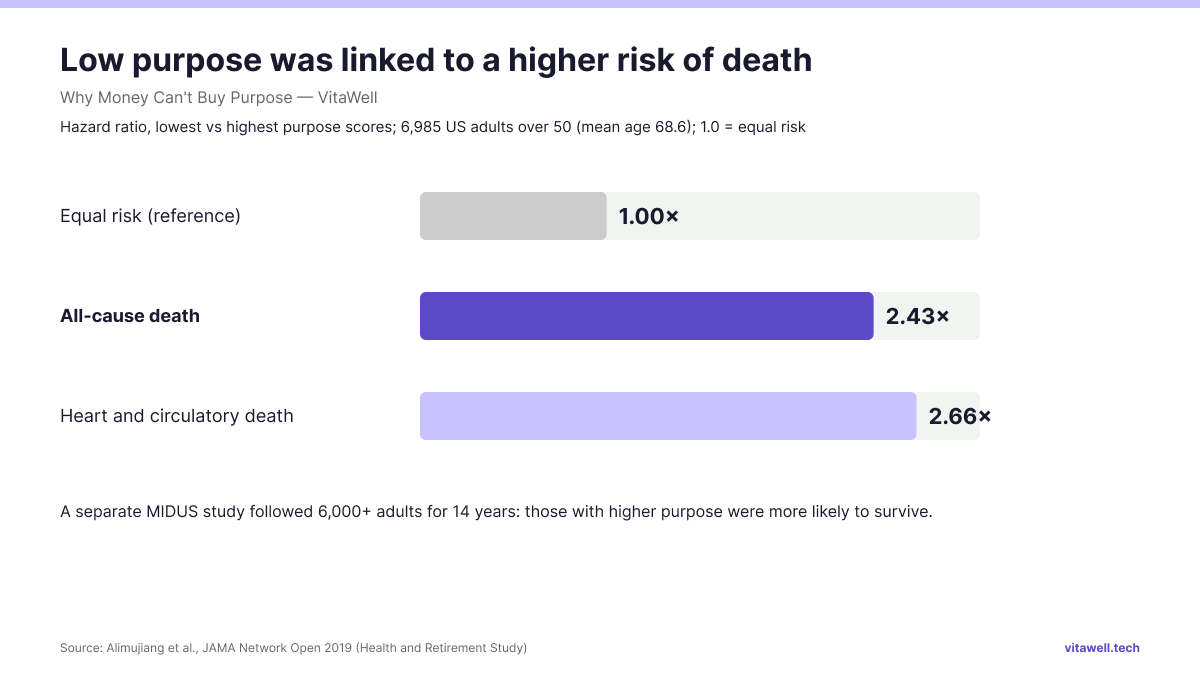
- Purpose and longevity: adults over 50 with the lowest purpose scores had 2.43 times the risk of death of those with the highest.
- Relationships matter most: in the Harvard Study of Adult Development, relationship satisfaction at 50 predicted health at 80 better than cholesterol did.
- Purpose is built through present-tense action, not discovered as a single grand calling.
The Story We're Told About Money and Fulfillment
Most people absorb a simple story: earn enough, and something inside will finally settle. Hospice physician Jordan Grumet, author of The Purpose Code, has watched that story fail at the end of life. "I've seen really, really happy poor people, and I've seen really, really miserable rich people," he told Upworthy, adding that wealth "doesn't seem to correlate" with peace at the end.
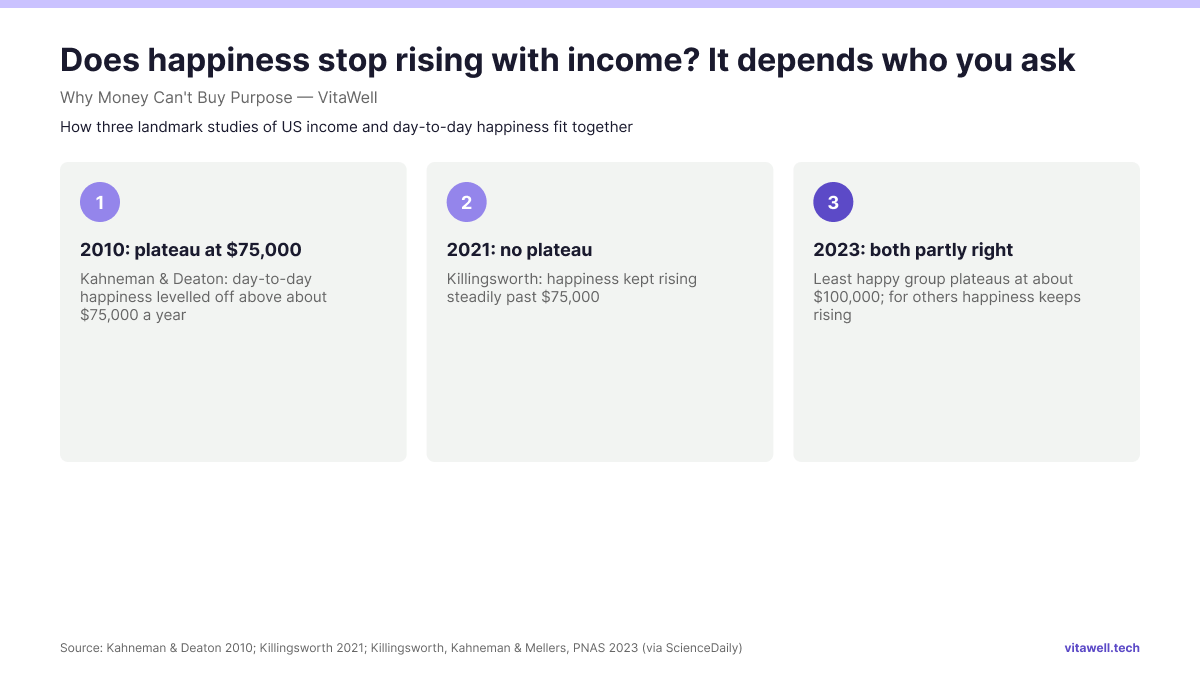
The research on money and happiness is more nuanced than either side of the debate suggests. In 2010, Kahneman and Deaton found day-to-day happiness levelled off above about $75,000 a year. In 2021, Killingsworth found no plateau. Their joint 2023 study in PNAS, reported by ScienceDaily (2023), reconciled the two: for the least happy group, happiness rose with income until about $100,000 and then stopped, while for others it kept rising.
Why Wealthy People Can Still Feel Empty
Two mechanisms help explain why more money does not fill every gap. Hedonic adaptation means people quickly get used to improvements, so a raise soon becomes the new normal. Social comparison means there is always someone with more. Signs that money has become a destination rather than a tool:
- Chronic dissatisfaction despite objective financial success.
- Difficulty saying what you are actually working toward.
- A belief that the next milestone will finally make things feel different.
- Putting off meaningful activities until after the raise, promotion or paid-off mortgage.
The pattern of reaching a goal and still feeling empty is explored in VitaWell's piece on the arrival fallacy.
What Purpose Actually Is (And What It Is Not)
Many people treat purpose as a grand calling waiting to be found. Grumet offers a more usable definition: purpose is the set of actions, now and going forward, that light you up. It often shows up as flow, the state where attention is absorbed and time seems to soften. Purpose is active and present-tense; it is less about explaining your life than living it.
Purpose vs. Why — A Critical Distinction
Your "why" is the meaning you give your past: the story of who you are and how you got here. Purpose lives in the present and near future. You do not need your whole life figured out to act on purpose today; you need to notice what creates engagement in your actual days and do more of it. VitaWell's guides to what gives life meaning and to flow as more than a productivity hack go deeper on both ideas.
Money as a Tool, Not a Destination
Grumet uses a navigation metaphor. If a good life is the destination and purpose is the route, money is like a GPS: it makes the trip smoother but cannot choose where to go. When money becomes the destination, there is no natural endpoint, so there is no sense of enough.
You Can Live Purposefully Without Abundant Money
Many of the most important sources of purpose cost little:
- Deep, reciprocal relationships.
- Creative work on problems you care about.
- Time spent in line with your values.
- Curiosity and energy directed at useful work.
- Contribution to a community or cause.
Financial security still matters as a foundation; VitaWell's article on financial security as a base layer for meaning explains why stability makes purpose easier to pursue.
The 4 Questions That Actually Point You Toward Real Purpose
Instead of asking how to make more money, which only optimizes the tool, start with questions that point toward purpose:
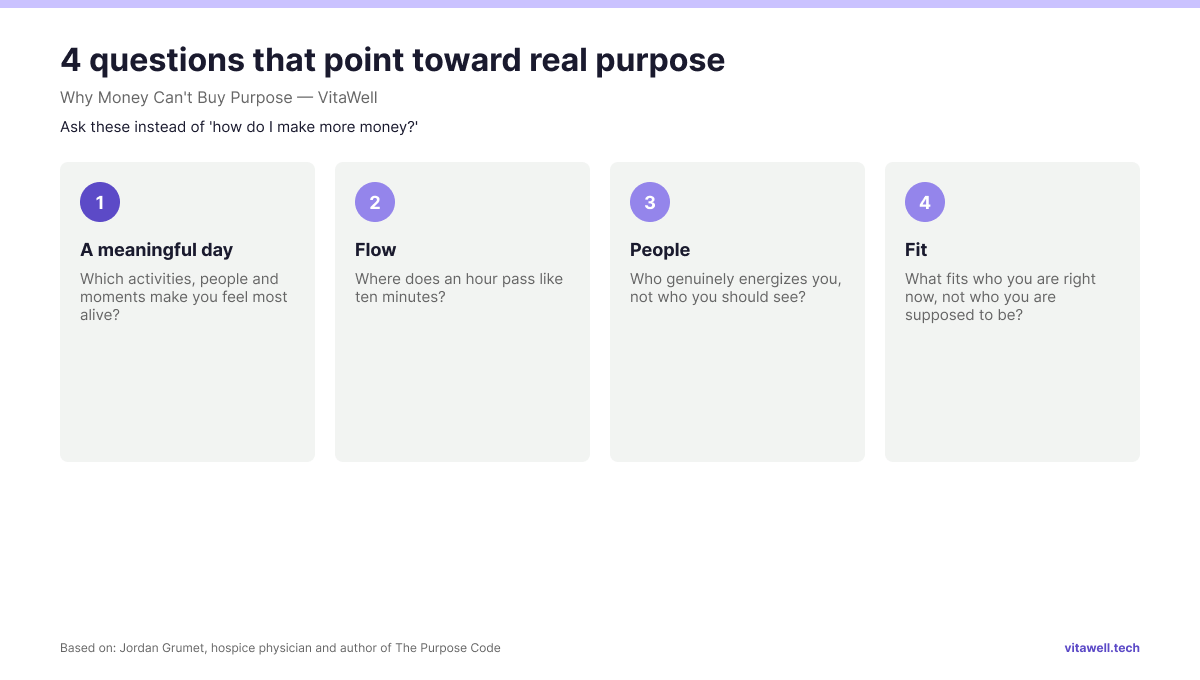
- What does a meaningful day look like for me? Not a fantasy day, but a real one: which activities, people and moments make you feel most alive?
- What pulls me into flow? Where does an hour pass like ten minutes?
- Who do I most want to spend my time with? Not who you should see, but who genuinely energizes you.
- What fits who I am right now? Not who you think you are supposed to be.
These questions rarely give tidy answers at once. Revisiting them every few months turns vague dissatisfaction into concrete changes.
Integrating Money and Purpose Intentionally
Once you have some direction, money questions become clearer: How much do I need to sustain this life? Should work itself be my main source of purpose, or should it fund purpose elsewhere? Which trade-offs am I willing to make?
Work as Purpose vs. Work as the Funding Source for Purpose
Neither choice is better. Some people choose meaningful work with modest pay; others earn more and use it to make room for relationships, creativity, health or community. The key is intentionality: money stays a tool for something that matters. VitaWell's piece on earning money without betraying your values looks at how to keep the two aligned.
The Surprising Science: Purpose Actually Builds Wealth
Purpose and money are not opposites. Using the US MIDUS study, Patrick Hill and colleagues followed adults for about nine years; 7,108 people took part at the start and nearly 5,000 were re-interviewed, according to the British Psychological Society (2016). Gains were largest for people aged 20 to 35.
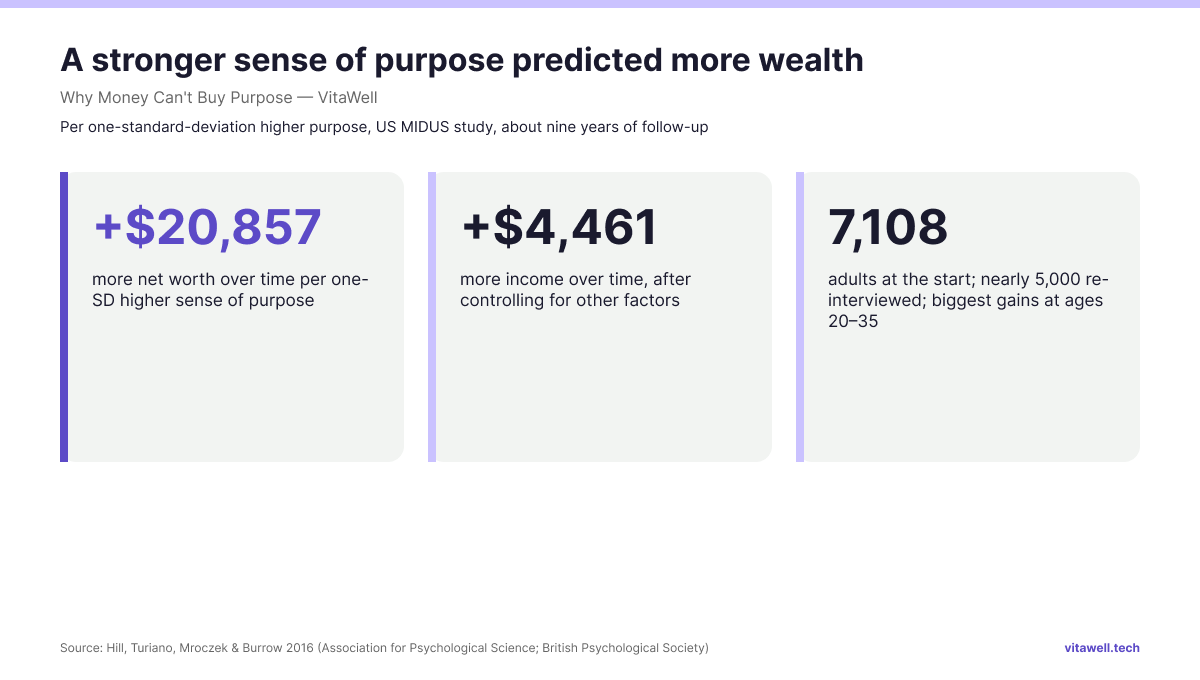
A one-standard-deviation higher sense of purpose was linked to about $4,461 more income and $20,857 more net worth over time, after controlling for other factors, as reported by the Association for Psychological Science. This is an observational finding, so it shows association rather than proof that purpose causes wealth; the authors suggest purposeful people may pursue long-term goals more consistently.
Purpose and a Longer Life
Purpose is also linked to survival. In a JAMA Network Open study of 6,985 US adults over 50 (mean age 68.6), people with the lowest purpose scores had 2.43 times the hazard of death of those with the highest, and 2.66 times the hazard of death from heart and circulatory conditions, according to the Health and Retirement Study record of Alimujiang et al. (2019).
An earlier MIDUS analysis by Hill and Turiano (2014) followed more than 6,000 people for 14 years; about 570 died, and those with higher purpose were more likely to survive even after accounting for other measures of wellbeing. Both studies are observational, so purpose may partly reflect health, but the link held after adjustment.
What the Dying Teach Us About Wealth and a Life Well Lived
Grumet measures a good life by regret. In his experience, people who die without major regrets are those who invested energy, courage and time in becoming who they wanted to be, whether or not money was involved. He argues the most lasting value of money comes from spending on growth and connection rather than on short-lived purchases.
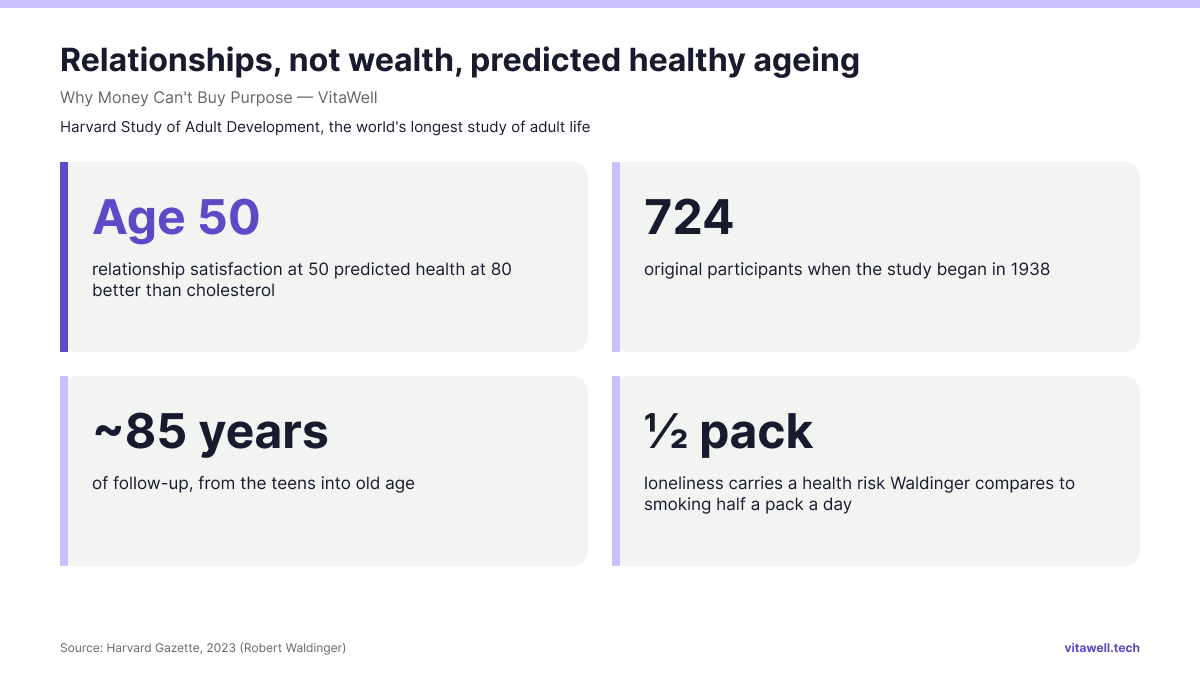
Long-term research points the same way. The Harvard Study of Adult Development began in 1938 with 724 participants and has run for about 85 years. Satisfaction with relationships at age 50 was a better predictor of health at 80 than cholesterol levels, and director Robert Waldinger compares the health risk of loneliness to smoking half a pack of cigarettes a day.
Money or Purpose? A Decision Guide
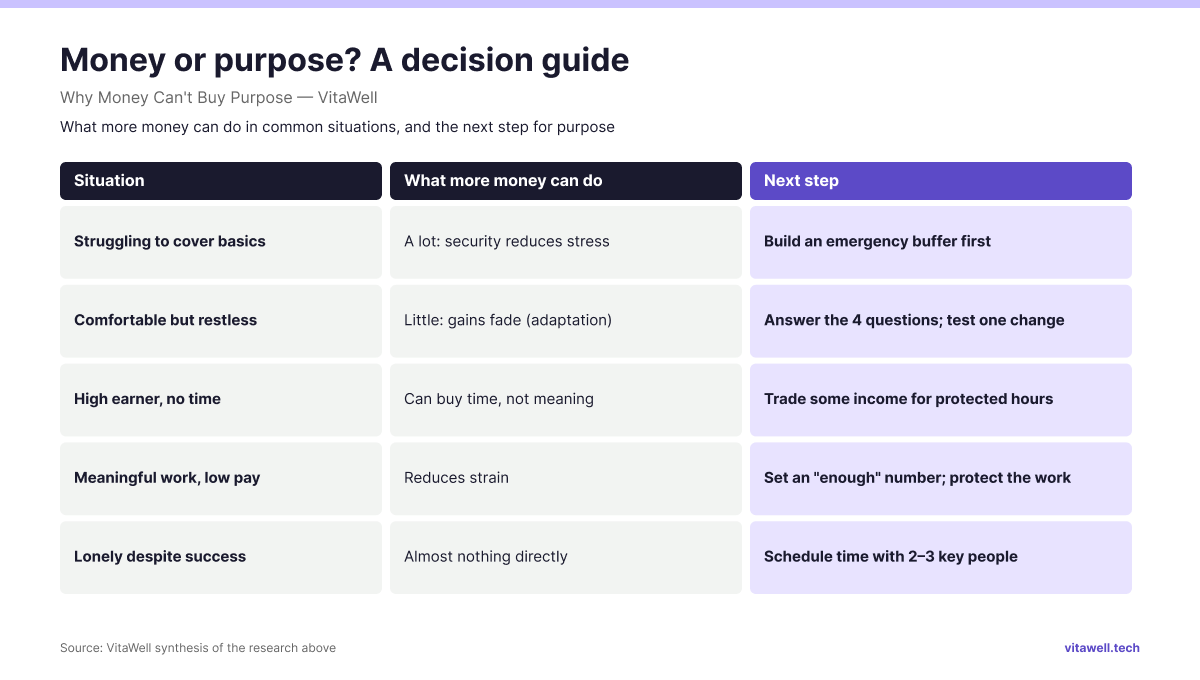
The table maps common situations to what money can and cannot solve, and a next step.
| Situation | What more money can do | What purpose needs | Next step |
|---|---|---|---|
| Struggling to cover basics | A lot: security reduces stress | Stability first | Build an emergency buffer before big life changes |
| Comfortable but restless | Little: gains fade through adaptation | Clear direction | Answer the 4 purpose questions and test one change |
| High earner, no time | Can buy time, not meaning | Time for people and flow | Trade some income for protected hours each week |
| Meaningful work, low pay | Reduces strain | Already strong | Set an "enough" number and protect the work |
| Lonely despite success | Almost nothing directly | Close relationships | Schedule regular time with 2–3 key people |
When to Talk to a Professional
- Emptiness or low mood lasts for weeks despite outward success.
- Money worries cause ongoing anxiety, sleep loss or conflict at home.
- You are considering a major financial or career change and want an objective view.
- Grief or end-of-life questions about yourself or a loved one feel overwhelming.
A therapist, financial planner or palliative care team can help with these different needs.
Frequently Asked Questions
Can money buy happiness?
Partly. A 2023 PNAS study found happiness rises with income for most people, with a plateau at about $100,000 only for the least happy group. Money reduces stress and expands options, but it does not provide purpose or close relationships, which independently predict wellbeing and health.
Does having a sense of purpose make you richer?
It is linked with it. In US MIDUS data, a one-standard-deviation higher sense of purpose predicted about $4,461 more income and $20,857 more net worth over roughly nine years. The study is observational, so it shows association, possibly because purposeful people pursue long-term goals more steadily.
Do people with purpose live longer?
Studies suggest so. Among 6,985 US adults over 50, those with the lowest purpose scores had 2.43 times the risk of death of those with the highest. A separate 14-year study of more than 6,000 adults found purposeful people were more likely to survive after accounting for other wellbeing measures.
What do people regret most at the end of life?
Hospice clinicians commonly describe regrets about relationships, overwork and not living true to themselves, rather than about money. Hospice doctor Jordan Grumet says people without major regrets are those who invested time and courage in becoming who they wanted to be. These are clinical observations, not survey statistics.
How do I find my purpose?
Treat purpose as something you build through action, not a single answer to discover. Notice which activities create flow, which people energize you, and what a meaningful ordinary day looks like. Then make small changes toward those things and review them every few months.
Conclusion
Money is a powerful tool: it reduces friction, creates options and, for most people, adds some happiness. But it cannot choose where your life is going. The evidence points to purpose and close relationships as the ingredients that predict wellbeing, health and even future income. Start with one of the four questions this week, and use VitaWell's AI life planner to turn the answer into small goals in your Meaning and Finances areas.
Related on VitaWell
- Purpose Anxiety: Why It Happens and How to Cope — for when searching for purpose itself becomes stressful.
- Minimalism and Money: Spend with Purpose — practical ways to align spending with what matters.
- The Mental Health Budget: A Research-Backed Framework for Building Psychological Wealth — building the kind of wealth money cannot buy.
This article is for informational purposes only and is not financial, medical or psychological advice.
Sources
- When Money Becomes the Destination — Psychology Today (Jordan Grumet)
- Upworthy — Hospice doctor shares the most powerful way money can create happiness
- Killingsworth, Kahneman and Mellers, 2023 — Income and emotional well-being (PNAS, via ScienceDaily)
- British Psychological Society, 2016 — Sense of purpose and wealth
- Association for Psychological Science — A meaningful job linked to higher income and a longer life (Hill et al.)
- Alimujiang et al., 2019 — Association between life purpose and mortality among US adults older than 50 (JAMA Network Open)
- Harvard Gazette, 2023 — Harvard Study of Adult Development (Waldinger)