Why Most Leaders Keep Failing Their Teams — The Science of 6 Follower Needs You Must Understand

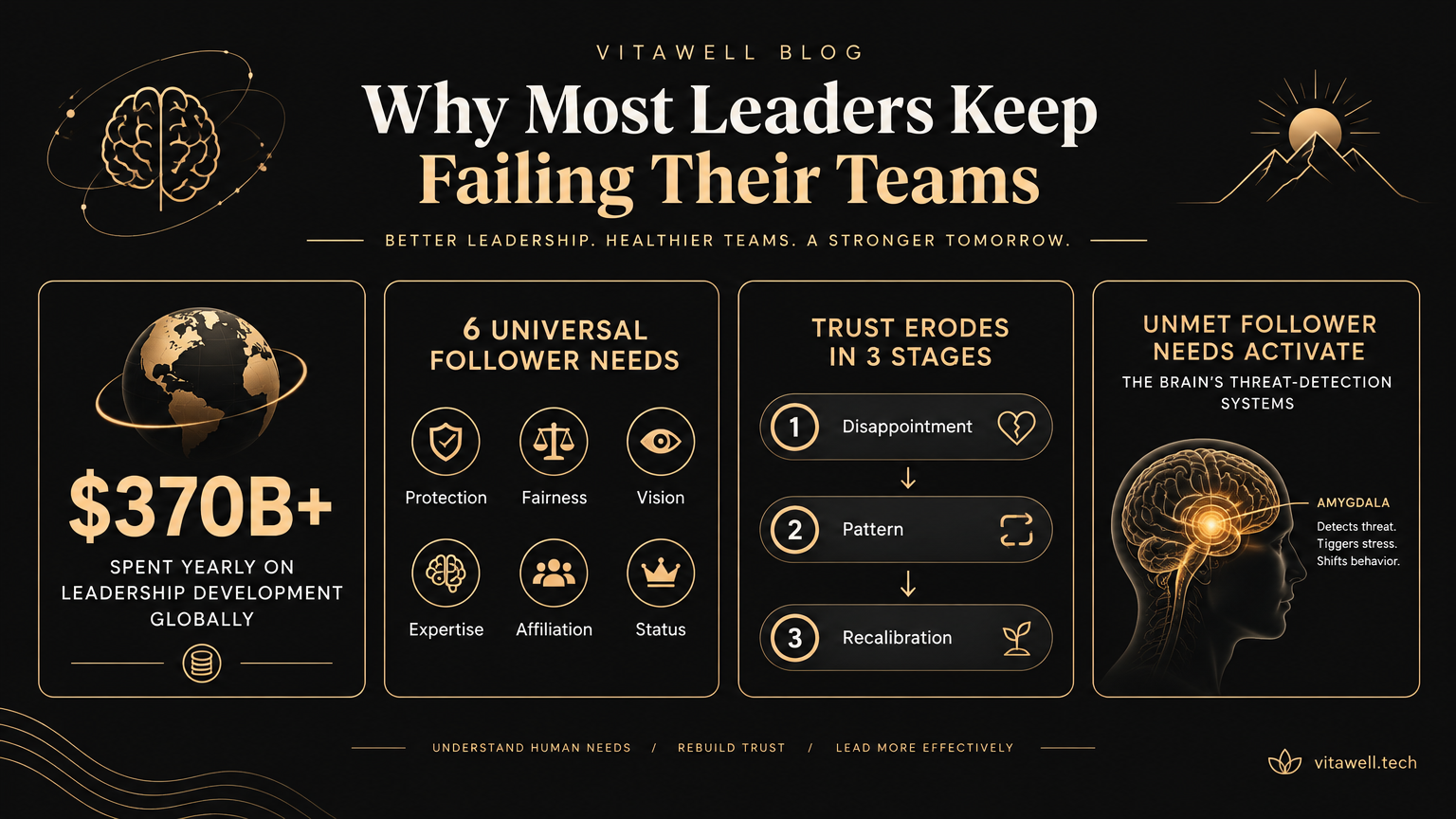
Organizations around the world now spend over $370 billion annually on leadership development. Yet global surveys consistently show that trust in leaders is declining, employee engagement is stagnant, and the gap between how leaders think they're performing and how their teams actually experience them is widening. The problem isn't a shortage of leadership training. The problem, according to new research from evolutionary psychology and organizational science, is that most leaders are optimizing the wrong variable — their own style — when they should be understanding and responding to the fundamental psychological needs of the people they lead.
Why Leadership Development Keeps Failing
The standard model of leadership development treats leadership as a set of behaviors the leader needs to master — communication skills, strategic thinking, emotional intelligence. These capabilities matter. But they miss a foundational question: What do followers actually need from a leader? Research published in Harvard Business Review shows that leaders who fail their teams often do so not because they lack skill, but because they lack alignment — the ability to meet what their specific team, in its specific context, actually requires.
Leadership Style vs. Leadership Alignment
Most leadership frameworks are style-based. They ask what kind of leader you are — transformational, transactional, servant, authentic — and then coach you to refine that style. The fundamental follower needs framework asks a different question: what does your team need from you right now? These are different questions with different answers, and confusing them has cost organizations enormous amounts of investment with disappointingly little return.
The Gap Between Leader Perception and Follower Reality
Studies of leadership perception consistently reveal a profound disconnect. When asked whether they provide adequate vision for their team, most leaders say yes. When their team members are asked independently whether they receive adequate vision from their leader, a dramatically smaller percentage agree. This perception gap is not unique to vision — it recurs across every dimension of follower need. Leaders who can't see the gap can't close it.
The Evolutionary Psychology Behind Why We Follow
To understand what employees need from leaders, it helps to understand why humans evolved to follow in the first place. Research by evolutionary psychologist Mark van Vugt and colleagues at VU Amsterdam has established that followership — the tendency to coordinate behavior around a designated person — is not a cultural artifact or organizational construct. It is a deeply evolved social strategy that allowed ancestral human groups to survive in complex, threat-rich environments.
Followership as an Adaptive Strategy
In our evolutionary past, being led by the right person in the right context was often the difference between survival and death. Groups that could coordinate around capable leaders — ones who could protect the group from predators, navigate resource scarcity, resolve internal conflicts fairly, and project collective vision — outcompeted groups that couldn't. The psychological mechanisms that made us responsive to these qualities in leaders were selected for over hundreds of thousands of years. Those same mechanisms still operate in modern organizations, triggering trust or distrust, engagement or disengagement, based on whether our fundamental follower needs are being met.
What Makes Us "Feel Led" — and Why It's Hardwired
When a leader meets our fundamental psychological needs, we don't just comply. We follow — with energy, creativity, loyalty, and discretionary effort. When those needs go unmet, we comply minimally, disengage emotionally, and begin the slow process of exiting, either physically or psychologically. The neuroscience supports this: unmet follower needs activate the same threat-detection systems as physical danger. The experience of a poor leader isn't just professionally frustrating. For the brain, it registers as unsafe.
The 6 Core Follower Needs — And What Leaders Get Wrong About Each
Van Vugt's research, validated across multiple cultures and organizational contexts, identifies six fundamental psychological needs that employees have from their leaders. Each need is universal, but the intensity and form it takes varies by person, role, team, and situation. Meeting these needs is the core job of a leader. Missing them is how leaders fail their teams.
1. Protection
At the most fundamental level, followers need leaders who protect them — from organizational threats, from unfair treatment, from excessive workload, from public humiliation, and from political dynamics that undermine their ability to do their jobs. What leaders get wrong: confusing visibility and advocacy. Many leaders advocate loudly in meetings but go silent when their team member actually needs to be defended. Protection must be consistent, not performative.
2. Fairness
Humans have an exquisitely sensitive fairness detection system. Research shows that perceived unfairness — in how work is assigned, how credit is distributed, how opportunities are allocated, how performance is evaluated — is among the most reliable predictors of team disengagement and attrition. What leaders get wrong: confusing consistency with fairness. Treating everyone identically isn't fair when people's circumstances and contributions differ. True fairness is equity, not uniformity.
3. Vision
Followers need to understand where they're going and why. Vision is not a mission statement. It's the clarity and meaning a leader provides that allows team members to connect their individual work to something larger than the immediate task. Without it, work becomes disconnected activity that slowly drains motivation. What leaders get wrong: assuming that sharing the company strategy counts as providing team-level vision. People need to understand not just where the company is headed but how their specific role fits and why it matters.
4. Expertise
Followers need leaders who know what they're doing — or who know enough to make credible decisions and recognize quality work. Expertise doesn't require the leader to be the most technically skilled person on the team, but it does require sufficient domain knowledge to earn respect. What leaders get wrong: managing up at the expense of managing in. Leaders who focus their energy on appearing competent to their superiors while remaining superficially engaged with their team's actual work quickly lose the credibility that expertise provides.
5. Affiliation
Human beings are profoundly social. The need for belonging — the sense that one is known, valued, and part of a trusted community — is not a soft need. Research consistently shows it is among the strongest predictors of performance, well-being, and retention. What leaders get wrong: treating affiliation as a team-building exercise rather than a continuous relational practice. A single annual offsite doesn't meet the ongoing need for connection. The relationships that create affiliation are built in small, consistent daily interactions.
6. Status
People need their contributions to be recognized and their standing elevated within the group. Status isn't about ego — it's about the fundamental human need to be valued, to have one's efforts seen and acknowledged, and to feel that one's standing in the community is secure and growing. What leaders get wrong: conflating praise with status recognition. Generic compliments don't meet this need. What meets it is specific acknowledgment that shows the leader genuinely understands what the person contributed and why it mattered.
How to Diagnose Your Team's Current Needs
Follower needs are not static. They shift with life circumstances, team dynamics, organizational changes, and the nature of the work itself. A team that needs vision above all else after a strategic pivot needs something entirely different six months later during stable execution. The leader's ability to read which needs are most active and most unmet is what separates adaptive leaders from those who keep applying the same approach regardless of what's needed.
Practical diagnostic questions to reflect on regularly:
- When was the last time I actively shielded a team member from something that threatened their ability to do good work? (Protection)
- Would every person on my team say that I distribute opportunities and credit fairly? (Fairness)
- Can each member of my team articulate specifically how their work connects to the team's larger purpose? (Vision)
- Do my team members believe I understand their work well enough to evaluate it accurately and represent it credibly? (Expertise)
- Does each person on my team feel genuinely known by me — their strengths, their challenges, their aspirations? (Affiliation)
- When did I last specifically and publicly recognize a team member in a way that elevated their standing? (Status)
What Misalignment Looks Like — and Why It Erodes Everything
When fundamental follower needs go unmet, the effects are not subtle. Research on the consequences of leadership misalignment shows predictable patterns: initial confusion and disillusionment give way to disengagement, then to either confrontational behavior or quiet withdrawal. The most capable people typically exit first, because they have more options. Those who remain often do so not from loyalty but from constraint, bringing the minimum viable effort to avoid consequences.
The Trust Erosion Sequence
Trust doesn't collapse all at once. It erodes in stages. The first stage is disappointment — an unmet expectation that is chalked up to oversight. The second is a pattern — repeated experiences that make the disappointment feel intentional or structural. The third is recalibration — the follower stops expecting the leader to meet their needs and begins working around them. At this point, the relationship has fundamentally changed, and repair requires explicit, sustained effort.
Adaptive Leadership: Research Findings Across Cultures
Studies conducted across the US, UK, and China found that while the six follower needs are universal, their relative salience varies by cultural context. Teams in higher power-distance cultures (such as China) placed greater emphasis on vision and protection. Teams in lower power-distance, more individualistic contexts (such as the UK) placed greater emphasis on fairness and affiliation. The practical implication is clear: effective global leaders cannot apply a single formula. They must develop the diagnostic sensitivity to identify which needs are most salient in each specific cultural and organizational context.
How to Rebuild Trust When You've Missed What Your Team Needed
When leaders realize they've been missing their team's needs — whether through feedback, observation, or attrition — the path back is not through a single grand gesture. It is through consistent, specific, sustained behavior change. Research on trust repair shows that credibility is rebuilt incrementally, through behavior that demonstrates awareness and change over time. What matters most is not the initial acknowledgment but the sustained follow-through that proves the acknowledgment was genuine.
Practical steps for trust repair:
- Name what went wrong specifically. Generic apologies are not trust repair. Identifying the specific need that went unmet — "I haven't been giving you enough recognition for your work" — demonstrates real awareness.
- Ask directly what the person needs going forward. This communicates that the relationship is now a dialogue, not a monologue, and gives you actionable, specific information.
- Change behavior visibly and consistently. Trust repair happens in behavior, not in conversation. Act differently in the next interaction, and the one after that, and the one after that.
- Accept that repair takes longer than failure. Trust that took months to erode will not return in a single conversation. Set realistic expectations for yourself and avoid the trap of expecting gratitude for change before it has been sustained long enough to be credible.
A Self-Assessment: Are You Meeting the Needs of the People You Lead?
Rate yourself honestly on each of these six dimensions, on a scale of 1–5 (1 = rarely, 5 = consistently):
- I actively protect my team members from organizational threats and unfair treatment. (Protection)
- I distribute opportunities, credit, and feedback equitably. (Fairness)
- Every team member can articulate how their work connects to our collective purpose. (Vision)
- I maintain sufficient understanding of my team's work to evaluate it credibly and represent it accurately. (Expertise)
- I invest consistently in knowing each team member as a whole person. (Affiliation)
- I regularly and specifically recognize individual contributions in ways that elevate standing. (Status)
Any dimension where your honest score is below 3 is a priority for immediate attention. The lowest score is typically where the greatest trust erosion is occurring.
Conclusion: Leadership Isn't About You
The most uncomfortable implication of the follower needs research is also its most clarifying: leadership isn't fundamentally about the leader. It is about the people being led — their needs, their contexts, their evolving requirements for the kind of leadership that enables them to contribute fully. Investing in understanding those needs is not soft leadership. It is the highest-leverage, most evidence-backed thing any leader can do.
Organizations that train leaders to diagnose and respond to follower needs — rather than simply refine their personal style — will close the persistent gap between leadership investment and leadership outcomes. And the leaders who do this work will build something that cannot be faked or bought: the loyalty and full engagement of people who believe their leader actually sees them.
Sources
Harvard Business Review — Are You Meeting the Needs of the People You Lead?