How Couples Build Their Own Microculture — And Why It Makes Your Bond Stronger
Research-backed guide to how couples build shared microcultures — and why it predicts relationship satisfaction more reliably than communication alone.

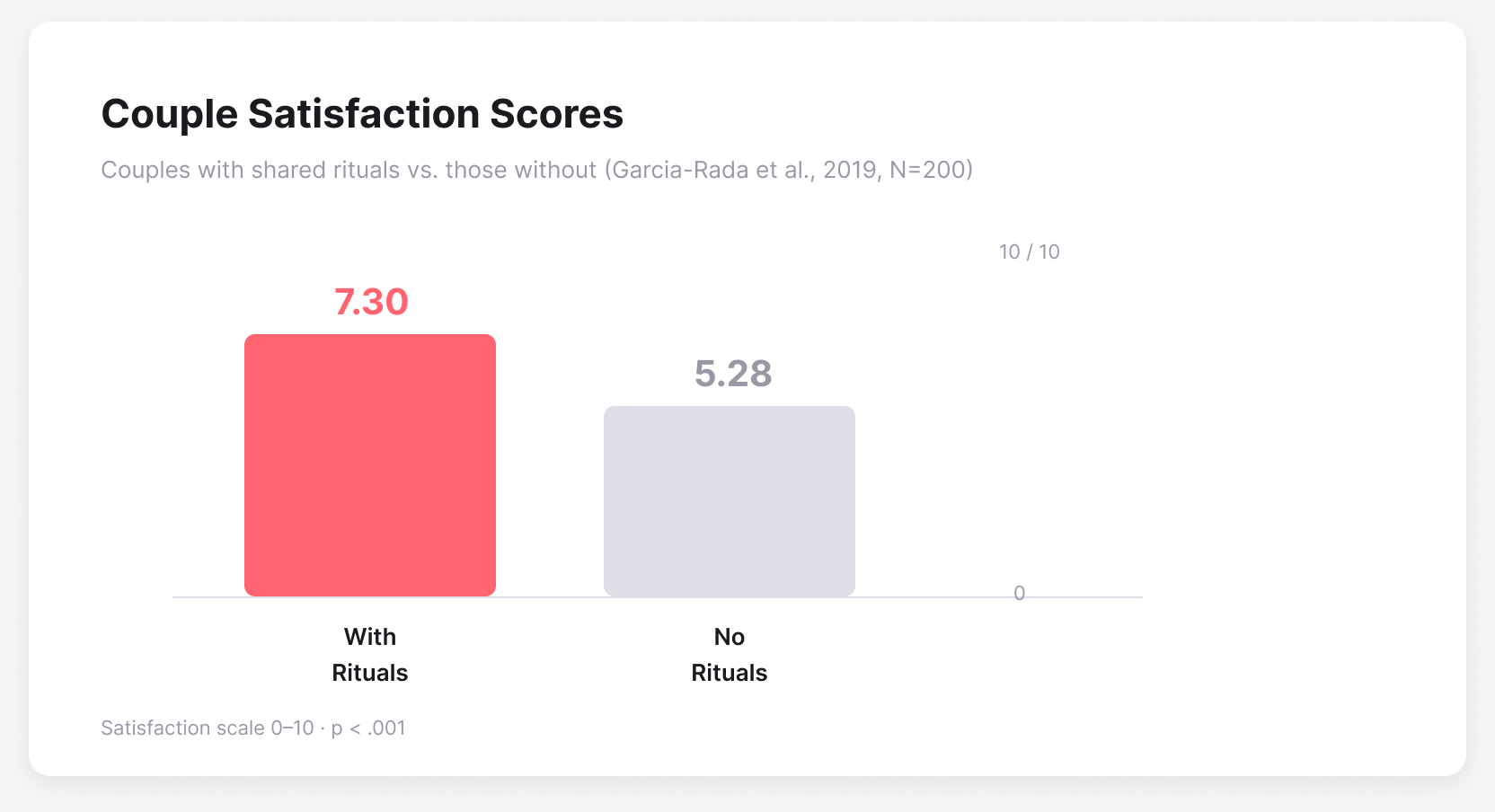
A couple microculture is a shared private world — a system of rituals, language, and meanings that only the two of you recognize. Research confirms this is not sentimental: couples who explicitly share rituals score 2 full points higher on satisfaction scales (7.30 vs 5.28 out of 10) compared to couples without them, in a study of 200 adults (Garcia-Rada, Sezer & Norton, 2019). Building a microculture is learnable, measurable, and one of the most reliable investments you can make in your relationship.
Key Takeaways
- Couples with shared rituals score significantly higher on satisfaction (M=7.30 vs M=5.28) and commitment than those without, across multiple studies.
- The benefit only fully appears when both partners mutually agree they share a ritual — one-sided perception does not produce the full effect.
- Rituals predict commitment significantly more strongly than routines do (b=1.24, p<.001 vs b=0.41, p=.099 — routines non-significant).
- Microcultures strengthen bonds primarily by building commitment first, not just generating positive feelings — commitment is the mechanism.
- Unhealthy microcultures exist: closed systems that reinforce isolation, enable bad habits, or suppress individual identity require active recognition.
What Is a Couple Microculture?
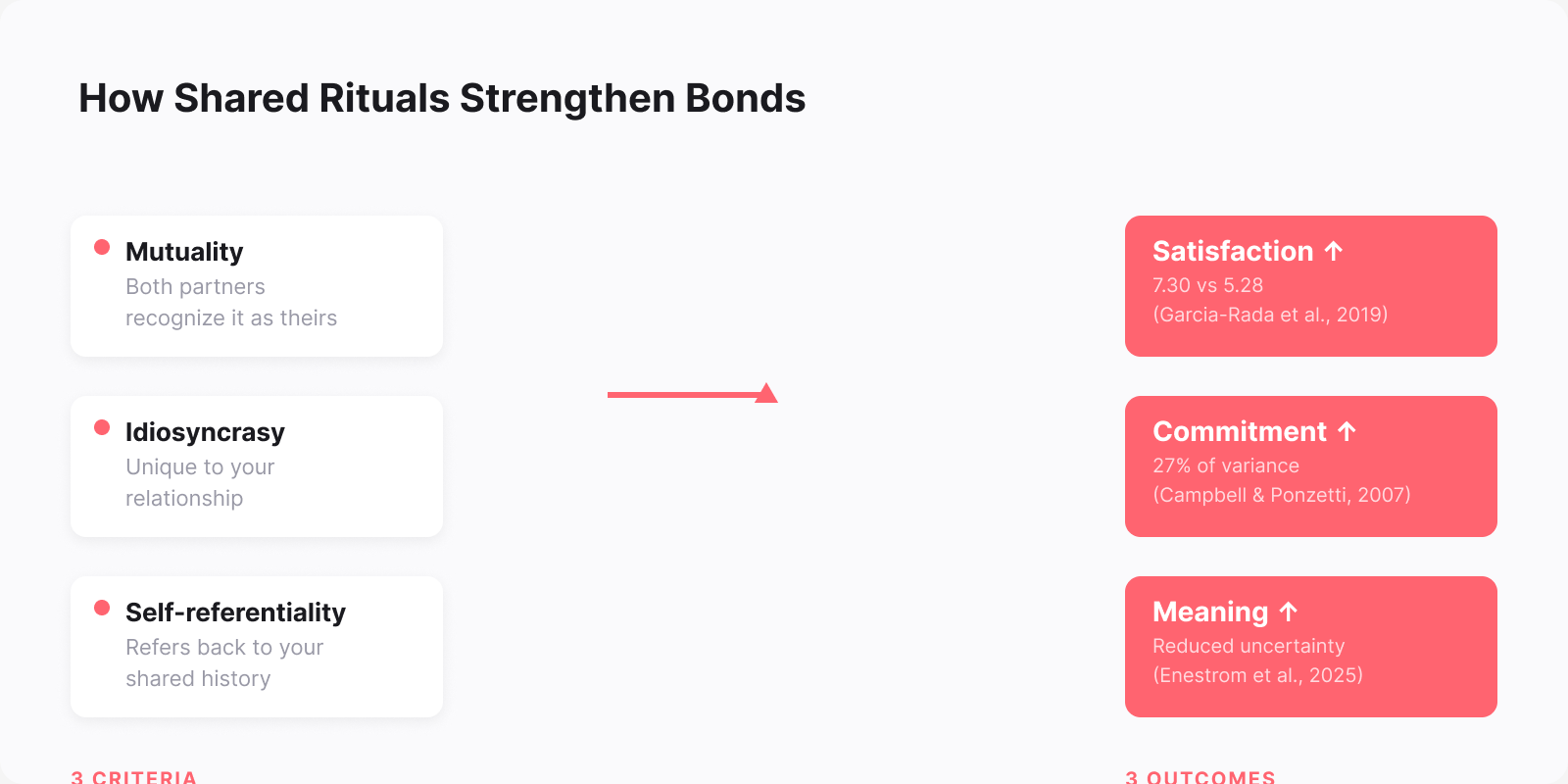
The term "microculture" describes a self-contained symbolic world shared by two people. Sociologists define it by three criteria. The first is mutuality: both partners recognize and acknowledge it as theirs. The second is idiosyncrasy: it differs meaningfully from the broader culture around them. The third is self-referentiality: it refers back to the couple's own shared history and experience.
Understanding what a microculture is requires knowing what it is not. A routine is functional — the Tuesday grocery run, the nightly toothbrushing sequence. A microculture carries meaning. The Tuesday taco night with the same playlist since year one is not just a food preference; it is a symbolic claim on a moment, a shared autobiography being written one week at a time. This distinction matters because, as the research shows, routines and rituals have very different effects on relationship quality. Just as family rituals shape household culture, couple rituals form the microculture of a partnership.
Microcultures also include private language. The nickname no one else uses, the in-joke that makes no sense explained, the look across a room that codes for "rescue me from this conversation" — these are not trivial. They are the vocabulary of a private world, and they signal to both partners that they share something that belongs only to them.
The Science — Why Microcultures Strengthen Bonds
The clearest evidence comes from Garcia-Rada, Sezer, and Norton (2019), who published three studies on couple rituals in the Journal of the Association for Consumer Research (full paper). In their first study of 200 adults, 70% reported having at least one shared couple ritual. The satisfaction gap was substantial: those with rituals scored an average of 7.30 out of 10 compared to 5.28 for those without — a difference of more than 2 full points on the scale.
Their second study extended this to 108 married couples who had been together an average of 28 years. When both partners independently agreed they shared a specific ritual, dyadic satisfaction averaged 8.03. When only one partner perceived the ritual, that figure dropped to 7.23 (F(2,105)=3.82, p=.025). This is the mutual agreement finding that most writing on rituals misses.
An earlier study by Campbell and Ponzetti (2007) of 100 premarital couples found that ritual participation correlated with relationship satisfaction (r=.60, p<.01) and commitment (r=.52, p<.01). In their regression model, shared rituals alone explained 27% of the variance in commitment scores (F=36.56, p<.001).
Four Types of Couple Rituals
Relationship researchers Bruess and Pearson (1997) identified four categories of couple rituals that appear consistently across relationships of different ages and structures.
Favorites rituals are recurring shared activities organized around a place, food, or activity both partners enjoy. The defining feature is that they are repeated with intention — not just because it is convenient, but because both people have decided it belongs to them. Garcia-Rada's first study identifies this category as the strongest predictor of satisfaction among the four.
Private communication rituals are the idiosyncratic language of the relationship. This includes pet names, inside jokes, nonverbal signals with established meaning, and phrases that have become shorthand for entire emotional states. The practical function of these rituals is to create a channel of communication that belongs exclusively to the two of them — a private frequency.
Play rituals are recurring humor patterns, games, and teasing scripts. These often develop spontaneously and stabilize over time into reliably repeatable exchanges. Research by Enestrom, Rossignac-Milon, Forest, and Lydon (2025), published in the Journal of Personality and Social Psychology, found across five studies of approximately 1,300 adults that shared meaning and shared reality reduce uncertainty and generate greater meaning in life (DOI: 10.1037/pspi0000472).
Celebration rituals mark transitions and milestones in ways the couple has made their own. These are not just the standard holidays — they include the anniversary traditions, the "we survived a hard week" rituals, and the first-day traditions. Campbell and Ponzetti (2007) found that this category showed the strongest relationship with long-term commitment (r=.52, p<.01).
| Ritual Type | Definition | Examples | Why It Works |
|---|---|---|---|
| Favorites | Recurring shared activities (place, food, activity) | Weekly taco night, Sunday hiking trail, the same coffee order | Builds shared autobiography; primary satisfaction predictor (Garcia-Rada et al. 2019) |
| Private Communication | Idiosyncratic language, pet names, nonverbal signals | A nickname only they use, a phrase that codes for "I need support," a look across a crowded room | Creates exclusive symbolic space; strengthens sense of a shared private world |
| Play | Recurring humor patterns, games, teasing scripts | An inside joke that resurfaces for years, recurring fake arguments about trivial things | Enestrom et al. 2025 — shared meaning reduces uncertainty and generates greater life meaning |
| Celebration | Marking milestones and transitions together | Anniversary rituals, "first day" traditions, their own version of key holidays | Campbell & Ponzetti 2007: commitment r=.52; rituals alone explain 27% of commitment variance |
The Mutual Agreement Requirement
One of the most practically important findings in this research is what Garcia-Rada and colleagues call the mutual agreement requirement. In their study of 108 married dyads, the satisfaction benefit of sharing a ritual depended significantly on whether both partners independently identified the same practice as a ritual (F(2,105)=3.82, p=.025). When only one partner perceived the ritual, the dyadic satisfaction score dropped from 8.03 to 7.23 — a meaningful reduction even in couples married an average of 28 years.
The implication is counterintuitive. Many couples have de facto rituals — things they do repeatedly together — without ever explicitly naming them or recognizing them as shared. The act of naming creates the mutual agreement that generates the relationship benefit. "This is ours" is not just a sentimental statement; it is a functional relationship intervention.
This finding connects to a broader principle: the work of balancing individual and shared identity in a relationship. Naming a practice as a shared ritual is a small act of creating a "we" alongside the "I" of each person — and that act turns a routine into something that actively strengthens the bond.
How Microcultures Build Commitment — Not Just Warmth
A common assumption is that rituals improve relationship quality by generating positive emotions. The data suggests the mechanism is more specific than that. In Garcia-Rada and colleagues' third study of 404 adults, rituals were a significant predictor of satisfaction (b=1.24, p<.001), while routines — doing the same things together without symbolic meaning — were not (b=0.41, p=.099). The difference in prediction is not marginal; routines do not reach statistical significance.
The mediation analysis from their first study clarifies why. When commitment was added to the model predicting satisfaction from rituals, the direct effect of rituals fell to b=0.65 — while commitment accounted for a large indirect path (ab=1.25). Rituals raise satisfaction primarily by raising commitment first. The mechanism is not mood elevation but rather a signal of investment and dedication: shared rituals communicate, implicitly and repeatedly, that both partners are building something they intend to maintain.
This is consistent with Enestrom et al. (2025) findings on shared reality: when two people share a symbolic framework — including the small private rituals of a couple microculture — it reduces existential uncertainty and generates a sense of meaning in life (DOI: 10.1037/pspi0000472). The mechanism is not simply fun or pleasure; it is the experience of a shared world that locates both people in something larger than the individual.
Building Your Couple Microculture — A Practical Guide
Building a microculture is not about manufacturing experiences from scratch. It is about recognizing what you already have, naming it, and deliberately adding to it. These five steps apply whether you are six months in or twenty-five years in. Understanding where you are in the relationship cycle helps you tailor which rituals to prioritize first.
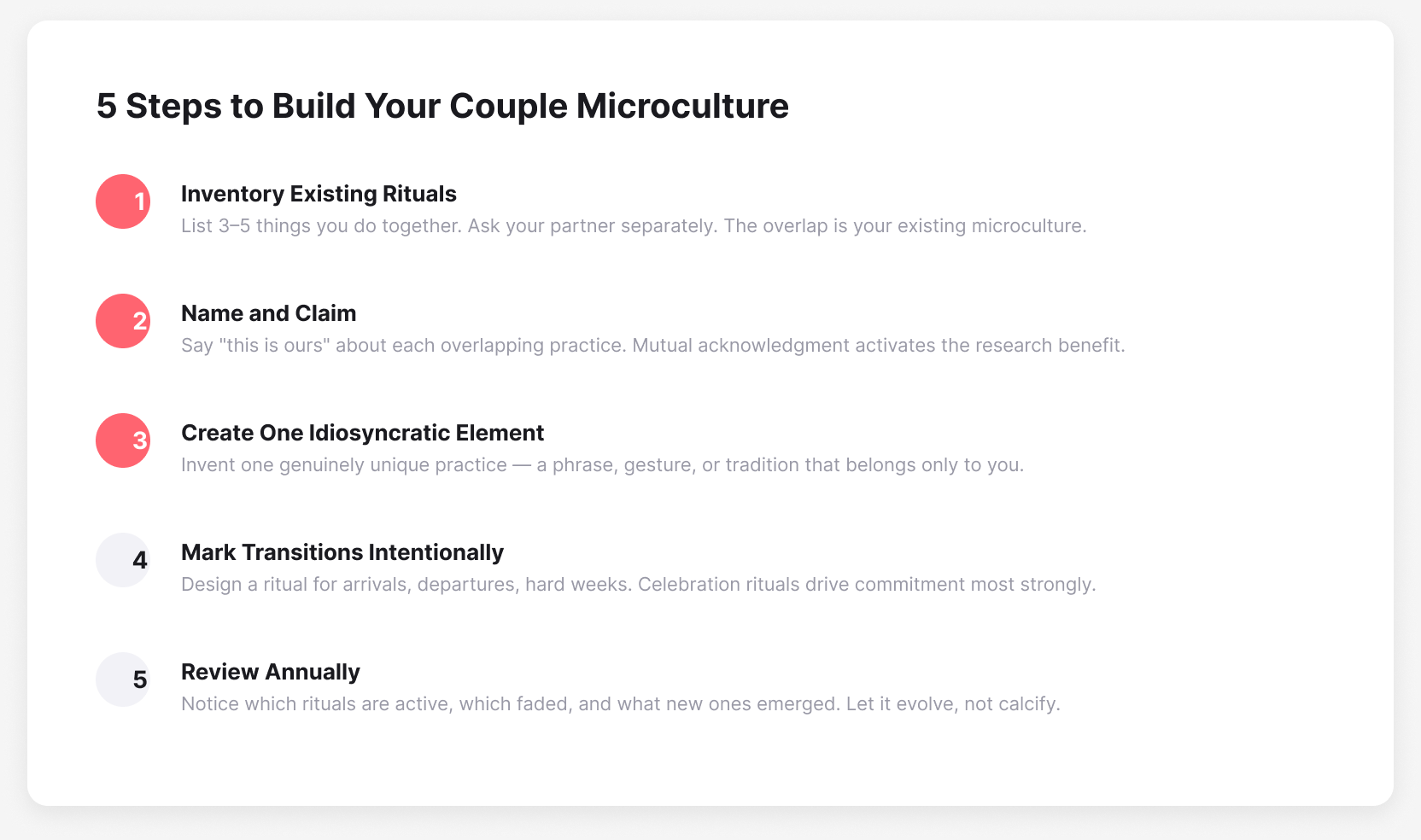
- Inventory your existing rituals. List three to five things you already do together on a recurring basis. Then ask your partner to do the same independently. The overlap — the things you both listed — is your existing microculture, whether or not you have ever called it that.
- Name and claim. For each overlapping item, explicitly recognize it as a ritual and say so. Use language like "this is ours" or "this is our thing." The mutual acknowledgment is not performative — it is the mechanism that makes the ritual work at the level the research identifies.
- Create one new idiosyncratic element. Add something genuinely invented: a phrase that belongs only to you, a small gesture, a strange tradition. The idiosyncrasy is part of what makes it exclusive. Generic rituals carry less power than ones with specific, invented meaning.
- Mark transitions intentionally. The highest-commitment rituals in the Campbell and Ponzetti data are celebration and transition rituals. Design a practice for the moments when you arrive home, return from trips, navigate a hard week, or cross a threshold together. These are the rituals that signal durability.
- Review annually. Microcultures grow and change. Building in an annual moment to notice which rituals are still active, which have faded, and what new ones have appeared lets the microculture evolve rather than calcify.
When Microcultures Become Unhealthy
Insularity occurs when the shared private world substitutes for external relationships rather than complementing them. A healthy microculture is additive — it deepens the couple's bond while both partners maintain relationships with family, friends, and community. An unhealthy one becomes the primary social world for one or both partners, crowding out everyone else. The diagnostic question: does your shared world make each of you more or less able to show up for the people around you?
Enabling occurs when shared rituals reinforce behaviors that damage one or both partners — rituals organized around excessive drinking, avoidance of difficult conversations, or patterns that one partner resists but goes along with to maintain the shared practice. The diagnostic question: does this practice make either of you feel worse in the morning than you did the night before?
Asymmetry occurs when one partner drives all the rituals and the other tolerates them. The mutual agreement requirement from the research is relevant here: a ritual that only one partner genuinely claims produces significantly less benefit for the relationship. The diagnostic question: if your partner described this practice to a friend, would they say "we do this" or "they do this and I go along with it"?
A healthy couple microculture, by contrast, generates a sense of expansiveness rather than enclosure — it makes both partners feel more fully themselves, not less.
FAQ — Couple Microcultures and Shared Rituals
What is a couple microculture?
A couple microculture is a shared symbolic world unique to a specific relationship. It includes recurring rituals, private language, inside jokes, and meanings that only the two partners recognize. It differs from routine in that it carries deliberate meaning — both partners know it is "theirs." Research shows it is a significant predictor of satisfaction and commitment in long-term relationships.
How do couple rituals affect relationship satisfaction?
In a study of 200 adults (Garcia-Rada, Sezer & Norton, 2019), those with shared rituals scored 7.30 out of 10 on satisfaction versus 5.28 for those without — a 2-point gap. A separate study of 100 premarital couples (Campbell & Ponzetti, 2007) found rituals accounted for 27% of commitment variance. The mechanism is primarily through commitment: rituals signal investment, which raises commitment, which raises satisfaction.
What are the different types of couple rituals?
The Bruess and Pearson (1997) framework identifies four types: Favorites (recurring activities), Private Communication (pet names, inside jokes, shared signals), Play (recurring humor and games), and Celebration (marking milestones and transitions). Each type contributes differently, with Celebration rituals showing the strongest link to long-term commitment.
Can you create new rituals if your relationship feels stale?
Yes. The research suggests the naming itself is part of the mechanism — recognizing existing shared practices as rituals and explicitly claiming them as "ours" activates the effect. New rituals can be deliberately designed. The five-step guide above outlines a process for identifying, naming, and building new elements of a couple microculture at any stage of a relationship.
What is the difference between a ritual and a routine in a relationship?
A routine is functional: it repeats because it is efficient or convenient. A ritual carries meaning: it repeats because both partners have implicitly or explicitly decided it signifies something about the relationship. Garcia-Rada and colleagues (2019) found that routines were not a significant predictor of relationship satisfaction (b=0.41, p=.099), while rituals were (b=1.24, p<.001) — confirming that the difference is not semantic but measurable.
Conclusion — Microcultures Are Built, Not Discovered
A couple microculture does not appear on its own. It is constructed — through deliberate naming, through invented idiosyncrasies, through the choice to mark transitions with something that belongs only to the two of you. The research is consistent across multiple studies and designs: couples who build and maintain shared rituals are more satisfied, more committed, and more resilient than those who do not. Start with the inventory. Find what you already have. Name it. Add one invented element. And revisit it every year as your life together changes. VitaWell's Relationships section has the frameworks to help you build every dimension of a connected, sustainable partnership.
Related on VitaWell
- Rituals for Letting Go and Moving On — Endings are also a kind of transition; this article explores how rituals support emotional closure just as powerfully as they build connection.
- Adult Sibling Estrangement — Understanding the role of shared history and ritual in family bonds helps explain both why estrangement happens and what rebuilding requires.
- Balanced Life Planning — A strong couple microculture is one element of a balanced life — this guide provides the broader framework for integrating relationships with other priorities.
This article is for informational purposes only and does not constitute relationship therapy or counseling advice. If you are experiencing significant relationship difficulties, consider speaking with a licensed therapist or counselor.