Why You Can't Stop Thinking About Work — And the Science of Truly Switching Off
Psychological detachment — mentally leaving work behind, not just physically — is what separates restorative rest from rest that leaves you drained. Here's what a 32-study meta-analysis and teacher cohort research reveal about how to actually switch off.
Psychological detachment from work — the mental state of genuinely stepping away, not merely being physically elsewhere — is the single strongest predictor of whether time off actually restores you. Without it, your brain keeps running background work processing even during vacations, which is why roughly half of all workers return from breaks feeling barely recovered.
The good news: detachment is a skill, not a personality trait. Research from the last five years has mapped exactly what it requires, which strategies work best, and why the people who struggle most are often doing something specific that keeps the loop running.
Key Takeaways
- Psychological detachment (mentally disengaging from work) is different from physical absence — you can be on a beach and still be cognitively at the office
- A 2025 meta-analysis of 32 studies confirms vacations improve well-being, but only when genuine detachment occurs
- Ruminators in a teacher cohort study recovered significantly less during a 2-week break than non-ruminators doing identical activities
- The most effective recovery combination is psychological detachment paired with physical activity
- Medium detachment, not maximum, is optimal — people who fully disconnect show slightly lower next-day engagement
Why Switching Off From Work Is So Hard
Your brain has a quirk that makes switching off genuinely difficult — not a matter of discipline. It's called the Zeigarnik effect: the tendency to remember unfinished tasks more vividly than completed ones. Psychologist Bluma Zeigarnik first documented this in the 1920s, noticing that waiters remembered unpaid tabs far better than settled ones.
Every open loop at work — the project without a clear next step, the email that needs a reply, the conversation that ended ambiguously — gets assigned a mental sticky note. Your brain keeps refreshing these automatically, even when you've physically left the office. Push notifications arrive every few minutes. Slack badges accumulate overnight. Remote work has dissolved the physical boundary that once forced a commute-shaped gap between home and office.
Psychological detachment, as defined by researchers Sonnentag and Fritz, is the mental state of truly being absent from work — not the same as physical absence. You can be on vacation and be psychologically at the office. You can be in a meeting room and, during focused creative work, be psychologically detached from most of your job demands.
Your brain's default mode network — the neural system that activates when you're not focused on a specific task — actively replays recent experiences, including work events, unless it's given an absorbing alternative. Passive "rest" (mindless scrolling, staring at a wall) often loops back to unresolved work stress rather than truly recovering from it.
The scale of the problem: 79% of Americans report feeling burned out — not from working, but from spending their vacation time on errands, medical appointments, and family obligations (Fortune/Talker Research, January 2025). And nearly half of US workers won't deplete their PTO in a given year (Eagle Hill Consulting, 2024).
What the Science Says About Detaching From Work
The evidence on psychological detachment has become some of the most consistent in occupational health psychology.
Sonnentag and Fritz's landmark 2010 study in the Journal of Applied Psychology tracked workers over time and found that those who scored higher on psychological detachment reported significantly higher life satisfaction and lower emotional exhaustion. The relationship between detachment and job performance was curvilinear: moderate detachment was most beneficial, while very high detachment slightly reduced next-day engagement and motivation. The goal is genuine recovery plus returning energized — not maximum disconnection.
A 2025 meta-analysis of 32 studies confirmed that vacations have a strong positive effect on well-being — and that this effect lasts longer than researchers had previously measured. The critical caveat: the benefit depended on what happened during the break. Workers who spent vacations ruminating saw markedly smaller gains.
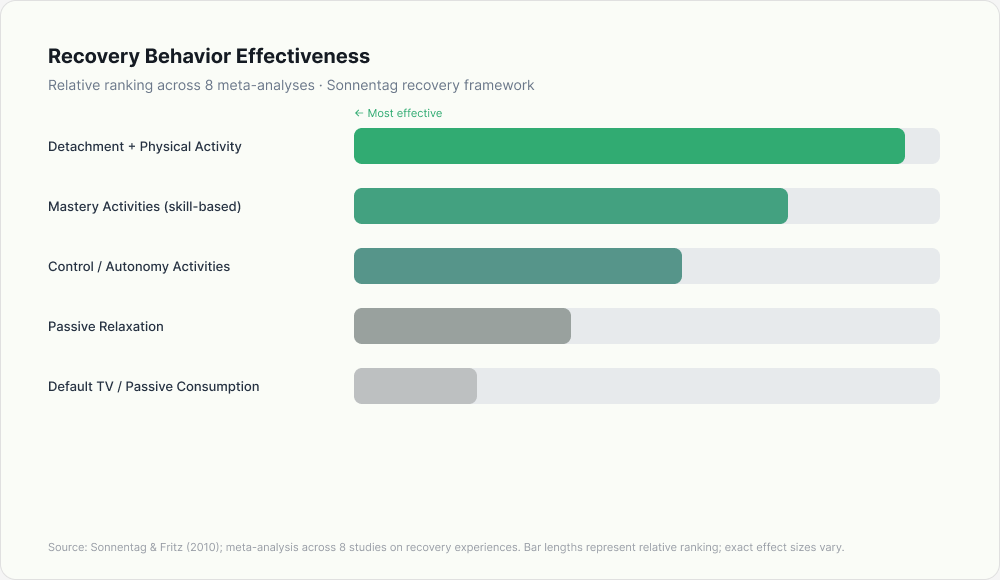
Researchers studying recovery behaviors ranked them by effectiveness across eight studies. The most effective combination: psychological detachment paired with physical activity. Passive activities like default television watching ranked lowest for genuine recovery.
A teacher cohort study published in the Journal of Occupational and Organizational Psychology tracked educators across a two-week school break. For most teachers, measures of emotional exhaustion, anxiety, and low mood declined noticeably. For teachers who scored high on work rumination, the break produced significantly smaller recovery gains — even when their daily activities were otherwise identical to the lower-rumination group. The difference wasn't what they did. It was whether their minds actually let them do it.
If your burnout recovery feels incomplete even after time off, this research points to the mechanism: physical rest without psychological detachment leaves the nervous system's threat-response circuits running in the background.
Practical Tips for Leaving Work at Work
Sonnentag's framework identifies four distinct recovery experiences, each contributing differently:
1. Detachment — the core ingredient. Strategies with evidence:
- The shutdown ritual: Before closing your laptop, write down tomorrow's single most important first task. This externalizes the open loop, giving your brain permission to stop holding it in working memory. Add a verbal cue ("Work is done for today") that signals closure. The mechanism: reducing the cognitive load of incomplete tasks documented by Zeigarnik research.
- Physical device separation: Keeping your phone in a different room during evenings removes the environmental trigger that re-activates work-mode processing. The visible presence of a smartphone on a table partially occupies cognitive resources even when untouched.
2. Relaxation — often confused with detachment, but distinct. You can be relaxed without being psychologically detached (a bath while mentally rehearsing a difficult conversation). And you can be psychologically detached while physically active (a hard workout where you're fully absorbed in the effort). The two ideally overlap but don't require each other.
3. Mastery — engaging in a challenging, non-work activity. Learning a language, playing an instrument, cooking a new recipe, working a jigsaw puzzle. Any activity that requires skill and produces a small sense of accomplishment engages achievement-processing circuits without the anxiety load of work performance, gradually rebuilding self-efficacy that job stress erodes.
4. Control — choosing your own activities. Research shows that even mundane activities like cooking or going for a walk produce more restoration when they feel like autonomous choices rather than obligations. The mechanism: restoration of the agency that high-demand work depletes.
Even brief intervals work. A 2016 meta-analysis by Wendsche and Lohmann-Haislah in Frontiers in Psychology found that micro-breaks of 5–10 minutes measurably reduce fatigue and restore performance — provided the break involves genuine mental disengagement rather than switching to a different form of cognitive work.
Play and unstructured time tend to satisfy multiple recovery dimensions simultaneously, which is part of why genuine leisure produces disproportionate restoration.
How to Take a Real Break (Based on Your Work Type)
Different jobs deplete different resources. Effective recovery isn't one-size-fits-all.
| Work Type | Primary Depletion | Most Effective Recovery | Avoid |
|---|---|---|---|
| Knowledge workers (analysts, programmers) | Executive function, focused attention | Mastery activities + physical movement; absorbing hobbies | Passive TV as default; work-adjacent reading |
| Emotional load (teachers, caregivers, service) | Empathy, emotional regulation | Physical activity; humor; aesthetic pleasure | Emotionally intense drama; listening to others' problems |
| High-pressure / deadline-driven | Working memory overload from open loops | Shutdown ritual; journaling (write worries + next steps) | Checking email "just once"; leaving tasks open-ended |
| Remote workers | Spatial work/home boundary | Physical environment change: walk, coffee shop | Staying at the same desk for evening hours |
A simple 3-step evening protocol:
- Shutdown ritual (30 min before screen-off): Write tomorrow's first task; review and close open tabs; say your shutdown phrase aloud.
- Physical transition (20 min): Walk, stretch, or any movement that isn't screen-based. For remote workers, this engineered commute is especially critical.
- Absorbing non-work activity (60 min): Something that qualifies as mastery or genuine play — not passive consumption as default.
Technology-driven work creep has made recovery harder for every work type: the expectation of always-on availability is itself a source of incomplete detachment, even when you're not actively working.
Why Switching Off Makes You Better at Work
Here's the counterintuitive finding: workers who properly detach are more engaged and perform better the next day — not less. This directly contradicts the assumption that maximum work exposure leads to maximum output.
Sonnentag's data show the curvilinear relationship clearly: moderate, genuine recovery leads to higher next-day engagement than either chronic overwork or complete disengagement. Recovery isn't subtracted from performance — it's the mechanism that makes sustained performance possible.
Your best ideas tend to arrive in the shower, on a walk, or in the first minutes after waking — that's your brain's default mode network, freed from active task-maintenance, running the associative processing that generates insight. Psychological detachment is not just recovery. It's also where creativity lives.
Pick one strategy from the table above and try it tonight. For high achievers in particular, it's worth asking whether the drive that makes you effective at work is also what keeps you from restoring it.
Rest isn't the absence of work. It's the science of returning better.
When to Talk to a Professional
If you consistently find it impossible to mentally disengage from work despite trying the strategies above, or if work rumination is affecting sleep, relationships, or daily functioning, consider speaking with a psychologist or occupational health specialist. Persistent inability to switch off can be a symptom of anxiety disorders or burnout at clinical levels, both of which respond well to evidence-based treatment.
Frequently Asked Questions
What is psychological detachment from work?
Psychological detachment is a mental state — not a physical location — in which you stop processing work-related thoughts, emotions, and demands. Defined by Sonnentag and Fritz, it's the core ingredient that separates genuinely restorative rest from rest that leaves you feeling no better than before.
Why can't I stop thinking about work when I'm off?
The Zeigarnik effect keeps unfinished tasks active in working memory. Modern always-on culture reinforces this by keeping work cues (notifications, email badges) in your environment. Your brain's default mode network replays recent events unless given an absorbing, non-work activity that occupies it instead.
How long does it take to recover from work stress?
A 2025 meta-analysis of 32 studies found the well-being effect of vacations is real and lasts longer than previously measured — but the speed depends heavily on whether psychological detachment occurs. Even short daily micro-breaks (5–10 minutes) reduce fatigue measurably if mental disengagement is complete.
Is work rumination the same as being motivated?
No. Work rumination — involuntary, repetitive thinking about work problems — is associated with higher exhaustion and lower recovery. It differs from intentional reflection or problem-solving, which you can close with a shutdown ritual. Motivation increases with genuine recovery; rumination erodes it.
What's the most effective way to relax after work?
Research ranks psychological detachment combined with physical activity as the most effective recovery pair. Passive relaxation (default television watching) is least effective. Mastery activities — anything requiring skill and producing small achievement — come second, followed by activities chosen with a sense of control and autonomy.
Related on VitaWell
- Burnout Recovery: Why Your Nervous System Still Feels Stuck
- Why Play Isn't Just for Kids
- When Ambition Becomes Exhausting: 5 Questions High Achievers Should Ask
This article is for informational purposes only and does not constitute medical advice. If you are experiencing symptoms of burnout, anxiety, or a mental health condition, please consult a qualified healthcare professional.
Sources
- Sonnentag, S., & Fritz, C. (2010). The Recovery Experience Questionnaire. Journal of Applied Psychology, 95(5), 977–983. — PubMed 20836591
- 2025 Vacation Well-being Meta-analysis (32 studies) — PubMed 39836131
- Teacher cohort study — DOI 10.1111/joop.12410
- Wendsche, J., & Lohmann-Haislah, A. (2016). A meta-analysis on antecedents and outcomes of detachment from work. Frontiers in Psychology, 7, 2072. — Full text
- Eagle Hill Consulting (2024). Nearly half of US workers won't deplete vacation time. — Source
- Fortune / Talker Research (January 2025). 79% of Americans feel burned out using vacation for errands. — Source
- Gallup Workplace Report. State of the Global Workplace (burnout data).