Eating Late and Going to Bed Late May Increase Your Risk of Metabolic Syndrome, New Research Finds
If you regularly eat late and sleep late, you may be 1.7x more likely to have multiple metabolic syndrome risk factors. Here's what the science says and what to do about it.

If you regularly eat dinner close to midnight and stay up well past 11 PM, new research published in iScience shows you may be nearly twice as likely to accumulate multiple metabolic syndrome risk factors as someone who eats and sleeps early. Among 87 adults with obesity studied by researchers at UTHealth Houston, 73% of late eaters and late sleepers had multiple markers of metabolic syndrome — compared to just 43% of early eaters and early sleepers. Metabolic syndrome is a cluster of conditions including high blood pressure, high blood sugar, and excess belly fat that significantly raises your risk of heart disease, stroke, and type 2 diabetes. The good news: when you eat is a behavior you can change.
Key Takeaways
- 73% of late eaters/sleepers had multiple metabolic syndrome risk factors vs 43% of early eaters/sleepers (Khoshaba et al., iScience 2026, n=87)
- Combining a late chronotype with late eating creates the highest metabolic risk of any pattern studied
- Late eating disrupts the gut's own circadian clock, causing leaky gut and systemic inflammation
- Eating late more than doubles hunger scores and slows calorie burning by roughly 52 kcal per day (Vujovic et al., Cell Metabolism 2022)
- Finishing your last meal 3 hours before bedtime and keeping a 10 to 12 hour eating window may lower your metabolic risk
What Is Metabolic Syndrome and Why Does Timing Matter?
Metabolic syndrome is not a single disease but a cluster of five conditions that frequently occur together. According to the American Heart Association, the five markers are: a waist circumference above 35 inches in women or 40 inches in men, blood pressure of 130/85 mmHg or higher, fasting blood sugar of 100 mg/dL or higher, triglycerides of 150 mg/dL or higher, and HDL (good) cholesterol below 50 mg/dL in women or 40 mg/dL in men. Having three or more of these criteria meets the clinical definition of metabolic syndrome, and each additional marker multiplies your cardiovascular and diabetes risk.
The condition is more common than most people realize. Data reviewed in a 2018 analysis in Physiology & Behavior Allison & Goel, 2018 found that over 1 in 3 US adults meets the criteria for metabolic syndrome — roughly 90 million people. What is less understood is how the timing of daily behaviors, particularly when you sleep and eat, interacts with your body's internal biological rhythms to influence whether those five markers accumulate. Research into circadian rhythms and longevity has shown that your internal clock governs far more than when you feel sleepy — it regulates insulin sensitivity, fat metabolism, and gut function in ways that make the timing of meals a genuine metabolic variable.
The 73 vs 43 Percent Finding: What the New Research Shows
A study published in iScience in November 2026 by Faraz Bishehsari, MD, PhD, director of the Gastroenterology Research Center at UTHealth Houston, and colleagues from Rush University Medical Center, Northwestern University, and the University of Nebraska analyzed two distinct aspects of circadian behavior in 87 adults with obesity: their chronotype (the natural tendency to be an early bird or night owl, assessed from sleep and activity patterns) and their actual food intake timing. The team then created a Metabolic-Inflammatory Score to track outcomes.
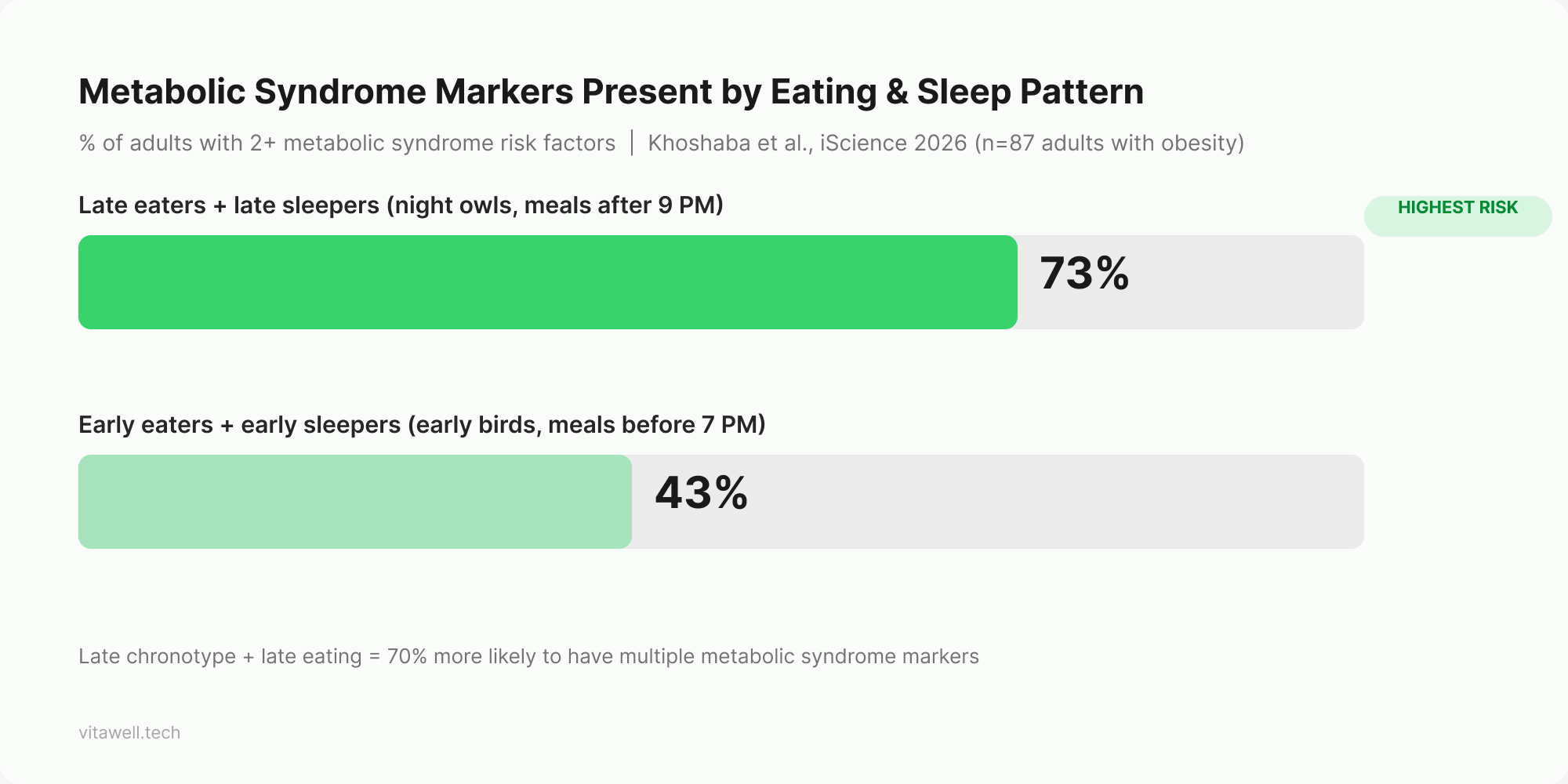
The result was stark: 73% of participants who combined a late chronotype with late eating habits had multiple metabolic syndrome risk factors, compared to 43% of those in the early chronotype and early eating group Khoshaba et al., iScience 2026. This observational study also found that night owls, independent of meal timing, had a higher number of metabolic syndrome risk factors than early birds — but peak risk appeared in those whose sleep schedule and eating schedule were misaligned in the same late direction.
"We know that what we eat matters for our health," Bishehsari noted, "but our findings suggest that when we eat is also important." The study population was adults with obesity, so findings may not generalize to leaner individuals — a limitation worth noting when interpreting the magnitude of risk. This observational design also cannot establish causality on its own; it shows association, not proof that late eating caused the metabolic changes.
Late chronotype is not purely a lifestyle choice. Genetics influence roughly 50% of chronotype variance, and the demands of work schedules can force night owls to live at odds with their biology. Research on work schedules and obesity risk has shown how external schedule pressures compound metabolic strain — an important social context for these findings.
Why Your Gut Is at the Center of This Story
The mechanism connecting late eating to metabolic syndrome runs directly through the gut. Most people know the brain has a circadian clock, the suprachiasmatic nucleus (SCN), which is reset daily by light exposure. What is less widely known is that the gut has its own independent circadian clock, called the food entrainable oscillator (FEO). The FEO is synchronized not by light but by meal timing — specifically by the first and last meals of the day.
When meal timing is shifted significantly later, the FEO falls out of sync with the SCN. This desynchronization disrupts the gut's normal repair and permeability cycles. In healthy gut physiology, tight junction proteins between intestinal cells seal the intestinal barrier during overnight fasting. When eating runs late into the night, those tight junctions are stressed during a period when the gut's protective mechanisms are at low ebb. The result is increased intestinal permeability — commonly called leaky gut — which allows bacterial components (such as lipopolysaccharide, or LPS) to leak into the bloodstream. The immune system recognizes LPS as a threat and mounts an inflammatory response, contributing to the chronic low-grade inflammation that underlies insulin resistance, elevated triglycerides, and visceral fat accumulation: the building blocks of metabolic syndrome.
In the Bishehsari et al. study, participants who showed the highest metabolic inflammatory scores also showed signs of leaky gut. Participants in the microbiome-targeted intervention arm who improved their gut barrier function showed increases in beneficial short-chain fatty acid (SCFA) producing bacteria — microbes like Faecalibacterium prausnitzii and Roseburia that help maintain gut integrity and reduce inflammation. "One intriguing possibility," Bishehsari said, "is that the gut microbiome and intestinal barrier help explain how disruptions in our daily biological rhythms are connected to metabolic inflammation." This gut-circadian link extends well beyond weight gain, with direct implications for heart and kidney disease risk.
The Evidence Builds: More Studies on Meal Timing and Metabolism
The iScience findings do not stand alone. A converging body of research points in the same direction.
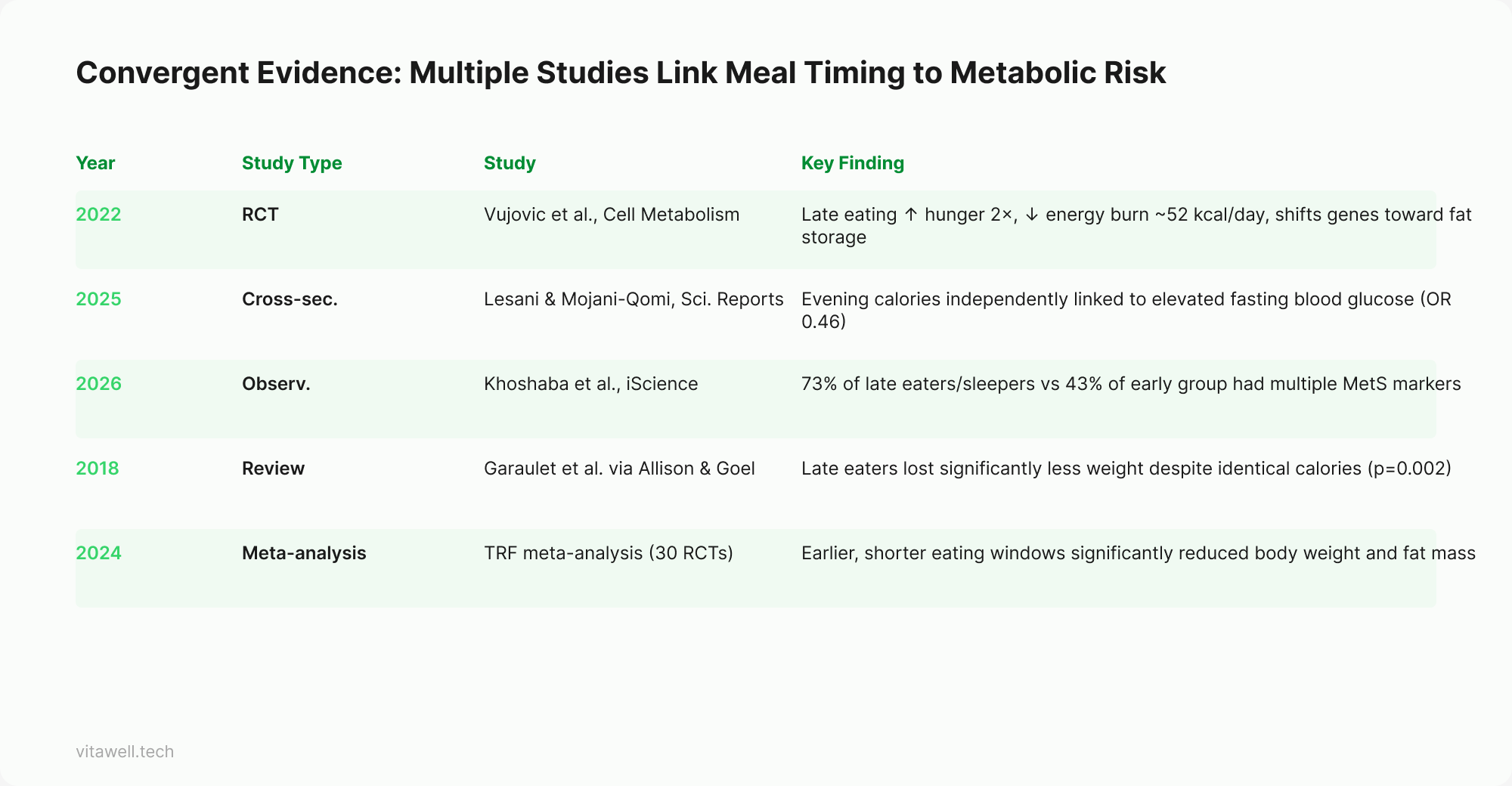
A cross-sectional study published in Scientific Reports in July 2025 by Lesani and Mojani-Qomi Lesani & Mojani-Qomi, Scientific Reports 2025 analyzed 574 Iranian women and found that consuming a greater share of daily calories in the evening was independently associated with elevated fasting blood glucose — a core metabolic syndrome marker — with an odds ratio of 0.46 (p=0.02). Metabolic syndrome prevalence in this cohort was 32.2%, consistent with other population data.
A 2022 randomized crossover trial at Brigham and Women's Hospital, led by Nina Vujovic and colleagues Vujovic et al., Cell Metabolism 2022, enrolled 16 adults with overweight or obesity in a tightly controlled setting where food composition and activity were held constant but meal timing was shifted by 4 to 5 hours. Late eating doubled self-reported hunger scores, reduced energy expenditure by approximately 52 kcal per day, downregulated genes involved in fat breakdown, and upregulated genes involved in fat storage. This randomized controlled trial design provides strong evidence that meal timing itself — not just what people eat — has causal metabolic effects.
A large weight-loss trial tracking 420 Spaniards found that late eaters lost significantly less weight than early eaters despite consuming the same calories (p=0.002), reported Garaulet and colleagues and cited in the Allison & Goel 2018 review. Laboratory studies by Bo et al. and Yoshizaki et al. found that when individuals ate identical meals in the morning versus the evening, the morning group had measurably lower post-meal glucose, lower insulin levels, and lower triglycerides — meaning the same food produces a better metabolic response earlier in the day.
At the population level, an analysis of NHANES 2015 to 2018 data found that eating windows longer than 12 hours and a later timing of the last meal were each linked to a higher risk of abdominal obesity MNT chrononutrition overview, 2025. And a meta-analysis of 30 randomized controlled trials found that time-restricted feeding — compressing eating into an earlier, shorter window — significantly reduced body weight and fat mass compared to unrestricted eating. These converging lines of evidence span observational epidemiology, controlled feeding trials, and mechanistic gene-expression studies, strengthening the overall case.
Your Chronotype-Eating Timing Risk Matrix
Not all late behaviors carry the same risk. Research suggests that the combination of your chronotype and your meal timing determines your overall level of circadian misalignment. The table below translates the evidence into an actionable risk framework:
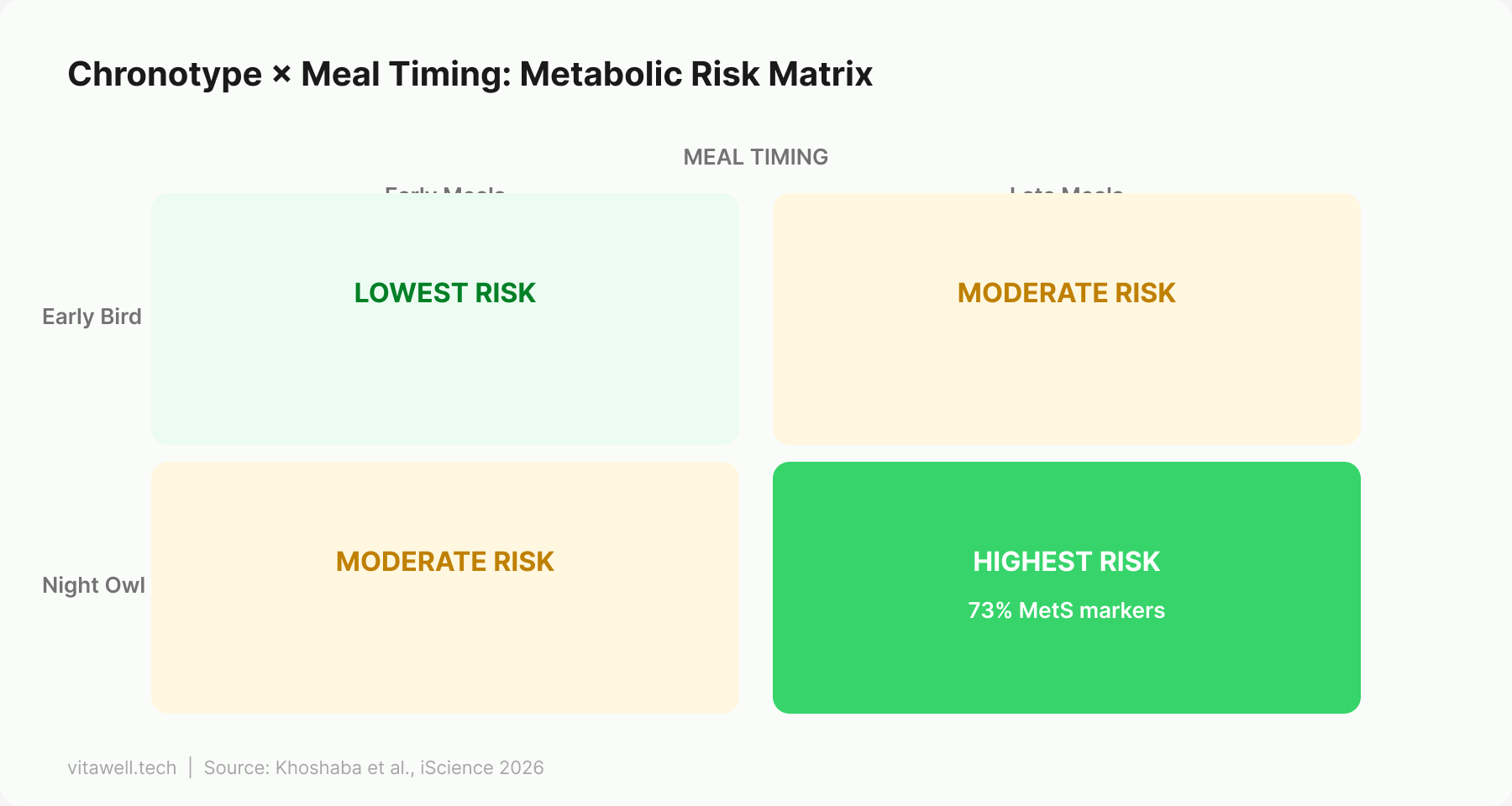
| Eating Pattern | Chronotype | Metabolic Risk Level | Key Action |
|---|---|---|---|
| Early meals (finish by 7 PM), early sleep (before 11 PM) | Early bird | Lowest risk | Maintain current pattern |
| Late meals (finish after 9 PM), early sleep (before 11 PM) | Early bird | Moderate risk | Shift last meal earlier; feeding misalignment reduces metabolic protection |
| Early meals (finish by 7 PM), late sleep (after midnight) | Night owl | Moderate risk | Meal timing is already a strength; focus on other metabolic habits |
| Late meals (finish after 9 PM), late sleep (after midnight) | Night owl | Highest risk — 73% MetS markers in iScience study | Priority: shift last meal 2 to 3 hours earlier regardless of sleep schedule |
A key insight from this framework: even if you cannot change your sleep schedule — because of work, family, or genetic chronotype — shifting meal timing earlier alone may substantially reduce your metabolic risk. You do not need to become a morning person to gain a meaningful metabolic benefit from eating like one.
The Chrono-Meal Protocol: Practical Steps to Align Your Eating Clock
Based on the convergent research, here is a practical protocol for reducing circadian misalignment through meal timing. These steps are graded from highest to lowest impact, so start at the top and add subsequent steps as each becomes routine. Consult your healthcare provider before making significant dietary changes, particularly if you take medications affected by food timing or have a diagnosed metabolic condition.
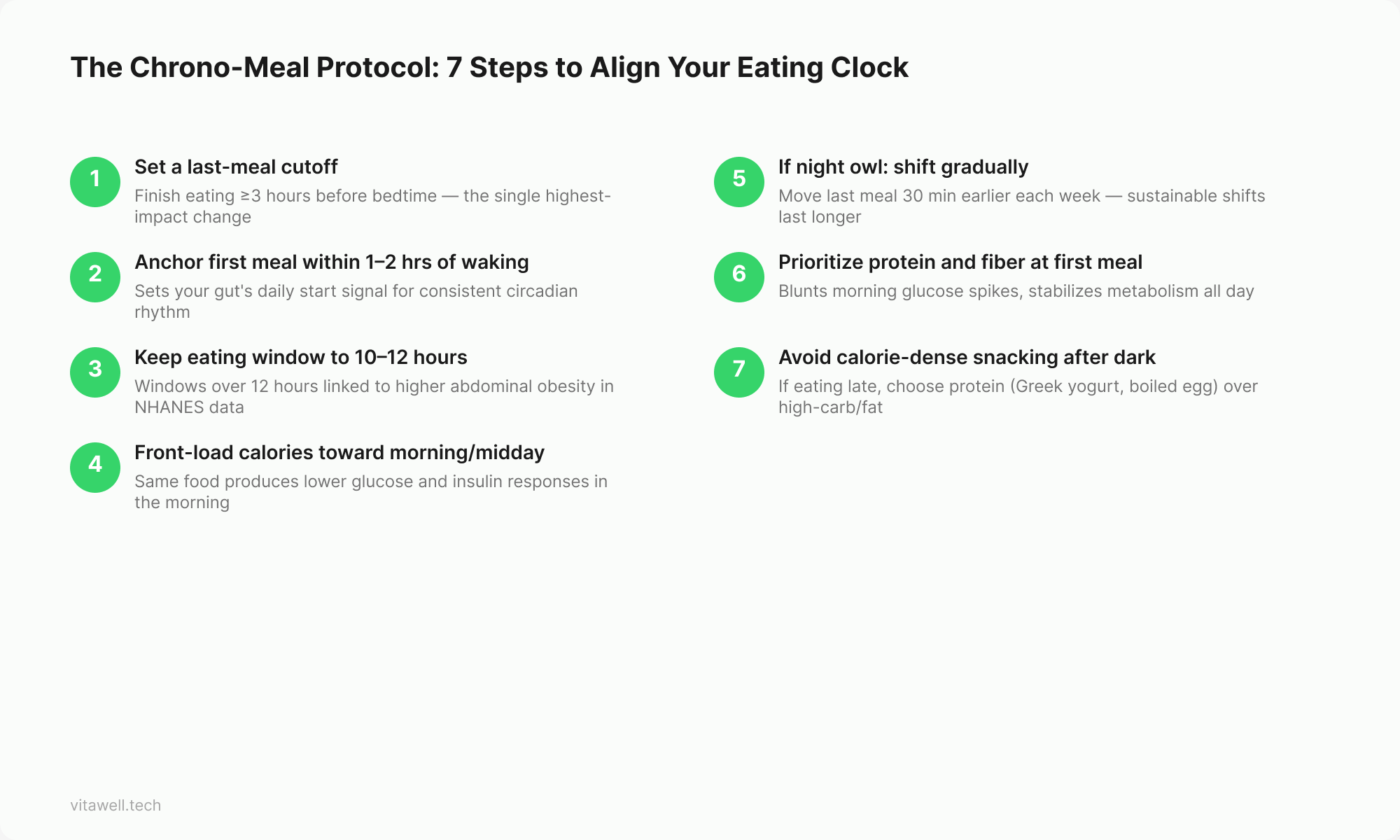
- Set a last-meal cutoff. Finish eating at least 3 hours before your usual sleep time. If you sleep at midnight, that means nothing after 9 PM. This is the highest-impact single change.
- Anchor your first meal within 1 to 2 hours of waking. This sets your FEO's daily start signal and creates a consistent eating rhythm the gut can synchronize to.
- Keep your total eating window to 10 to 12 hours. NHANES data and multiple TRF trials suggest that windows longer than 12 hours are associated with higher abdominal obesity. Compressing to 10 to 12 hours can be achieved by steps 1 and 2 alone.
- Front-load calories toward the morning and midday. The same meal produces lower glucose and insulin responses in the morning than in the evening. Aim for your largest meal before 2 PM.
- If you're a night owl, shift gradually. Move your last meal 30 minutes earlier each week rather than making an abrupt change. Sustainable shifts are more effective than ones that don't last.
- Prioritize protein and fiber at your first meal. Both blunt the glucose spike that otherwise peaks in the morning hours for people with insulin resistance, stabilizing your metabolic response for the rest of the day.
- Avoid calorie-dense snacking after dark. If you must eat late, choose protein-forward options (such as plain Greek yogurt or a boiled egg) over high-carbohydrate or high-fat options, which provoke larger metabolic responses when the gut is in its low-circadian phase.
Pairing this protocol with a consistent wind-down evening routine can reinforce both eating discipline and sleep timing simultaneously, since light exposure from screens after dark also signals the brain's clock to stay awake longer.
When to Talk to a Doctor
Metabolic syndrome is often asymptomatic in its early stages — many people do not know they have it until a routine blood panel or blood pressure check reveals problems. The following are signs to discuss with a healthcare provider:
- Waist circumference above 35 inches (women) or 40 inches (men), especially if it has increased in recent years
- Fasting blood glucose readings above 100 mg/dL on more than one occasion
- Blood pressure consistently at or above 130/85 mmHg
- Triglycerides above 150 mg/dL or HDL below 50 mg/dL (women) or 40 mg/dL (men) on a lipid panel
- Family history of type 2 diabetes, heart disease, or stroke
Request a fasting lipid panel, fasting glucose, and blood pressure check if you have not had one in the past year and identify with a late-eating or late-sleeping pattern. Early identification of two or more metabolic syndrome markers creates an opportunity to intervene with lifestyle changes before the full syndrome develops. Any dietary modification, particularly time-restricted feeding, should be discussed with a physician if you take medications for diabetes, blood pressure, or thyroid conditions, as these can be affected by food timing.
Frequently Asked Questions
What is metabolic syndrome and how is it diagnosed?
Metabolic syndrome is diagnosed when three or more of five criteria are met: high waist circumference, blood pressure at or above 130/85 mmHg, fasting glucose at or above 100 mg/dL, high triglycerides, and low HDL cholesterol. A physician assesses findings from a physical exam and blood panel. It affects over 1 in 3 US adults.
Does eating late at night really cause weight gain?
Research suggests yes, independent of total calories. A 2022 randomized trial at Brigham and Women's Hospital found that eating late reduced calorie burning by roughly 52 kcal per day, doubled hunger, and suppressed fat-breakdown genes — even when food content and exercise were held constant.
What time should you stop eating to avoid metabolic problems?
Finish your last meal at least 3 hours before sleep and keep your total eating window within 10 to 12 hours. For someone who sleeps at 11 PM, that means no eating after 8 PM and ideally no first meal before 8 to 10 AM.
Can night owls lower their metabolic risk without changing sleep schedule?
Yes. A night owl who finishes meals by 7 to 8 PM carries only moderate metabolic risk — substantially lower than one who eats late too. Meal timing is more modifiable than chronotype, offering a practical lever even when sleep schedules are constrained by genetics or shift work.
How does the gut microbiome connect to metabolic syndrome?
Late eating desynchronizes the gut's circadian clock, increasing intestinal permeability. This allows bacterial components into the bloodstream, triggering inflammation that promotes insulin resistance and visceral fat — core metabolic syndrome components. Improving gut barrier function, as in the iScience study, correlates with increases in beneficial SCFA-producing bacteria.
Conclusion
The emerging field of chrononutrition is shifting the conversation about metabolic health beyond "what you eat" toward "when you eat." New research from UTHealth Houston confirms that combining a late chronotype with late eating creates the highest risk of multiple metabolic syndrome markers — 73% prevalence versus 43% in early eaters and sleepers. The mechanism runs through the gut's own circadian clock, linking meal timing to intestinal permeability, inflammation, and the gut microbiome in ways that are only now coming into focus.
The practical implication is straightforward: if your meals routinely extend past 9 PM, shifting your last meal earlier — even by 30 to 60 minutes at a time — may be one of the highest-leverage health changes available to you. It requires no special foods, no supplements, and no gym membership. Start with step one of the Chrono-Meal Protocol and build from there. For more evidence-based strategies on living healthier across all eight life areas, explore VitaWell.
Related on VitaWell
- Your Daily Routine Is Either Aging You Faster or Slower — Johns Hopkins research on how daily circadian habits directly influence how fast you age at a cellular level.
- Working Long Hours Is Making You Heavier — How overwork schedules drive the late eating and disrupted circadian patterns that compound metabolic risk.
- Morning Routines That Boost Energy and Focus — Build the morning anchor habits that complement earlier meal timing and strengthen your body's circadian alignment.
This article is for informational purposes only and does not constitute medical or nutritional advice. Consult a qualified healthcare provider before making significant changes to your diet, eating schedule, or health routine.
Sources
- Medical News Today — Eating and sleeping later associated with increased health risks
- Khoshaba E, et al. Circadian misalignment associates with inflammation, gut barrier, and microbiome composition in humans with obesity. iScience. 2026. DOI: 10.1016/j.isci.2026.117892
- Lesani A, Mojani-Qomi M. Evening energy intake timing and metabolic syndrome risk. Scientific Reports. 2025
- Vujovic N, et al. Late isocaloric eating increases hunger, decreases energy expenditure, and modifies metabolic pathways. Cell Metabolism. 2022
- Allison KC, Goel N. Timing of eating in adults across the weight spectrum. Physiology & Behavior. 2018
- Medical News Today — Chrononutrition: how meal timing affects your health. 2025