Why Funny Job Ads Backfire: New Research Shows Humor Hurts Hiring
Humor in job ads feels clever, but new 2026 research shows it lowers application intent and raises doubts about fair hiring. Here's what the evidence says actually works in a job description.
Humorous job descriptions may feel like smart employer branding, but new research shows they reduce candidates' willingness to apply, raise doubts about fair hiring, and attract less-qualified applicants. Three independent data sources from 2026 point in the same direction: clarity and honesty outperform cleverness when it comes to attracting the right candidates and building trust.
Key Takeaways
- A 2026 academic study testing humor across 750+ job seekers in three experiments found it lowered application interest and raised concern about whether HR processes are fair
- Monster's 2026 survey of 1,060 job seekers found 85% were more likely to apply with honest descriptions, while 78% were likely to abandon a vague or unclear posting
- Platform data from LinkedIn, Indeed and ZipRecruiter shows neutral-tone job descriptions draw 76% positive impressions vs. 60% for casual language, and job descriptions under 300 words get 8.4% more responses
- The only measurable upside of humor: a 2016 study found it slightly raised sharing intent — with no effect on actual apply rates
- What works: clear salary ranges (the top trust driver for 53% of candidates), concrete expectations, and plain language
The Strategy That Looks Smart but Isn't
The internet has no shortage of job ads that describe the ideal candidate as a "rockstar," "ninja," or "unicorn," ask for someone who works hard and plays harder, or pepper the posting with inside jokes about workplace culture. The logic behind these choices is understandable: a distinctive voice stands out in a crowded market, signals authenticity, and attracts people who might appreciate the team's personality.
The problem is that candidates don't process job ads the way companies think they do. What reads as "fun and approachable" to a hiring manager often reads as "unprofessional or risky" to someone who hasn't yet decided whether this company deserves their time. A new wave of research is quantifying that gap — and the numbers aren't flattering for humor.
What Three Data Sources Found
Experiment 1 and 2: 750+ Job Seekers, Humor Lowers Apply Intent
The most direct evidence comes from Cheng et al. (2026), published in the International Journal of Selection and Assessment. The researchers tested humor in job descriptions across three experiments with more than 750 participants. In experiments one and two, humor in the job posting produced two measurable effects: it lowered participants' interest in applying, and it raised their concern about whether the hiring process would be fair.
Experiment three introduced a wider variety of job description styles and found no statistically significant overall difference in outcomes — but this result doesn't rehabilitate humor. It reflects the diluted signal when humor is one of many conditions tested, not a finding that humor works. The directional effect from experiments one and two held: when humor was clearly the differentiating feature, it hurt.
This matters because the study design was controlled. Participants saw either a humorous or neutral version of an otherwise identical posting. The only variable was tone — which makes the fairness concern finding particularly striking. Humor doesn't just lower enthusiasm; it triggers skepticism about whether the company will make decisions equitably.
What 1,060 Job Seekers Say They Actually Want
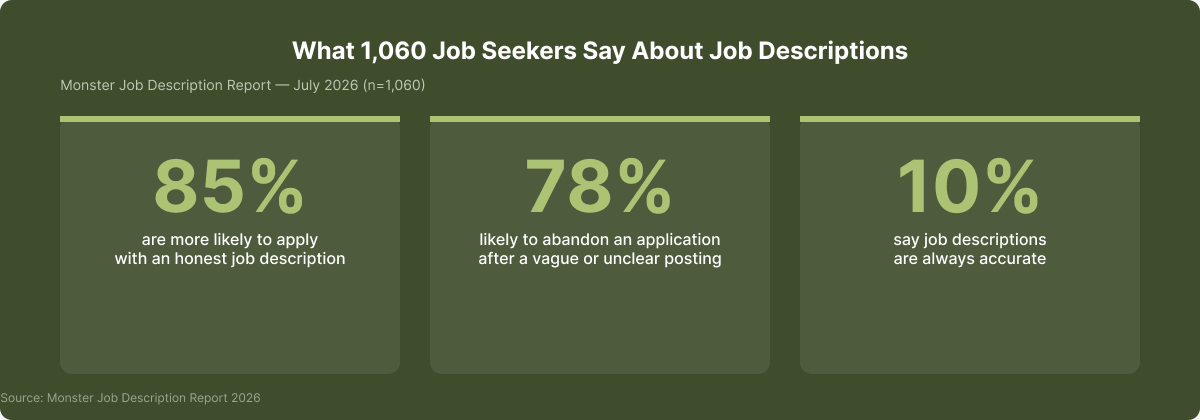
Monster's Job Description Report (July 2026, n=1,060, conducted via Pollfish) provides the candidate perspective at scale. Only 10% of respondents said job descriptions are always accurate — a baseline of skepticism that makes candidates even more sensitive to signals of reliability. Against that backdrop, 85% said they were more likely to apply for a job with an honest description, 76% said they trust postings that describe the role realistically, and 78% said they were likely to abandon an application after reading a vague or unclear job posting.
The top trust driver, cited by 53% of respondents, was a clear salary range. Not team values, not culture statements, not a fun tone: a number. Candidates aren't looking for entertainment in job ads — they're looking for enough reliable information to decide whether to invest the effort of applying.
Platform Data: Neutral Tone Wins
Insight Global's August 2026 analysis aggregated platform-level data from LinkedIn, Indeed and ZipRecruiter and reached consistent conclusions. Neutral-toned job descriptions received positive impressions from 76% of candidates, compared to 60% for casual language — a 16-percentage-point gap that reflects a broad pattern, not noise.
Additional findings: job descriptions under 300 words receive 8.4% more responses than longer ones. Gender-neutral language increases response rates by 42%. And 42% of employers reported revising their job descriptions because they were attracting too many unqualified candidates — a signal that the wrong language filters in the wrong people.
Why Humor Backfires: The Psychology Behind the Data
The research findings make more sense when you consider how candidates read job ads. A job description is not marketing copy — it's a contract signal. It tells candidates what the role involves, what the company expects, and by implication, how the organization makes decisions. Humor creates friction in that process in several ways.
First, there's signal mismatch. Humor signals informality. For roles that require professionalism, precision or high-stakes judgment, that signal conflicts with what candidates want to know the company values. Even in genuinely casual workplaces, humor in a formal hiring document raises questions about how seriously the organization takes the commitment it's making.
Second, the Cheng et al. findings on fairness perception are specific: when candidates see humor, they more frequently question whether HR processes will treat them fairly. The mechanism likely relates to perceived seriousness — a process that doesn't take itself seriously may not take candidate evaluation seriously either.
Third, humor frequently substitutes for specifics. The "ninja developer wanted" posting almost never includes a clear scope of work, a salary range or a realistic description of day-to-day tasks. Vagueness is costly: 78% of candidates will abandon applications after reading unclear descriptions. Clarity in professional communication — the ability to signal exactly what you mean and what you value — is a skill that matters as much for organizations presenting themselves to candidates as it does for individuals navigating their careers.
The Job Description Mistakes That Cost You Qualified Applicants
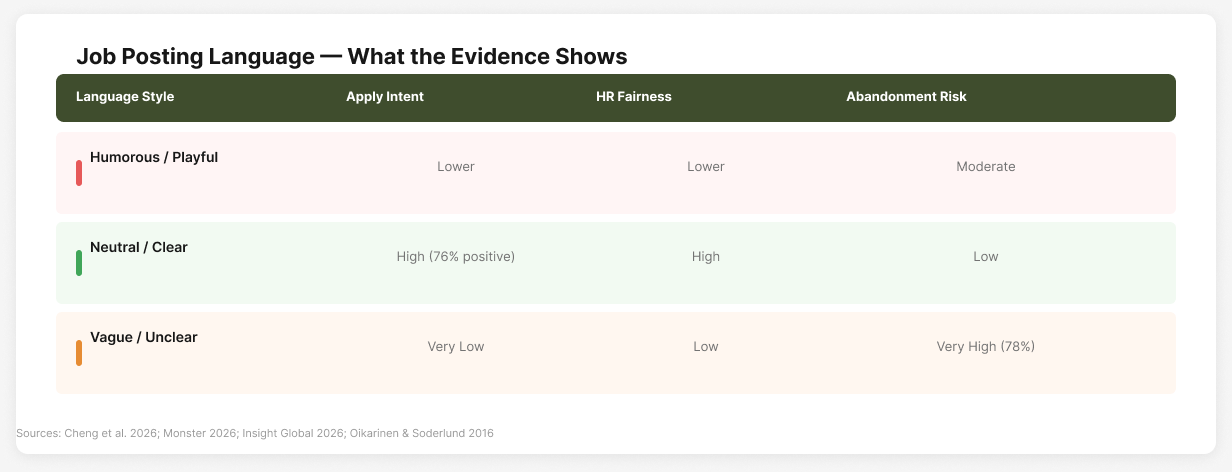
The research synthesizes into a clear picture of which language choices help and which hurt. The table below draws on Cheng et al. (2026), Monster (2026), Insight Global (2026) and Oikarinen & Söderlund (2016, Australasian Marketing Journal):
| Language Style | Apply Intent | Perceived HR Fairness | Qualified Applicant Rate | Sharing Intent | Abandonment Risk |
|---|---|---|---|---|---|
| Humorous / playful | Lower (Cheng 2026) | Lower (Cheng 2026) | Likely lower (42% employer revisions) | Higher (Oikarinen 2016) | Moderate |
| Neutral / clear | High (76% positive impressions) | High | High | Moderate | Low |
| Vague / unclear | Very low | Low | Low | Low | Very high (78%, Monster 2026) |
Sources: Cheng et al. 2026; Monster Job Description Report 2026; Insight Global / LinkedIn / Indeed 2026; Oikarinen & Söderlund 2016
The one finding that might seem to favor humor — higher sharing intent (Oikarinen & Söderlund, 2016) — is real but limited. Candidates share humorous job ads more often. They just don't apply for them more often. Virality and application volume are not the same metric, and confusing them is a costly error. Trust in hiring is an extension of the same trust dynamic that governs how teams function: when the signals don't match the reality, people notice, and the relationship starts at a deficit.
What Actually Works: A Research-Backed Job Description Formula
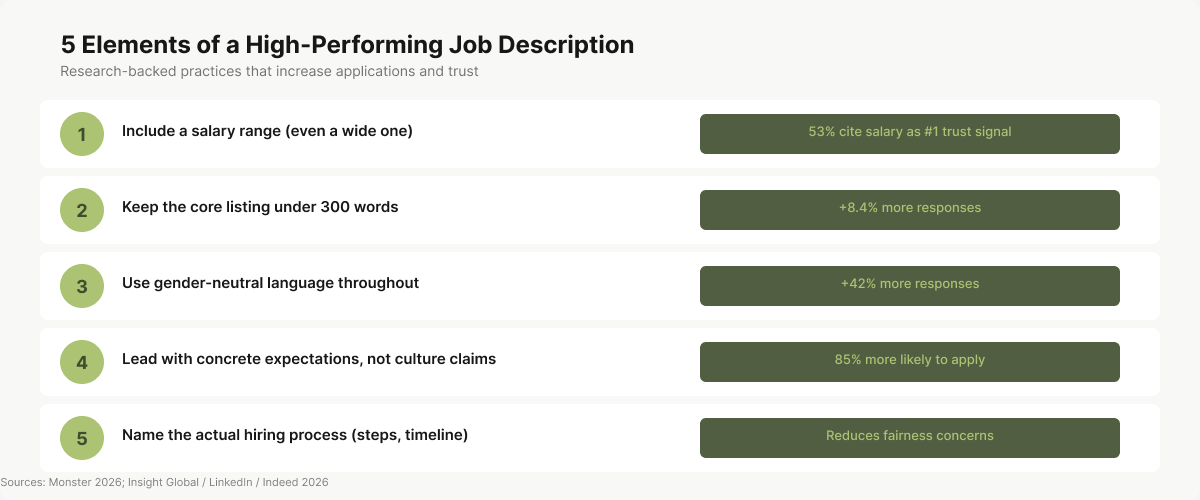
The same research that documents the problem also points directly to the solution. High-performing job descriptions share five features, each backed by data:
- Include a salary range. Fifty-three percent of candidates cite clear salary ranges as the top trust signal in a job description (Monster 2026). Even a broad range outperforms vague language like "competitive compensation."
- Keep the core listing under 300 words. Job descriptions shorter than 300 words receive 8.4% more responses than longer ones (LinkedIn data via Insight Global 2026). Every sentence should earn its place.
- Use gender-neutral language throughout. Gender-neutral wording increases response rates by 42% (Indeed data via Insight Global 2026). Tools like Textio and Gender Decoder flag gendered terms automatically.
- Lead with concrete expectations, not culture claims. Eighty-five percent of candidates are more likely to apply when the description is honest (Monster 2026). Specific duties, realistic requirements and clear deliverables outperform personality assertions.
- Name the actual hiring process. Describe the steps, timeline and who's involved. This directly addresses the fairness concern Cheng et al. identified — candidates who know what to expect are more likely to trust the process and complete the application.
When Does a More Casual Tone Actually Work?
The research doesn't argue for sterile corporate language across the board. There are contexts where a warmer, more direct voice is appropriate: creative agencies, design studios, content teams, early-stage startups where culture genuinely is a differentiating feature, and roles where interpersonal chemistry is part of the selection criteria.
The important distinction is between personality embedded in specifics versus personality as a substitute for specifics. "We're a small team of three designers working on fintech products, and we move fast — you'll own projects end to end" communicates both culture and expectations. "Join our rockstar team of unicorns who don't believe in Mondays" communicates neither. Knowing which workplace culture signals actually reflect a healthy environment — versus performative branding — is a skill that helps job seekers as much as it helps employers writing better ads.
It's also worth noting that some companies use humor in job ads specifically to filter for a particular personality type. The question is whether that filter is working as intended — the data suggests it filters out more of the qualified applicants it wants to attract than it filters in. Some of the loudest employer branding about workplace fun conceals demanding, unsustainable environments — a pattern worth scrutinizing in any hiring process.
When to Talk to a Professional
If your organization is seeing high candidate abandonment rates, unexpectedly low application volumes, or pools dominated by underqualified applicants, the job description is a logical first place to audit. HR professionals and talent acquisition specialists can run structured A/B tests on job description language. Employer branding consultants provide systematic audits across a full library of postings. And compensation consultants can help benchmark salary ranges — the most direct lever on candidate trust, according to the Monster data.
Frequently Asked Questions
Does humor in job descriptions attract more applicants?
No — the reverse appears to be true. Cheng et al. (2026) found humor in job descriptions lowered candidates' interest in applying across two controlled experiments. While humorous postings may circulate more widely (Oikarinen & Söderlund, 2016), sharing intent and apply intent are different outcomes. Viral job ads don't necessarily generate more applications from qualified candidates.
What do job seekers actually want to see in a job posting?
Monster's 2026 survey of 1,060 job seekers found the top priorities are accuracy and honesty: 85% said they were more likely to apply with an honest description, and only 10% found current postings always accurate. The single most-cited trust signal was a clear salary range, mentioned by 53% of respondents.
Why do candidates abandon job applications?
Monster's 2026 data found 78% of candidates were likely to abandon an application after reading a vague or unclear posting. Additional factors include opaque hiring processes and mismatched expectations. Clarity in language, expectations and process is the most direct remedy.
What language makes a job description more effective?
Neutral, specific language consistently outperforms humorous or vague alternatives. Insight Global's 2026 aggregation found neutral-tone postings received positive impressions from 76% of candidates versus 60% for casual language. Under 300 words, gender-neutral wording and concrete expectations each independently improve response rates.
Does gender-neutral language in job postings really make a difference?
Yes — by a substantial margin. Indeed platform data cited by Insight Global (2026) found gender-neutral wording in job descriptions increases response rates by 42%. Gendered language — whether masculine-coded or any gender-signaling phrasing — narrows the applicant pool before candidates self-select on fit.
Conclusion
The appeal of a witty job ad is understandable. Standing out feels like it should matter in a crowded hiring market. But the research now available from 2026 — an academic study with controlled conditions, a large-scale candidate survey and aggregated platform data — tells a consistent story: humor in job descriptions lowers application intent, raises concerns about fair treatment, and attracts candidates who don't stay engaged through to completion.
The most effective employer branding isn't clever — it's honest. Candidates who know what a role actually involves, what it pays and how the hiring process works are more likely to apply, more likely to complete the application, and more likely to arrive with realistic expectations. That's the ROI of clarity. VitaWell covers the evidence-based side of career and professional life across all eight life areas.
Related on VitaWell
- Why AI Makes You Work More, Not Less — hiring processes are increasingly AI-mediated; human-readable clarity in job descriptions matters more as AI tools filter applications
- Why Most Organizational Change Fails — hiring quality and job description accuracy feed directly into organizational performance; misaligned hires from vague postings compound change failures
- The Power of Writing Online for Career Growth — the same principles that make job descriptions effective — clarity, specificity, authentic voice — apply to professional writing for career development
Sources
- Inc.com (2026) — Funny Job Postings Actually Backfire, Research Finds
- Cheng et al. (2026). Humor in job descriptions and application intentions. International Journal of Selection and Assessment.
- Monster (2026). Job Description Report (n=1,060, Pollfish).
- Insight Global (2026). How to Write a Job Description: Platform data from LinkedIn, Indeed, ZipRecruiter.
- Oikarinen T. & Söderlund M. (2016). The effects of humor in job advertisements. Australasian Marketing Journal.