Why You Can't Stop Thinking About Work — And the Science of Truly Switching Off
Most people mistake passive activities for rest. Research shows 75% of workers struggle to mentally detach from work — and the consequences show up in sleep, concentration, and mental health. Here's the science of truly switching off.
Most people think scrolling their phone after work counts as rest. It doesn't. Research shows 75% of workers struggle to mentally detach from work, and that failure isn't just uncomfortable — it predicts higher depression risk, worse sleep, and lower performance the next day. The fix isn't about willpower; it's about four specific types of recovery that science has identified and quantified.
Key Takeaways
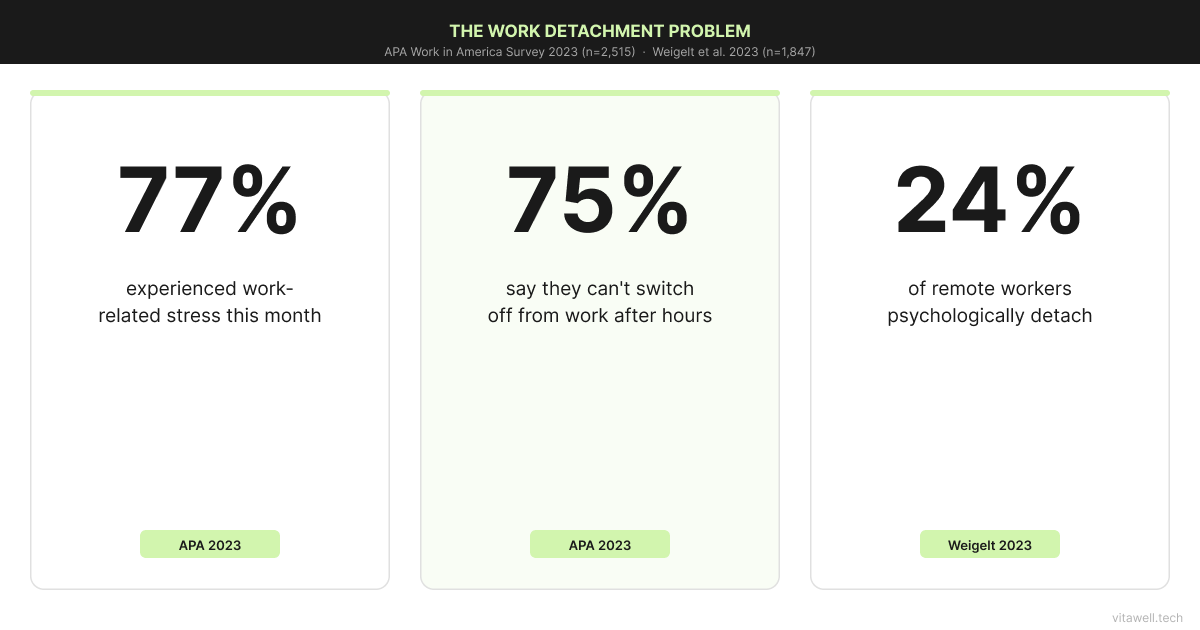
- APA's 2023 Work in America Survey (n=2,515) found 77% of workers experienced work-related stress in the past month; 75% say they can't switch off after work.
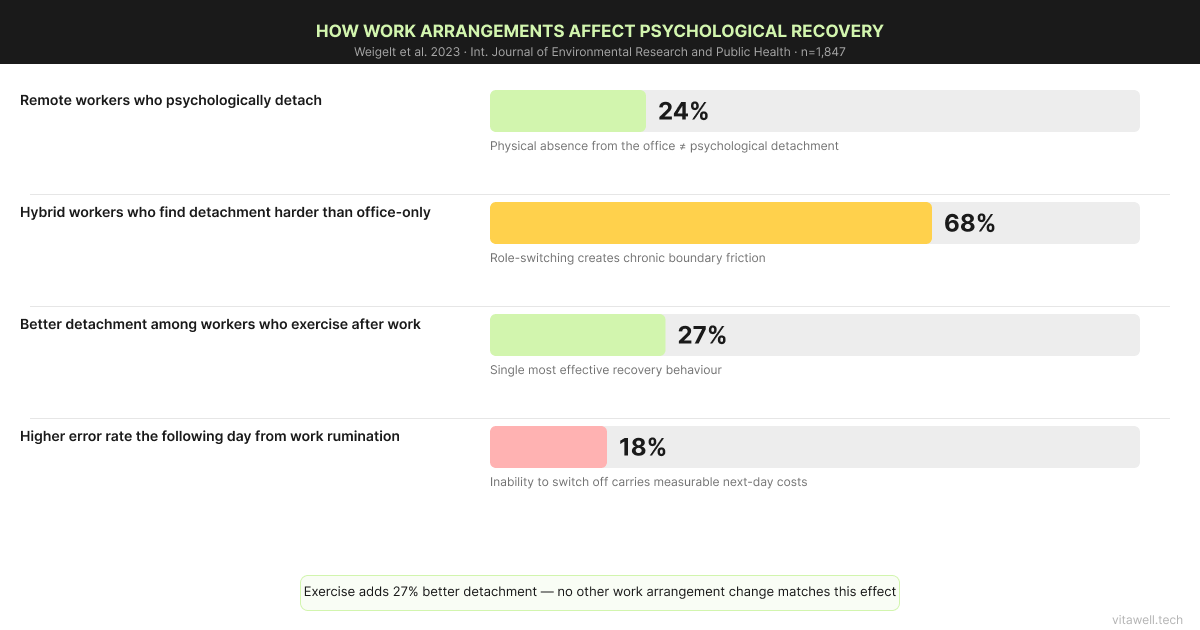
- Only 24% of remote workers psychologically detach from work, with 68% finding hybrid arrangements harder than office-only (Weigelt et al. 2023, n=1,847).
- Workers who detach have 20% depression risk versus 29% for those who don't, plus 23% better next-day concentration (Foulk et al. 2025).
- Sonnentag & Fritz (2007) identified four recovery experiences — detachment, relaxation, mastery, control — each producing distinct, measurable outcomes independent of the others.
- The workaholics paradox: working more hours predicts worse psychological detachment, creating a burnout loop that extra effort cannot fix.
The Problem With How We Think About "Rest"
Finish work for the day, collapse on the sofa, turn on Netflix, pick up your phone. That sequence feels like recovery. The body is horizontal, the laptop is closed, the meeting is over. By most ordinary definitions, this is rest.
It isn't — at least not in any way that the research recognizes as psychologically beneficial. Physical inactivity is not the same as mental disengagement from work, and the gap between those two things is where most of the damage happens.
According to the American Psychological Association's 2023 Work in America Survey, which polled 2,515 U.S. workers, 77% reported work-related stress in the past month. More telling: 75% said they struggle to mentally switch off from work during non-work hours. These aren't people failing to relax — in many cases they are physically resting. The problem is that their brains never received a signal to stop processing the job.
The key concept here is psychological detachment — a term from occupational health research meaning complete mental disengagement from work during non-work time. Not physical absence from the office, not being offline, not simply not checking email. Actual cessation of work-related thought. This turns out to be considerably rarer than it sounds, and considerably more important than most people realize.
What the Research Actually Shows
Why 75% of Workers Stay Stuck in Work Mode
The APA's 2023 data captures something important: even among workers who report taking time off, the majority are not experiencing psychological detachment. They are physically absent from the workplace but mentally still inside it — reviewing conversations, rehearsing tomorrow's tasks, monitoring for the next notification.
The 75% figure who say they can't switch off isn't a population of workaholics or high achievers with unusually demanding roles. It is the workforce at large. The implication is that the default cognitive mode for most employed adults, even outside working hours, is a form of ambient work processing that never fully stops.
What Happens When You Can't Let Go
The consequences of this persistent mental engagement are well-documented and go beyond discomfort. A 2025 study published in the Journal of Applied Psychology by Foulk and colleagues tracked workers' ability to detach and found workers who achieved psychological detachment showed a d=+0.44 improvement in job satisfaction and a d=+0.30 improvement in sleep quality compared to those who did not. Depression risk was 20% among detachers versus 29% among non-detachers — a substantial difference. Next-day concentration was 23% better for those who had successfully disengaged the previous evening.
A parallel study by Baktash and Pütz published in the Journal of Happiness Studies in 2025 found that workers who engaged in structured recovery activities showed a d=0.38 improvement in well-being and d=0.29 improvement in work engagement — meaning recovery doesn't just restore capacity, it builds it. Mastery activities reduced rumination by 31%.
Weigelt and colleagues, in a 2023 study published in the International Journal of Environmental Research and Public Health with 1,847 participants, measured the downstream performance effect: workers who ruminated about work during non-work hours had an 18% higher error rate the following day. Recovery isn't a lifestyle preference. It is a performance variable with measurable, quantifiable impact.
The workaholics paradox. Among workers who self-described as workaholics, Baktash and Pütz found 40% more burnout risk than among non-workaholics. The pattern is precisely backwards from what many high performers intuit: working more hours predicts worse psychological detachment, which predicts higher burnout, which predicts worse performance. The effort intended to solve the problem creates more of it.
Work Arrangements and Detachment Rates
Weigelt et al. (2023) also broke down detachment rates by work arrangement, and the results reframe the remote-work conversation. Only 24% of remote workers achieved psychological detachment from work during non-work hours — a figure low enough to suggest that the structural conditions of remote work actively undermine recovery, not merely complicate it. Among hybrid workers, 68% found detachment harder than workers in fully office-based roles.
Exercise emerged as the clearest behavioural predictor: workers who exercised during non-work hours showed 27% better detachment rates than those who did not.
Why Your Brain Won't Let Work Go: The Psychology of Rumination
The persistence of work cognition outside working hours isn't a character flaw or a failure of discipline. It has a recognized mechanism.
The Zeigarnik effect, first described by Soviet psychologist Bluma Zeigarnik in the 1920s and confirmed in dozens of subsequent studies, is the tendency of the brain to continue processing unfinished tasks in working memory until they are either completed or explicitly offloaded. An unresolved deadline, an unanswered email, a decision deferred to tomorrow — each one continues to occupy cognitive space because the brain treats it as an open loop it is responsible for closing.
A second mechanism is signal contamination. The home environment, for anyone who works remotely or takes work home, becomes saturated with work-associated cues: the same desk used for Zoom calls, the laptop sitting open, the notification sound from a work app. These cues trigger work cognition even without any deliberate intention to work. The brain has been conditioned to associate those signals with professional processing, and it obliges.
The 18% higher error rate identified in the Weigelt study is the operational cost of this spillover. Rumination is not merely unpleasant; it consumes cognitive resources that the following day's work requires. AI tools and always-on communication platforms are structural contributors to the detachment problem — they extend the cognitive reach of work into every hour.
The 4 Recovery Experiences — And What Each One Actually Does
The definitive framework for understanding why some activities actually restore cognitive capacity while others do not comes from Sonnentag and Fritz's 2007 paper, which remains the most-cited work in occupational recovery research. They identified four distinct recovery experiences, each with its own mechanism and its own measurable effect.
The critical point is that these four experiences are independent of each other. A holiday that involves constant Slack-checking can include relaxation but zero psychological detachment. Exercise can produce mastery without detachment if the exerciser spends the run mentally rehearsing tomorrow's presentation. Each experience requires its own deliberate condition.
| Recovery Experience | What It Means | Key Effect Size | Who Benefits Most | Common Mistake | Best Practice |
|---|---|---|---|---|---|
| Psychological Detachment | Complete mental disengagement from work during non-work time | d=+0.44 job satisfaction (Foulk 2025) | High-demand, deadline-heavy roles | Thinking through tomorrow's tasks during "off" time | Set a digital sunset: no work devices or apps after a fixed time |
| Relaxation | Low-effort, low-arousal activities that reduce activation | d=+0.30 sleep quality (Foulk 2025) | High cognitive-load workers; parents; caregivers | High-stimulation "rest" (action films, social media) | Light walking, reading fiction, stretching, nature exposure |
| Mastery | Engaging in a challenging non-work skill or activity | 31% less rumination (Baktash 2025) | Workaholics; high-achievers; people with low job control | Choosing activities that still feel like work (reading industry news) | Learning an instrument, cooking new recipes, sport, crafting |
| Control | Autonomy over how non-work time is structured and spent | d=0.29 work engagement (Baktash 2025) | Workers with low daily autonomy; shift workers | Defaulting to "whatever" time use that others decide | Actively scheduling personal activities during the week |
Sources: Sonnentag & Fritz 2007; Foulk et al. 2025; Baktash & Pütz 2025; Weigelt et al. 2023
The Recovery Mistakes That Keep Work Thoughts Running
Three patterns reliably undermine recovery despite feeling like they should work.
The first is fake rest: passive, high-stimulation activities. Watching an action series, doomscrolling social media, consuming rapid-fire video content — these activities keep arousal elevated without producing the low-activation state that true relaxation requires. The nervous system does not reset; it merely redirects. This distinction matters because the research on sleep quality improvement (d=+0.30 from Foulk et al.) was associated with genuine relaxation, not passive stimulation.
The second is the workaholics paradox revisited. Workers who attempt to solve burnout through more effort — taking on extra projects to prove their value, checking in over weekends to stay ahead — are adding to the very cognitive load that recovery is meant to address. The 40% higher burnout risk identified by Baktash and Pütz among self-described workaholics reflects this loop. The same drive that fuels high achievement makes psychological detachment feel impossible — and the data shows the cost.
The third is work-adjacent "off" time: reading business books, listening to work podcasts, planning side projects related to your career. These activities activate the same cognitive networks as working. They use different content but the same professional processing mode. The brain is still at work.
How Your Work Arrangement Shapes Your Recovery
The 24% detachment rate among remote workers described by Weigelt et al. reflects a structural problem, not an individual one. When home and office are the same space, the environmental cues that signal "work mode" are present throughout the non-work day. The boundary that the commute or the office building used to provide has disappeared.
Hybrid workers face a different version of the same problem. The 68% who find detachment harder than office-only workers are not simply dealing with two environments — they are dealing with the cognitive cost of switching between them without stable routines. Neither the home nor the office fully registers as "off" because both are associated with work behavior.
Office workers with a commute have an underappreciated advantage here. Research by Faber and colleagues (2019) identified the commute as a natural transition ritual — a period of movement and mental shift that many remote workers lack and many hybrid workers have only on some days. When commuting is impossible or impractical, an intentionally designed transition ritual serves the same function.
The practical implication is that recovery strategies cannot be generic. What works for an office worker navigating physical separation from the workplace will not automatically work for a remote worker whose laptop never leaves the room where they sleep. Boundary-setting in remote and hybrid work is as much a team norm as an individual practice.
What Actually Works: A Science-Backed Evening Recovery Protocol
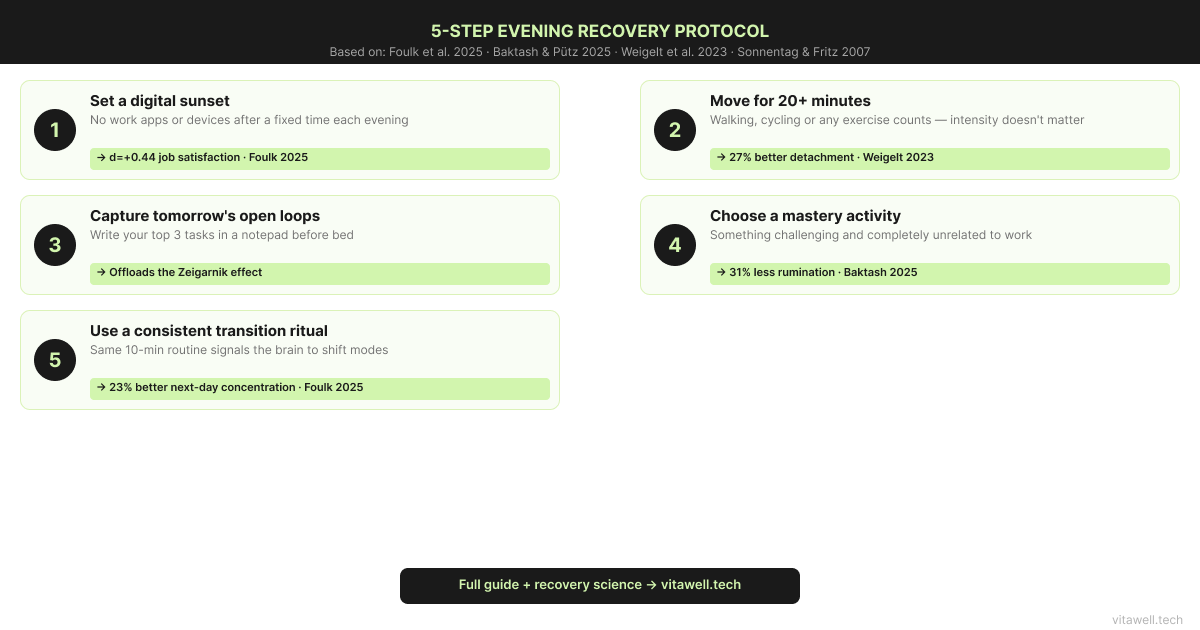
The research synthesizes into five specific actions, each linked to one or more of the recovery experiences Sonnentag and Fritz identified.
- Set a digital sunset. Choose a fixed time after which no work applications are accessed. This is the most direct behavioural intervention for psychological detachment. Foulk et al.'s d=+0.44 job satisfaction finding was specifically associated with the ability to disengage cognitively — a digital sunset creates the structural condition for that disengagement by removing the cues that trigger work cognition.
- Move for 20 or more minutes. Walking, cycling, any exercise. Weigelt et al. found 27% better detachment rates among workers who exercised during non-work hours. The mechanism likely involves both the physical state change and the competing cognitive focus that movement provides.
- Capture tomorrow's open loops. Before ending the working day, write down the top three unresolved tasks or decisions. This directly addresses the Zeigarnik mechanism: the brain continues processing open loops because it has no other way to ensure they won't be forgotten. An external record — even a brief handwritten note — allows the working memory to release the task.
- Choose a mastery activity. Something genuinely challenging that has nothing to do with work: a musical instrument, a new recipe, a sport, a craft, a language. Baktash and Pütz's finding of 31% less rumination with mastery activities reflects the displacement of work cognition by a competing high-engagement task. The challenge is the mechanism — passive activities don't produce the same effect.
- Use a consistent transition ritual. A fixed 10-minute routine — the same sequence of actions every day — that signals to the brain that work is over. Making tea, walking around the block, changing clothes, playing a specific piece of music. Workers who used consistent transition rituals showed the 23% better next-day concentration identified by Foulk et al. Sustainable career performance depends on recovery as much as on effort — and knowing how to restore capacity is a career skill.
When to Talk to a Professional
Persistent inability to psychologically detach — where these strategies consistently fail and work thoughts dominate non-work hours regardless of effort — can signal clinical conditions distinct from ordinary work stress. These include occupational burnout (recognized by the WHO as a workplace phenomenon characterized by exhaustion, cynicism and reduced professional efficacy), work addiction, and anxiety disorders.
If rest consistently fails to feel refreshing despite deliberate effort, if you find yourself unable to stop working even when you want to, or if work cognition is disrupting sleep, relationships, or basic daily functioning, occupational health specialists and therapists with cognitive-behavioral therapy (CBT) specialization are the appropriate next step. Many employers also offer Employee Assistance Programs (EAPs) that provide confidential access to mental health support.
Frequently Asked Questions
What is psychological detachment from work?
Psychological detachment is the experience of mentally switching off from work during non-work hours — not just being physically away from the office, but genuinely ceasing work-related thought. It is one of four recovery experiences identified by Sonnentag and Fritz (2007) and is associated with improved sleep quality, lower depression risk, and better next-day performance.
Why can't I stop thinking about work even when I try?
The Zeigarnik effect means the brain retains unfinished cognitive tasks in working memory until they are completed or offloaded. Work also leaves environmental cues — notification sounds, the laptop's presence, the desk associated with video calls — that trigger work cognition even without deliberate intention. Writing down unresolved tasks before leaving work and removing work device access after a fixed time are the two most direct interventions.
Does remote work make it harder to switch off?
Yes, substantially. Weigelt et al. (2023) found only 24% of remote workers achieved psychological detachment, compared to higher rates among office workers. The absence of a physical boundary between work and home space means work-associated cues remain present throughout non-work hours. Intentional environmental design — a dedicated workspace, a consistent end-of-day routine, digital limits — partially compensates for the lost structural separation.
What activities actually help with psychological detachment?
Sonnentag and Fritz's framework identifies four categories: psychological detachment (no work cues or thoughts), relaxation (low-arousal activities), mastery (challenging non-work skill), and control (autonomy over non-work time). Exercise is the strongest single predictor, with Weigelt et al. finding 27% better detachment among workers who exercised. Passive high-stimulation activities — social media, action films — do not produce the low-arousal state that genuine recovery requires.
Is checking work emails after hours really that harmful?
The research suggests yes, in a specific way. Each email check reactivates work cognition, reopens closed mental loops, and prevents the transition into genuine detachment. Among workers who could not detach, Foulk et al. found 29% depression risk versus 20% among detachers, and an 18% higher next-day error rate from rumination (Weigelt 2023). The cumulative effect of habitual after-hours checking is a persistent low-grade activation that prevents the full cognitive reset that recovery requires.
Conclusion
The inability to stop thinking about work is not a personal weakness or a symptom of ambition — it is a predictable result of work environments and cognitive mechanisms that actively work against recovery. Seventy-five percent of workers experiencing it suggests a systemic problem, not an individual one.
The research is clear about what recovery actually requires: not more downtime, but different kinds of cognitive activity — specifically, the four experiences of detachment, relaxation, mastery, and control that Sonnentag and Fritz identified. Passive inactivity does not substitute for these. Neither does willpower. The practical question is which conditions allow each experience to occur, and the five-step protocol above is built directly from that evidence.
You don't need more willpower to switch off. You need a different kind of activity after work — and a structure that makes it possible. VitaWell covers the evidence-based side of career and life across all 8 areas.
Related on VitaWell
- Why AI Makes You Work More, Not Less — AI and automation tools are a structural driver of the always-on problem the article addresses — they extend working hours and blur the boundary that detachment depends on.
- The 5 Human Skills That Will AI-Proof Your Career — Recovery and sustainable capacity are prerequisites for the judgment, creativity, and relationship skills that make professionals irreplaceable to AI.
- Why Funny Job Ads Backfire — Hiring norms around availability and "always-on" culture shape the detachment difficulty the article addresses.
This article provides general information and is not a substitute for professional medical or psychological advice.
Sources
- APA (2023). Work in America Survey (n=2,515). American Psychological Association.
- Sonnentag S. & Fritz C. (2007). The Recovery Experience Questionnaire. Journal of Occupational Health Psychology.
- Foulk et al. (2025). Psychological detachment and next-day outcomes. Journal of Applied Psychology.
- Baktash M. & Pütz V. (2025). Recovery experiences and worker well-being. Journal of Happiness Studies.
- Weigelt O. et al. (2023). Work arrangement, detachment and performance. International Journal of Environmental Research and Public Health (n=1,847).
- Faber A. et al. (2019). The commute as transition ritual. Ergonomics.