What fMRI Research Reveals About How Gratitude Rewires Your Brain — And 3 Proven Ways It Protects Your Health
Gratitude isn't just a mood booster — fMRI research shows it physically changes the brain's medial prefrontal cortex, and new data links it to measurable health protection across three distinct pathways.
Gratitude isn't a mood — it's a measurable brain state. fMRI scans show that practicing gratitude activates the medial prefrontal cortex (mPFC), a region linked to learning and decision-making, and the effect grows stronger over time. Fox et al. (2015) documented mPFC and ACC activation in grateful thinking. That neurological shift translates directly into health outcomes: a 2024 study of 49,275 adults found that people with higher gratitude scores had a 9% lower risk of dying from any cause (Chen et al. 2024, JAMA Psychiatry) over the follow-up period. The science is no longer asking whether gratitude works — it's asking how, and for whom, and at what dose.
Key Takeaways
- fMRI research confirms gratitude activates and rewires the medial prefrontal cortex (mPFC), with measurable change emerging in as little as 2–3 weeks.
- A 2024 JAMA Psychiatry study (n=49,275) linked higher gratitude to 9% lower all-cause mortality.
- A 2023 meta-analysis of 64 randomized trials showed gratitude practices reduce depression symptoms (PHQ-9 −1.86 points) and anxiety (GAD-7 −1.63 points).
- Gratitude letters improved mental health even when participants never sent them — 77% of participants kept their letters private.
- 15 minutes per day, 5 days per week, for at least 6 consecutive weeks produces the clearest neural and clinical benefits according to UCLA Health guidelines.
The fMRI Evidence: What a Grateful Brain Actually Looks Like
The Neural Signature of Gratitude
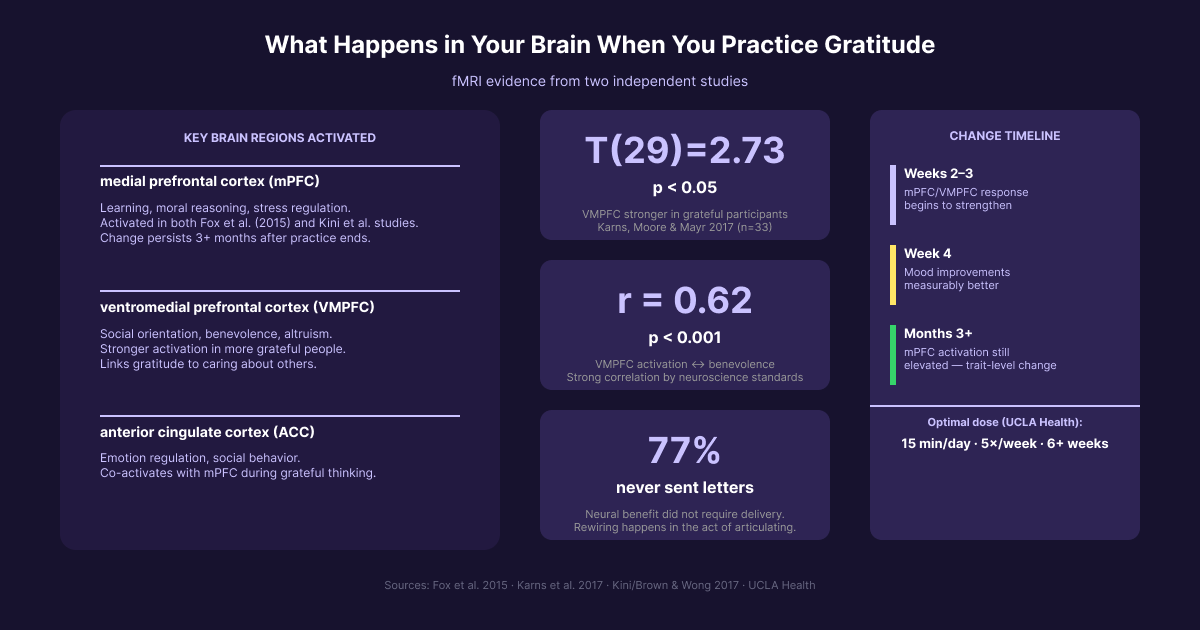
When researchers at the University of Oregon put participants inside an fMRI scanner and asked them to feel gratitude while donating to charity, one brain region stood out: the ventromedial prefrontal cortex (VMPFC). Karns, Moore & Mayr (2017) found significantly stronger VMPFC response in more grateful participants (T(29)=2.73, p<0.05). More strikingly, their sense of benevolence — how much they cared about others' wellbeing — correlated with VMPFC activation at r=0.62 (p<0.001). That is a strong correlation by neuroscience standards; it means the brain's response to gratitude and its orientation toward other people move together almost in lockstep.
An earlier study by Fox et al. (2015) scanned 23 adults and found the same mPFC region active during grateful thinking, alongside the anterior cingulate cortex (ACC), which regulates emotion and social behavior. Both studies point to the same conclusion: gratitude has a specific neural address.
Why This Change Matters
The mPFC is not simply a "feel-good" region. It is involved in learning, moral reasoning, and updating beliefs based on new information. When gratitude repeatedly activates this region, it may strengthen the neural pathways that allow people to recognize positive aspects of their situation more readily — a kind of perceptual training that happens to run through the brain's executive center.
A landmark study by Kini et al. (reported in Brown & Wong 2017) tested this directly. Around 300 adults receiving mental health counseling wrote gratitude letters for three weeks. Those who wrote showed better mental health outcomes at four weeks and twelve weeks — but critically, the mPFC activation at the three-month fMRI scan was stronger in letter-writers than in controls, long after the writing exercise ended. The brain had stored the change.
One detail deserves attention: 77% of participants never sent their letters. The neural benefit did not depend on delivery. Gratitude appears to reshape the brain through the act of articulating it — not through the response it receives.
This matters for anyone who thinks gratitude requires a recipient, a celebration, or the right circumstances. It doesn't. The rewiring happens in the writing, in the naming, in the noticing.
If you're exploring what gives your life meaning beyond daily habits, understanding how the brain processes positive experience is a useful starting point.
Three Pathways From Brain to Body: How Gratitude Protects Your Health
The neural evidence is compelling, but what makes gratitude clinically relevant is its downstream effect on three distinct health pathways. Each is backed by independent bodies of evidence.
| Health Pathway | Key Measure | Effect / Finding | Study Type | Source |
|---|---|---|---|---|
| Mortality risk | All-cause mortality | 9% lower in high-gratitude group | Prospective cohort (n=49,275) | Chen et al. 2024, JAMA Psychiatry |
| Depression | PHQ-9 score | −1.86 points (p=0.0004) | Meta-analysis of 64 RCTs | Diniz et al. 2023 |
| Anxiety | GAD-7 score | −1.63 points (p<0.0001) | Meta-analysis of 64 RCTs | Diniz et al. 2023 |
| Life satisfaction | SWLS scale | +6.86% higher | Meta-analysis of 64 RCTs | Diniz et al. 2023 |
| Neural change | mPFC/VMPFC activation | Significant at T(29)=2.73, p<0.05 | fMRI RCT (n=33) | Karns et al. 2017 |
Pathway 1 — Mental Health Protection
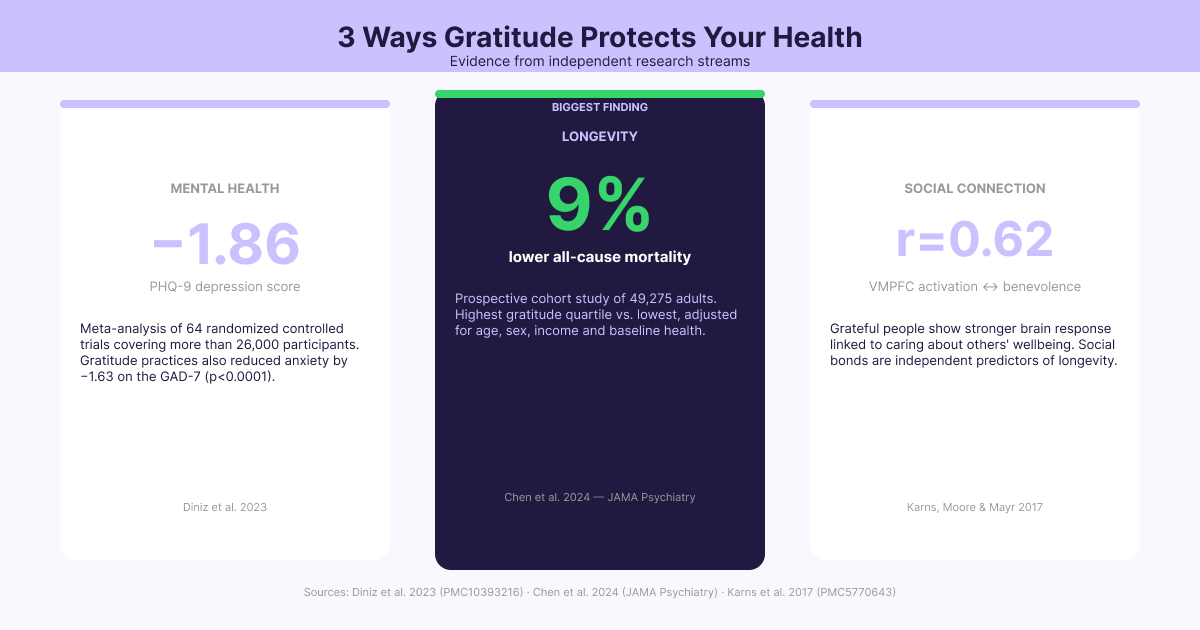
A 2023 meta-analysis by Diniz et al. synthesized 64 randomized controlled trials and found that gratitude interventions reduced depressive symptoms with a mean difference of −1.86 on the PHQ-9 (p=0.0004) and reduced anxiety with a mean difference of −1.63 on the GAD-7 (p<0.0001). Life satisfaction scores were 6.86% higher in gratitude groups.
To put the depression number in context: a PHQ-9 drop of 1.86 points is roughly the difference between a "moderate" score of 14 and a "mild" score of 12. It won't eliminate clinical depression, but across more than 26,000 people in 70+ studies, the effect is consistent enough to make gratitude a meaningful adjunct to other mental health support.
For more on how thought patterns shape mental wellbeing, the relationship between cognitive style and mental health is a closely related thread.
Pathway 2 — Physical Health and Longevity
The Chen et al. (2024) study published in JAMA Psychiatry followed 49,275 adults and is, to date, the largest prospective study linking gratitude to mortality. Participants in the highest gratitude quartile had a 9% lower risk of death from any cause over the follow-up period, after adjusting for age, sex, income, and baseline health.
The proposed mechanism is consistent with the neural evidence: gratitude may dampen hypothalamic-pituitary-adrenal (HPA) axis reactivity — the stress response system — which over time reduces inflammation and lowers cardiovascular strain. The mPFC region that gratitude activates is also involved in regulating the HPA axis, which provides a plausible biological bridge between brain activation and longevity data.
Pathway 3 — Social Connection and Resilience
The r=0.62 correlation between VMPFC activation and benevolence in the Karns et al. study points to something that mortality statistics can't fully capture: gratitude changes how people orient toward others. People with active gratitude practices report stronger social bonds, more prosocial behavior, and greater sense of community support — which are themselves independent predictors of health and longevity.
This social pathway also helps explain why gratitude reduces burnout. When people feel more connected and supported, they maintain a larger psychological reserve against chronic stress.
Who Benefits Most — And When Results Show Up
Gratitude research includes people across a wide range of starting points, and the evidence suggests that the people who benefit most are not necessarily those who start with the strongest mental health. The Kini et al. counseling study found measurable effects in adults already experiencing significant distress. The Diniz meta-analysis specifically included clinical populations. If you're struggling, the bar to entry is intentionality — not wellbeing.
The timeline for effects breaks into three phases, based on the available evidence:
Weeks 2–3: Neural change. The fMRI studies suggest mPFC/VMPFC response strengthens within two to three weeks of consistent practice. This is the earliest measurable biological signal.
Week 4: Mood improvement. The Diniz meta-analysis and Kini et al. both show measurable mood improvements at the four-week mark — before the neural change reaches its peak.
Weeks 12+: Lasting effects. At the twelve-week follow-up in the Kini et al. study, benefits persisted. The mPFC activation at three months suggests the brain has begun to encode the gratitude orientation as a stable trait rather than a practice.
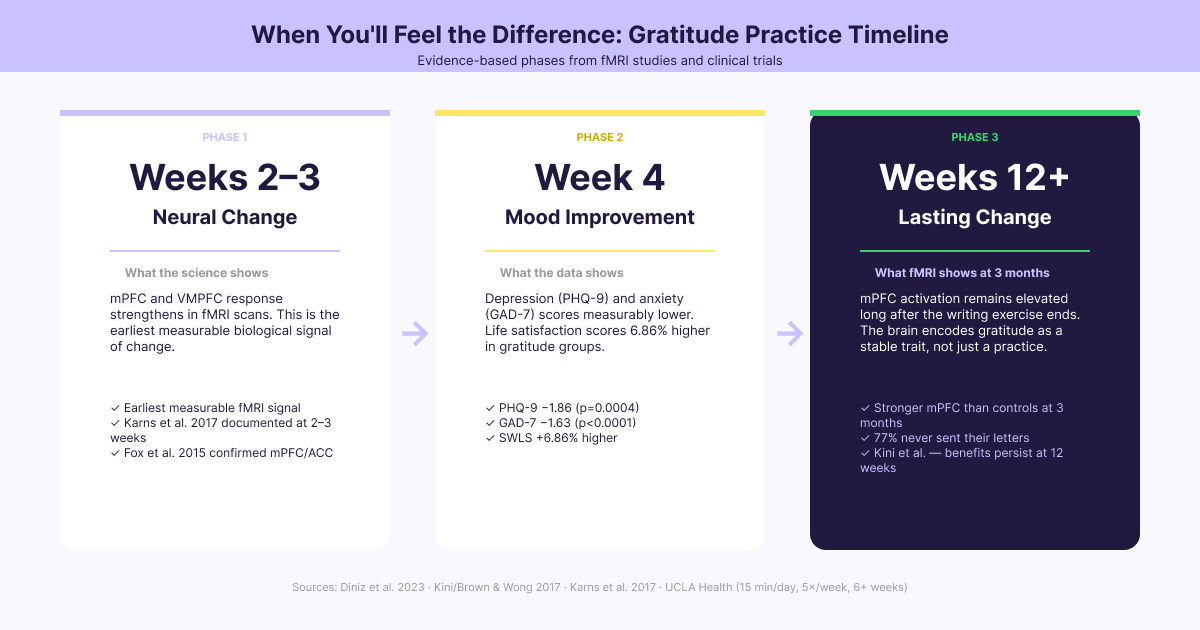
UCLA Health recommends a minimum threshold of 15 minutes per day, five days per week, for at least six weeks to produce clear and consistent benefits. This is the dose at which the clinical evidence is strongest.
Mental health apps often make similar promises — if you're weighing them against structured gratitude practice, the evidence on digital mental health tools is worth examining alongside this data.
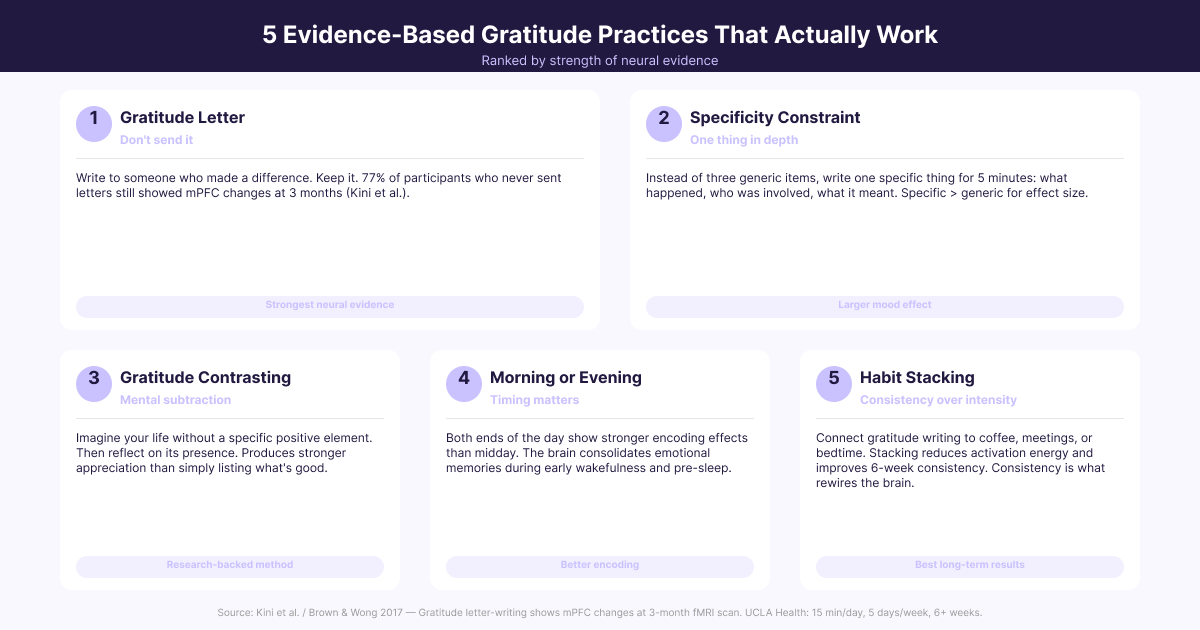
5 Evidence-Based Gratitude Practices That Actually Work
- Write a gratitude letter — and don't send it. Write a detailed letter to someone who made a meaningful difference in your life. Explain specifically what they did and how it changed you. Keep it. The Kini et al. study showed neural benefits even when 77% of participants never delivered their letters.
- Use a specificity constraint. Instead of listing "three good things," write one thing with as much specificity as you can in five minutes. What happened, who was involved, what it meant to you. Generic gratitude lists produce smaller effects than specific, elaborated ones.
- Practice gratitude contrasting. Imagine your life without a specific positive element — a relationship, a skill, a place. Then reflect on its presence. Research suggests this "mental subtraction" technique produces stronger appreciation than simply noting what's good.
- Time your practice to morning or evening. Both ends of the day show stronger encoding effects than midday practice, likely because the brain consolidates emotional memories during early wakefulness and pre-sleep.
- Stack with an existing habit. Connect gratitude writing to something you already do — coffee, the end of a meeting, before sleep. Habit stacking reduces the activation energy required and significantly improves consistency over six-week periods. Consistency, not intensity, is what the neural evidence rewards.
When to Talk to a Professional
Gratitude practices are well-tolerated and have a strong safety profile. They are not a substitute for professional mental health care, medication, or therapy when these are clinically indicated. If you are experiencing persistent low mood, significant anxiety, or symptoms that impair daily functioning, speak with a licensed mental health professional. The effects documented in this article represent population-level averages; individual response varies.
If you're currently in recovery from burnout or high-stress periods, a professional can help you determine how to integrate practices like gratitude into a broader recovery plan rather than adding to an already-full plate.
Frequently Asked Questions
How long does it take for gratitude practice to rewire the brain?
fMRI studies show measurable changes in the medial prefrontal cortex (mPFC) within two to three weeks of consistent practice. Mood improvements tend to appear by week four, and lasting neural changes are documented at three months. The key variable is consistency: daily practice for at least six weeks produces the clearest results, according to UCLA Health guidelines.
Does gratitude practice work for people who are depressed or anxious?
Yes. The 2023 Diniz meta-analysis of 64 randomized trials specifically included clinical and subclinical populations and found statistically significant reductions in both depression (PHQ-9 −1.86) and anxiety (GAD-7 −1.63). Gratitude practice is not a replacement for clinical treatment, but it has demonstrated additive benefits alongside standard care.
Do you have to feel grateful for gratitude practice to work?
No. The neural benefits appear to come from the practice of articulating and elaborating on positive experiences — not from an emotional state you need to achieve first. Starting with one specific, concrete thing — however small — is sufficient.
What is the most effective gratitude practice?
The strongest evidence exists for gratitude letter-writing, which produced mPFC changes visible on fMRI scans three months after the intervention ended. Daily specificity-focused journaling has comparable mood benefits in shorter-term studies. Consistency and specificity matter more than the format.
Is gratitude practice enough on its own for mental health?
For mild to moderate symptoms, gratitude practice contributes meaningfully based on current evidence. For moderate-to-severe depression or anxiety, it functions best as an adjunct — something that works alongside therapy and other evidence-based treatment, not instead of it.
Conclusion
Gratitude is one of the few psychological practices with both a confirmed neural mechanism and a mortality signal in a large prospective study. The mPFC activation documented by fMRI isn't incidental — it's the same region involved in learning, moral reasoning, and stress regulation, which explains why the effect reaches from brain to body. The 9% lower mortality risk, the consistent depression and anxiety reductions across 64 trials, and the evidence that the brain continues to change months after a practice ends all point in the same direction: this is a practice worth taking seriously.
You don't need the right circumstances, a willing recipient, or a moment of felt gratitude to begin. You need a few minutes and something specific to name. The neuroscience suggests the rest follows.
Ready to build a practice that actually sticks? Explore VitaWell's full approach to meaning and mental health at vitawell.tech.
Related on VitaWell
- The Arrival Fallacy: Why Achieving Your Goals Can Leave You Feeling Empty — If gratitude helps you notice what's already present, this article explains why future-oriented thinking so often disappoints — and what actually produces lasting fulfillment.
- Stop Waiting for Perfect: The Science-Backed Case for Embracing Imperfection — Gratitude and self-compassion share neural ground. This article covers the evidence for embracing where you are, rather than waiting for conditions to be right.
- Rituals for Letting Go and Moving On — Gratitude and release are complementary capacities. This piece explores the evidence-based rituals that help people move forward without minimizing what they've been through.
This article is for informational purposes only and does not constitute medical or mental health advice. If you are experiencing symptoms of depression, anxiety, or other mental health conditions, please consult a qualified healthcare professional.
Sources
- JAMA Psychiatry — Chen et al. (2024): Gratitude and all-cause mortality (n=49,275)
- Diniz et al. (2023) — Meta-analysis of gratitude interventions (64 RCTs, >26,000 participants)
- Karns, Moore & Mayr (2017) — fMRI study of gratitude and VMPFC activation (n=33)
- Brown & Wong / Kini et al. — How gratitude changes you and your brain (Greater Good, UC Berkeley)
- Fox et al. (2015) — What does a grateful brain look like? (Greater Good, UC Berkeley)