
4 Science-Backed Lifestyle Habits That Slow Brain Aging, Per the Largest U.S. Dementia Study
Four lifestyle habits slow brain aging when practiced as a structured program — the finding from the largest lifestyle-based dementia trial in the U.S.

Four lifestyle habits — physical activity, nutrition, cognitive engagement, and social stimulation — measurably slow brain aging and cognitive decline when practiced together as a structured program. The US POINTER trial, the largest lifestyle-based brain health study in the United States with 2,111 participants and a 2-year follow-up, found that adults following a coordinated multi-domain program improved executive function significantly more per year than a self-guided group doing the same habits (P=0.008). The benefit held even for people with APOE4 genetic risk and was greatest for those starting with lower baseline cognition — making earlier action more valuable, not less.
Key Takeaways
- The POINTER trial found structured multi-domain habit practice improved global cognition 0.029 SD/year more than self-guided lifestyle change, and executive function 0.037 SD/year more (P=0.008)
- 8 of 10 cardiometabolic measures (markers of heart and metabolic health, such as blood sugar, cholesterol, and blood pressure) — including HbA1c, LDL cholesterol, and diastolic blood pressure — improved significantly more in the structured group, per CTAD 2026 data not yet covered by most outlets
- People starting with lower cognitive baseline gained the most benefit (P=0.02 interaction), reinforcing the case for acting before decline progresses
- APOE4 carriers benefited equally to non-carriers (P=0.95) — genetic risk does not block lifestyle gains
- WHO 2026 guidelines state up to 45% of dementia risk is preventable through modifiable lifestyle factors per PAHO
What the US POINTER Trial Measured — and Why It Stands Apart
The US Study to Protect Brain Health Through Lifestyle Intervention to Reduce Risk (POINTER) is a 5-site Phase 3 randomized controlled trial, the largest of its kind in the United States and directly adapted from the successful Finnish FINGER trial. Its goal was to test whether a coordinated, multi-domain lifestyle intervention could protect cognitive function in older American adults at elevated risk.
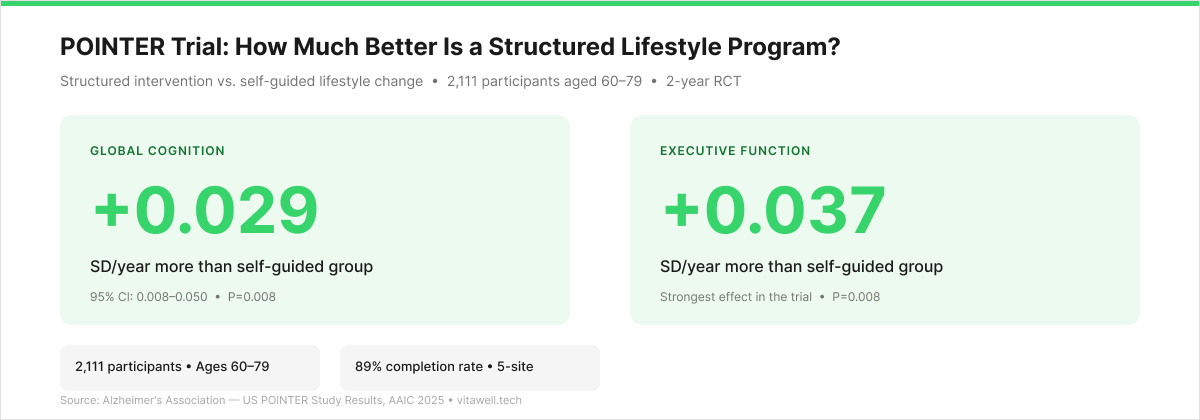
The trial enrolled 2,111 participants aged 60–79, with a mean age of 68.2 years. The group was deliberately diverse: 68.9% female, 30.8% from ethnoracial minority groups, 78% with a first-degree family history of memory loss, and 30% carrying the APOE4 gene variant — the strongest common genetic risk factor for Alzheimer's disease. Participants were randomized into two arms: a structured multi-domain intervention group (38 group peer-meetings over two years, plus clinician check-ins) and a self-guided group that received the same health information and recommendations without the structured support.
Remarkably, 89% of participants completed the 2-year assessment — an unusually high retention rate for a trial of this length and complexity. The primary outcome was a global cognitive composite covering memory, executive function, processing speed, and attention. Results announced at AAIC 2025 showed that the structured group improved 0.029 standard deviations (SD) per year more than the self-guided group in global cognition (95% CI 0.008–0.050, P=0.008) — in cognitive trials, one SD represents the full spread of scores across all participants, so 0.03 SD/year is a clinically meaningful signal of group-level benefit — with executive function improving 0.037 SD/year more.
According to the WHO 2026 dementia prevention guidelines, 57+ million people worldwide are currently living with dementia, and up to 45% of that risk is attributable to modifiable lifestyle factors. POINTER is the most rigorous direct test of whether acting on those factors actually works.
The 4 Habits That Slow Brain Aging: What the Structured Program Actually Looked Like
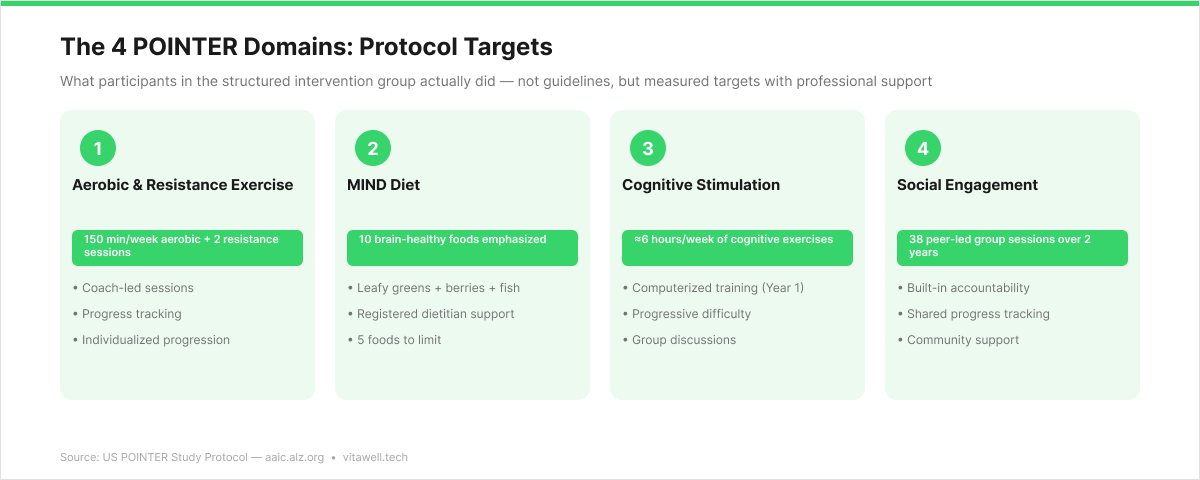
POINTER's intervention was not a vague recommendation to 'live healthier.' Each domain had specific targets and professional support.
1. Aerobic and Resistance Exercise
Participants aimed for a minimum of 150 minutes per week of moderate-intensity aerobic activity, plus two resistance training sessions per week. Sessions were coach-led and included progression tracking — the difference between being told to exercise and actually being held accountable to doing it.
2. MIND Diet
The MIND diet (Mediterranean-DASH Intervention for Neurodegeneration Delay) organizes foods into 10 brain-healthy groups to emphasize — leafy greens, berries, nuts, olive oil, fish, whole grains, beans, poultry — and 5 to limit: red meat, butter and margarine, cheese, pastries and sweets, and fried or fast food. Participants worked with registered dietitians for personalized meal planning. Research on plant-based diet and Alzheimer's risk shows that even partial adherence is associated with slower cognitive aging in observational studies.
3. Cognitive Stimulation
The cognitive training component included approximately 6 hours per week of computerized cognitive exercises in year one, with progressive difficulty calibrated to individual performance. Group discussions and mentally challenging activities provided an additional cognitive layer beyond the digital training.
4. Social Engagement
The structure of the intervention was itself a social intervention: 38 peer-led group sessions over two years built regular social contact into the protocol. Participants shared progress, faced shared challenges, and held each other accountable — an underappreciated component that most DIY health plans lack entirely.
The Cardiometabolic Connection: How Lifestyle Rewires the Brain's Environment
The cognitive results from AAIC 2025 were widely reported, but a second wave of data presented at CTAD (Clinical Trials on Alzheimer's Disease) in November 2026 adds critical mechanistic detail that most sources have not yet covered.
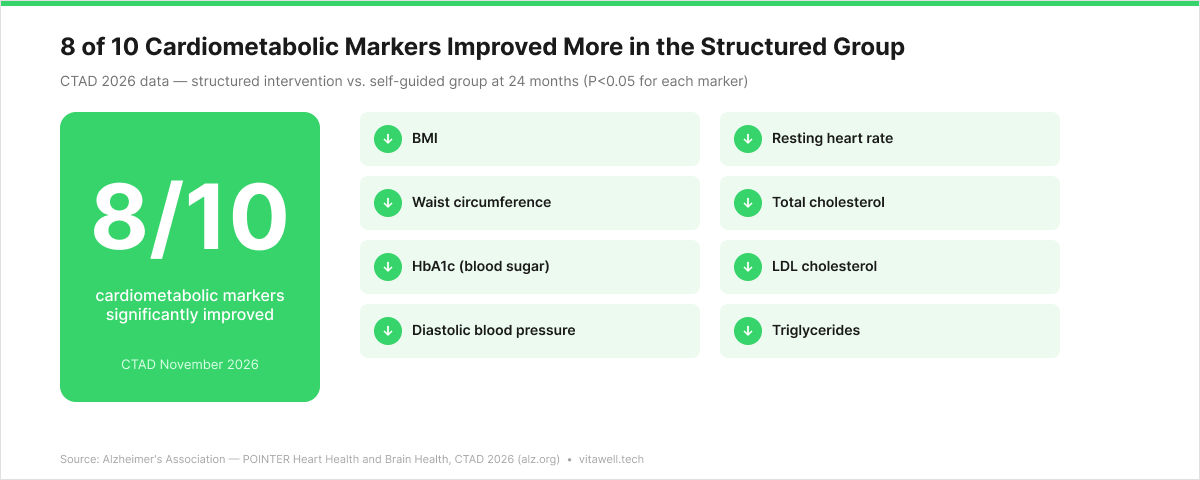
At 24 months, the structured intervention group improved significantly more than the self-guided group on 8 of 10 cardiometabolic measures. These included BMI, waist circumference, HbA1c (a marker of blood sugar control), diastolic blood pressure, resting heart rate, total cholesterol, LDL cholesterol, and triglycerides.
This matters because the vascular and metabolic pathway is responsible for approximately 40% of dementia risk. Here is how each improvement translates to the brain: better HbA1c reduces cerebral insulin resistance, a mechanism increasingly implicated in Alzheimer's pathology; lower LDL cholesterol slows atherosclerotic plaque buildup in the cerebral arteries; reduced diastolic blood pressure cuts the risk of white matter lesions and improves cerebral perfusion; and a lower resting heart rate is a reliable marker of improved cardiovascular fitness, which supports steady-state blood flow to brain tissue. The two exercise types shown to lower blood pressure most effectively, according to a 31-trial meta-analysis, are exactly those emphasized in POINTER: aerobic and resistance training.
| Cardiometabolic Marker | What Improvement Signals | Why It Matters for Brain Health |
|---|---|---|
| BMI (body mass index) | Reduced significantly more in structured group | Lower adiposity reduces neuroinflammation and metabolic burden on the brain |
| Waist circumference | Reduced significantly more | Visceral fat drives systemic inflammation that damages brain tissue over time |
| HbA1c (blood sugar control) | Improved significantly more | Better glucose regulation reduces cerebral insulin resistance, an Alzheimer's driver |
| Diastolic blood pressure | Reduced significantly more | Lower BP reduces white matter lesions and improves cerebral perfusion |
| Resting heart rate | Reduced significantly more | Lower RHR signals improved cardiovascular fitness and better steady-state brain blood flow |
| Total cholesterol | Reduced significantly more | Less circulating cholesterol reduces atherosclerotic risk in cerebral arteries |
| LDL cholesterol | Reduced significantly more | Lower LDL slows plaque buildup in the brain's vascular network |
| Triglycerides | Reduced significantly more | Elevated triglycerides accelerate cognitive decline via vascular and inflammatory mechanisms |
Source: Alzheimer's Association CTAD 2026
Who Benefits Most: POINTER's Personalization Data
One of the most practically important findings from the trial is about who gains the most. People with lower baseline cognitive performance got significantly greater benefit from the structured intervention than those with higher baseline scores (P=0.02 for the interaction term). In plain terms: if your cognition is already starting to show wear, acting now produces more return than waiting.
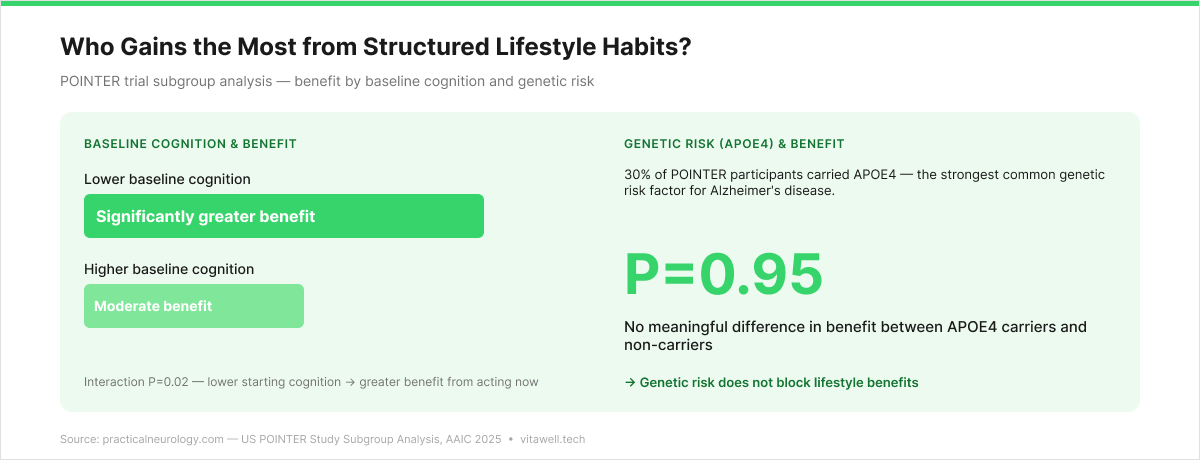
For people worried about genetic risk, the data is reassuring. The POINTER trial included 30% APOE4 carriers — a genuinely high-risk group — and found no meaningful difference in benefit compared to non-carriers (P=0.95 for interaction). Carrying the APOE4 variant increases your lifetime risk for Alzheimer's but does not blunt the protective effect of a structured lifestyle program.
That 78% of participants had a first-degree family history of memory loss makes this finding especially relevant. This was not a low-risk academic sample — it was people facing real elevated risk, and the lifestyle approach still moved the needle. The more information you have about your personal risk, the more you should explore what each dementia risk factor contributes and what you can do about it.
A 4-Week Starter Protocol: How to Build Structure Into Your Habits
POINTER's control group received the same health information as the intervention group and was encouraged to do the same 4 habits. The difference in outcomes came from structure: measurable targets, group accountability, clinician check-ins, and regular progress review. If you do not have access to a clinical trial, you can build an equivalent structure yourself.
Week 1 — Establish and audit
- Exercise: Three 30-minute brisk walks + one bodyweight strength session; write down your minutes
- Nutrition: MIND diet pantry audit; add leafy greens daily and berries three times this week
- Cognition: 20 minutes of a cognitively demanding activity (new language, chess, strategy game) four times this week
- Social: Schedule one social commitment (walking with a friend counts)
- Accountability: Choose your accountability partner; share your Week 2 targets with them tonight
Week 2 — Build
- Exercise: Four 30-minute aerobic sessions + two resistance sessions; aim for 120 minutes total aerobic
- Nutrition: Add one MIND-diet fish meal; reduce processed foods to two or fewer occasions this week
- Cognition: 30 minutes × four days; switch to a different cognitively demanding activity
- Social: Add a group class or activity — a fitness class, book club, or volunteer session
Week 3 — Full protocol
- Exercise: Reach the 150-minute weekly aerobic threshold + two resistance sessions; track on a simple log
- Nutrition: Five of seven days fully MIND-compliant; alcohol no more than one drink per day if consumed
- Cognition: 45 minutes × four days; include at least one socially cognitive activity (discussion group, class)
- Social: First weekly habit review call with your accountability partner
Week 4 — Sustain and set direction
- Maintain all four domain targets from Week 3
- Set three-month targets for each domain with specific, measurable milestones
- Identify one upgrade per domain (a new exercise mode, a new MIND-diet recipe, a harder cognitive challenge)
- Schedule a monthly check-in with your accountability partner
Locking this into your daily routine is the multiplier. Research on how consistent timing and habit stacking affect longevity shows that anchoring new habits to existing ones dramatically improves adherence over months.
When to Talk to a Professional
Lifestyle habits are powerful tools for brain health maintenance and risk reduction, but they are not substitutes for medical evaluation when cognitive decline has already progressed.
Talk to a doctor if you notice memory lapses that affect daily function (missed appointments, repeated questions, getting lost on familiar routes), if a family member has raised concerns about your cognition, or if you want a baseline cognitive assessment before starting a structured lifestyle program. Standard screening tools like the MoCA (Montreal Cognitive Assessment) or MMSE (Mini-Mental State Examination) can establish a baseline against which future changes can be measured. If you have a strong family history of early-onset dementia or test positive for APOE4, a referral to a neurologist for a fuller assessment is worthwhile.
A lifestyle program is most powerful as prevention or early intervention — the POINTER data makes clear that the lower your baseline, the more benefit you gain from starting now, but there is a point where medical management becomes the priority.
FAQ
What are the best lifestyle habits to prevent brain aging?
The strongest evidence points to four: regular aerobic and resistance exercise, a brain-healthy diet (especially the MIND diet), cognitive stimulation through mentally demanding activities, and social engagement. The US POINTER trial found these habits are most effective when practiced together as a structured program rather than sporadically.
How long does it take for lifestyle changes to improve brain health?
The POINTER trial measured statistically significant cognitive and cardiometabolic improvements over 24 months. Some cardiometabolic markers (blood sugar, blood pressure) can improve within weeks to months of consistent practice. Cognitive changes are slower to measure, but structural brain benefits — better cerebral blood flow, reduced inflammation — begin with consistent habit practice over months.
Does APOE4 genetic risk mean lifestyle changes won't help me?
No. The POINTER trial included 30% APOE4 carriers and found no meaningful difference in benefit compared to non-carriers (P=0.95 for interaction). Carrying the APOE4 variant increases your lifetime dementia risk but does not block the protective effect of a structured lifestyle program.
What is the MIND diet and how does it support brain health?
The MIND diet combines the Mediterranean and DASH diets, emphasizing 10 brain-healthy food groups (leafy greens, berries, nuts, olive oil, fish, whole grains, beans, poultry) and limiting 5 (red meat, butter, cheese, pastries, fried food). Observational studies consistently link higher MIND diet adherence to slower rates of cognitive aging.
Can I do the POINTER protocol on my own without joining a clinical trial?
Yes — the four domains (150 min/week exercise, MIND diet, cognitive training, social engagement) are all self-implementable. What the trial showed is that structure matters: measurable targets, accountability partners, and consistent tracking produced better results than self-guided habits. The 4-week starter plan above translates the trial's approach into a DIY framework.
Conclusion
POINTER's most important message is not just that these four habits work — it is that the way you practice them determines how well they work. The structured group and the self-guided group had access to the same information and the same habits. The difference was accountability, measurement, community, and consistent repetition across two years.
The cardiometabolic findings from CTAD 2026 explain the mechanism: lifestyle change that improves blood sugar, blood pressure, cholesterol, and body composition creates a brain environment where neurons are better supplied with oxygen and glucose, less inflamed, and less exposed to vascular damage. That environment either speeds aging or slows it. These four habits slow it.
Earlier is better, genetic risk is not a barrier, and the structure you build around these habits matters as much as the habits themselves. Explore VitaWell's Health and Rest areas for more evidence-based tools to build the kind of consistent, structured lifestyle that keeps your brain sharper across decades.
Related on VitaWell
- Walking: The Simplest Habit That Improves Your Life — Walking is the most accessible entry point for the physical exercise component in the POINTER protocol; start here if you're building an activity habit.
- Burnout Recovery and the Nervous System — Chronic stress undermines the same cardiometabolic pathways POINTER's lifestyle program restores; this post shows how to protect your nervous system.
- The Science of Why Midlife Might Be the Best Time of Your Life — Midlife is the key window for brain-protective lifestyle change; this post explains why timing matters most.
This article is for informational purposes only and does not constitute medical advice. If you have concerns about cognitive health, speak with a qualified healthcare professional.
Sources
- Practical Neurology — US POINTER Study Results: Structured Lifestyle Intervention Improved Cognition
- Alzheimer's Association — POINTER Heart Health and Brain Health (CTAD 2026)
- Alzheimer's Association — US POINTER Study Results Announced (AAIC 2025)
- PAHO/WHO — New WHO Guidelines: 45% of Dementia Risk Could Be Prevented or Delayed (2026)
- Medical News Today — Combining Physical, Mental and Social Habits Slows Brain Aging: 2-Year Trial