
Creatine and Healthy Aging: What Science Now Tells Us About Muscles, Brain Health, and Longevity After 50
Creatine does more than build muscle. Research now links it to slower biological aging, brain resilience, and lower mortality risk in adults over 50.

Creatine supplementation has the strongest evidence for maintaining muscle mass and strength during resistance training in adults over 50, with emerging research linking it to slower biological aging, modest brain health benefits, and lower long-term mortality. The benefits are not uniform—postmenopausal women, vegetarians, and adults under 65 appear to see the largest gains. Here is what the current research actually shows.
Key Takeaways
- Creatine combined with resistance training preserves lean mass and leg strength in older adults; the clearest benefit is in postmenopausal women taking ≥5g/day.
- Brain benefits are modest and inconsistent—16 RCTs show small improvements in memory and reaction time, but no significant effect in the 60+ subgroup alone.
- Higher dietary creatine correlates with lower DNA methylation aging scores, suggesting a link to slower biological aging.
- A 20-year follow-up study of 4,000+ US adults found ≥1g/day linked to lower all-cause mortality.
- Women, vegetarians and vegans, and adults under 65 are most likely to see meaningful gains from supplementation.
Why Aging Changes Your Body's Relationship with Creatine
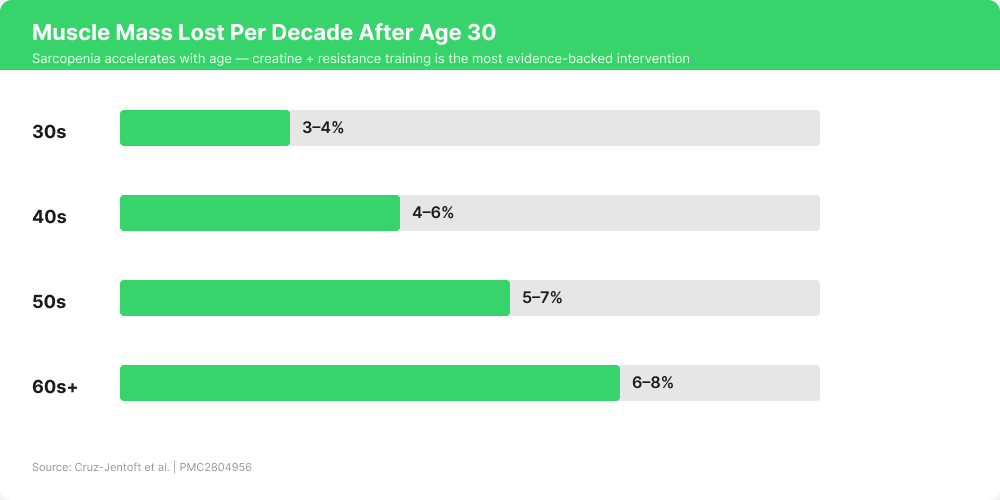
Creatine is not just a performance supplement—it is a compound your body synthesizes naturally from the amino acids arginine and glycine, stored primarily in skeletal muscle and used to rapidly regenerate energy during high-intensity activity. After age 30, adults lose roughly 3–8% of muscle mass per decade, a process called sarcopenia (the progressive loss of skeletal muscle mass and strength) that accelerates after 60 and is one of the main drivers of reduced mobility, falls, and loss of independence in older adults.
At the same time, the body's capacity to synthesize and store creatine shifts. Women produce less endogenous creatine than men and store less in muscle tissue; estrogen appears to play a role in creatine metabolism, meaning postmenopausal women—once estrogen levels fall sharply—face a double disadvantage in creatine availability. Research on creatine and women's health across the lifespan confirms this hormonal connection. Vegetarians and vegans, who consume no dietary creatine from meat or fish, start with lower baseline creatine stores and are likely to see larger relative gains from supplementation. Studies on creatine supplementation in vegetarians support this finding.
Understanding these age-related shifts explains why creatine research in older adults has accelerated over the past decade—and why the results look different from the athletic performance literature. If you are already exploring balance and strength exercises for older adults, creatine supplementation is worth considering alongside them.
Creatine and Aging Muscles: What 7 Trials Found in Postmenopausal Women
A 2026 systematic review and meta-analysis examined seven randomized controlled trials enrolling 608 postmenopausal women with an average age of 62, all combining creatine supplementation with resistance training. Smith-Ryan et al., 2026 — Creatine Supplementation in Postmenopausal Women: A Systematic Review and Meta-Analysis found specific results: creatine added an average of 0.37 kg of lean body mass and improved leg press performance by 7.5 kg compared to placebo—but only when participants were taking at least 5g per day and completing resistance training consistently.
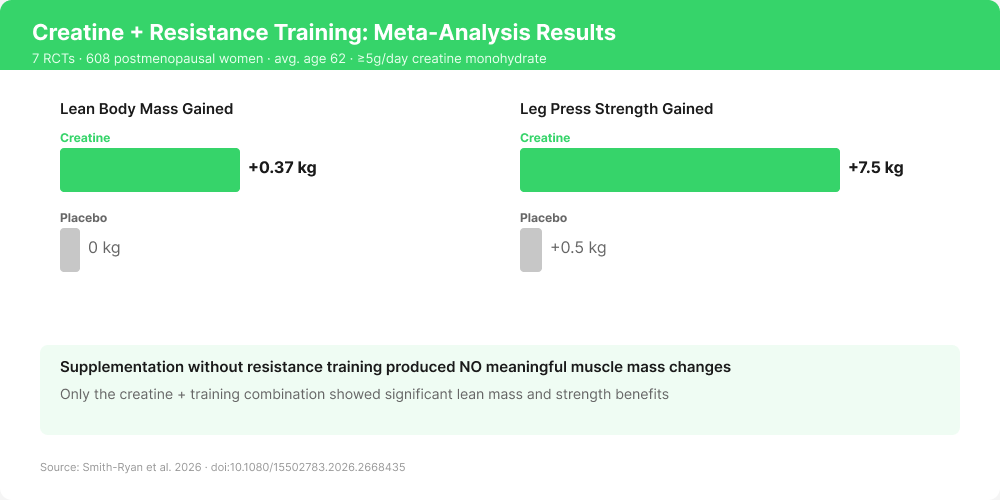
That last condition matters. Creatine supplementation alone, without resistance exercise, did not produce meaningful muscle mass changes in this population. The mechanism is straightforward: creatine increases the availability of phosphocreatine in muscle cells, which allows harder training sessions and faster recovery, which in turn drives greater muscle adaptation. The supplement amplifies the signal; the training provides it.
This is the most robust evidence in the aging creatine literature. The 7-trial, 608-participant dataset gives it a level of confidence unusual for nutritional supplement research, and the sex-specific focus is rare—most earlier meta-analyses grouped men and women together, obscuring the fact that postmenopausal women may have the most to gain.
How Creatine Supports the Aging Brain (And Where Evidence Falls Short)
The brain contains roughly 5% of the body's total creatine, used to buffer energy in high-demand situations such as sustained thinking, stress, and sleep deprivation. This has led to substantial interest in whether creatine supplementation could slow cognitive aging.
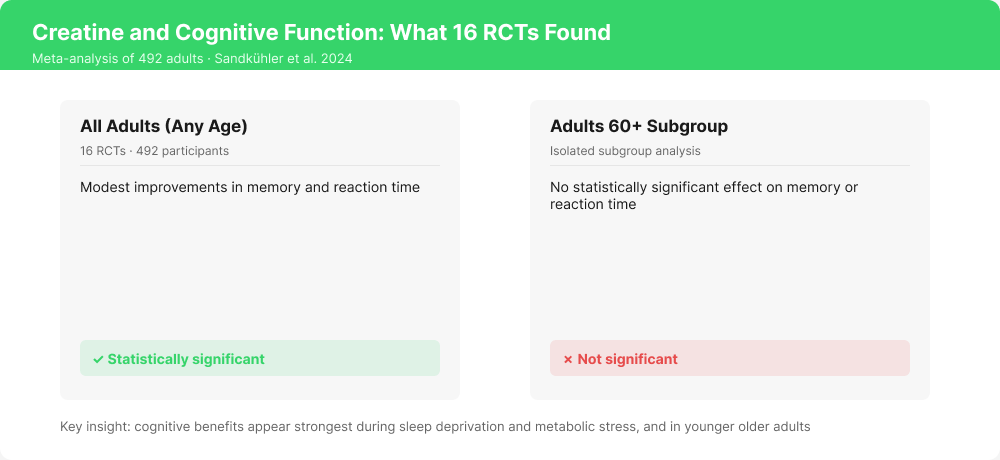
A 2024 meta-analysis of 16 randomized controlled trials involving 492 adults found modest improvements in memory and reaction time among creatine-supplemented groups overall. Sandkühler et al., 2024 — Creatine Supplementation and Cognitive Function: A Systematic Review and Meta-Analysis found that when researchers isolated the subgroup of adults aged 60 and older, the effect was no longer statistically significant—suggesting that any cognitive benefit may occur earlier in the aging process, or that the samples were too small to detect effects in older cohorts.
A more intriguing finding came from a 2024 study examining 15 adults after 21 hours of sleep deprivation. Participants who received creatine at 0.35g/kg body weight maintained their memory and processing speed, while the placebo group declined. McMorris et al., 2024 — Creatine Supplementation and Cognitive Resilience During Sleep Deprivation suggests creatine acts as a cognitive buffer during metabolic stress, which has real-world relevance for older adults whose sleep quality often deteriorates with age.
The most preliminary—but most discussed—finding involves Alzheimer's disease. A 2025 pilot study at the University of Kansas enrolled 20 patients with mild Alzheimer's and gave them 20g of creatine per day for 8 weeks. Brain creatine levels rose by 11% on MRI imaging, and some cognitive measures improved. University of Kansas / Alzheimer's Pilot, 2025 — Creatine Supplementation and Brain Creatine in Early Alzheimer's Disease had no placebo arm, making it impossible to draw causal conclusions, but it has prompted calls for a full RCT. For now, it is hypothesis-generating, not practice-changing.
Taken together, the evidence suggests creatine has real but modest and conditional effects on cognitive function—most likely in younger older adults, in conditions of sleep deprivation or metabolic stress, and possibly in early dementia as an adjunct (not a treatment). Understanding which modifiable factors for dementia prevention have the strongest support remains essential context for any discussion of creatine and brain health.
Creatine, Biological Aging, and Longevity: What Long-Term Data Shows
Two strands of research connect creatine to aging at the cellular level.
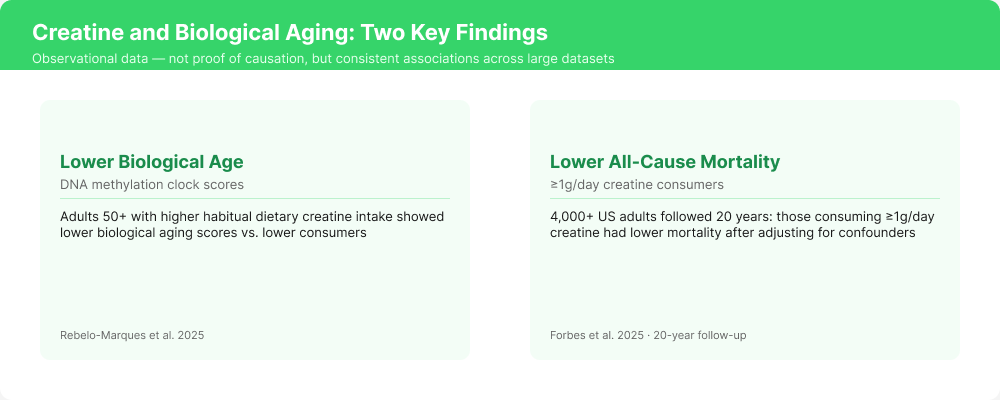
The first is a 2025 study measuring DNA methylation patterns—chemical tags on DNA that act as biological aging clocks by reflecting decades of cumulative cellular wear—in adults over 50. Rebelo-Marques et al., 2025 — Dietary Creatine and Epigenetic Aging in Adults Over 50 found that participants with higher habitual dietary creatine intake showed lower biological aging scores compared to those who consumed less, independent of other diet and lifestyle factors. This does not prove causation; people who eat more meat (the primary dietary creatine source) may differ from vegetarians in many ways. But it adds to a picture in which creatine is not just a muscle fuel but a compound implicated in broader cellular maintenance.
The second strand is a 2025 longitudinal study that followed over 4,000 US adults for approximately 20 years. Forbes et al., 2025 — Creatine Intake and Mortality: Longitudinal Analysis of 4,000+ US Adults found that those who consumed at least 1g of creatine per day—from dietary sources and supplements combined—had lower all-cause mortality compared to lower consumers, after adjusting for confounders. This is an observational cohort, not an RCT, so it cannot prove that creatine itself was causal. But the association held across age groups and both sexes, and 20 years of follow-up gives it unusual statistical power.
Together these findings shift creatine from a narrow muscle supplement to a compound with plausible longevity relevance—while remaining honest about the limits of observational data. For more on daily habits that slow biological aging, the research on circadian rhythms and longevity offers complementary insights.
Who Benefits Most: A Decision Framework by Age, Sex, and Diet
Not everyone stands to gain equally from creatine supplementation after 50. The table below summarizes what the evidence currently supports for different population groups.
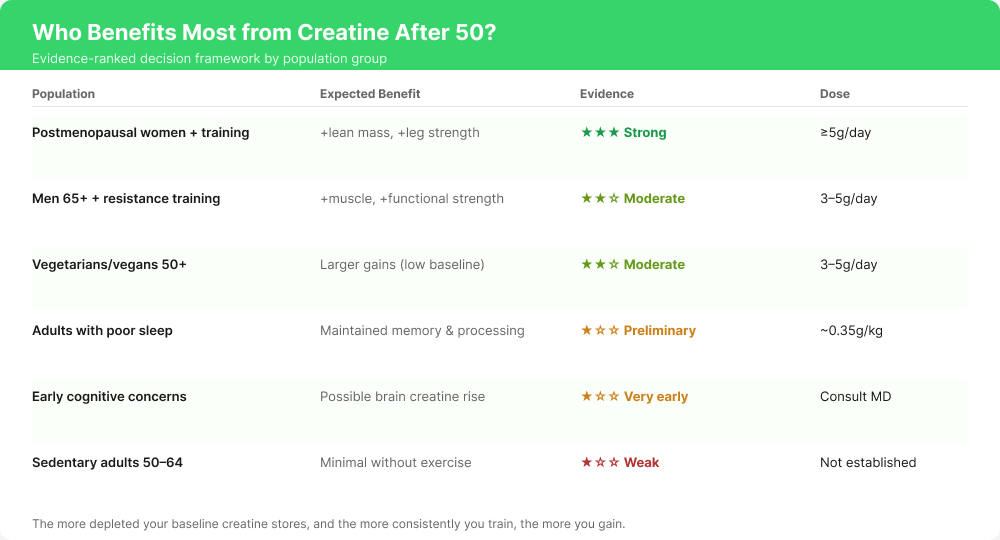
| Population | Expected Benefit | Evidence Strength | Minimum Effective Dose | Key Study |
|---|---|---|---|---|
| Postmenopausal women + resistance training | +lean mass, +leg strength | Strong (7 RCTs, 608 women) | ≥5g/day | 2026 meta-analysis |
| Men 65+ + resistance training | +muscle mass, +functional strength | Moderate (multiple RCTs) | 3–5g/day | PMC3963244 review |
| Vegetarians/vegans 50+ | Larger gains due to low baseline stores | Moderate (diet study inference) | 3–5g/day | PMC5469049 |
| Adults with frequent sleep deprivation | Maintained memory and processing | Preliminary (n=15) | ~0.35g/kg | 2024 sleep study |
| Adults with early cognitive concerns | Possible brain creatine increase | Very preliminary (n=20, no placebo) | 20g/day ×8wk (exploratory only) | 2025 Kansas pilot |
| Healthy adults 50–64 (sedentary) | Modest benefit without exercise | Weak | Not established without training | 2026 meta-analysis |
How to Use Creatine After 50: Practical Protocol
If the evidence supports your situation, here is a practical starting framework based on current research:
- Choose creatine monohydrate. It is the most studied form, the least expensive, and the only form with the evidence base described in this article. Creatine HCl, creatine ethyl ester, and other variants lack equivalent research.
- Start with 3–5g per day. A loading phase (20g/day for 5–7 days) can saturate muscle stores faster but causes more GI discomfort and is not necessary for long-term outcomes. Gradual loading at 3–5g/day reaches the same saturation within 3–4 weeks.
- Take 5g/day if you are a postmenopausal woman. The 2026 meta-analysis found effects only at ≥5g/day in this group.
- Time it around training. Post-workout appears marginally better than pre-workout in some studies, but the difference is small. Consistency matters more than timing.
- Combine with resistance training. Supplementation without exercise produces minimal muscle benefit in older adults. Aim for two to three sessions per week targeting major muscle groups.
- Give it at least 8 weeks. Most trial protocols run 8–24 weeks; shorter periods are unlikely to show meaningful changes in muscle composition.
- Drink adequate water. Creatine draws water into muscle cells. Increase fluid intake modestly (an extra glass or two per day).
- Monitor for GI symptoms. Loose stools or stomach cramping typically resolve at lower doses or with meal-timing adjustments.
When to Talk to a Professional
Creatine is well-tolerated in healthy adults at standard doses (3–5g/day), but some situations warrant medical guidance before starting:
- Kidney disease or reduced kidney function: Creatine is filtered by the kidneys. While evidence does not show creatine damages healthy kidneys, those with pre-existing kidney conditions should consult their physician.
- Medication interactions: Nephrotoxic medications (such as NSAIDs used regularly) or medications that affect creatinine clearance may interact.
- Existing cognitive symptoms: If memory changes or other cognitive symptoms are present, creatine is not a substitute for evaluation and evidence-based treatment. Use it only as an adjunct to medical care, not as self-treatment.
- Diabetes: Some studies show creatine influences glucose metabolism. Those managing blood sugar should discuss supplementation with their healthcare provider.
Frequently Asked Questions
At what age should you start taking creatine?
There is no established minimum age for health-related use in adults. The strongest evidence for anti-aging benefits begins in studies of adults 50 and older—particularly postmenopausal women in their 60s. Younger adults do not appear to have the same depleted baseline creatine stores that make supplementation most valuable for older populations.
Is creatine safe for older women?
Yes, based on current evidence. The 2026 meta-analysis of 608 postmenopausal women found no significant adverse events at 5g/day over trial periods of 12–52 weeks. As with all supplements, those with kidney conditions or on certain medications should check with a physician first.
Can you take creatine without exercising?
You can, but the muscle-building benefits are minimal without resistance training. The 2026 meta-analysis found no lean mass benefit in sedentary groups. Potential benefits for brain health and longevity from dietary creatine do not require exercise as a co-factor, based on current research.
Does creatine help with memory and focus in seniors?
Modestly, and not reliably in those over 60. The 2024 meta-analysis of 16 RCTs found small improvements overall but no significant effect in adults 60+. The strongest cognitive signal appears during sleep deprivation or metabolic stress. Creatine should not be positioned as a memory supplement for older adults based on current evidence.
What type of creatine is best for older adults?
Creatine monohydrate. All research cited in this article used monohydrate, and it remains the only form with sufficient evidence in older populations. More expensive forms (HCl, buffered, ethyl ester) have no demonstrated advantage and in some cases have less evidence for comparable absorption.
Conclusion
Creatine has earned its place as one of the more evidence-backed supplements for healthy aging—not because it does everything claimed for it, but because the evidence for what it does do (preserve muscle mass in conjunction with resistance training, with the strongest effect in postmenopausal women) is unusually solid for a nutritional supplement. The emerging data on biological aging and longevity adds a layer of interest worth watching, even as those studies remain observational.
The practical takeaway for adults over 50 is straightforward: if you are postmenopausal, vegetarian, or already doing resistance training consistently, the evidence supports giving creatine monohydrate a 12-week trial at 3–5g per day. If you are sedentary, supplementation is unlikely to produce meaningful results without first establishing a training habit. At VitaWell, we believe informed choices start with understanding what the research actually says—and what it does not.
Those interested in decades of research on healthy aging in midlife will find creatine fits into a broader picture of modifiable factors.
Related on VitaWell
- Two Best Exercise Types to Lower Blood Pressure: A 31-Trial Meta-Analysis — Discover the specific exercise types with the strongest evidence for cardiovascular health in midlife and beyond.
- New WHO Guidelines Reveal How to Prevent Up to 45% of Dementia Cases — The most comprehensive evidence-based guide to dementia prevention, relevant to anyone interested in long-term brain health.
- The Science of Why Midlife Might Be the Best Time of Your Life — What 30 years of longitudinal research shows about wellbeing, identity, and opportunity in the second half of life.
This article provides general information based on published research and is not medical advice. Consult a qualified healthcare professional before starting any new supplement, especially if you have an existing health condition.
Sources
- Healthline — Sarcopenia Overview
- Smith-Ryan et al., 2026 — Creatine Supplementation in Postmenopausal Women: A Systematic Review and Meta-Analysis
- Sandkühler et al., 2024 — Creatine Supplementation and Cognitive Function: A Systematic Review and Meta-Analysis
- McMorris et al., 2024 — Creatine Supplementation, Sleep Deprivation, and Cognition
- University of Kansas / Alzheimer's Pilot, 2025 — Creatine Supplementation and Brain Creatine in Early Alzheimer's Disease
- Forbes et al., 2025 — Creatine Intake and Mortality: Longitudinal Analysis of 4,000+ US Adults
- Rebelo-Marques et al., 2025 — Dietary Creatine and Epigenetic Aging in Adults Over 50
- Smith-Ryan et al., 2021 — Creatine Supplementation in Women's Health: A Lifespan Perspective
- Antonio & Ciccone, 2013 — Creatine Supplementation in Vegetarians: A Review