
10-Minute Floor Exercise Improves Balance and Agility in Just 2 Weeks — What New Research Shows
A 2026 trial found a 10-minute lying-down routine improved balance and agility in two weeks. Here are the four moves, what the evidence does and doesn't show, and how to build on them.

A 10-minute floor exercise for balance, done lying on your back once a day for two weeks, was associated with less body sway, faster side-steps and better trunk flexibility in a 2026 study published in PLOS One. The routine pairs gentle core contractions with leg and toe control. It was tested only in healthy young adults, so it is a promising, low-risk starting point rather than a proven fall-prevention program.
Key Takeaways
- Four supine moves (abdominal press, small bridge, leg slide, toe "rock-paper-scissors") took about 10 minutes a day for two weeks.
- The study had 39 participants, all healthy adults, which makes the results encouraging but early.
- The fast change most likely comes from better nerve-to-muscle coordination, not from bigger muscles.
- For fall prevention, the strongest evidence still supports balance and functional exercise done standing, which cuts the rate of falls by about 24%.
- A 10-second one-leg stand is a simple way to check your balance before and after you start.
What the 2026 Study Actually Tested
The research team, led by Yoriko Atomi, PhD, of the University of Electro-Communications in Tokyo, ran two small trials. According to the university's press release on EurekAlert, the paper appeared in PLOS One on April 29, 2026.
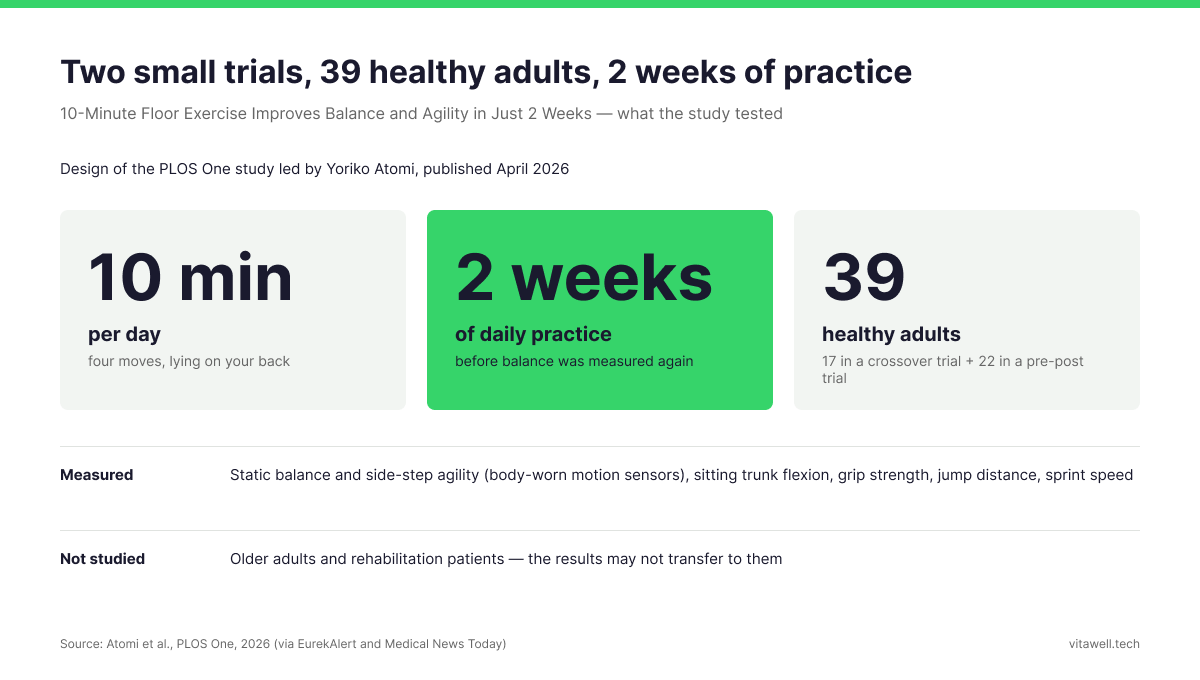
- Randomized crossover trial: 17 healthy young men completed both an exercise phase and a no-exercise control phase, so each person served as his own comparison.
- Pre-post trial: 22 healthy men and women were measured before and after two weeks of the routine.
Balance was measured with body-worn motion sensors during a static standing test and a side-step agility task. Flexibility was measured with sitting trunk flexion, and the team also recorded grip strength, jump distance and sprint speed, as Medical News Today reported. Public summaries describe the gains in balance, agility and flexibility as significant but do not give effect sizes.
Two details are often misreported. The toe exercise is a rock-paper-scissors game played with the toes, not a simple scrunch. And no older adults or rehabilitation patients took part, which Atomi herself flagged: "we should also be cautious about directly generalizing these findings."
The 10-Minute Floor Exercise for Balance, Step by Step
Lie on your back on a mat or firm carpet with your knees bent and feet flat. The protocol below follows the figure description in the study's press release. Move slowly and breathe normally throughout.
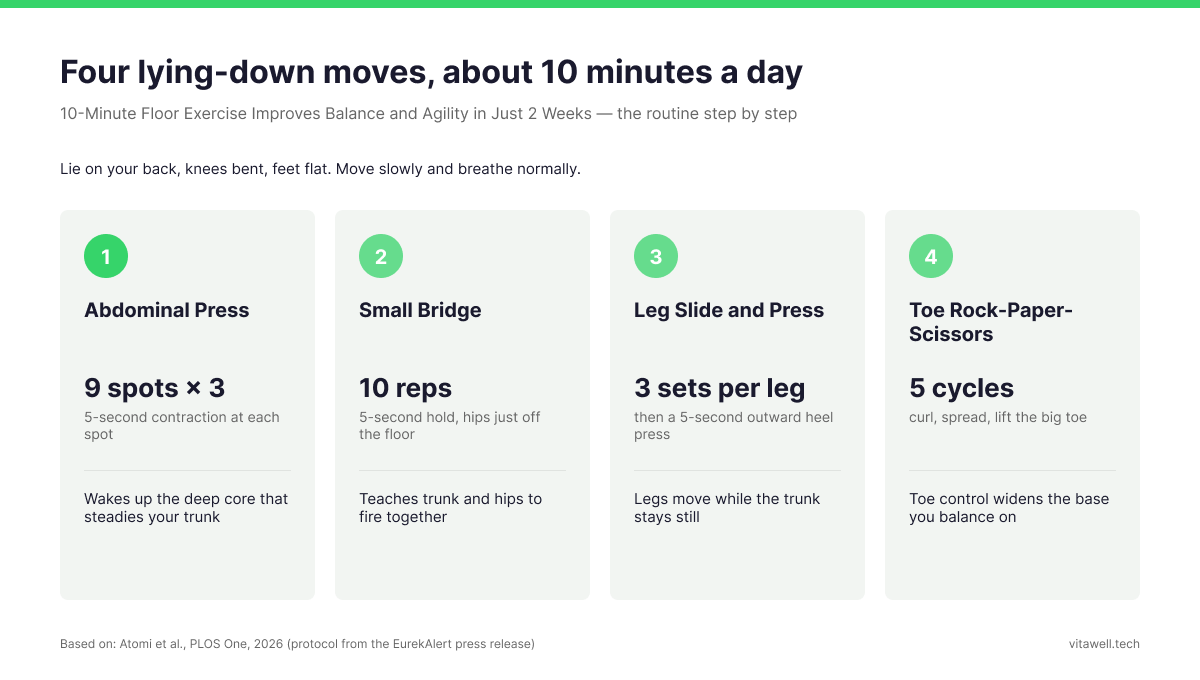
1. Abdominal Press
Rest your fingertips on your belly. Press gently into one spot and tighten your abdominal muscles against your fingers for 5 seconds. Work through nine spots around the abdomen, three times each. This wakes up the deep core muscles that keep your trunk steady when your limbs move.
2. Small Bridge
Keep the abdomen lightly braced and tilt your pelvis so your lower back flattens toward the floor. Then squeeze your buttocks and lift your hips just a little off the floor. Hold for 5 seconds and lower; repeat 10 times. The point is linkage, not height: trunk and hips learn to fire together.
3. Leg Slide and Press
Slide one heel along the floor until the leg is straight, keeping the same ankle angle, then slide it back. Alternate legs for three sets per side. At the end, push both heels outward against the floor and hold for 5 seconds. This trains your legs to move while your trunk stays still, the same demand you face when you step or catch yourself.
4. Toe Rock-Paper-Scissors
Make a "rock" by curling all toes, "paper" by spreading them wide, and "scissors" by lifting the big toe while pressing the others down, or the reverse; this is one common version, as the study does not specify each shape. Cycle through the three shapes five times. Toe control widens the effective base you balance on.
Why Balance Can Improve in Two Weeks
Muscles take weeks to grow, so a two-week change points elsewhere. The explanation the researchers favor is neuromuscular adaptation: your nervous system gets better at activating the right muscles, in the right order, with less wasted effort. This is a likely explanation, not one the study measured directly.
Lying down helps. Atomi notes that the supine position removes most of the work of holding yourself up against gravity, leaving a simpler setting in which to practise coordinating trunk and legs. The same idea of the brain adapting quickly to movement shows up in research on how short exercise sessions affect the brain.
The toes matter more than most people think. In a prospective study of 176 retirement-village residents with a mean age of 80.1, 41% fell within 12 months, and weaker toe plantarflexor strength was independently associated with falling (Menz and colleagues, Journal of Gerontology, 2006). Plantarflexors are the muscles that press the toes down into the ground.
Does This Routine Prevent Falls?
Not yet proven. Falls are a large problem: more than 14 million US adults aged 65 and older, about 1 in 4, report a fall each year, and the age-adjusted fall death rate rose 21%, from 64.7 to 78.4 per 100,000 between 2018 and 2024, according to the CDC's Older Adult Falls Data.
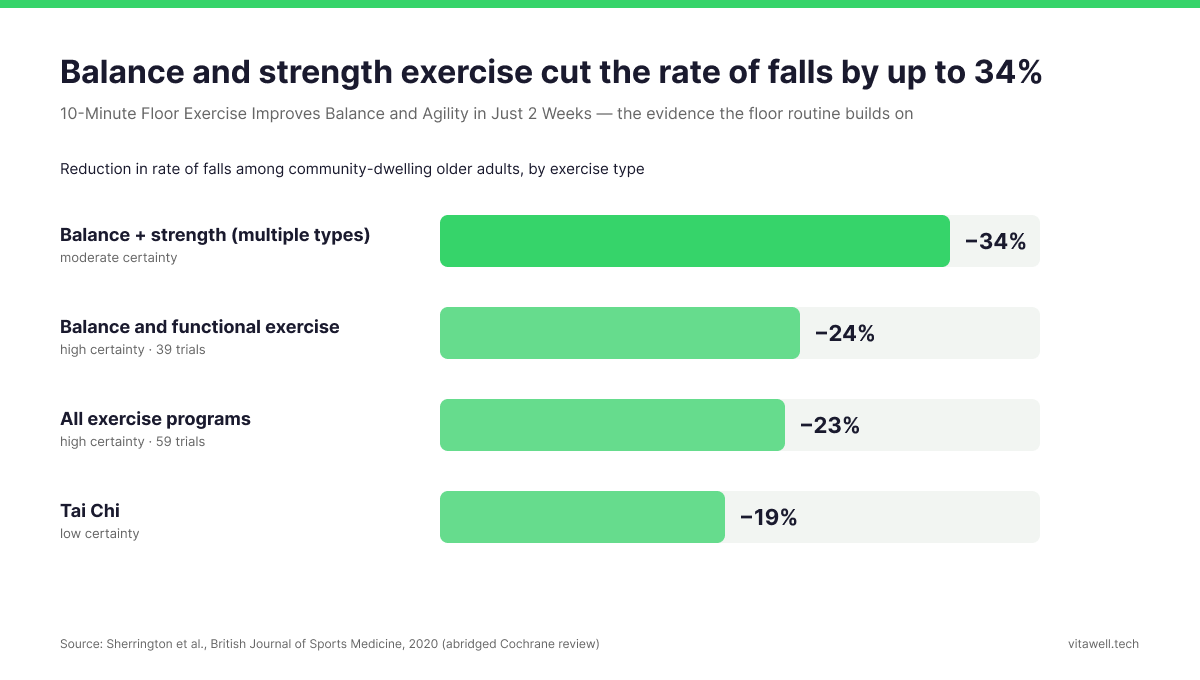
The best evidence on prevention comes from a review of exercise trials in community-dwelling older adults (Sherrington and colleagues, British Journal of Sports Medicine, 2020), an abridged Cochrane systematic review:
- All exercise programs cut the rate of falls by 23% (59 trials, 12,981 participants, high certainty).
- Balance and functional exercise cut it by 24% (39 trials, 7,920 participants, high certainty).
- Programs combining balance work with resistance training cut it by 34% (moderate certainty).
- Tai Chi cut it by 19% (low certainty).
Those programs were mostly done standing and ran for months. The supine routine has not been tested against falls, so treat it as a warm-up or an entry point for people who cannot yet train safely on their feet.
What the Evidence Does and Doesn't Show
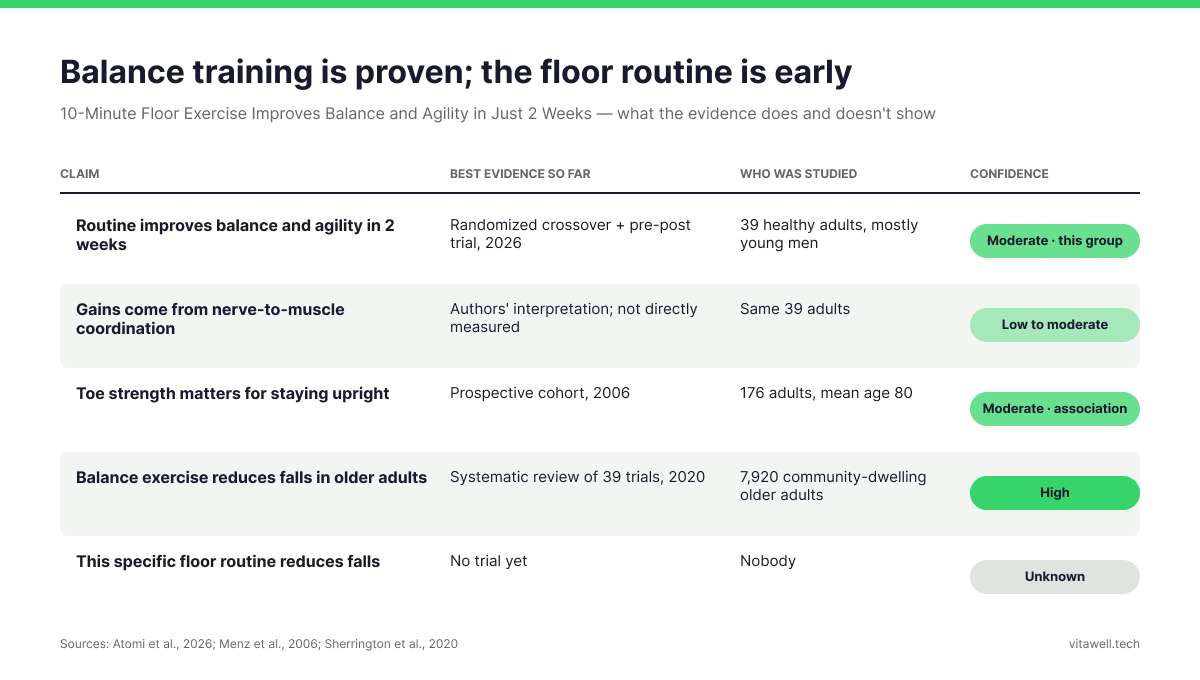
| Claim | Best evidence so far | Who was studied | Confidence |
|---|---|---|---|
| The routine improves standing balance and agility in 2 weeks | Randomized crossover + pre-post trial, 2026 | 39 healthy adults, mostly young men | Moderate for this group, low for others |
| The gains come from nerve-to-muscle coordination | Authors' interpretation; not directly measured | Same 39 adults | Low to moderate |
| Toe strength matters for staying upright | Prospective cohort, 2006 | 176 adults, mean age 80 | Moderate (association, not cause) |
| Balance exercise reduces falls in older adults | Systematic review of 39 trials, 2020 | 7,920 community-dwelling older adults | High |
| This specific floor routine reduces falls | No trial yet | Nobody | Unknown |
Read the table from the bottom up when you decide what to do: the routine is safe and plausibly useful, but the fall-prevention benefit you want comes from the programs in the fourth row.
Test Your Balance Before and After
A quick self-check gives you a baseline. Stand next to a counter, lift one foot and rest it behind the other calf, keep your arms at your sides and look straight ahead. Try to hold for 10 seconds, three attempts per side.
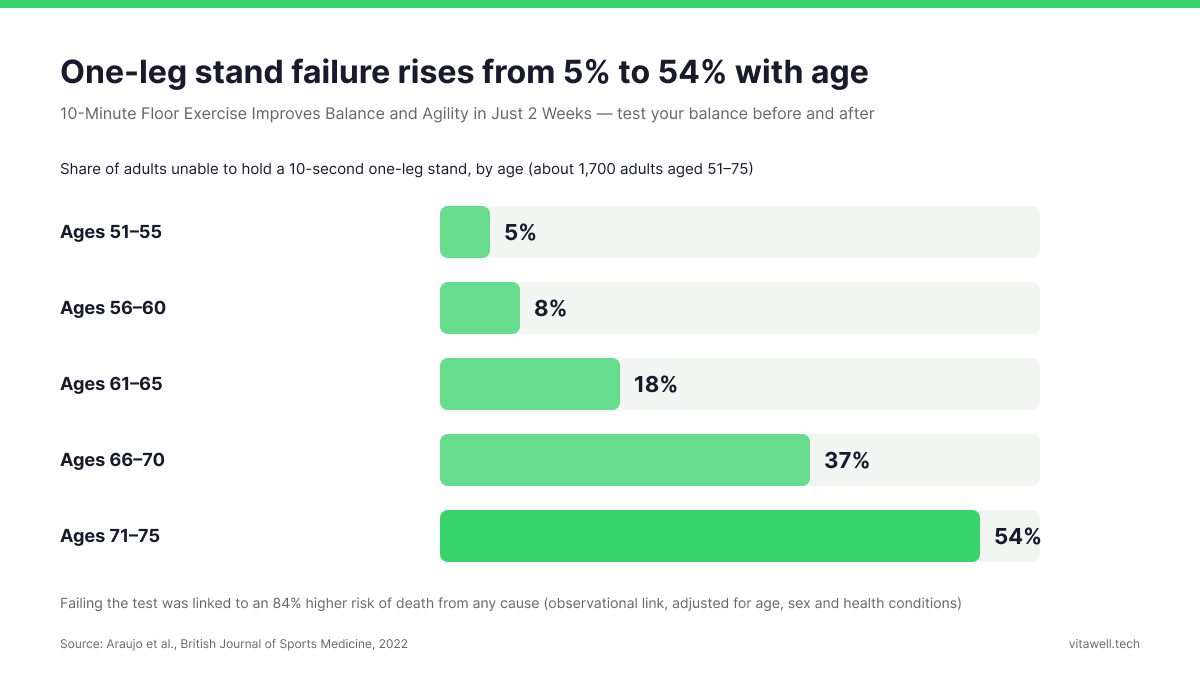
In a study of about 1,700 adults aged 51 to 75 followed for roughly seven years, about 1 in 5 could not complete this 10-second stand (Araujo and colleagues, British Journal of Sports Medicine, 2022). The share who failed rose sharply with age:
- Ages 51–55: 5%
- Ages 56–60: 8%
- Ages 61–65: 18%
- Ages 66–70: 37%
- Ages 71–75: 54%
Failing the test was linked to an 84% higher risk of death from any cause after adjusting for age, sex and health conditions. That is an observational link, not proof that balance training extends life, but it shows the test is a meaningful marker. Repeat it after two and four weeks of training.
A 4-Week Plan From Floor to Standing
The World Health Organization advises adults 65 and older to do multicomponent activity combining balance, coordination and strength on three or more days a week (WHO 2020 guidelines, summarised by the University of Sydney). This plan uses the floor routine to get there.
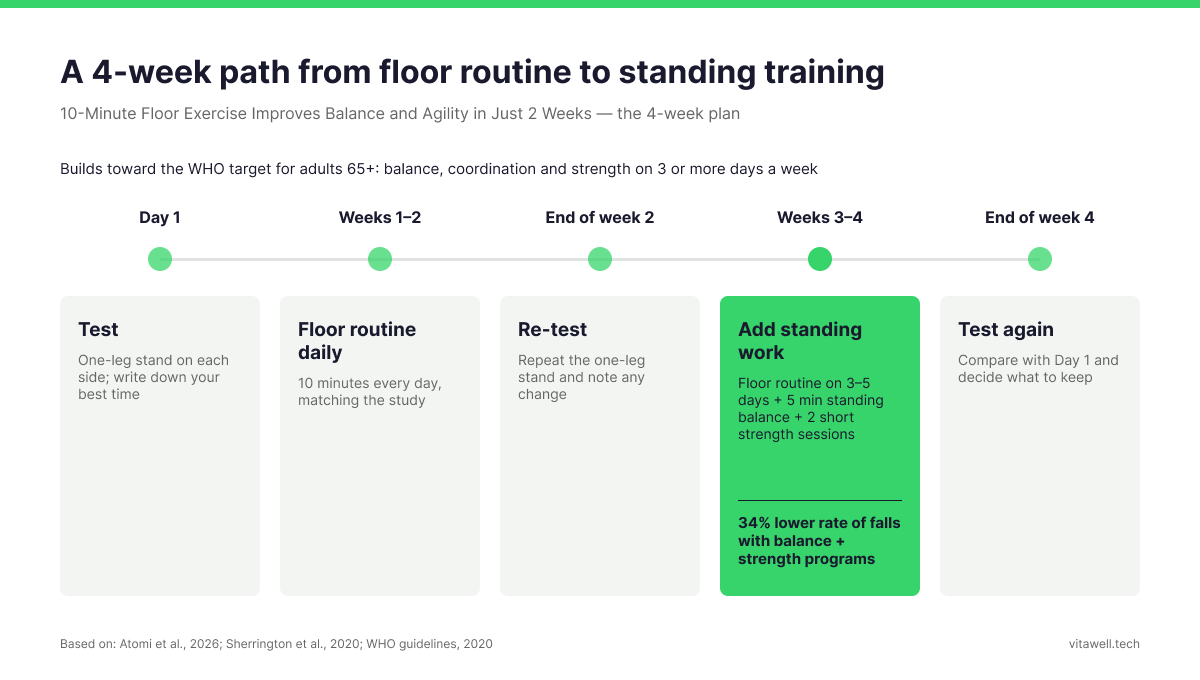
- Day 1: Do the one-leg test on each side and write down your best time.
- Weeks 1–2: Do the 10-minute floor routine every day, matching the study. Morning, before getting up, works for many people.
- End of week 2: Repeat the one-leg test and note any change.
- Weeks 3–4: Keep the floor routine on 3–5 days and add 5 minutes of standing balance next to a counter: heel-to-toe stance, one-leg stance, slow side-steps.
- Also in weeks 3–4: Add two short strength sessions (sit-to-stands, heel raises, wall push-ups). Combined balance and strength programs showed the largest fall reduction, 34%.
- End of week 4: Test again and decide what to keep. Pair it with the exercise types that also help blood pressure if you want one weekly routine for several goals.
If sticking with it is the hard part, these tips for building a workout routine that sticks apply here too: same time, same place, and a visible check-off.
When to Talk to a Professional
- You have fallen in the past year, or you feel unsteady when walking or turning.
- You have dizziness, numbness in your feet, or new weakness on one side.
- You are recovering from surgery or a back, hip or knee injury.
- Any of the moves cause pain rather than mild effort.
A doctor or physiotherapist can check for causes such as medication side effects, inner-ear problems or nerve damage, and can tailor a fall-prevention program. Atomi also suggests in-person instruction with follow-up where possible, with video guidance as the next-best option.
Frequently Asked Questions
Can you improve balance by exercising lying down?
Early evidence says yes, at least in healthy adults. In the 2026 PLOS One study, a 10-minute supine routine done daily for two weeks was associated with less body sway and better side-step agility. Lying down lowers the effort of holding yourself up, which lets you practise coordinating core and legs safely before progressing to standing work.
How long does it take to improve balance?
Measurable changes appeared after two weeks of daily practice in the 2026 study, likely because the nervous system adapts quickly. Fall-prevention trials in older adults usually run for several months. Expect early gains in steadiness within weeks, and plan on keeping balance work in your routine for at least three days a week over the long term.
Do toe exercises improve balance?
They probably help. Toe strength widens the base you stand on, and in a study of 176 older adults, weaker toe plantarflexor muscles were independently linked to falling within a year. The 2026 routine included toe rock-paper-scissors, but the study tested the whole routine, so the toe exercise's separate effect is unknown.
How can I test my balance at home?
Stand beside a counter and try to hold a one-leg stance for 10 seconds with your free foot behind your standing calf and arms by your sides. In a 2022 study of about 1,700 adults aged 51 to 75, roughly 1 in 5 could not do it. Repeat the test every few weeks to track progress.
Conclusion
The 2026 study adds a useful tool: ten minutes on the floor, no equipment, and a measurable change in two weeks for healthy adults. It does not replace the standing balance and strength training that has the strongest evidence for preventing falls. Use the floor routine as your entry point, test yourself before and after, and build toward three balance-and-strength days a week. You can schedule each step of the 4-week plan in VitaWell's Health area so it becomes a habit rather than an intention.
This article is for information only and is not medical advice. Talk to a healthcare professional before starting a new exercise program, especially if you have had falls or have a health condition.
Sources
Medical News Today — Brief daily lying-down exercise linked to better balance and agility