5 Holiday Pressures Psychologists Say It's OK to Say No To
The holidays stress 89% of Americans. Here are five specific pressures psychologists say you're not obligated to comply with — backed by research on guilt, grief, and social obligation.

The holiday season is built around the idea that everyone should feel grateful, joyful, and connected. The reality is more complicated. According to the American Psychological Association's 2023 Stress in America survey, conducted with Harris Poll across 2,061 adults, 89% of Americans report feeling stressed during the holiday season — and 41% say their stress increases compared to the rest of the year.
Psychologists have a name for the gap between how we're supposed to feel and how we actually feel: emotional expectation mismatch. And they have a clear message: saying no to certain holiday pressures is not only acceptable — it may be essential for your psychological wellbeing.
This guide covers five specific holiday pressures that research and clinical practice consistently identify as sources of unnecessary suffering, along with the evidence-backed reasoning for why declining them is healthy.
Key Takeaways
- 89% of Americans feel stressed during the holiday season; 41% say stress increases compared to the rest of the year (APA/Harris Poll, 2023)
- 58% cite money as a top stressor; 38% cite finding the right gifts — both driven by social pressure, not necessity
- 72% describe the holidays as bittersweet; 63% use at least one negative term to describe how they feel
- Psychologists consistently identify guilt, financial pressure, and social obligation as the three primary drivers of holiday distress
- Saying no to specific pressures isn't avoidance — it's a form of boundary-setting that research links to lower anxiety and stronger long-term relationships
What the Data Actually Shows About Holiday Stress
The APA's 2023 survey findings are worth sitting with. When adults were asked to describe the holidays, 72% said bittersweet, and 63% chose at least one clearly negative term. Only 10% described the holidays as a purely positive time. These are not the numbers of a universally joyful season.
What drives the distress? The top sources are financial pressure (58%), finding the right gifts (38%), and managing family conflict and expectations. These stressors share a common structure: they arise not from the holidays themselves but from social obligation — the feeling that you have to spend a certain amount, attend certain gatherings, perform a certain emotional register, and absorb a certain amount of interpersonal difficulty without complaint.
Critically, 88% of respondents reported having at least one coping strategy during the holidays. But 38% said their coping included behaviors they recognized as potentially harmful — overeating, excessive drinking, isolation, or avoidance. This suggests that many people are managing holiday stress in ways that make it worse, not better.
Understanding what psychological wellness actually requires is the foundation — and it starts with recognizing which pressures are worth engaging with and which ones aren't.
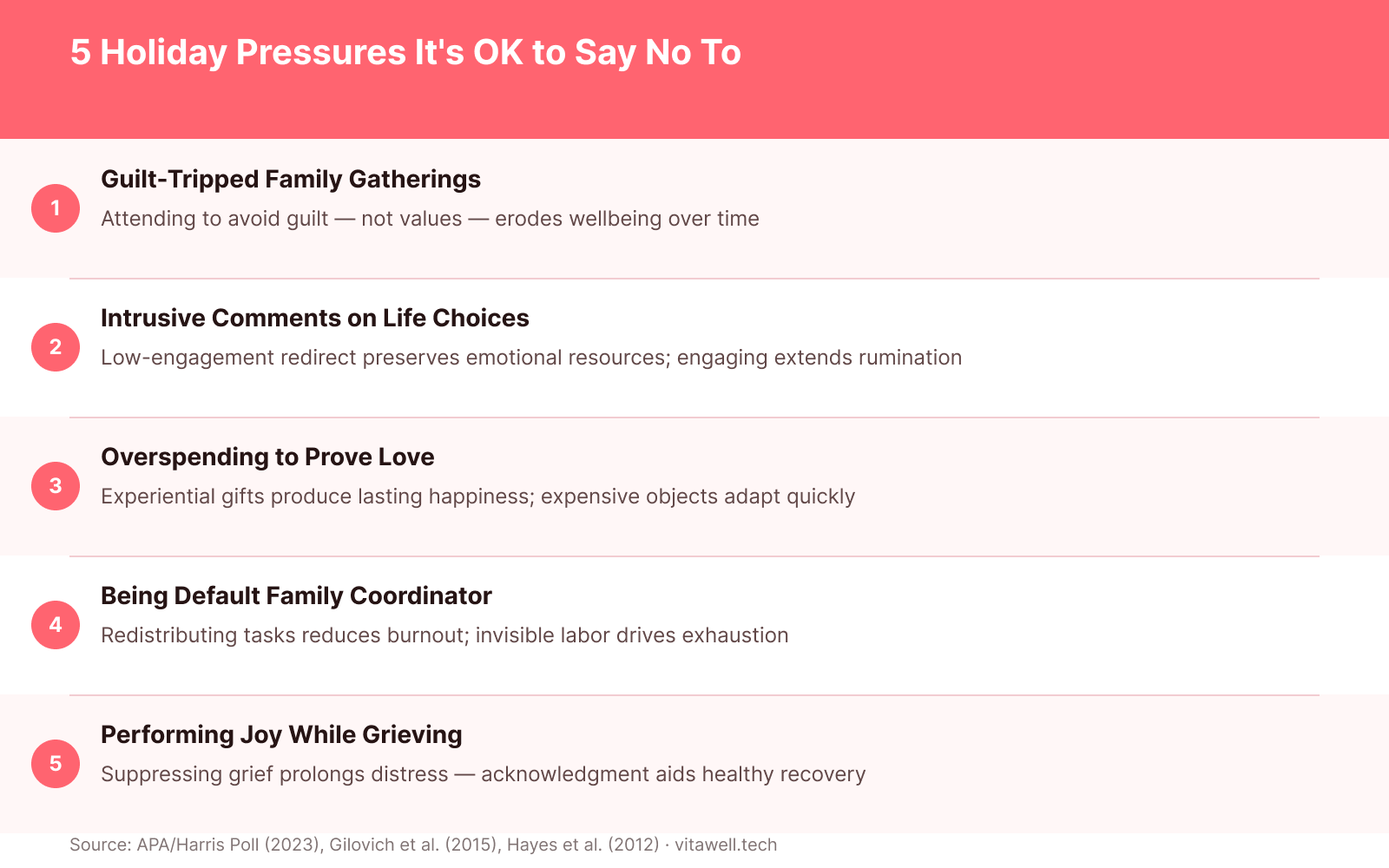
The 5 Pressures at a Glance
| Holiday Pressure | Primary Driver | Psychologist's Verdict |
|---|---|---|
| Guilt-tripped gatherings | Fear of family disapproval | Attending to avoid guilt erodes wellbeing over time |
| Intrusive comments on life choices | Social performance expectation | Low-engagement redirect preserves emotional resources |
| Overspending to prove love | Financial signaling pressure | Experiential gifts outperform expensive ones for lasting happiness |
| Being default family coordinator | Invisible labor assumption | Redistributing tasks reduces burnout risk |
| Performing joy while grieving | Social emotional conformity | Suppressing grief prolongs distress — acknowledgment aids recovery |
1. Guilt-Tripped Family Gatherings
The pressure to attend every family gathering — even ones you anticipate will be stressful, hostile, or draining — is perhaps the most socially enforced obligation of the season. The implicit message is that declining means you don't value family. Psychologists disagree.
Attending high-conflict family gatherings out of guilt, rather than genuine desire, activates the stress response in ways that can last days. Research on psychological flexibility — a core concept in Acceptance and Commitment Therapy — consistently shows that actions taken to avoid guilt, rather than move toward values, tend to increase distress over time, not reduce it.
The key distinction: choosing to attend a gathering because it aligns with your values (connection, love, tradition) is different from attending to avoid a guilt trip. The former builds psychological wellbeing. The latter erodes it.
Saying no to a gathering you genuinely dread is not abandoning family. It is making a values-consistent choice — which is exactly what psychological research recommends. If you do choose to attend, building a daily routine that includes recovery time before and after high-stress social events can meaningfully reduce their impact.
2. Intrusive Comments About Your Life Choices
The holiday table is a reliable venue for uninvited assessments: your relationship status, your weight, your career, your parenting decisions, your politics. These comments often come packaged as concern or curiosity. Psychologists are clear that you are not obligated to engage with them.
Responding to every intrusive comment is emotionally expensive and rarely productive. Research on rumination — the tendency to replay difficult interactions — shows that engaging with provocative or critical comments tends to extend the activation of negative affect long after the encounter ends. The more you engage, the more you tend to replay it.
The alternative is not aggression or rudeness. It is the low-engagement redirect: a neutral, non-defensive response that signals the topic is closed. "I'm actually quite happy with how things are going" and then changing the subject. Practiced consistently, this approach preserves your emotional resources for the interactions that actually matter.
This is particularly important for people managing stress from the cumulative load of competing demands, where even small emotional expenditures on unproductive interactions add up.
3. Overspending to Prove Love
The APA survey found that 58% of Americans cite money as a primary holiday stressor. Gift-giving pressure is part of this — but the deeper issue is that financial decisions in the holiday season are often driven by social signaling rather than genuine relationship-building.
Research on hedonic adaptation consistently shows that material gifts produce shorter-lasting happiness than experiential gifts or quality time. Studies by Thomas Gilovich and colleagues at Cornell found that people report greater enduring satisfaction from experiences than from objects of equivalent cost — and that the effect is stronger when the experience is shared. The expensive item that signals financial effort produces less lasting goodwill than a low-cost shared activity.
This matters because overspending to signal love has a documented downside beyond debt: it creates an implicit expectation of reciprocity that can generate resentment when not matched. It also frames the relationship as a financial transaction, which research on relationship quality suggests is corrosive to genuine intimacy over time.
You are not required to prove love through spending. Setting a budget and communicating it directly — rather than trying to intuit and match what others might spend — reduces financial anxiety and tends to be received better than anticipated.
4. Being the Default Family Coordinator
In many families, one person absorbs the invisible work of the holidays: coordinating logistics, managing conflicting schedules, mediating disputes, tracking everyone's dietary needs, and ensuring that the event goes smoothly. This role is often gendered and rarely voluntary. It is frequently unacknowledged until it's performed imperfectly.
The psychological cost of this invisible labor is real. Research on cognitive load and emotional labor — work that requires managing your own emotions and others' emotions simultaneously — shows consistent associations with exhaustion, reduced life satisfaction, and elevated symptoms of anxiety and depression when this labor is chronic and unrecognized.
Saying no to being the default coordinator means two things in practice: redistributing planning tasks explicitly rather than absorbing them, and releasing the standard to which you hold the event's outcome. If the family gathering is less tidy, less precisely timed, or less perfectly catered than you would have produced on your own, that is an acceptable outcome. The alternative — shouldering the full coordination burden to preserve a standard that largely goes unnoticed — is a reliable path to burnout.
Understanding why it's hard to mentally disconnect from work and responsibility is relevant here: the cognitive patterns that make it difficult to stop thinking about work operate identically when the "work" is running your family's holiday.
5. Performing Joy When You're Grieving
If you have experienced a significant loss — a death, a divorce, a diagnosis, the end of a relationship — the holidays can be acutely painful in a way that is completely at odds with the season's expected emotional register. Seventy-two percent of Americans describe the holidays as bittersweet. For people in acute grief, this understates the difficulty.
The pressure to perform holiday joy — to seem fine, to participate enthusiastically, to not dampen others' experience — is a form of emotional suppression. Research on grief and emotional suppression is consistent: suppression tends to prolong distress, not reduce it. Grieving people who are allowed (and allow themselves) to acknowledge grief while still participating in life tend to integrate loss more effectively than those who suppress it in service of social expectations.
Saying no to performed joy means declining the obligation to seem fine when you are not. It means telling people close to you that you are having a hard time. It means giving yourself permission to step away when you need to, to skip parts of gatherings, or to participate at reduced intensity. These are not signs of weakness or dysfunction. They are psychologically sound responses to a genuinely difficult situation.
Who This Is Hardest For
The pressures described above are not equally distributed. People with strong people-pleasing tendencies — a trait associated with elevated anxiety and low psychological self-efficacy — find boundary-setting at the holidays particularly difficult because the anticipated social consequences feel more threatening.
People with a history of family conflict or emotional enmeshment often find guilt-based obligation most entrenched during the holidays, precisely because the season amplifies attachment and belonging cues.
And people experiencing grief or acute stress find the contrast between internal experience and external expectation sharpest at precisely the moment when everyone around them is expecting warmth and celebration.
None of this means you must decline everything. It means that the ability to selectively decline — to recognize which pressures are worth engaging with and which ones serve no one — is a genuine psychological skill worth developing.
When to Talk to a Professional
If you are experiencing significant anxiety or depression as the holidays approach — anticipatory dread that is interfering with daily functioning, persistent low mood, or difficulty separating holiday-specific stress from ongoing psychological distress — this is worth discussing with a therapist or psychologist. Psychologists can provide specific tools for managing family dynamics, grief, and social pressure that go well beyond general advice.
The APA survey found that 38% of Americans are already coping with holiday stress in ways they recognize as potentially harmful. If your coping strategies have crossed that line, professional support is appropriate and effective.
FAQ
Is it selfish to skip holiday gatherings?
Declining a gathering that is reliably high-conflict or genuinely harmful to your wellbeing is not selfishness — it is a psychologically sound boundary. Selfishness implies disregard for others' wellbeing. Protecting your mental health from contexts that damage it is self-care, not self-indulgence. Psychologists distinguish between self-interested choices that harm others and choices that simply decline to absorb harm. Skipping a gathering that leaves you depleted for weeks falls in the second category.
How do I say no to a family gathering without causing a conflict?
The most effective approach is directness combined with warmth: "I'm going to sit this one out this year — I need some time to recharge, and I know I'll be better company in lower-key settings." Avoid over-explaining or apologizing. Over-explanation invites negotiation; a warm, clear statement does not. People may still be disappointed, but disappointment is not the same as damage to the relationship.
What does the research say about holiday overspending?
Research consistently shows that material gifts produce shorter-lasting happiness than experiential gifts or quality time (Gilovich et al., Cornell). Overspending does not produce proportionally higher relationship satisfaction — and can generate resentment through implicit reciprocity expectations. Setting and communicating a clear budget is psychologically healthier than trying to signal love through spending.
How do you handle intrusive comments at holiday dinners?
The most effective strategy is the low-engagement redirect: a brief, neutral, non-defensive acknowledgment followed by a subject change. "I'm happy with where things are — what have you been up to?" Engaging substantively with intrusive comments tends to extend the interaction and increase rumination afterward. Practiced neutrality is not coldness; it is emotional efficiency.
Is it normal to feel sad during the holidays?
Yes. The APA's 2023 data found that 72% of Americans describe the holidays as bittersweet, and 63% use at least one clearly negative term. For people experiencing grief, loss, or significant life transitions, sadness during the holidays is a normal and appropriate emotional response — not a sign that something is wrong with them. Psychologists recommend acknowledging the feeling rather than suppressing it.
Conclusion
The holiday season carries a specific emotional narrative that many people cannot access from where they actually are. Psychologists are not arguing for withdrawal or avoidance — they are arguing for selectivity. The capacity to identify which pressures are worth engaging with, and to decline the ones that serve no genuine purpose for anyone, is not a character flaw. It is a skill.
Eighty-nine percent of Americans feel stressed during the holidays. The pressures described in this article — guilt-based obligation, intrusive commentary, financial performance, invisible coordination labor, and suppression of grief — are among the most reliably documented sources of that stress. None of them require your compliance.
For more research-backed approaches to psychological wellbeing and boundary-setting, explore the three elements of meaning science says are essential for genuine happiness.
Related on VitaWell
- The Three Elements of Meaning That Science Says Are Essential for True Happiness — Purpose, coherence, and mattering: the research-backed framework for a life that feels worthwhile, beyond day-to-day mood.
- 3 Science-Backed Daily Habits That Protect You From Burnout — Before It Starts — The habits that build stress resilience at the physiological level, with the evidence behind each one.
- A Daily Routine That Reduces Pain and Depression — Building the daily structure that provides the stable foundation for emotional regulation and recovery.
This article is for informational purposes only and does not constitute medical or psychological advice. For concerns about depression, anxiety, or mental health, consult a licensed mental health professional.
Sources
- American Psychological Association & Harris Poll. (2023). Stress in America: Holiday Stress Survey. N=2,061 US adults. American Psychological Association.
- Gilovich T, Kumar A, Jampol L. (2015). A wonderful life: Experiential consumption and the pursuit of happiness. Journal of Consumer Psychology, 25(1), 152–165.
- Hayes SC, Strosahl KD, Wilson KG. (2012). Acceptance and Commitment Therapy: The Process and Practice of Mindful Change (2nd ed.). Guilford Press.
- Nolen-Hoeksema S, Wisco BE, Lyubomirsky S. (2008). Rethinking Rumination. Perspectives on Psychological Science, 3(5), 400–424.
- Hochschild AR. (1983). The Managed Heart: Commercialization of Human Feeling. University of California Press.
- Bonanno GA, Keltner D. (1997). Facial expressions of emotion and the course of conjugal bereavement. Journal of Abnormal Psychology, 106(1), 126–137.