Is Sleeping Too Much Bad for You? What Sleeping 9+ Hours Says About Your Heart Health
Sleeping 9 or more hours is linked to higher death risk, especially with heart disease. The evidence suggests long sleep is a signal to investigate, not a habit to cut.
Is sleeping too much bad for you? Regularly sleeping 9 hours or more is linked to a higher risk of death and heart problems in many studies, including a new one in people with heart disease. But the best available evidence suggests that long sleep is mostly a marker of something else, such as illness, broken sleep, low mood or medication, not a direct cause of harm. The useful response is not to set an earlier alarm. It is to find out why your body is asking for more sleep.
Key Takeaways
- In a 2026 study of 3,287 US adults with heart disease, sleeping 9 or more hours was linked to a 51% higher hazard of death over about 15 years, compared with 7 to 8 hours.
- Large meta-analyses show a U-shaped curve: both short and long sleep are linked to higher mortality, and the long-sleep link is often the stronger one.
- Genetic studies support a causal role for short sleep in heart disease but not for long sleep, and studies that measure sleep with wrist devices do not find extra risk at 8 hours or more.
- How regular your sleep is may predict mortality better than how long it is.
- A new or growing need for sleep, unrefreshing sleep, loud snoring or daytime sleepiness are reasons to see a doctor.
Is Sleeping Too Much Bad for You?
Oversleeping usually means sleeping more than 9 hours in 24 hours on a regular basis, not the occasional long weekend lie-in. The American Academy of Sleep Medicine and Sleep Research Society consensus statement says adults should sleep 7 or more hours per night. It adds that more than 9 hours may be appropriate for young adults, people recovering from sleep debt and people who are ill, and that for everyone else it is uncertain whether long sleep carries a health risk.
The US National Heart, Lung, and Blood Institute recommends 7 to 9 hours for adults and states that sleeping more than 9 hours a night is "not necessarily harmful." So official guidance treats long sleep as a question to look into, not as a danger in itself.
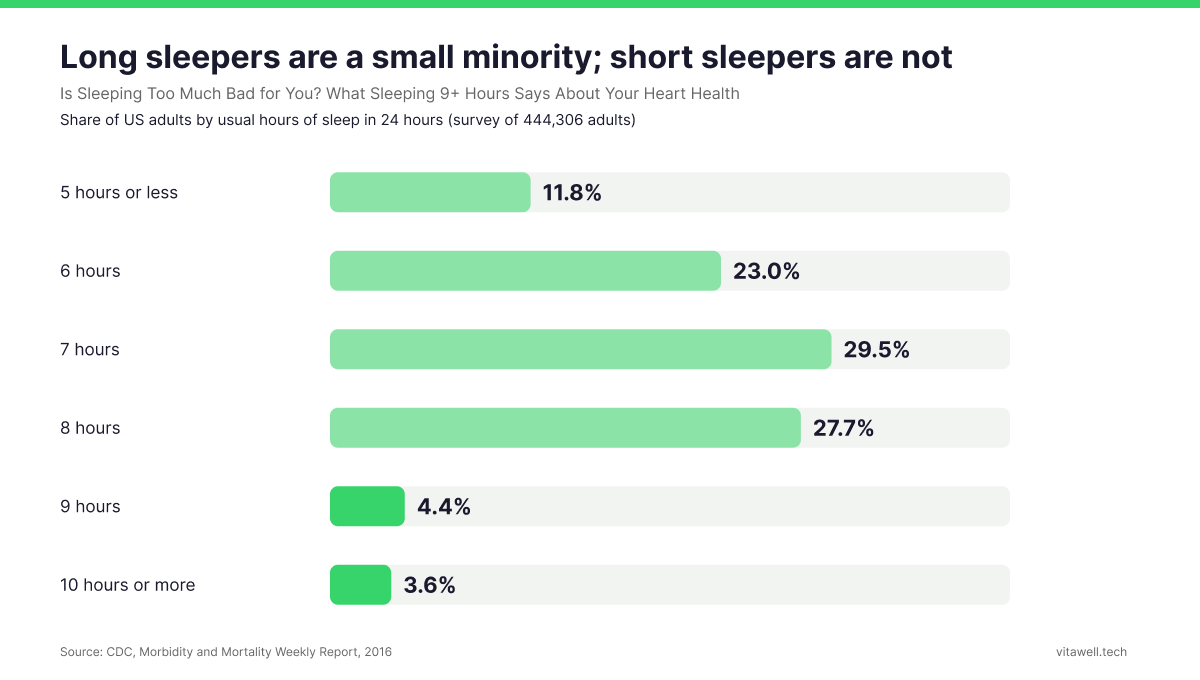
Long sleep is also much less common than short sleep. In a CDC survey of 444,306 US adults, 4.4% reported sleeping 9 hours and 3.6% reported 10 hours or more, while 11.8% slept 5 hours or less and 23.0% slept 6 hours. The rest reported 7 hours (29.5%) or 8 hours (27.7%). More recent CDC data from 2024 put the share of adults sleeping less than 7 hours at 30.5%.
What the New Heart Disease Study Found
The study that prompted new headlines was published in PLOS ONE in November 2026 by Adebile and colleagues. It followed 3,287 US adults who reported having heart disease in the 2004 National Health Interview Survey and linked them to death records through 2019, about 15 years. This was an observational cohort study, which can show associations but cannot prove cause.
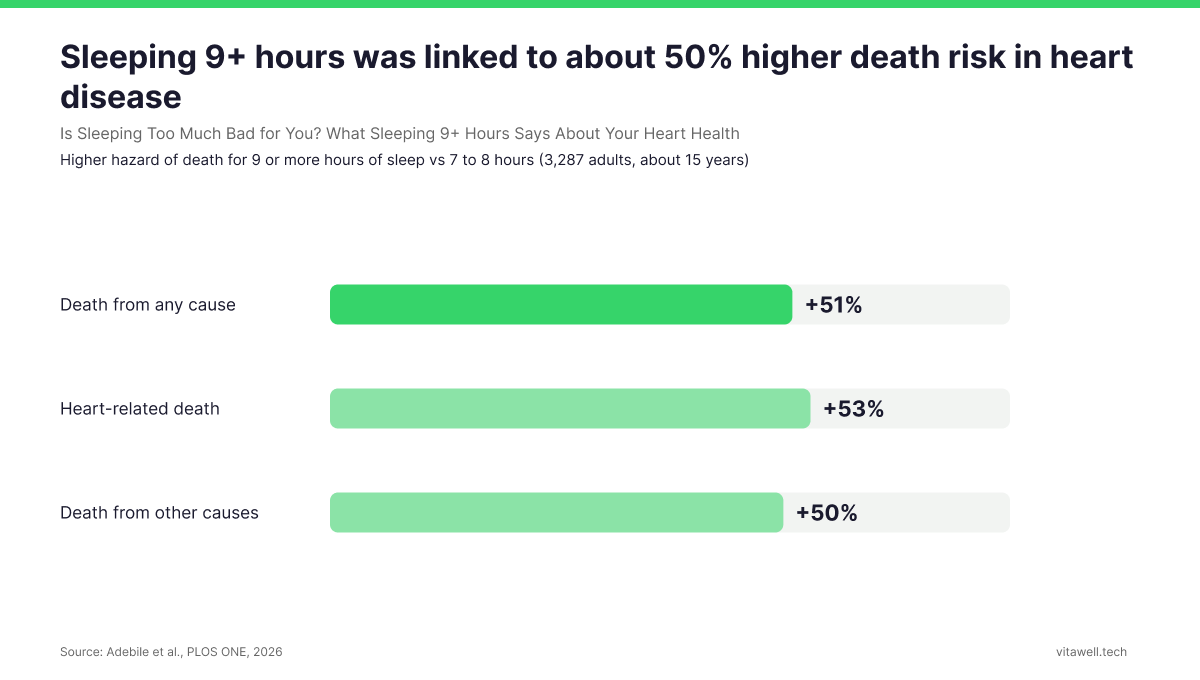
Compared with people who slept 7 to 8 hours, those who slept 9 hours or more had:
- a 51% higher hazard of death from any cause (hazard ratio 1.51, 95% confidence interval 1.32 to 1.73)
- a 53% higher hazard of heart-related death (hazard ratio 1.53)
- a 50% higher hazard of death from other causes (hazard ratio 1.50)
A hazard ratio compares the rate of an event between two groups over the follow-up period; 1.51 means a 51% higher rate. Short sleep of 6 hours or less was not significantly linked to mortality once the researchers adjusted for health and lifestyle factors. The lowest predicted risk sat at about 6 to 7 hours.
Context matters here. This was a group that was already ill: 49.4% of participants died during follow-up. Sleep was self-reported once, in 2004, and the authors note they could not account for depression, the severity of sleep apnea, medication use or how advanced the heart disease was. They conclude that sleep duration may be a simple marker of remaining risk in people with heart disease.
Lead author Tolulope Victoria Adebile told Medical News Today: "The goal is not necessarily to get people to sleep less, but to understand why they may be sleeping more." For people living with a heart condition, sleep quality matters as well, as covered in our guide to how sleep quality protects the brain in heart disease and diabetes.
The U-Shaped Curve: Long and Short Sleep Across Studies
The heart study fits a pattern seen for decades. When researchers plot sleep duration against mortality, the line is U-shaped: risk is lowest around 7 hours and rises on both sides. The table below puts five large studies side by side.
| Study | Who was studied | Long sleep and death risk | Short sleep and death risk |
|---|---|---|---|
| Adebile et al., 2026 (cohort) | 3,287 US adults with heart disease | 51% higher at 9+ hours | Not significant after full adjustment |
| Ungvari et al., 2025 (meta-analysis) | 79 cohort studies | 34% higher at 9+ hours | 14% higher under 7 hours |
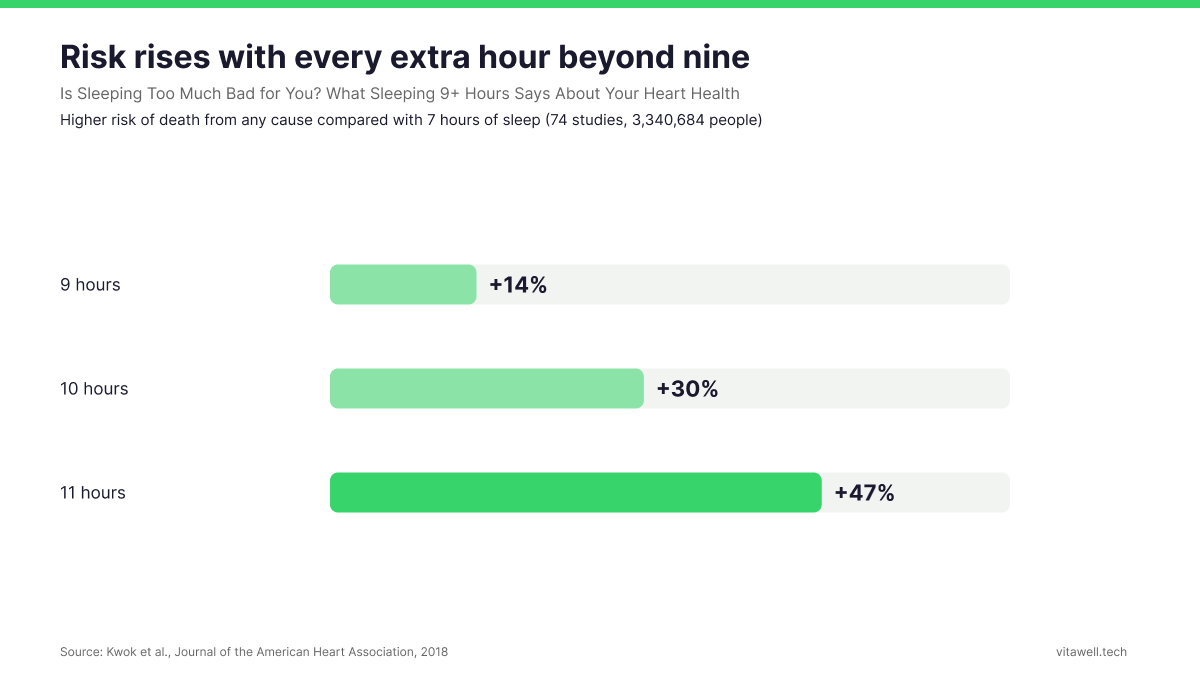
| Kwok et al., 2018 (dose-response meta-analysis) | 74 studies, 3,340,684 people | 14% higher at 9 hours, 30% at 10 hours, 47% at 11 hours | No significant difference under 7 hours |
| NHANES analysis, 2022 (cohort) | 25,481 US adults | 74% higher at 9+ hours | 40% higher at 5 hours or less |
| UK Biobank wrist-device study, 2024 (cohort) | 88,282 adults with measured sleep | No higher risk at 8+ hours | 29% higher at 5 hours |
Two things stand out. First, in studies based on self-reported sleep, the long-sleep link is as strong as or stronger than the short-sleep link. In the 2025 meta-analysis by Ungvari and colleagues, the hazard ratio was 1.34 for long sleep and 1.14 for short sleep. In the 2022 analysis of the NHANES survey, it was 1.74 versus 1.40.
Second, the risk climbs with each extra hour. The dose-response meta-analysis by Kwok and colleagues estimated the relative risk of death at 1.14 for 9 hours, 1.30 for 10 hours and 1.47 for 11 hours, compared with 7 hours. The same shape appears in research on the sleep window linked to slower biological aging.
Does Long Sleep Cause Harm, or Signal It?
An association this consistent invites the conclusion that long sleep is dangerous. Three lines of evidence argue against reading it that way.
Genetic studies point at short sleep, not long sleep
Mendelian randomization is a method that uses inherited gene variants as a natural experiment, which makes it less vulnerable to the problem of illness changing sleep. A study of 404,044 UK Biobank participants by Ai and colleagues (European Heart Journal, 2021) found that genetically predicted short sleep raised the odds of coronary artery disease (odds ratio 1.29). Genetically predicted long sleep was not associated with any of the 12 cardiovascular diseases examined, as the accompanying editorial summarizes. The editorial also notes the analysis had less statistical power for long sleep, so this is strong evidence, not final proof.
An earlier UK Biobank study of 461,347 people by Daghlas and colleagues reported the same split. Both short sleep (under 6 hours) and long sleep (over 9 hours) were linked to more heart attacks in the observational data, with hazard ratios of 1.20 and 1.34, but the genetic analysis supported a causal effect only for short sleep.
Measured sleep tells a different story than reported sleep
Most long-sleep findings rely on people estimating their own sleep, and people tend to report time in bed. Someone whose sleep is broken by pain, breathing pauses or frequent waking may spend 10 hours in bed to get 6 or 7 hours of actual sleep. When 88,282 UK Biobank adults wore wrist accelerometers, sleeping 5 hours a day was linked to a 29% higher risk of death compared with 7 hours, but sleeping 8 hours or more was not linked to higher mortality.
Common conditions drive long sleep
- Obstructive sleep apnea, in which breathing repeatedly stops during sleep. A 2025 modelling study estimated it affects 32.4% of US adults aged 20 and over, many of them undiagnosed. Estimates vary with the definition used.
- Depression and other mental health conditions. In a French national survey of 24,671 adults, 2.7% slept 10 hours or more, and long sleep was strongly associated with having a psychiatric condition (adjusted odds ratio 6.0).
- Medications and alcohol that cause drowsiness.
- Chronic illness, including heart disease itself, which raises the need for rest.
How Heart Guidelines Score Long Sleep
The American Heart Association added sleep to its cardiovascular health checklist, Life's Essential 8, in 2022. Each of the eight metrics is scored from 0 to 100, and the sleep scale gives a concrete sense of how much weight cardiologists put on long sleep. The bands, as set out in a Journal of the American Heart Association editorial, are:
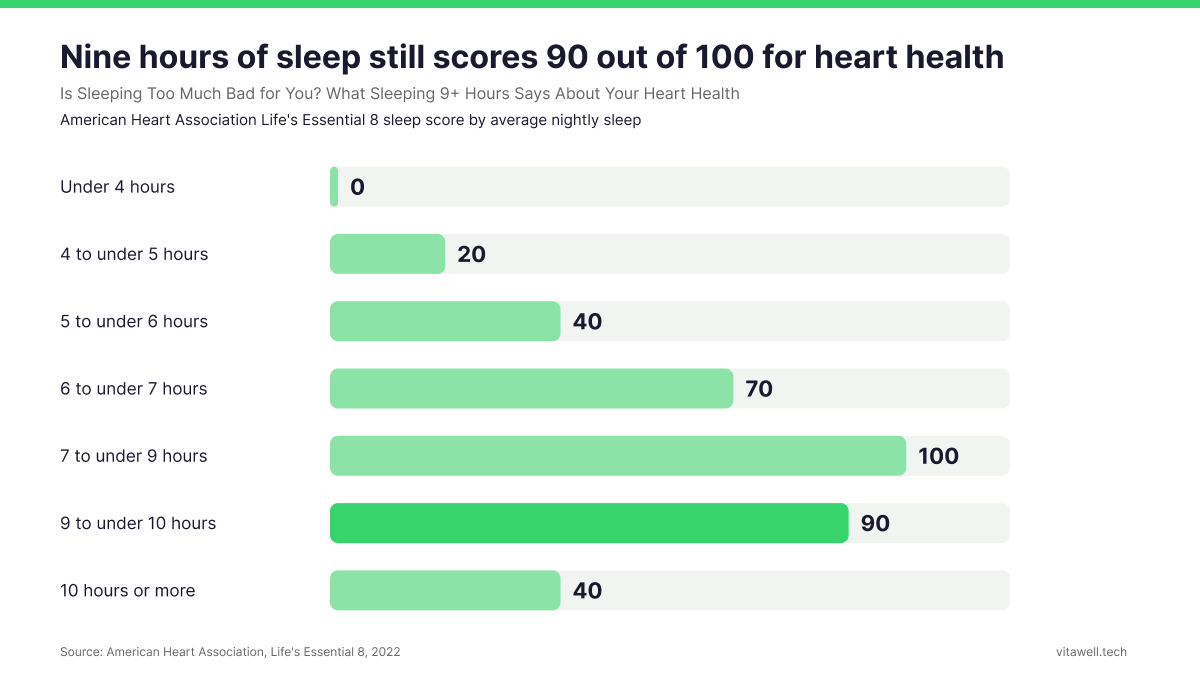
- 7 to under 9 hours: 100 points
- 9 to under 10 hours: 90 points
- 6 to under 7 hours: 70 points
- 5 to under 6 hours, or 10 hours and more: 40 points
- 4 to under 5 hours: 20 points
- under 4 hours: 0 points
In other words, 9 hours barely costs anything. It is at 10 hours or more that the score drops to the same level as sleeping 5 to 6 hours.
Sleep Regularity May Matter More Than Duration
Hours are only one dimension of sleep. In a 2024 study of 60,977 UK Biobank participants by Windred and colleagues, people with more regular sleep and wake times had a 20% to 48% lower risk of death from any cause than the least regular sleepers. The authors report that regularity was a stronger predictor of mortality than sleep duration.
A second analysis of 88,975 participants published in eLife found a hazard ratio of 1.53 for death among the least regular sleepers compared with those in the middle. Both studies are observational. Still, they suggest that a steady 8.5 hours is a different thing from 6 hours on weekdays and 11 on Sunday, a pattern that often starts with putting off bedtime during the week.
Healthy Long Sleeper or Warning Sign? A 2-Week Self-Check
Some people simply need more sleep. The question is whether your long sleep is a stable trait or a change. This self-check is our synthesis of the research above, not a diagnostic test.
Long sleep is more likely to be harmless if:
- you have needed about the same amount for most of your adult life
- you wake up refreshed and stay alert through the day
- you are a young adult, are recovering from illness or are catching up after a short-sleep stretch
It deserves a closer look if:
- your sleep need has grown over recent weeks or months
- you sleep 9 or more hours and still wake up tired
- you snore loudly, or someone has seen you stop breathing in your sleep
- you doze off unintentionally during the day
- your mood has been low, or you recently started a new medication
- you have heart disease, diabetes or another chronic condition
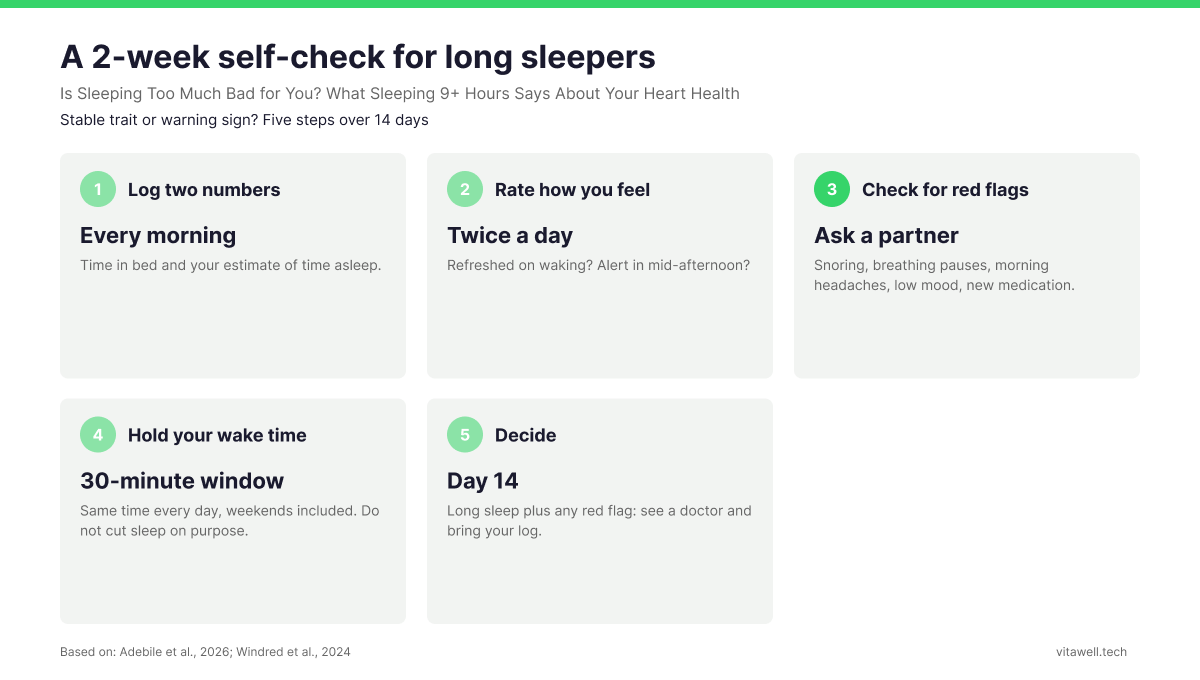
To find out which group you are in, run this for 14 days:
- Log two numbers each morning. Write down your time in bed and your best estimate of time asleep. A gap of more than an hour between them points to broken sleep.
- Rate how you feel twice a day. On waking: refreshed or not. Mid-afternoon: alert or fighting sleep.
- Check for red flags. Ask a partner about snoring or breathing pauses, and note morning headaches, low mood and any new medication.
- Hold your wake time steady. Get up within the same 30-minute window every day, including weekends. Do not cut sleep on purpose.
- Decide on day 14. Long sleep plus any red flag means booking an appointment and taking your log along. Refreshed, stable and no red flags means you are probably a natural long sleeper.
A paper diary is enough. Wearables can help with timing, but they estimate sleep imperfectly, and close monitoring can backfire for anxious sleepers, as explained in our piece on sleep trackers and insomnia.
When to Talk to a Professional
See a doctor if long sleep is new, if it has lasted more than a few weeks without an obvious reason such as illness or sleep debt, or if any of the red flags above apply. Ask specifically about screening for sleep apnea and depression and about a review of your medications.
If you have heart disease, mention changes in your sleep at your next cardiology visit. The 2026 study does not show that sleeping less will protect you, and no trial has tested deliberately shortening sleep in long sleepers. Restricting sleep on your own is not recommended. Seek urgent care for chest pain, shortness of breath when lying down, or fainting.
Frequently Asked Questions
Is it bad to sleep 9 or 10 hours every night?
Not necessarily. US health agencies say more than 9 hours is not harmful in itself and can suit young adults and people who are ill or catching up on sleep. Studies link 9 or more hours to higher mortality, with risk rising at 10 and 11 hours, but the link probably reflects underlying health problems.
Why am I still tired after 9 hours of sleep?
Being tired after long sleep usually means the sleep itself is poor or something else is draining your energy. Common causes include sleep apnea, depression, sedating medications, alcohol and chronic illness. Time in bed is not the same as time asleep, so broken sleep can leave you unrefreshed.
Does oversleeping cause heart disease, or is it a sign of it?
Current evidence favors "sign." Observational studies link long sleep with heart attacks and death, but genetic studies of more than 400,000 people found a causal signal only for short sleep. Studies measuring sleep with wrist devices also found no extra mortality risk at 8 hours or more.
Is sleeping too much worse than sleeping too little?
In self-reported data the statistical link with death is often stronger for long sleep: 34% higher versus 14% higher in a 2025 meta-analysis of 79 studies. But short sleep is far more common and has better evidence of directly causing harm, so it remains the bigger public health problem.
Conclusion
Sleeping 9 or more hours is best read as information. In people with heart disease it tracks with a clearly higher risk of death, yet the weight of evidence says long sleep reflects poor health more than it produces it. Keep your schedule regular, watch for changes and red flags, and bring a two-week log to your doctor if something has shifted. Sleep sits at the center of VitaWell's Health and Rest areas, and the guides below go deeper on getting it right.
Related on VitaWell
- How Much Sleep You Need to Lower Dementia Risk — And Why Exercise Makes All the Difference — the same U-shaped pattern, this time for brain health, and how activity changes it.
- The Science of Sleep: Unlocking Better Rest — the basics of sleep stages and habits that improve sleep quality.
- The Calming Power of White Noise for Better Sleep and Relaxation — one low-cost way to reduce the night-time awakenings that stretch time in bed.
This article is for general information only and is not medical advice. Talk to a qualified health professional about your own sleep and heart health.
Sources
- Medical News Today — Heart disease: Longer sleep linked to higher death risk
- Adebile et al., 2026 — Sleep duration and cause-specific mortality among US adults with heart disease, PLOS ONE
- Ungvari et al., 2025 — Sleep duration and all-cause mortality meta-analysis, GeroScience
- Kwok et al., 2018 — Self-reported sleep duration and quality and cardiovascular disease and mortality, Journal of the American Heart Association
- NHANES 2005-2014 cohort, 2022 — Sleep duration and mortality in US adults, Frontiers in Public Health
- UK Biobank accelerometer study, 2024 — Device-measured sleep duration and mortality, Sleep
- European Heart Journal editorial, 2021 — on Ai et al., Mendelian randomization of sleep duration and cardiovascular diseases
- Daghlas et al., 2019 — Sleep duration and myocardial infarction, Journal of the American College of Cardiology
- Windred et al., 2024 — Sleep regularity is a stronger predictor of mortality risk than sleep duration, Sleep
- UK Biobank sleep regularity study, 2023 — eLife
- Journal of the American Heart Association editorial, 2022 — Life's Essential 8 scoring
- American Academy of Sleep Medicine and Sleep Research Society, 2015 — Recommended amount of sleep for a healthy adult
- National Heart, Lung, and Blood Institute — How much sleep is enough
- CDC, 2016 — Prevalence of healthy sleep duration among adults, MMWR
- CDC National Center for Health Statistics, NCHS Data Brief 559 — Sleep in US adults, 2024
- Respiratory Medicine, 2025 — Estimated prevalence of obstructive sleep apnea in US adults
- French national survey of long sleepers, 2014 — PLoS ONE