
How Long Should You Wait Before Sex, Moving In Together, or Getting Married? Science Has an Answer
How long should you wait before sex, moving in or marriage? The studies point less to a number of months than to whether you decide together.

There is no single right number of months for relationship timing, but the research does give usable ranges. Couples who delay sex tend to report somewhat better relationship quality, couples who move in together after a clear commitment do better than those who move in to “test” things, and dating three or more years before a proposal is linked to a lower divorce hazard. Across all three milestones, the stronger predictor is whether you decide together or drift.
Key Takeaways
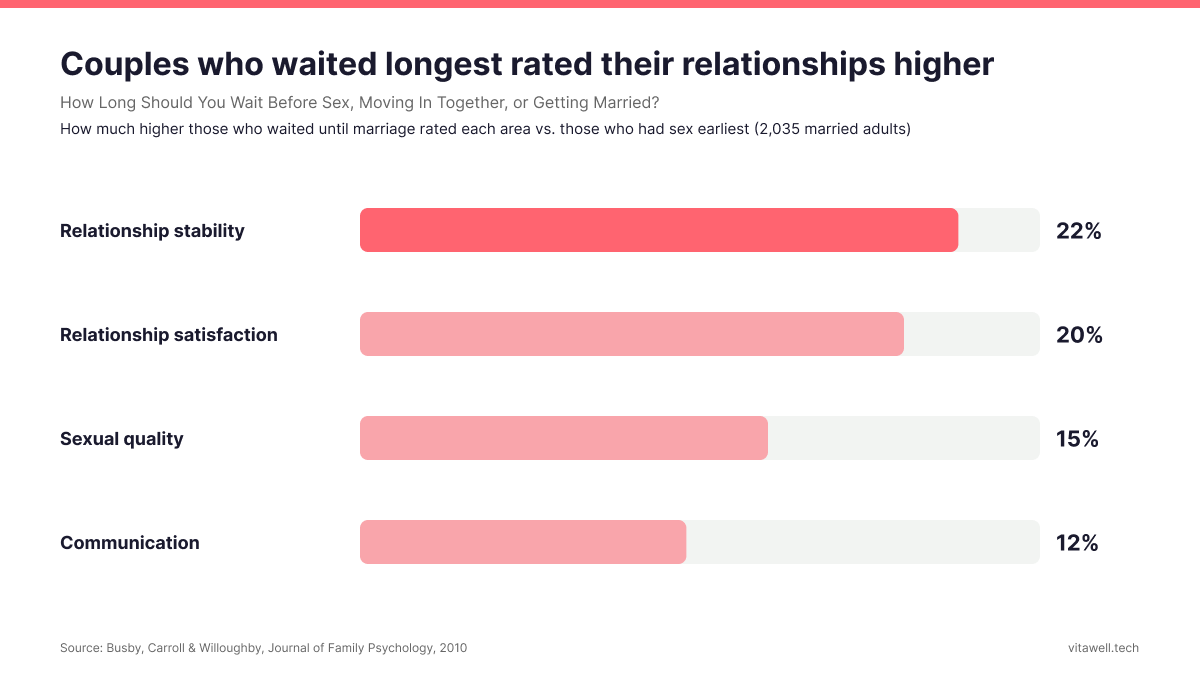
- In a survey of 2,035 married people (Busby, Carroll & Willoughby, 2010), those who waited longest to have sex rated relationship stability 22% higher and satisfaction 20% higher than those who had sex earliest. The data are correlational.
- Pew Research Center (2019) found that 59% of U.S. adults ages 18–44 have lived with an unmarried partner, more than the 50% who have ever married.
- Marriages ended for 34% of people who moved in before getting engaged, versus 23% of those who moved in only after engagement or marriage (Stanley & Rhoades, Institute for Family Studies, 2023).
- Moving in to “test” the relationship predicted worse relationship functioning and more breakups in a five-year study of 485 adults (Chapman et al., 2026).
- Dating three or more years before a proposal was tied to a roughly 24% lower hazard of divorce than dating under a year (Francis-Tan & Mialon, 2015).
Relationship Timing: Why the Calendar Isn’t the Only Variable
If you search for how long to wait before moving in together, you will find confident answers ranging from six months to two years. Some of these benchmarks have data behind them. But a more important pattern runs through the research: the couples who do best are not necessarily those who waited the longest. They are the ones who actively decided, rather than gradually drifted.
This distinction, a deliberate decision versus relationship inertia, comes from Scott Stanley, Galena Rhoades and Howard Markman at the University of Denver. Their 2006 paper “Sliding versus Deciding” in the journal Family Relations argued that couples who slide into shared leases and routines add constraints that make leaving harder before they have chosen each other. The idea was built to explain cohabitation, but it is a useful lens for every milestone in this article.
When to Have Sex: What Research Says About Timing and Satisfaction
The largest study on this question surveyed 2,035 married people about when they first had sex with their spouse. Busby, Carroll and Willoughby (2010), writing in the Journal of Family Psychology, compared those who waited until marriage with those who had sex earliest in the relationship. The waiting group rated relationship stability 22% higher, satisfaction 20% higher, sexual quality 15% better and communication 12% better. People who delayed sex but did not wait until marriage saw about half of those benefits.
Smaller studies point the same way. In his November 2026 review for Psychology Today, philosopher Aaron Ben-Ze’ev cites Vancour and Fallon (2017), who reported greater satisfaction among young adults who waited several months before becoming sexually involved.
Read these numbers with care. Both studies are cross-sectional surveys, a design that captures one moment in time and cannot show cause. The Busby team controlled for religious involvement, but people who wait may differ in other ways, such as being more deliberate about relationships in general. The practical takeaway is modest: giving emotional closeness time to develop is associated with better outcomes, and the timing should be one both partners freely choose.
When to Move In Together: The Cohabitation Inertia Trap
Living together is now the more common experience. A Pew Research Center report on marriage and cohabitation (2019) found that 59% of U.S. adults ages 18 to 44 have lived with an unmarried partner, while 50% have ever married. In Pew’s own survey of 9,834 adults, 48% said couples who live together first have a better chance of a successful marriage. Another 13% said a worse chance, and 38% said it makes little difference.
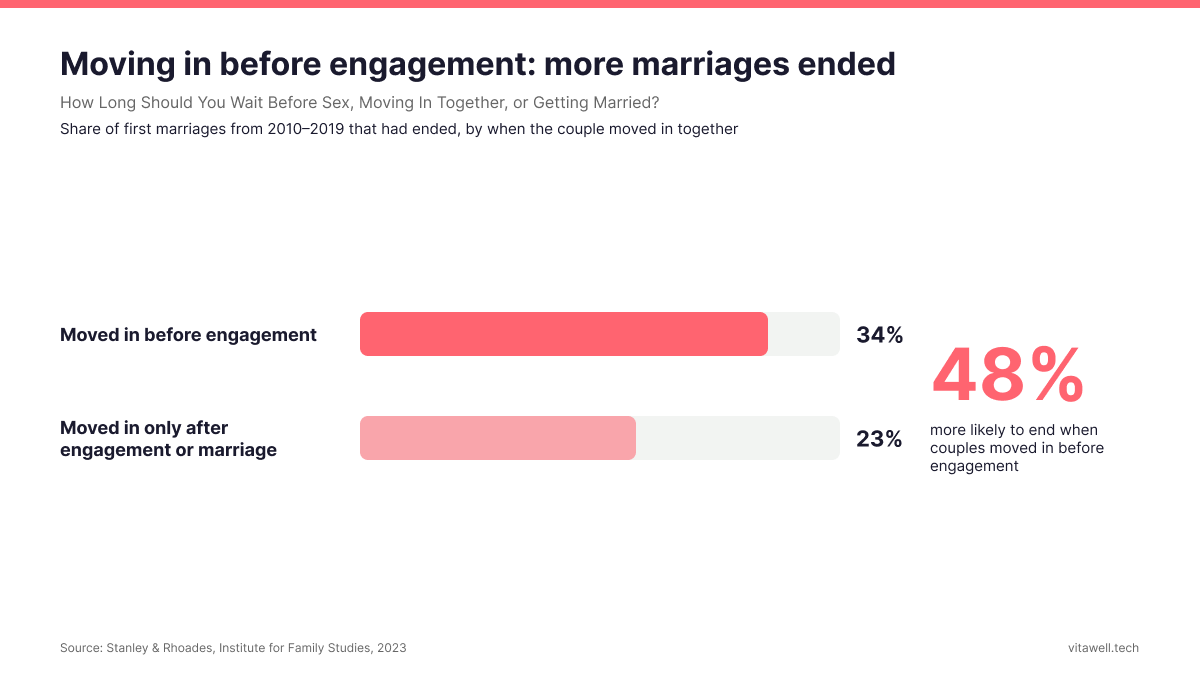
The evidence is more conditional than that belief. In a national sample of Americans who first married between 2010 and 2019, Stanley and Rhoades (2023) found that 34% of marriages had ended among people who moved in before getting engaged. Among those who moved in only after engagement or marriage, the figure was 23%, which makes the first group’s marriages 48% more likely to end. The study is observational, so it shows a pattern, not proof that the order of events causes divorce.
Motivation matters too. Chapman, Liu, Stanley and Rhoades (2026), in Couple and Family Psychology, followed 485 adults who moved in with a partner, surveying them up to 11 times over five years. Moving in to spend more time together predicted better relationship functioning. Moving in to test the relationship predicted worse functioning and a higher likelihood of breaking up, while convenience predicted neither.
The authors add a caveat: the reasons seem to reflect how good the relationship already was, not to change its later course. In other words, wanting a “test” is often a sign of existing doubt. Once you share a home, the question of how to maintain individuality within a shared life also becomes central.
The research-supported approach: move in together because you are already committed, not to find out whether you could be.
When to Get Married: The Case for Two to Three Years
Ben-Ze’ev notes that many relationship researchers and therapists suggest two to three years of dating before marriage. The best available numbers come from economists Andrew Francis-Tan and Hugo Mialon (2015), in Economic Inquiry, who surveyed 3,151 ever-married U.S. adults. After adjusting for demographic and relationship factors, people who dated three or more years before the proposal had a divorce hazard ratio of 0.76 compared with those who dated less than a year. A hazard ratio compares how quickly an event happens in two groups, so 0.76 means a roughly 24% lower rate of divorce over time.
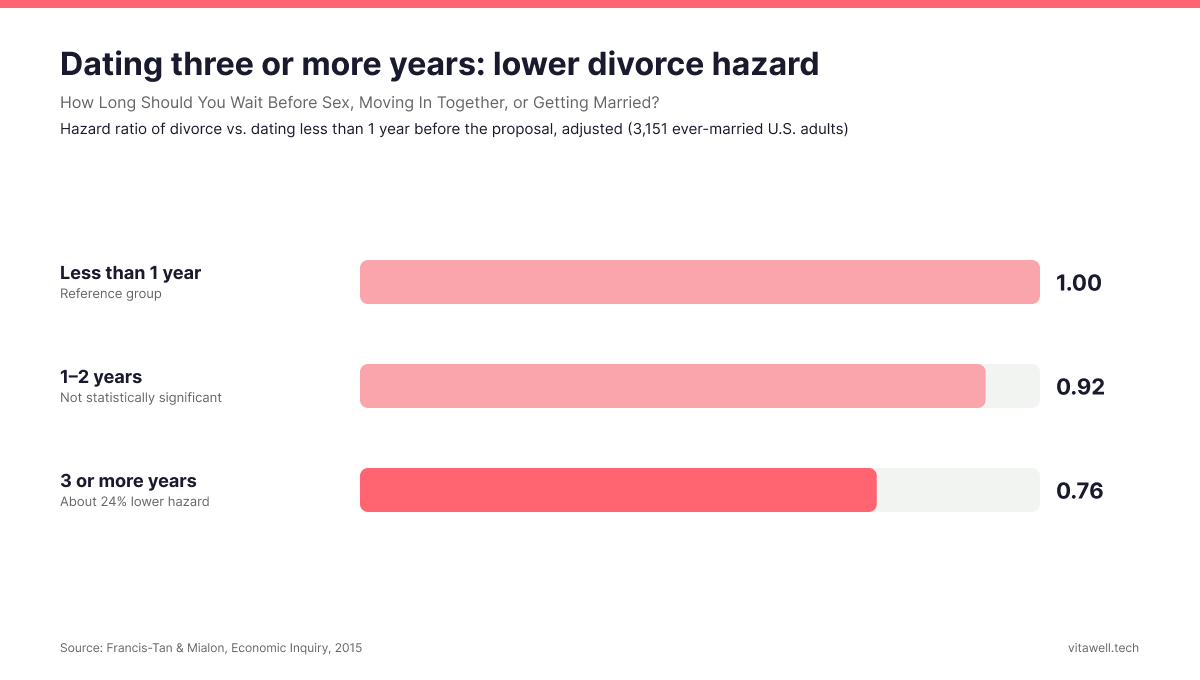
Dating one to two years gave a ratio of 0.92, a difference too small to separate from chance. The longer-dating advantage was clear for men and not statistically significant for women in the adjusted model. The sample came from an online survey panel, so it is not fully representative of all marriages.
Why would time help? Two mechanisms are plausible: it takes time to see a partner across different situations (stress, conflict, family, money), and early romance tends to be idealized. Neither mechanism requires a fixed number of months. What they require is that you have seen enough of each other’s ordinary and difficult days to choose with open eyes.
The Hidden Factor: Deciding vs. Drifting
“Sliding vs. deciding” names relationship inertia as a risk of its own, separate from timing. Couples who slide through transitions (from dating to exclusive, to living together, to marriage) without an explicit conversation pile up shared constraints before they have made a shared choice. Ben-Ze’ev’s review notes that more than half of cohabiting couples report never having explicitly discussed moving in before doing so.
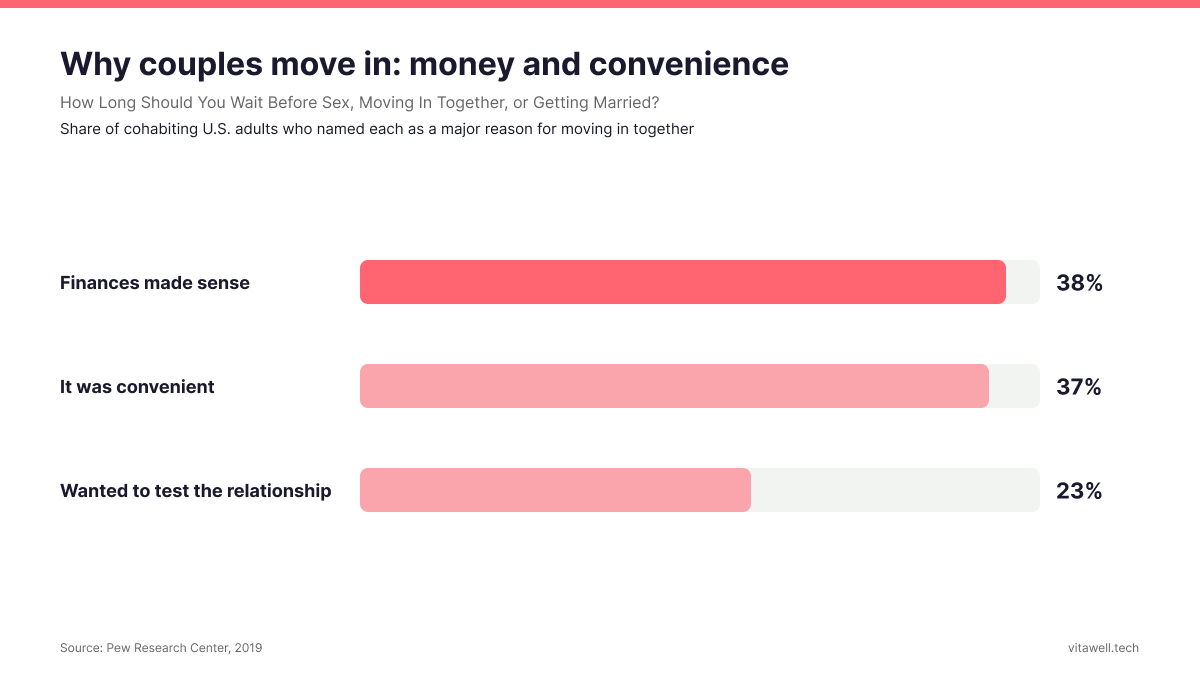
Pew’s 2019 survey shows how practical the pull can be. Among cohabiting adults, 38% said finances were a major reason they moved in, 37% cited convenience and 23% wanted to test the relationship.
Why does drifting matter? Every implicit transition raises the cost of leaving. Once you share a lease, a pet and a social circle, leaving is logistically and emotionally expensive, even if the relationship is not working well. That higher exit cost can keep couples together past the point where they would otherwise recognize incompatibility.
The antidote isn’t a fixed timeline. It is a pause at each turning point where both partners say out loud what the next step means and choose it. An earlier Denver study of 120 cohabiting couples (Rhoades, Stanley and Markman, 2009) found that testing the relationship as a reason for moving in was linked to more negative communication and lower confidence in the relationship.
Relationship Milestone Decision Guide
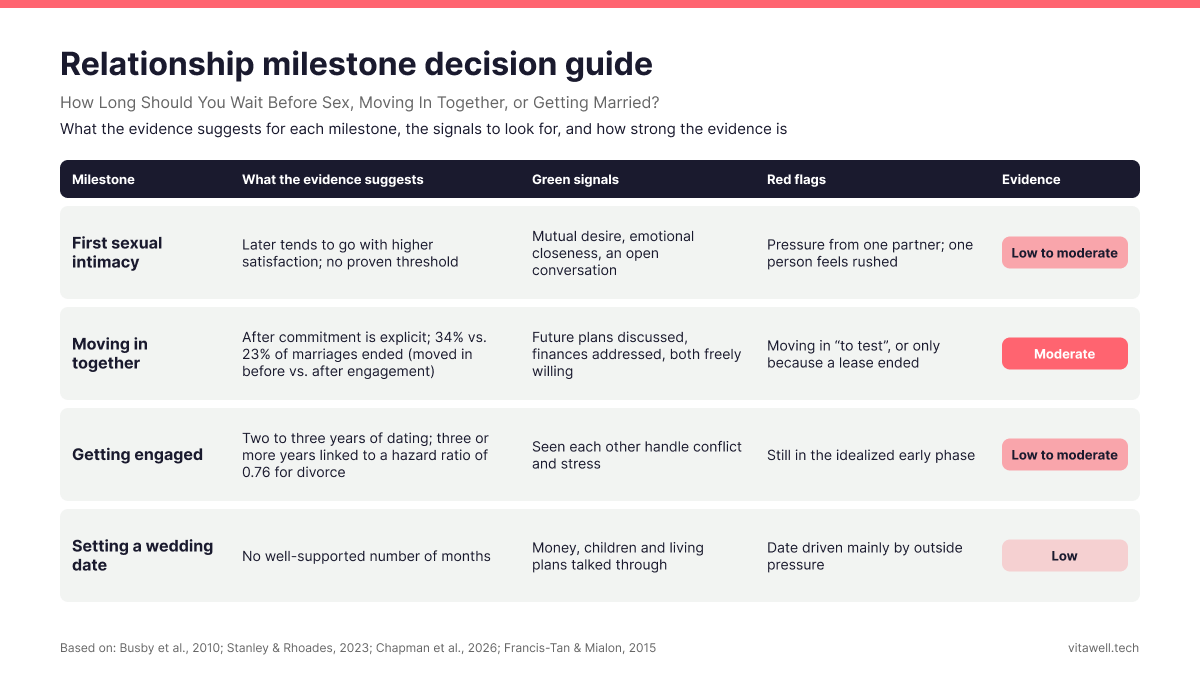
| Milestone | What the Evidence Suggests | Green Signals | Red Flags | Evidence Strength |
|---|---|---|---|---|
| First sexual intimacy | Later tends to go with higher satisfaction; no proven threshold | Mutual desire, emotional closeness, an open conversation about it | Pressure from one partner, one person feels rushed | Low to moderate (cross-sectional surveys) |
| Moving in together | After commitment is explicit; 34% vs. 23% of marriages ended when couples moved in before vs. after engagement | Future plans discussed, finances addressed, both freely willing | Moving in “to test”, or only because a lease ended or rent was cheaper | Moderate (national sample plus five-year longitudinal study) |
| Getting engaged | Two to three years of dating; three or more years linked to a hazard ratio of 0.76 for divorce | You have seen each other handle conflict and stress; values and goals compared | Still in the idealized early phase, no major stress weathered together | Low to moderate (one large online survey plus expert opinion) |
| Setting a wedding date | No well-supported number of months | Money, children and living plans talked through; both choose the date | Date driven mainly by outside pressure from family or circumstances | Low (expert opinion) |
What Deliberate Timing Looks Like in Practice
Based on the research, the following practices characterize the “deciding” rather than “drifting” approach to relationship milestones.
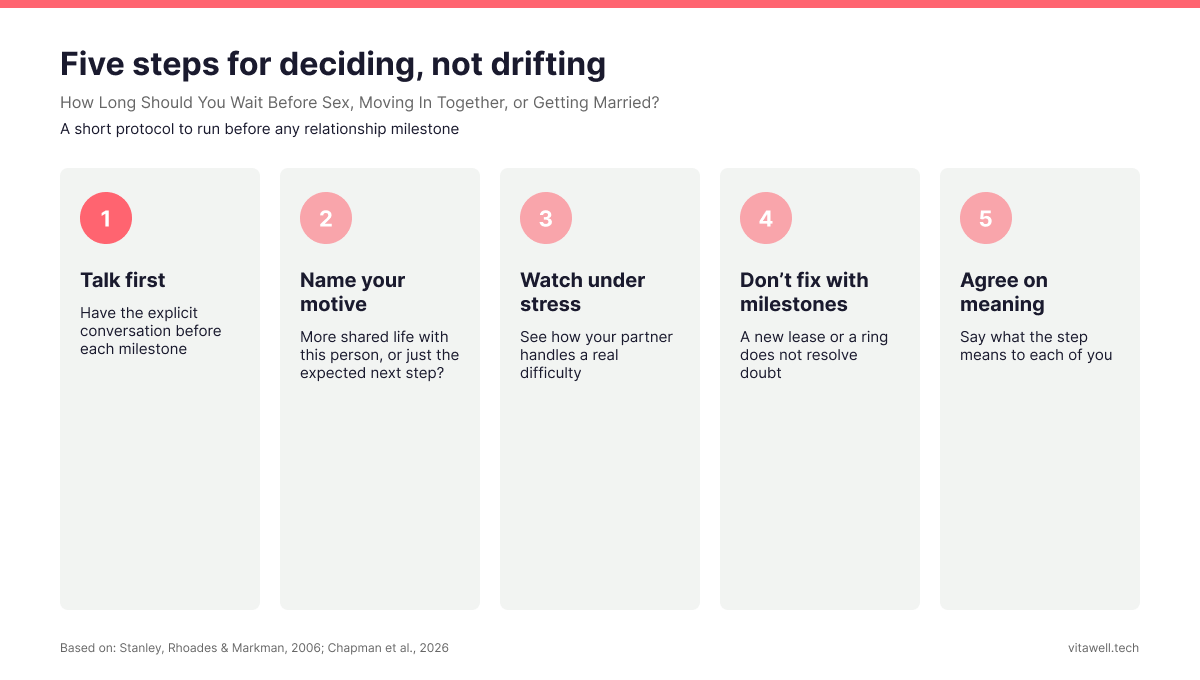
- Have the explicit conversation before each milestone. Don’t wait for circumstances to force a decision. “I’d like to talk about whether moving in makes sense for us” is a decision conversation. “My lease is up, so I guess I’ll move in with you” is drifting.
- Identify your motivation. Before each milestone, ask: am I doing this because I want more of a shared life with this person, or because it feels like the expected next step? The testing motivation for cohabitation is associated with worse outcomes; wanting more time together is not.
- Observe your partner across adversity. Two to three years usually includes at least one real stressor, such as a job loss, a family crisis or a health scare, that shows how your partner handles difficulty. What you observe matters more than time elapsed alone.
- Don’t use milestones to fix problems. A new lease or a ring does not resolve doubt. Shared commitment comes before shared living, not as a result of it.
- Agree explicitly on what the milestone means. “Moving in together” can mean “a step toward marriage” to one partner and “testing the waters” to the other. Making the shared meaning explicit before the move reduces mismatched expectations and resentment later.
When Moving Quickly Works — and When It Doesn’t
The research is probabilistic, not prescriptive. Couples who marry after six months sometimes build long, stable marriages; couples who date for five years before marrying sometimes divorce within two. The dating-length and sexual-timing findings are population-level patterns with wide individual variation.
The studies above do not test which couples can safely move fast, so what follows is reasoning, not data. A faster timeline is plausibly less risky when both partners have lived independently, have talked through values and future plans, and are not reacting to a recent breakup. A slower one makes sense when either partner feels unsure, pressured or new to serious relationships.
The key variable is deliberateness, not duration. A couple that makes an explicit, discussed decision to move quickly is in a different position from a couple that drifts through the same timeline without conversation.
What to Do if Your Timeline Doesn’t Match Your Partner’s
Mismatched timelines are a common source of early-relationship conflict. Couples who avoid the conversation tend to default to the more eager partner’s pace without real agreement. The person who wanted to move more slowly can feel overridden, and the person who wanted to move faster can doubt whether the other is fully committed.
The productive path is a direct conversation about what each milestone means to each person, what their preferred timeline is, and why. If that conversation ends the relationship rather than advancing it, practices for processing that loss can help both people move forward constructively.
When to Talk to a Professional
Consult a licensed couples therapist or relationship counselor if you are facing a significant timeline mismatch, recurring conflict about readiness for cohabitation or marriage, a history of relationship trauma that affects decision-making, pressure or fear around sex or commitment, or the end of a long-term relationship that involved living together. The American Association for Marriage and Family Therapy (AAMFT) maintains a directory for finding a licensed professional in your area.
Frequently Asked Questions
How long should you date before moving in together?
No study sets a minimum number of months. The clearer finding concerns sequence and motive: in a 2023 national sample, 34% of marriages ended among couples who moved in before engagement, against 23% who moved in after. Move in once you have both discussed your future, your finances and what living together means.
Is it true that having sex too early hurts a relationship?
Not necessarily. A 2010 survey of 2,035 married people found that those who waited longest rated their relationship stability 22% higher and satisfaction 20% higher than those who had sex earliest. That is a correlation from one snapshot survey. It cannot show that early sex causes problems, and individual couples vary widely.
Does living together before marriage reduce divorce risk?
The data do not show a protective effect. About 48% of U.S. adults believe living together first improves the odds, but research links cohabiting before a clear commitment with more marriages ending. Couples who move in to spend more time together fare better than those who move in to test the relationship.
What is relationship inertia, and why does it matter?
Relationship inertia is the tendency to keep moving forward through exclusivity, cohabitation and marriage because leaving has become costly, not because you chose each step. Stanley, Rhoades and Markman call this “sliding” as opposed to “deciding”. Shared leases, pets and friends raise the cost of leaving and can hold together a relationship that is not working.
What is the optimal time to date before getting engaged?
No period guarantees success. In a 2015 survey of 3,151 ever-married adults, dating three or more years before the proposal was tied to a hazard ratio of 0.76 for divorce compared with under one year. Many therapists suggest two to three years, enough time to see a partner under stress.
Conclusion
The question of how long to wait before major relationship milestones has research-backed answers, but the most important variable isn’t the number of months. It is whether you are making a deliberate decision or drifting through a transition that circumstances made convenient. The 2026 research on reasons for moving in, two decades of work on sliding versus deciding, and the findings on sexual timing and dating length point the same way: commitments that are explicit and mutually chosen tend to fare better than those built on inertia. The conversation about readiness, motivation and what a milestone means to each of you matters more than the calendar.
For more on building a life that integrates your relationship alongside your other priorities, explore VitaWell’s approach to balanced life planning.
Related on VitaWell
- Dating in the Digital Age: Real Tips That Work — Guidance on the earlier stage of finding and getting to know a compatible partner.
- Balancing Independence and Togetherness — How couples handle the tension between individuality and shared life once a relationship deepens.
- Rituals for Letting Go and Moving On — Ways to process a relationship that didn’t survive a milestone decision.
This article is for informational purposes only and does not constitute relationship, psychological or medical advice. Individual circumstances vary; speaking with a licensed couples therapist is appropriate when facing major relationship decisions.
Sources
- Psychology Today — Ben-Ze’ev, A. (Nov. 21, 2026). How Long Should We Wait for Sex, Cohabitation, and Marriage?
- Chapman, Liu, Stanley & Rhoades, 2026 — Reasons for cohabitation are associated with relationship outcomes over time. Couple and Family Psychology, 15(2)
- Stanley & Rhoades, Institute for Family Studies, 2023 — What’s the Plan? Cohabitation, Engagement, and Divorce
- Pew Research Center, 2019 — Marriage and Cohabitation in the U.S.
- Francis-Tan & Mialon, 2015 — “A Diamond Is Forever” and Other Fairy Tales. Economic Inquiry, 53(4)
- Busby, Carroll & Willoughby, 2010 — Compatibility or restraint? The effects of sexual timing on marriage relationships. Journal of Family Psychology, 24(6)
- Rhoades, Stanley & Markman, 2009 — Couples’ Reasons for Cohabitation. Journal of Family Issues, 30(2)
- Stanley, Rhoades & Markman, 2006 — Sliding versus Deciding: Inertia and the Premarital Cohabitation Effect. Family Relations, 55(4)