How City Design Can Inspire Awe and Build Community Connection
Cities that trigger awe — through green space, public art, and human-scale design — measurably reduce loneliness and strengthen community bonds. Here is the science and what you can do with it.
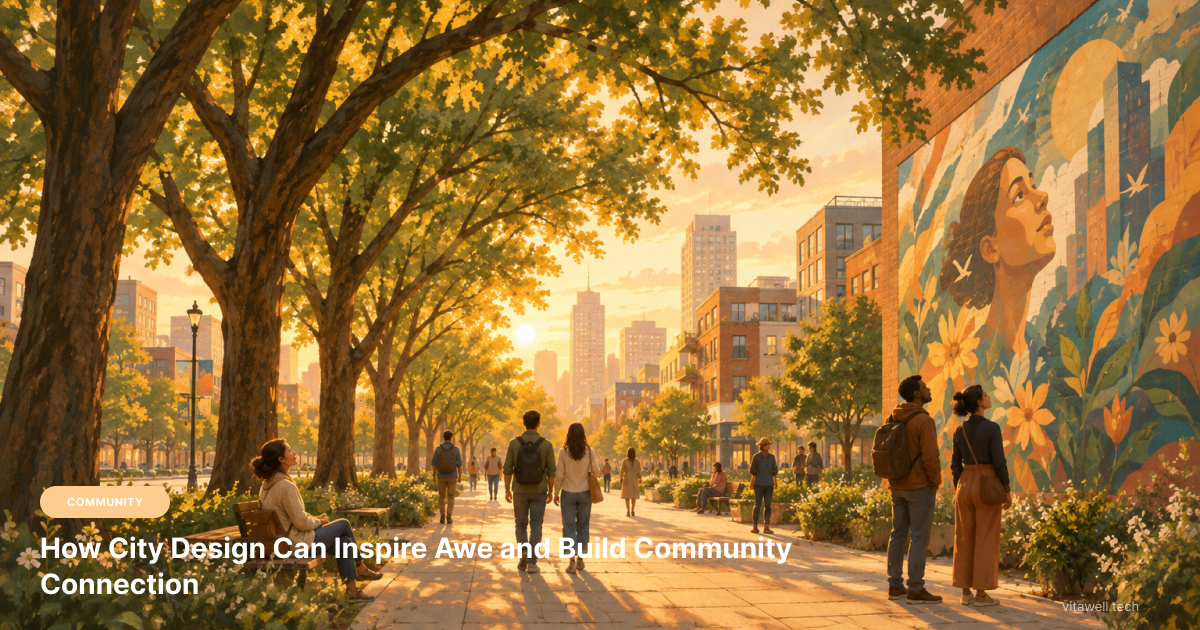
The cities we live in are quietly shaping how connected — or how alone — we feel. Research shows that urban environments designed to trigger awe — the emotion of being part of something bigger than yourself — reduce loneliness, increase generosity toward strangers, and strengthen the social fabric of communities. You don't need a grand canyon or a cathedral: a well-placed mural, a tree canopy, or an unexpected view can deliver the same effect in your morning commute.
Key Takeaways
- WHO data (2025) links loneliness to 871,000 deaths per year worldwide — urban design is now a public health issue
- Awe triggers a "small self" effect: people feel less isolated and more connected to those around them (Piff et al., N=2,078)
- Green space corridors, public art, and slow-paced urban design demonstrably reduce loneliness and increase social interaction
- Children's perspectives are the most reliable guide to designing awe-inspiring public spaces
- Six practical steps — from slowing your walk to advocating for better spaces — can help you find awe in any city
The Loneliness Epidemic — and Why Cities Are Part of the Problem
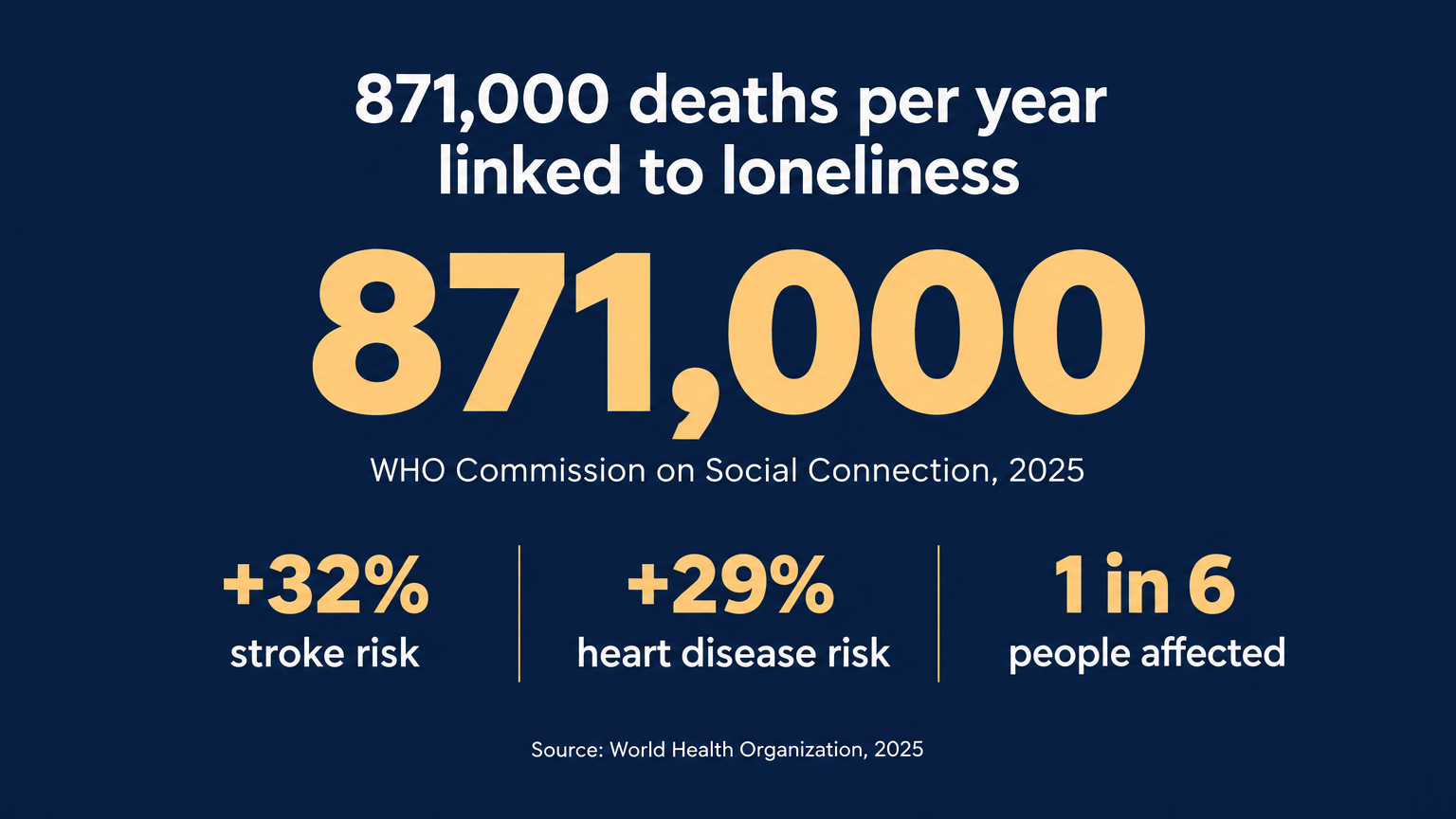
Loneliness is no longer a personal inconvenience. The World Health Organization's 2025 Commission on Social Connection found that 1 in 6 people worldwide are affected by loneliness, and the condition is linked to an estimated 871,000 deaths every year — roughly 100 deaths every hour. Loneliness increases the risk of stroke by 32%, heart disease by 29%, and significantly accelerates cognitive decline.
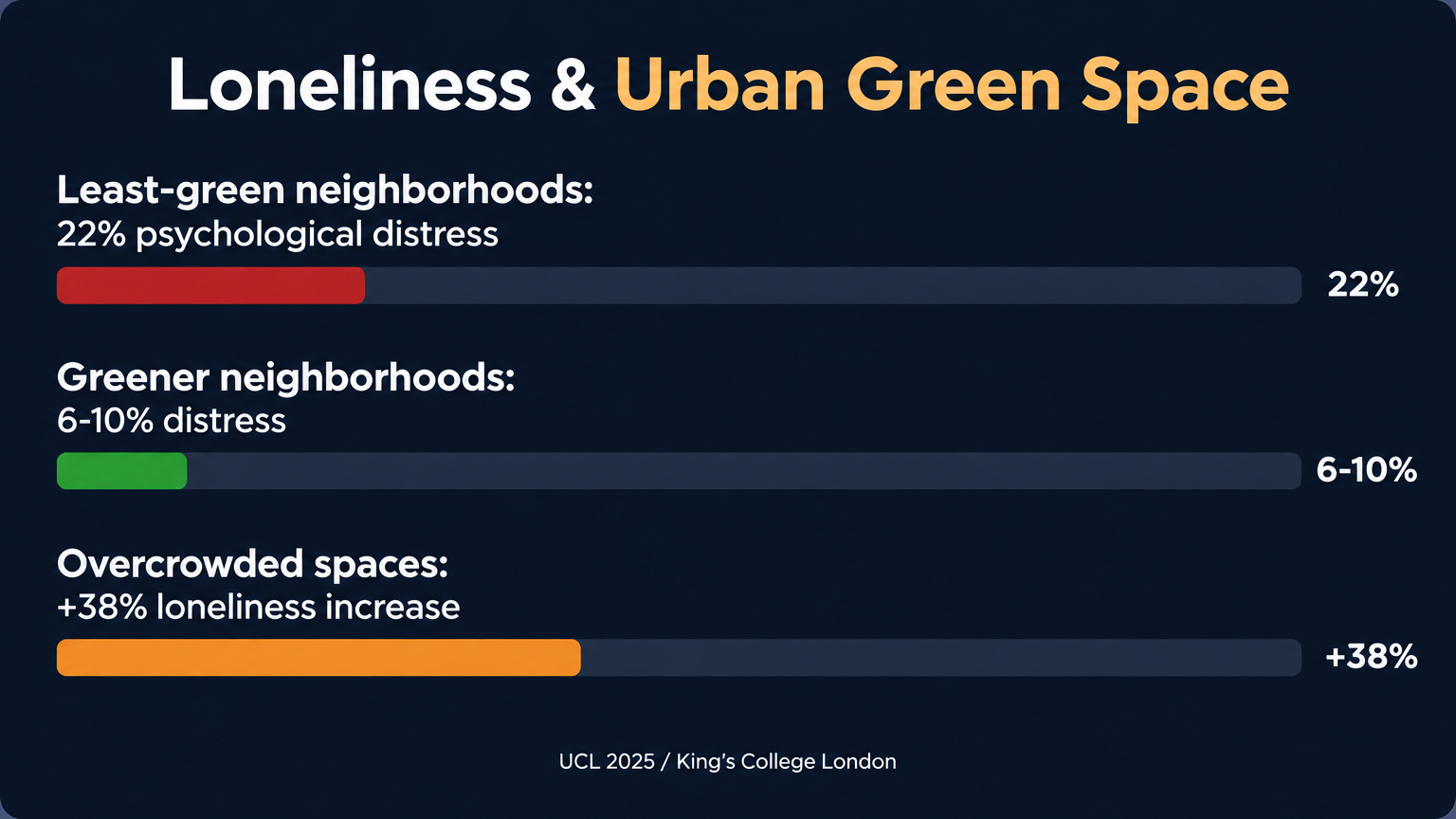
Cities are both the site of this crisis and, potentially, its cure. Research from King's College London found that overcrowded urban environments — dense spaces lacking green areas, visual interest, or social infrastructure — increase loneliness by 38%. Urban density without design intention doesn't bring people together; it pushes them apart. If you've ever walked through a wind-tunnel concrete plaza and felt more alone than before, the data confirms what your body already knew. The barriers to connection in modern cities are numerous and often invisible.
The question is not whether cities can fix loneliness — they clearly can make it worse or better. The question is what design principles actually move the needle toward connection. Emerging research points to one emotion as a reliable catalyst: awe.
What Is Urban Awe — and Why Should Cities Design for It?
Psychologists define awe as the experience of encountering something so vast or unexpected that your existing mental frameworks need to be updated. It's the feeling you get standing beneath a cathedral dome, emerging from a subway into a dazzling skyline, or watching light filter through an urban forest canopy. The Greater Good Science Center at UC Berkeley has documented awe's effects across dozens of studies: it improves mood, lowers inflammation markers, makes people feel like time is more expansive, and — crucially for loneliness — fundamentally shifts how people relate to each other.
Paul Piff and colleagues at UC Irvine conducted five studies involving 2,078 participants and found that experiencing awe consistently increases prosocial behavior. The mechanism is what researchers call the "small self" effect: when awe makes you feel part of something vast, your preoccupation with your own concerns shrinks, and you become more attentive and generous toward the strangers around you. In one striking finding, visitors who had spent time near an awe-inspiring T. rex skeleton were significantly more likely to use universal descriptors to describe themselves — "an inhabitant of Earth" rather than "a student" or "tall." In another study, awe-induced participants drew self-portraits nearly 33% smaller than those in a neutral condition, suggesting that awe literally changes how much space you feel you occupy relative to the world.
This is why urban awe matters for community. It doesn't just make you feel better — it makes you more open to the people around you. The same mechanism that makes slow looking at art build empathy works in the city at large. The city becomes not just a backdrop for your commute, but a force that gently dissolves the walls between you and others.
The 5 Urban Awe Channels
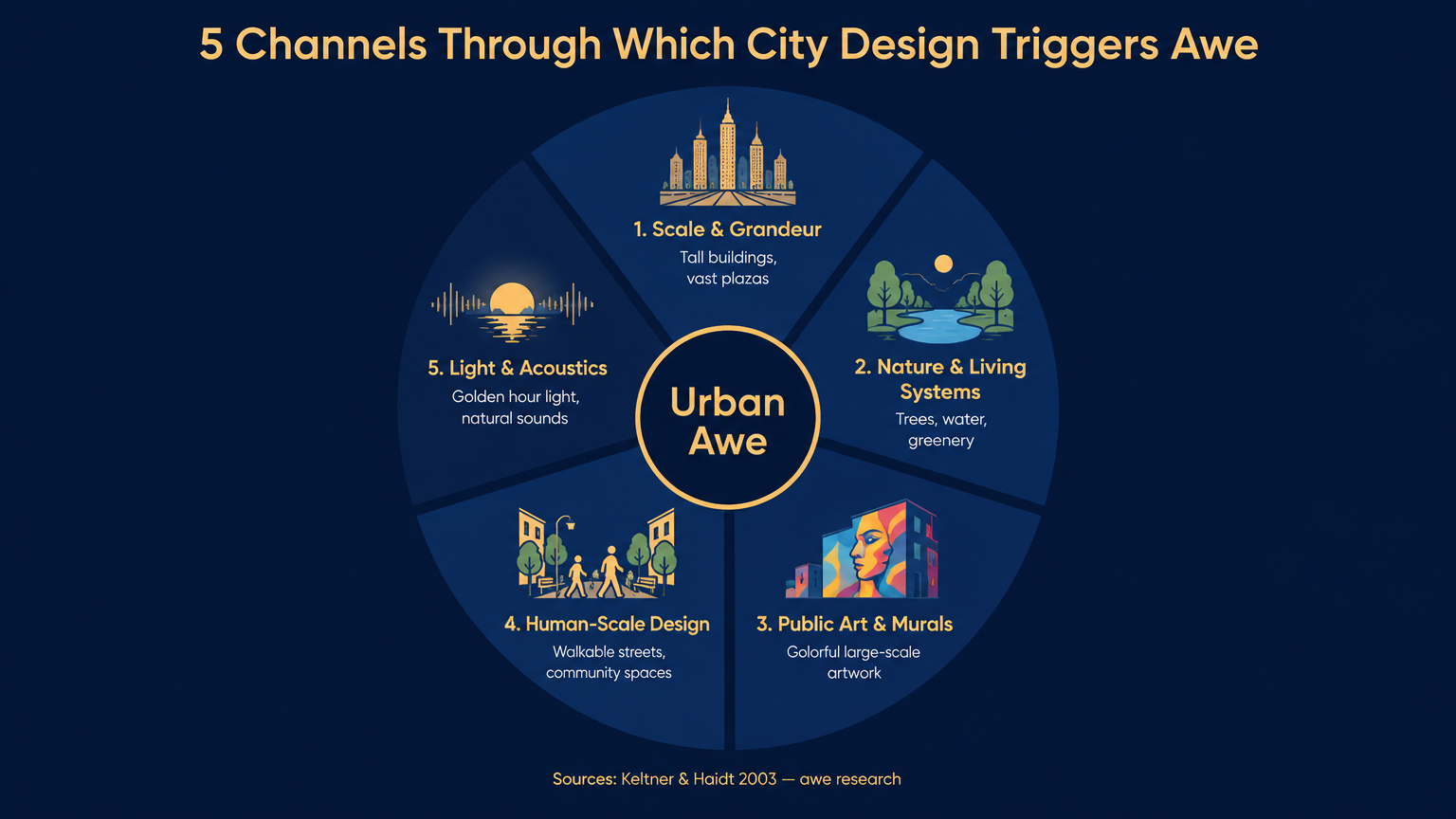
Social anthropologist and urban designer Louise Vogel Kielgast, whose work is part of the Gambrell Foundation-funded "Cities of Awe" series, has spent years studying how cities can be intentionally shaped for wonder. Her research, alongside evidence from urban ecology and public space design, points to five distinct channels through which cities can trigger awe.
1. Architecture and Scale
Grand proportions, unexpected negative space, the contrast of old stone against modern glass — architecture can trigger awe even in a single glance. This doesn't require landmark buildings. A preserved church facade between glass towers, an unusually wide boulevard that opens into an unexpected sky view, a covered arcade — all of these can produce brief but genuine moments of wonder in daily urban life.
2. Living Green Infrastructure
Green space is not decoration. Research from University College London published in October 2025 found that 22% of adults in the least-green urban areas report high psychological distress, compared with just 6–10% in greener neighborhoods. A 2024 study by Cardinali and colleagues examining four European cities found that accessible green space corridors improve social cohesion and mental health outcomes simultaneously. Trees, in particular, trigger awe through their scale, age, and unpredictability. A 200-year-old oak in an urban square does something that no concrete structure can: it reminds you that life extends far beyond your own timeline.
3. Public Art and Activation
The 2025 Bentway report from Toronto's celebrated underpass park found that public art installations create "stickier spaces" — places where people linger longer and interact more with strangers than in spaces without art. This is not simply aesthetics. Art that stops you, makes you tilt your head, or makes you say "how did they do that?" is triggering awe — and in doing so, it creates the conditions for a glance, a comment, a conversation. Shared wonder is one of the fastest shortcuts to human connection. Looking beyond yourself — toward the art, the city, the stranger — is how community forms.
4. Chance Encounters and Social Tempo
Kielgast emphasizes that awe is not only visual — it also lives in the unexpected human encounter. Cities designed for slowness create more of these moments. Wide sidewalks that feel like rooms, benches placed at angles that invite conversation rather than parallel isolation, café tables that spill onto the street, public fountains that give children an excuse to splash — all of these slow the tempo of movement and create the micro-pauses in which connection becomes possible. Research shows that perceived social inclusivity — the feeling that the space welcomes you and others — is associated with a 21% decrease in loneliness (King's College London).
5. Designing for Children's Curiosity
The Gehl + Gambrell Foundation project "In Awe of Charlotte" enrolled 40 young citizen scientists to study their own city's capacity for awe. Their finding was deceptively simple: the quality of the built environment is directly related to people's ability to feel safe enough to slow down and wander. Children, who have not yet learned to rush or ignore their surroundings, are the most reliable sensors of urban awe. A space that a child finds magical — surprising, safe, full of texture and invitation — tends to work for everyone. Cities that design for children's wonder design for human flourishing broadly. Our surroundings shape our energy in ways we rarely pause to notice.
Urban Design Elements by Awe Potential and Community Benefit
| Design Element | Awe Channel | Community Benefit | Real-World Example |
|---|---|---|---|
| Tree canopy corridor | Nature | -38% loneliness in greener areas (King's College) | High Line, New York City |
| Large-scale public mural | Public Art | Stickier spaces: longer stays (Bentway 2025) | The Bentway, Toronto |
| Wide, meandering sidewalks | Chance encounters | More spontaneous social interactions | Strøget, Copenhagen |
| Mixed-use ground floors | Social tempo | -21% loneliness with perceived inclusivity | Amsterdam canal streets |
| Children's play plazas | Children's curiosity | Safety + wonder = awe for all ages | Gehl "Cities of Awe" project |
| Sky-view urban parks | Architecture/scale | "Small self" effect → prosocial behavior (Piff) | Millennium Park, Chicago |
What Happens in Your Brain When a City Triggers Awe
Awe's effects are measurable and fast. Studies show that even brief awe experiences — a moment looking up at a tall tree, a glance at a sweeping mural — produce real physiological and psychological shifts. People who experience awe feel that time is more expansive, which makes them more willing to offer their time to others. They feel less absorbed in their personal concerns, which makes them more receptive to those around them. And they feel, as the research consistently shows, more like citizens of a shared world rather than isolated individuals navigating a crowd.
This is the design opportunity hiding in the loneliness epidemic. Awe is not a luxury feature of exceptional cities — it is a public health tool available to any neighborhood willing to invest in a mural, a tree, or a bench placed at a human angle.
6 Practices to Find More Awe in Your Daily City Environment
- Slow down your walk. Deliberately cut your walking pace by half once a day. Notice the texture of walls, the shapes of windows, the faces of people going the other direction.
- Explore shared spaces with fresh eyes. Visit a plaza, library, or park you usually pass through without stopping. Sit for ten minutes without your phone.
- Notice small wonders. A patch of moss on a concrete step, an unusual door, a tree growing through a cracked sidewalk — small wonders build an awe habit over time.
- Make room for connection. Greet a neighbor. Make eye contact at the coffee shop. Say yes to a local event you'd normally skip. Awe opens the door; connection is the conversation you have once you're through it.
- See your neighborhood through a child's eyes. Ask a child what they find magical about your street. Their answer will tell you something a city planner missed.
- Advocate for better spaces. Attend a city council meeting on a park proposal. Support local greening or public art initiatives. Volunteer with urban design or community garden projects. The cities that inspire awe are built by people who demanded them.
When to Talk to a Professional
If feelings of chronic loneliness are significantly affecting your daily life, wellbeing, or health, please speak with a therapist or counselor. Loneliness is a recognized public health risk — it deserves professional attention alongside any lifestyle changes you make.
Frequently Asked Questions
How does urban design affect mental health?
Dense, low-green urban environments increase loneliness by up to 38%, according to King's College London research. Conversely, cities with accessible parks, public art, and slow-paced streets lower psychological distress and promote social connection. Urban design is a direct mental health intervention — not just an aesthetic choice.
What is "urban awe" and can I experience it in any city?
Urban awe is the feeling of vastness and wonder triggered by your built environment — a sweeping skyline, a giant mural, or a tree-lined avenue you've never really looked at. Research shows awe is accessible in everyday city life; it doesn't require grand natural landscapes. Any city can be designed — or experienced — as a source of wonder.
Does public art actually reduce loneliness?
Yes. The 2025 Bentway report found that public art installations create "stickier spaces" where people stay longer and interact more with strangers. This increased social contact directly counters the conditions that produce loneliness.
Why are children's perspectives important for city design?
Children naturally notice what adults overlook — texture, scale, surprise, wonder. The Gehl + Gambrell Foundation's "In Awe of Charlotte" project found that cities designed for children's curiosity and safety produce environments where everyone — not just children — feels safe enough to wander and connect.
Can a single city feature really make me feel less alone?
Research suggests yes — measurably. Piff et al.'s five studies involving 2,078 participants show that even brief awe experiences shift attention from self-concern to others, increasing helping behavior toward strangers. A walk through a beautiful park or a moment in front of a striking mural can shift your social orientation within minutes.
Building Cities — and Lives — That Make Room for Wonder
The science of awe gives cities something concrete to design toward: not just density or efficiency, but moments of genuine wonder that pull us out of ourselves and toward each other. While urban planners and architects are beginning to take this seriously — and the WHO's 2025 loneliness report makes the case that they must — you don't have to wait for your city to change. Every time you slow down to notice something beautiful in your environment, you are practicing the kind of attention that builds connection. And every time you advocate for a park, a mural, or a wider sidewalk, you are part of making a city that heals loneliness one block at a time.
This article is for informational purposes only and does not constitute medical or psychological advice. If you are experiencing chronic loneliness or its mental health effects, please speak with a qualified healthcare professional.
Related on VitaWell
- Walking: The Simplest Habit That Improves Your Life — walking is the most direct way to experience urban awe and stumble into accidental community
- How to Host Meaningful Gatherings — once awe opens you to connection, gatherings are how you deepen it
- Reconnecting With Nature: A Spiritual Reset — when urban nature isn't enough, deeper nature immersion restores the same awe circuitry
Sources
- WHO Commission on Social Connection — Social connection linked to improved health and reduced risk of early death, Jun 30 2025
- Greater Good Science Center — Awe-Makers: Designing Cities for Connection (podcast), Nov 26 2026
- Piff et al., UC Irvine — Awe Promotes Altruistic Behavior (5 studies, N=2,078)
- World Economic Forum / King's College London — Loneliness, green space, and cities
- UCL Centre for Longitudinal Studies, Oct 2025 — How do greener neighbourhoods impact your mental health?
- The Bentway, 2025 — New Bentway report shows how public spaces reduce urban loneliness
- Cardinali, 2024 — Urban Forestry & Urban Greening: green space corridors, social cohesion and mental health in four European cities
- Gehl + Gambrell Foundation — In Awe of Charlotte
- Summer Allen, Greater Good Science Center — Eight Reasons Why Awe Makes Your Life Better