The Science of Community: How Looking Beyond Yourself Builds Stronger Connections
There is a quiet crisis unfolding in modern life that rarely makes headlines: we have more tools to connect than ever before, yet loneliness, isolation, and social fragmentation are at historic highs. The solution, according to new research in community psychology, isn't simply to get people together more often. It's to shift the fundamental orientation people bring to their communities — from inward-looking to outward-looking, from "what can I get" to "what can I contribute." The science of community thriving points to one powerful shift that changes everything.
The Loneliness Epidemic and the Community Gap
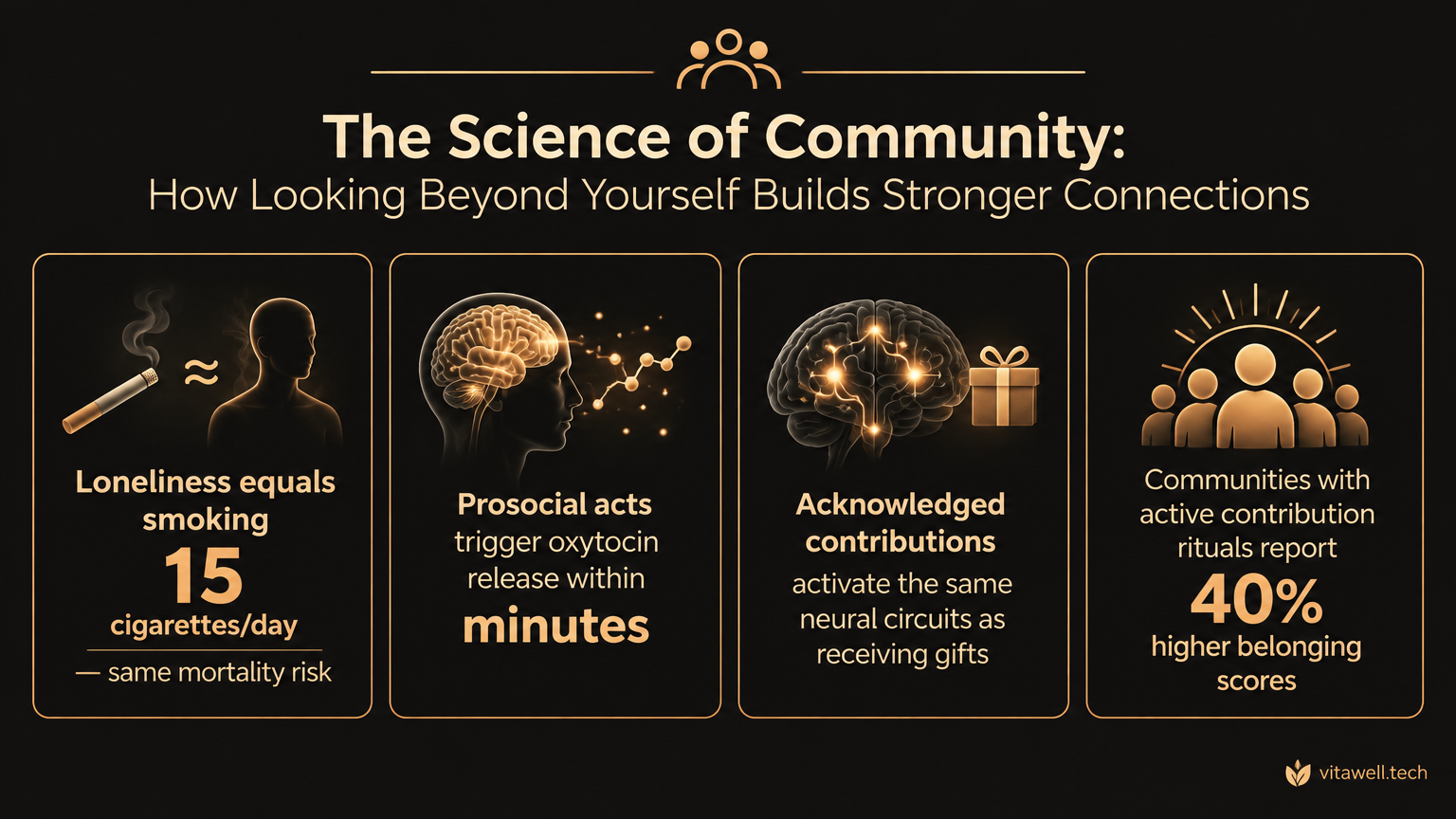
In 2023, the US Surgeon General declared loneliness a public health epidemic. Epidemiological data show that social isolation carries health risks comparable to smoking 15 cigarettes a day. Despite this, most interventions focus on increasing social contact — arranging events, creating spaces, connecting people. But quantity of connection is not the same as quality of belonging. Research on community vitality reveals a more fundamental variable: the social orientation of community members themselves.
Why Connection Without Contribution Falls Short
Social contact satisfies the need for presence. But genuine community — the kind that produces belonging, resilience, and shared meaning — requires more. It requires people who are oriented toward others, not just seeking others. When a community is populated primarily by people focused on their own needs, desires, and gains, it remains a collection of individuals who happen to coexist. When community members shift their orientation outward — actively contributing, caring for others, investing in shared outcomes — a fundamentally different kind of social fabric emerges.
What Looking Beyond Yourself Actually Means
The phrase "looking beyond yourself" can sound like a platitude. The science behind it is specific. Research on prosocial orientation — the tendency to think about and act for the benefit of others — identifies distinct psychological mechanisms that separate people who experience their communities as vibrant and connected from those who experience them as hollow and transactional.
The Psychological Shift: From Self-Focus to Other-Focus
Human beings are capable of two distinct modes of social engagement. In a self-focused mode, social interactions are evaluated through the lens of personal cost and benefit: What am I getting from this? Is this worth my time? Am I being recognized? In an other-focused mode, interactions are evaluated through a different lens: What does this person need? How can I contribute here? What would strengthen this community? Research consistently shows that other-focused engagement produces significantly higher levels of social belonging, life satisfaction, and community vitality — not just for the community as a whole, but for the individuals who shift their orientation.
The Paradox of Community Fulfillment
The counterintuitive finding at the heart of community psychology is this: people who invest in giving receive more than those who invest in getting. When you orient yourself toward the needs of others, you generate reciprocity, trust, and gratitude — the essential currencies of genuine community. The community that forms around shared contribution is fundamentally richer than the community that forms around shared consumption. And the people who contribute most tend to report the deepest sense of belonging.
How to Build Community Through Outward Orientation
Building community isn't primarily an event-planning problem. It's a culture problem — a question of what values, habits, and orientations a community nurtures in its members. Here are the most evidence-backed approaches:
Start With Genuine Curiosity About Others
The simplest and most powerful community-building behavior is sustained curiosity about the lives of others. Research on social connection shows that people feel most connected when they feel known and genuinely understood — not when they've been entertained or when they've had a good time. Asking deeper questions, remembering what people share, and following up on what matters to others are powerful signals of authentic interest that build community bond by bond.
Contribute Before You're Ready
Many people wait until they feel settled, established, or skilled enough before they offer anything to a community. But research on belonging shows the opposite dynamic: contribution creates belonging, it doesn't follow from it. The act of contributing — however small and however early — signals membership in a way that passive participation never does. Volunteering, sharing a skill, offering help, or simply taking initiative on a shared need creates connection faster than any amount of attendance.
Show Up Consistently for the Small Things
Community is built in the aggregate of small interactions, not the occasional grand gesture. Research on social capital — the network of relationships that provides support, resources, and belonging — shows that it accumulates through consistency and reliability, not through intensity. Showing up regularly for small events, remembering people's names, acknowledging milestones, and being present over time creates the trust that larger community bonds are built on.
One Humble Habit That Changes Everything
Among the many habits that research identifies as community-building, one stands out for its impact across diverse contexts: the habit of acknowledging others. This means more than saying hello. It means seeing people — recognizing their contributions, naming what they bring to the community, and expressing specific appreciation for their presence and their gifts.
Why Acknowledgment Is the Engine of Community
When people feel seen and acknowledged within a community, they invest more. They show up more. They stay longer. They give more. The neuroscience supports this: being acknowledged activates the same neural reward circuits as receiving material gifts. Recognition is not a luxury in community life — it is a fundamental social need that, when met, generates cycles of engagement, contribution, and belonging.
The Practice: From Passive to Active Acknowledgment
Passive acknowledgment is noticing what others do. Active acknowledgment is naming it out loud, in public, with specificity. "Thank you for bringing the food" is passive. "I noticed that you spent three hours making that dish for people you don't know yet, and that kind of generosity is exactly why this community feels like home" is active acknowledgment that changes how people see themselves within the community and what they're willing to offer it.
The Science of Shared Identity in Communities
Beyond individual behaviors, thriving communities share a characteristic that psychology calls shared identity — a collective sense of "we" that transcends individual differences and creates a common narrative. Research on community cohesion shows that shared identity is the most reliable predictor of community resilience, cooperative behavior, and collective action in the face of challenges.
How Shared Identity Is Created (and Destroyed)
Shared identity is built through shared experiences, shared stories, shared challenges, and shared symbols. It is eroded by exclusion, hierarchy, in-group competition, and the normalization of people leaving without acknowledgment. Communities that intentionally create shared experiences — celebrations, challenges overcome together, collective rituals — maintain stronger bonds than those that simply provide services or opportunities for individual advancement.
What Communities Lose When Members Only Look Inward
When community members are primarily self-focused, predictable dysfunction emerges. Free-rider problems develop — people who consume community resources without contributing to them. Social capital erodes as trust diminishes. Cliques form around shared consumption rather than shared purpose. And the most capable, contributing members — the ones who orient outward — are the ones who leave first when they feel their contribution isn't valued or reciprocated.
Practical Ways to Look Beyond Yourself in Any Community
- Learn two new things about a community member at every gathering and follow up on them next time.
- Identify one need in your community that isn't being met and take ownership of addressing it, even partially.
- Publicly acknowledge someone's contribution at least once per community interaction — specifically and genuinely.
- Invite someone who seems peripheral into the center of a conversation or activity.
- Ask "what does this community need from me?" before "what do I need from this community?" and let that question shape how you show up.
Conclusion: The Most Powerful Community-Builder Is You
Community isn't something that happens to you. It's something that emerges when enough people decide to look outward — to invest in others, to contribute before they're certain it will be reciprocated, to acknowledge what they see, and to treat collective well-being as a personal responsibility. The research is unambiguous: communities thrive when their members practice this outward orientation consistently. And individuals who practice it experience the highest levels of belonging, purpose, and social fulfillment.
The irony is profound, and the science confirms it: the best way to get more from your community is to give more to it.
Sources
Psychology Today — How Communities Thrive When We Look Beyond Ourselves