Slow Looking: How 15 Minutes With One Artwork Builds Awe, Empathy and Connection
Most people give an artwork under 30 seconds. What 15 minutes of slow looking does for beauty, empathy and stress — how strong the evidence is, and how to start.
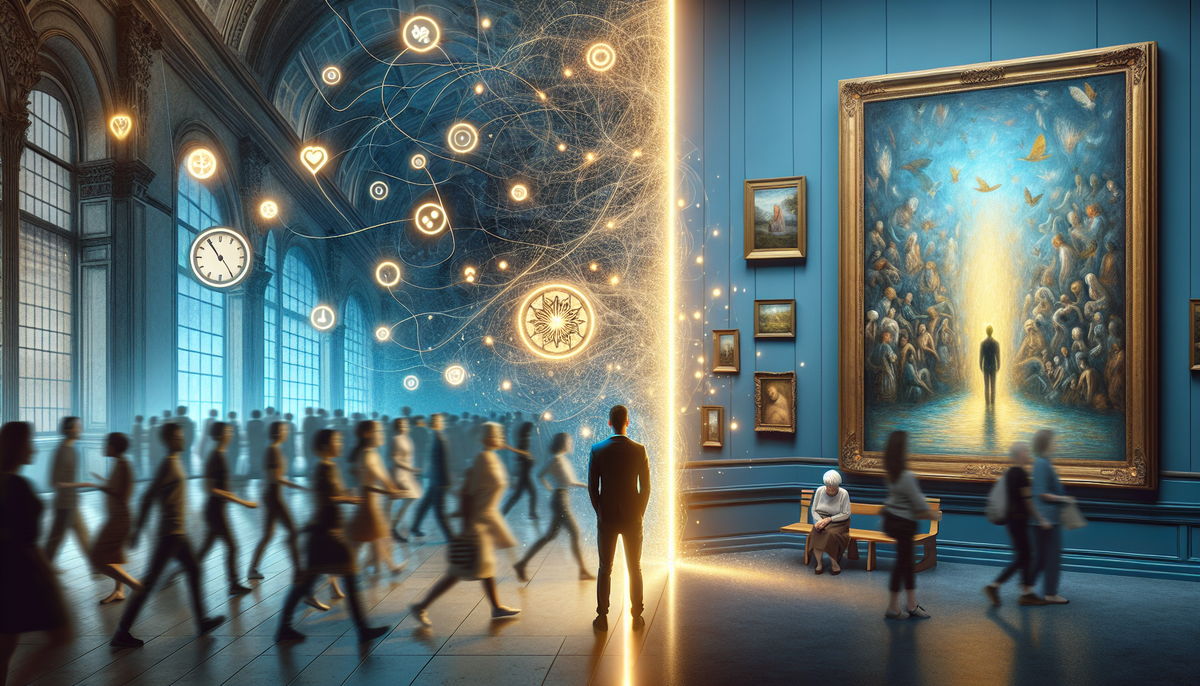
Slow looking means giving one artwork 10 to 20 minutes of structured attention instead of the usual half-minute glance. Museum studies put the average look at about 28 seconds, so a 15-minute session is roughly 31 times longer. Small studies link that extra time to seeing more beauty, feeling more empathy and lower stress, while the strongest health evidence comes from regular arts engagement over years rather than any single session.
Key Takeaways
- Visitors at two major art museums looked at each work for a mean of 27 to 29 seconds, and half looked for 21 seconds or less.
- A 15-minute structured look in a Penn Museum study left liking unchanged but raised ratings of beauty, empathy and compassion.
- In a 196-person gallery trial, one 90-minute slow-art session cut stress scores by 16.9%, though the drop did not differ significantly from the waitlist group.
- Viewing original paintings for 20 minutes lowered cortisol by 22%, versus 8% for reproductions, in an early study that has not yet been peer reviewed.
- Over 14 years, adults who engaged with the arts every few months had a 31% lower risk of death, an observational link rather than proof of cause.
The 27-Second Trap: How Long People Really Look at Art
The famous 27-second figure is real, and it has held up. Jeffrey and Lisa Smith timed visitors at the Metropolitan Museum of Art in 2001 and found a mean of 27.2 seconds and a median of 17 seconds per artwork. When they repeated the study at the Art Institute of Chicago with Pablo Tinio, the 2017 results in Psychology of Aesthetics, Creativity, and the Arts showed a mean of 28.63 seconds and a median of 21 seconds. The most common viewing time in both studies was 10 seconds.
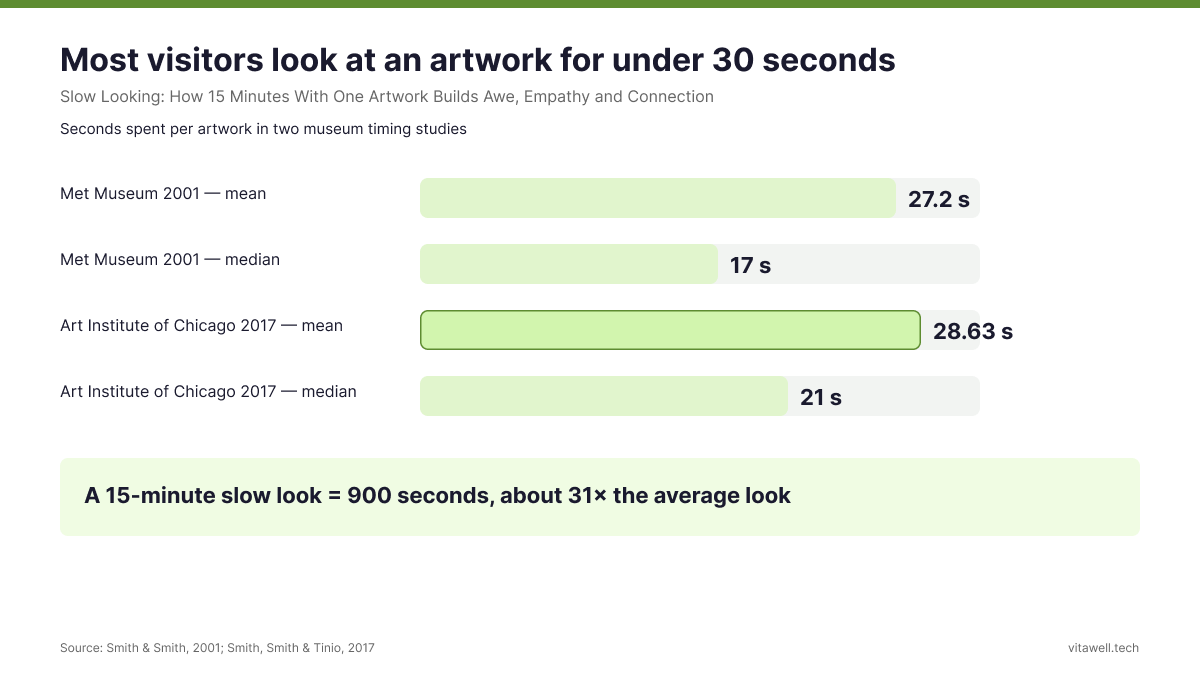
Those seconds often include reading the label and taking a photo. A 15-minute session is 900 seconds, about 31 times the average look. The gap mirrors a wider pattern of skimming everything, which VitaWell's piece on how the endless feed fragments attention explores in daily life.
What Slow Looking Is — and Where It Comes From
Slow looking is deliberate, unhurried attention to a single object, usually an artwork, guided by simple prompts. It is not passive staring: the viewer moves through what the work looks like, what it makes them feel and what it brings to mind. Museum educators have used versions of it for years, and many museums now run "slow art" sessions built around it.
The practice drew new attention in a 2026 episode of The Science of Happiness from UC Berkeley's Greater Good Science Center. Host Dacher Keltner spoke with Anjan Chatterjee, founding director of the Penn Center for Neuroaesthetics, and Colin Robertson, who leads education and research at the Nevada Museum of Art. Neuroaesthetics is the study of what happens in the brain and body when people experience beauty and art.
The broader field is large. A 2019 WHO scoping review by Daisy Fancourt and Saoirse Finn drew on more than 3,000 studies of the arts and health, though most were not about slow looking specifically.
The 15-Minute Slow-Looking Protocol, Step by Step
The protocol described by Chatterjee splits 15 minutes into three equal blocks, with a fourth rule that applies throughout. It works with a painting, a photograph, an object at home or a view outdoors.
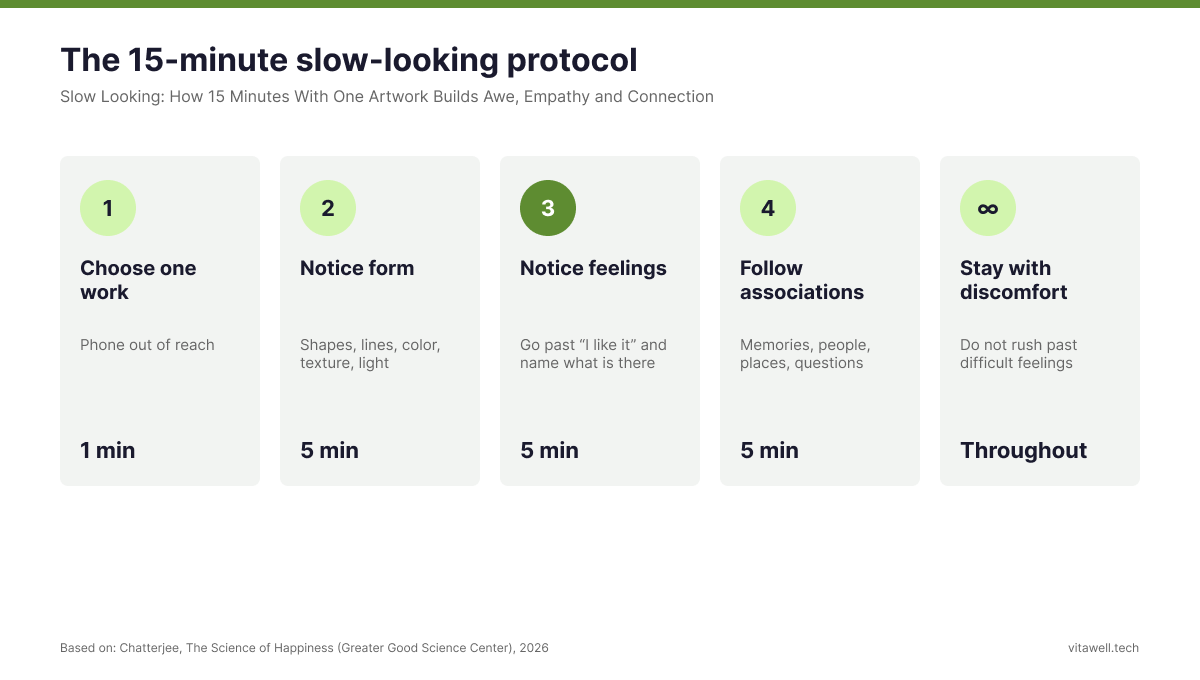
Step 1: Choose one work and remove distractions (1 minute)
Pick a single piece and put your phone out of reach. Sit or stand where you can see the whole work without straining. The goal is not to understand the piece but to stay with it long enough for your experience to change.
Step 2: Notice form only (5 minutes)
Look at shapes, lines, colors, textures, light, shadow and composition. Let your eyes travel slowly from edge to edge and into corners you would usually skip. Hold off on judging whether it is good.
Step 3: Notice your feelings (5 minutes)
Turn attention inward. Go past "I like it" or "I don't" and name what is actually there: curiosity, unease, calm, sadness, nostalgia or awe. Chatterjee compares this to wine tasting, where a richer vocabulary lets people notice more in the same glass.
Step 4: Follow associations (5 minutes)
Let the work lead your thoughts to memories, people, places or questions. Follow them without editing. Many people are surprised how fast the last block passes once they have a structure.
Throughout: stay with discomfort
If difficult feelings come up, do not rush past them; they are part of what the work is doing. The same method works outdoors, which is why it pairs well with the practices in VitaWell's guide to reconnecting with nature.
What Slow Looking Changes: Beauty, Not Liking
Chatterjee described a study at the Penn Museum, an anthropology museum, with University of Pennsylvania students. Each person viewed four works: two in their normal way and two for 15 minutes using the protocol above. Ratings of liking did not change, but ratings of beauty did, and participants reported more empathy and compassion after the slow sessions. The sample size and statistics were not given in the episode, so treat this as a promising early finding.
The split between liking and beauty matters. Liking is a quick preference; perceived beauty seems to grow with attention, as the viewer notices more of what the artist built in. Some participants also felt uncomfortable emotions, especially with Indigenous and African works whose colonial history became visible. Chatterjee argued those feelings are worth staying with in a safe setting rather than avoiding.
What a Gallery Trial Found on Stress and Well-Being
The most rigorous test of a slow-art session so far is Slow Art Plus, a waitlist randomized controlled trial at National Gallery Singapore. Andy Hau Yan Ho and colleagues reported in Frontiers in Public Health in 2024 that 225 adults enrolled and 196 completed a single 90-minute group session. It combined slow looking with mindfulness, self-compassion, a short creative response and sharing in pairs.
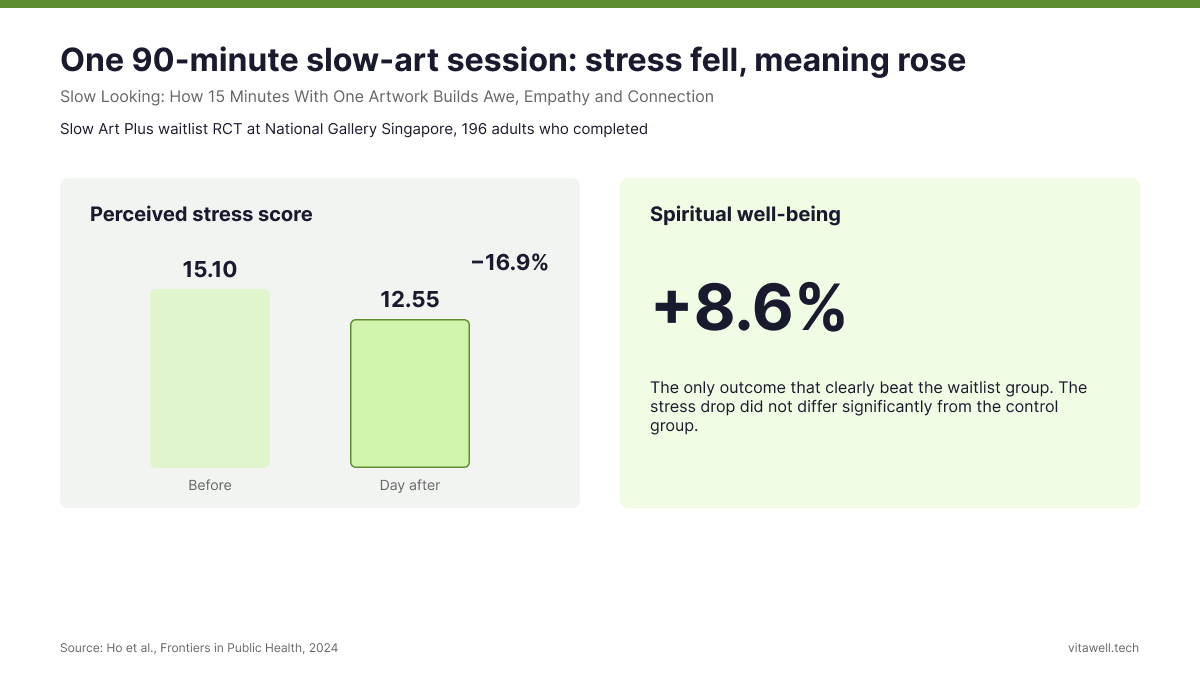
In the session group, stress scores on the Perceived Stress Scale fell from 15.10 to 12.55 the day after, a 16.9% drop. Spiritual well-being, a measure of meaning and peace, rose by 8.6% and was the outcome that clearly beat the waitlist group. The stress drop, however, did not differ significantly from the control group over time, and the "common humanity" score did not change significantly.
The honest reading: one session reliably increased a sense of meaning, while the stress benefit is plausible but not yet proven against a control. People with depression or other major mental health conditions were excluded, so results apply to generally healthy adults.
Originals vs. Reproductions: What Happens in the Body
A 2025 study from King's College London, funded by Art Fund, measured the body directly. Researchers at King's College London had 50 adults aged 18 to 40 view paintings by Manet, Van Gogh and Gauguin for about 20 minutes. Half saw the originals at The Courtauld Gallery; half saw reproductions in a non-gallery setting.
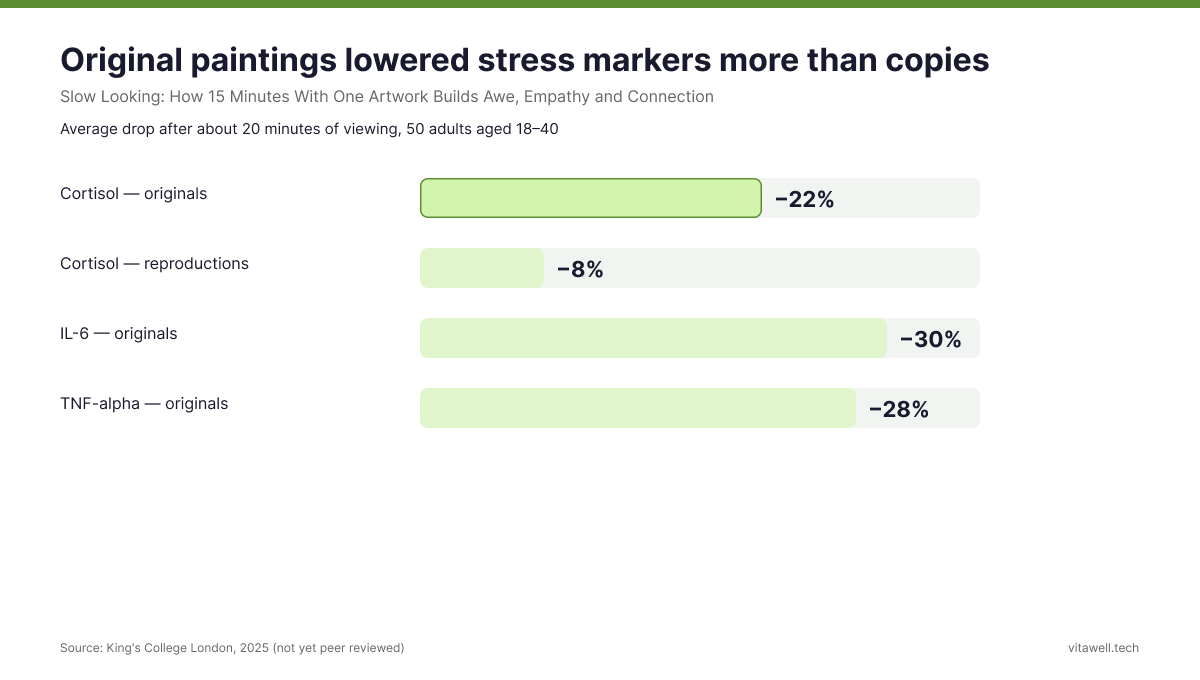
Cortisol, a stress hormone, fell by an average of 22% in the gallery group and 8% in the reproduction group. The gallery group also showed a 30% drop in IL-6 and a 28% drop in TNF-alpha, two cytokines, signaling proteins linked to inflammation. The study had not been peer reviewed when announced, and it is small, so treat the size of the effect as provisional.
A practical decision rule follows: reproductions and screens still work for practicing attention, but if you can reach originals, use them for at least some sessions.
Awe, Inflammation and the Small Self
Awe is the feeling of being in the presence of something vast that stretches your understanding. In a study of more than 200 young adults, Jennifer Stellar, Dacher Keltner and colleagues (Emotion, 2015) found that people who reported more positive emotions, and awe in particular, had the lowest levels of the inflammatory marker IL-6. The data are correlational, so lower inflammation might also make awe more likely.
Awe can also be practiced on purpose. In an 8-week randomized trial, Virginia Sturm and colleagues (Emotion, 2022) asked 60 healthy older adults to take weekly 15-minute walks, with half told to look for moments of awe. Awe walkers reported more joy and prosocial emotion, smiled more broadly in their walk selfies and showed bigger drops in daily distress. Anxiety, depression and life satisfaction did not change in either group.
Long-Term Arts Engagement and Health
Single sessions are only part of the picture. Daisy Fancourt and Andrew Steptoe at UCL (BMJ, 2019) followed 6,710 adults aged 50 and over for 14 years. People who visited museums, galleries, theatre or concerts every few months had a 31% lower risk of dying during follow-up than those who never did; those who went once or twice a year had a 14% lower risk.
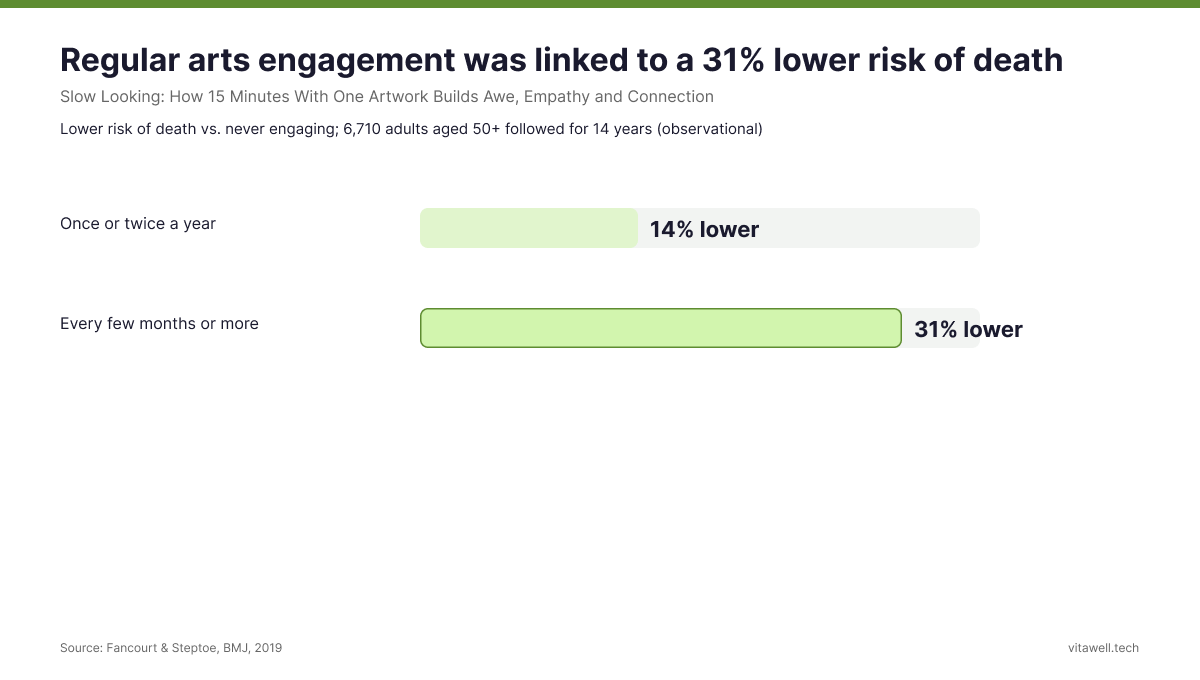
This is an observational study, so it cannot prove that art caused the difference, and the authors note that cognition, mental health and physical activity may explain part of it. VitaWell's article on arts engagement and biological aging covers newer UCL work on the same question.
How Strong Is the Evidence? A Claim-by-Claim Guide
The table grades each common claim about slow looking by the best study behind it and what that study can and cannot show.
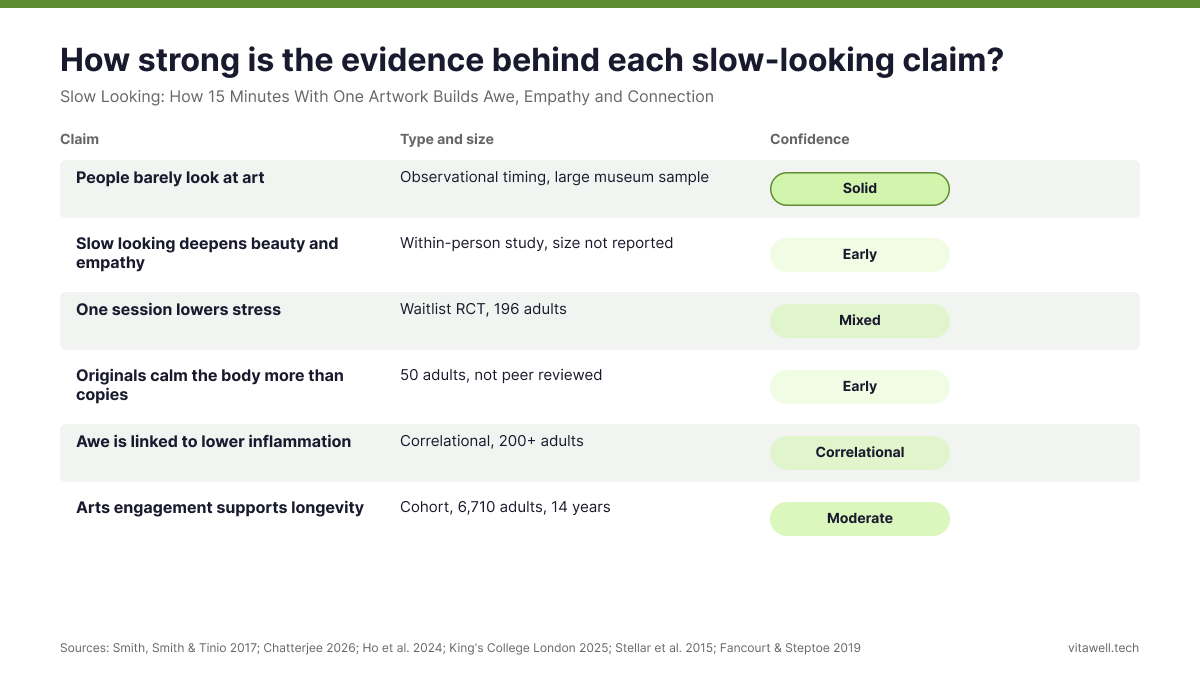
| Claim | Best evidence | Type and size | What it shows | What it does not show |
|---|---|---|---|---|
| People barely look at art | Smith, Smith and Tinio, 2017 | Observational timing, large museum sample | Mean 28.63 s, median 21 s per work | Why people move on, or what they gain |
| Slow looking deepens beauty and empathy | Chatterjee, Penn Museum | Within-person study, size not reported | Beauty, empathy and compassion up; liking unchanged | Lasting change; effects in non-students |
| One session lowers stress | Slow Art Plus, 2024 | Waitlist RCT, 196 adults | Stress −16.9% within group; spiritual well-being up vs control | Stress benefit beyond control; long-term effect |
| Originals calm the body more than copies | King's College London, 2025 | Two-group comparison, 50 adults, not peer reviewed | Cortisol −22% vs −8% | Replicated, peer-reviewed effect size |
| Awe is linked to lower inflammation | Stellar et al., 2015 | Correlational, 200+ adults | More awe, lower IL-6 | That awe causes lower inflammation |
| Regular arts engagement supports longevity | Fancourt and Steptoe, 2019 | Cohort, 6,710 adults, 14 years | 31% lower mortality risk with frequent engagement | Cause and effect |
The pattern is clear: the more specific the claim about slow looking itself, the smaller and newer the study. The practice is low-risk and cheap, which makes it reasonable to try while the evidence matures.
Looking Together: Why Shared Viewing Builds Connection
Robertson described on the podcast how group slow looking changes a room. When people stand before one work and say what they notice, they discover that others see and feel very different things, and a shared conversation forms around the same object. He observed that adults are more guarded than children, worrying about the "right" answer, and that a structured format gives them permission to speak.
The Slow Art Plus session used the same idea, with groups of 6 to 12 people and paired sharing. Activity-based, low-pressure settings like this are an easy way to meet people, a theme VitaWell covers in its piece on soft socializing.
A 4-Week Slow-Looking Plan
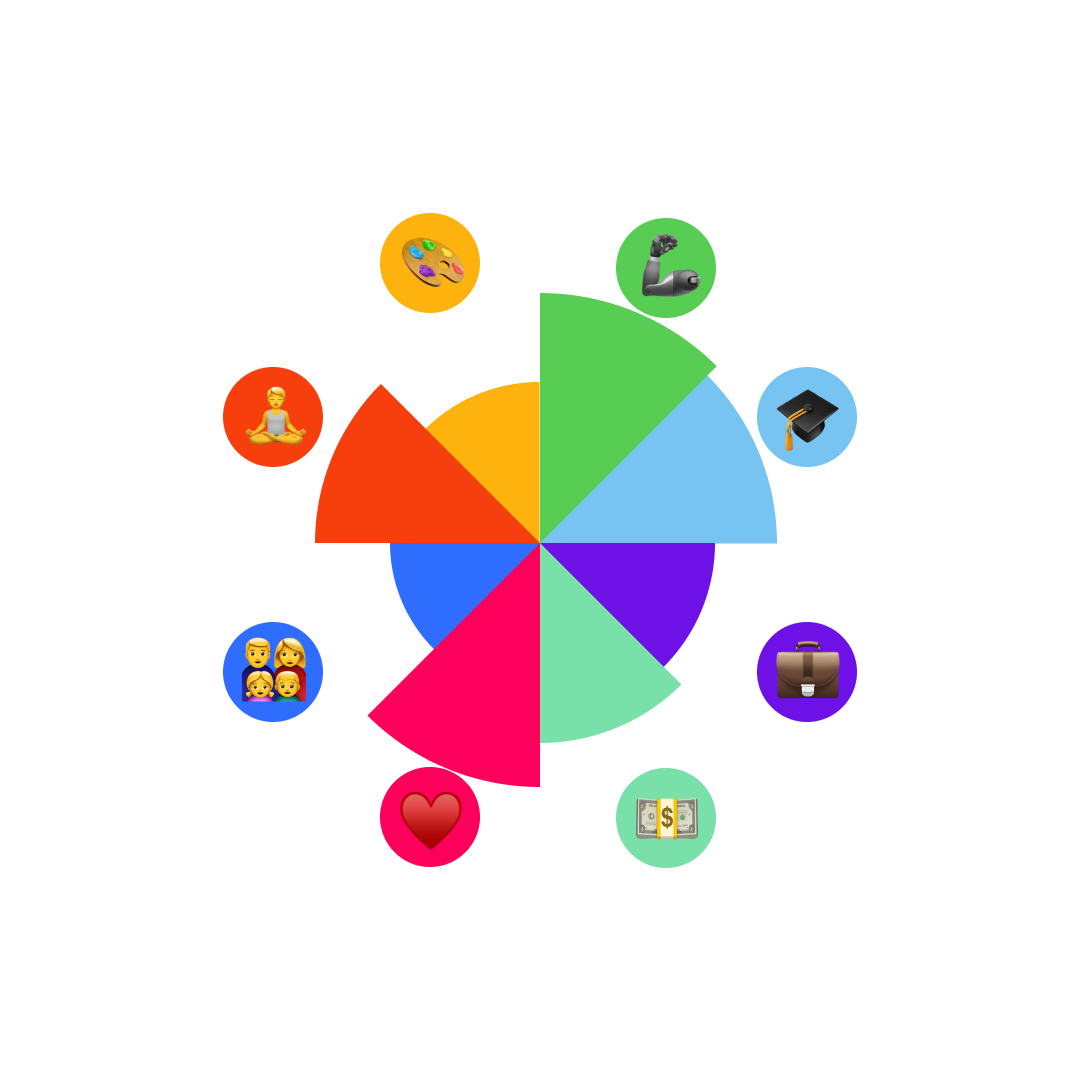
Use this plan to turn one experiment into a habit. Each week adds one element and touches a different VitaWell life area.
- Week 1 (Rest): Two 15-minute sessions at home with one image, a print or a view from a window. Phone in another room.
- Week 2 (Meaning): One session with a work that feels uncomfortable or unfamiliar. Afterwards, write three lines on what surprised you.
- Week 3 (Growth): Visit a museum or gallery and choose one original. Spend 15 minutes with it and skip the rest of the room if you like.
- Week 4 (Relationships): Do a session with a friend or partner. Look in silence for 10 minutes, then take turns sharing what you noticed and felt.
Track each session in one line: date, work, minutes and one word for how you felt before and after. After four weeks, keep the format that felt most worthwhile and schedule it monthly.
When to Talk to a Professional
- Stress, low mood or anxiety has lasted more than two weeks and affects sleep, work or relationships.
- Strong emotions that come up during reflective practices feel overwhelming or keep returning.
- You are using art or other activities to avoid problems that keep getting worse.
- You have thoughts of harming yourself; in that case contact local emergency services or a crisis line right away.
Slow looking is a well-being practice, not a treatment. Arts-based programs can sit alongside therapy, but they do not replace it.
Frequently Asked Questions
What is slow looking?
Slow looking is the practice of spending 10 to 20 minutes with one artwork or object, moving from what it looks like to what you feel and what it reminds you of. It contrasts with the typical museum glance of under 30 seconds and is used by museums, educators and researchers studying aesthetic experience.
How long should you look at a painting?
There is no fixed rule, but the protocol used in recent research is 15 minutes: five on form, five on feelings and five on associations. Studies show most visitors spend about 28 seconds per work, so even five focused minutes is a large step up from normal viewing.
Does looking at art reduce stress?
Possibly. A 2025 King's College London study found cortisol fell 22% after viewing originals, and a 2024 gallery trial found stress scores dropped 16.9% after one session. But the first study is small and not yet peer reviewed, and the trial's stress change did not beat its control group.
Can looking at art make you more empathetic?
Early evidence suggests it can, at least briefly. In a Penn Museum study, students who looked at works for 15 minutes reported more empathy and compassion than after normal viewing. Group discussion of the same work also exposes people to other perspectives, though long-term effects on empathy have not been tested.
How do you practice slow looking at home?
Choose any image, object or window view, put your phone away and set a 15-minute timer. Spend five minutes on shapes and colors, five on your feelings and five on the memories or questions it raises. Repeat weekly with different works and note how each session felt.
Conclusion
Slow looking asks for something rare: 15 minutes of attention on one thing. The evidence that it deepens beauty, meaning and calm is early but consistent, and the long-term link between arts engagement and health is strong enough to justify the time. Treat it as a small, repeatable ritual rather than a cure. VitaWell's AI life planner can schedule your 4-week plan across the Rest, Meaning, Growth and Relationships areas so the habit sticks.
Related on VitaWell
- Creative Expression as Self-Therapy — the making side of art, where slow looking covers the viewing side.
- Why Flow Is Not a Productivity Hack — another state of deep, absorbed attention and why it matters for well-being.
- Mindful Walking: Meditation in Motion — a way to bring the same quality of attention, and the awe-walk idea, outdoors.
This article is for informational purposes only and is not a substitute for professional medical or mental health advice.
Sources
- Greater Good Science Center, 2026 — The Art of Slowing Down (The Science of Happiness)
- Smith, Smith and Tinio, 2017 — Time spent viewing art and reading labels
- Ho et al., 2024 — Slow Art Plus waitlist randomized controlled trial (Frontiers in Public Health)
- King's College London, 2025 — The positive impact of art on the body
- Stellar et al., 2015 — Positive emotions, awe and lower IL-6 (Emotion)
- Sturm et al., 2022 — Awe walks promote prosocial positive emotions in older adults (Emotion)
- Fancourt and Steptoe, 2019 — Arts engagement and mortality (BMJ)
- Fancourt and Finn, 2019 — WHO scoping review on arts and health