Money Shame: Why You Avoid Your Finances and How to Break the Shame Spiral
Money shame, not laziness, is often why people stop opening bills or checking balances. Here is what the research shows and a small plan for looking again.
Money shame is the feeling that your financial situation proves something is wrong with you, and it is one of the main reasons people stop opening bills, checking balances or asking for help. Research on financial shame shows that it pushes people to withdraw from their money, which makes hardship worse and produces more shame. The way out is not more willpower. It is naming the feeling, taking one small, timed look at the numbers, and telling at least one person.
Key Takeaways
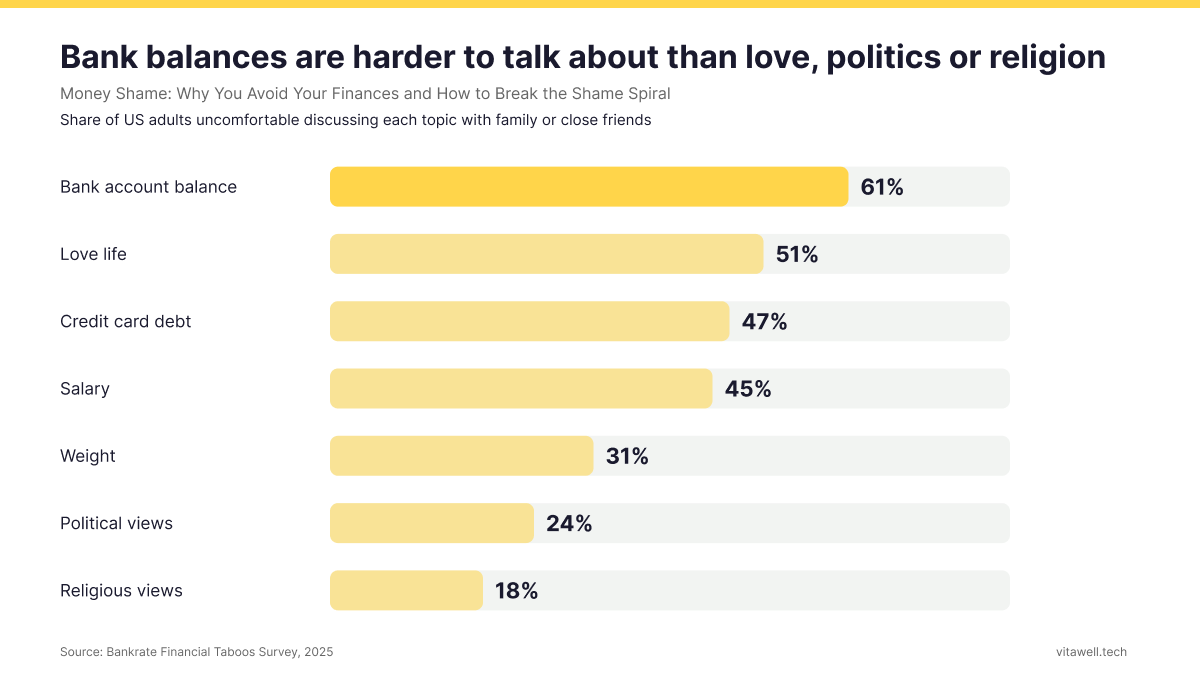
- Money is harder to talk about than almost anything else: 61% of US adults are uncomfortable discussing their bank balance with family or close friends (Bankrate, 2025).
- Shame and guilt are different. In bank-account data, shame predicted costly money decisions and guilt did not (Gladstone et al., 2021).
- In an experiment, 57.5% of people placed in a financial-shame condition opened a past-due payment email right away, compared with 78.4% of the control group.
- Inner shame and fear of being judged respond to different fixes: self-kindness and naming the feeling for the first, company and disclosure for the second.
- A 10-minute "first look" that separates seeing the numbers from fixing them is a low-risk way to start.
What Is Money Shame?
Money shame is a painful belief about yourself that is triggered by money: "I am bad with money," "I should be further along," "people would think less of me if they knew." Psychologist Maarit Lassander, writing in Psychology Today in November 2026, describes two forms. Internal shame is the verdict you pass on yourself. External shame is the fear of how other people will judge you.
It is not the same as worry. Financial anxiety is fear about what might happen; shame is a judgment about who you are. The two often travel together, and the skills for stepping back from financial anxiety help, but shame adds a specific urge that anxiety does not: the urge to hide.
That urge is easy to see in survey data. In Bankrate's 2025 Financial Taboos Survey, a YouGov poll of 2,474 US adults, 61% said they were uncomfortable discussing their bank account balance with family or close friends. That was more than for their love life (51%), credit card debt (47%), salary (45%), weight (31%), political views (24%) or religious views (18%).
Comfort also varies by group. In the same survey, 52% of Gen Z adults were comfortable sharing their bank balance, compared with 33% of baby boomers, and 45% of men compared with 34% of women. The poll used a weighted online panel, so treat the figures as estimates.
Shame vs. Guilt About Money: Why the Difference Matters
Guilt is about a behavior: "I overspent this month." Shame is about the self: "I am irresponsible." The distinction sounds small, but the two feelings point in opposite directions. Guilt tends to push people toward repair. Shame tends to push them toward hiding.
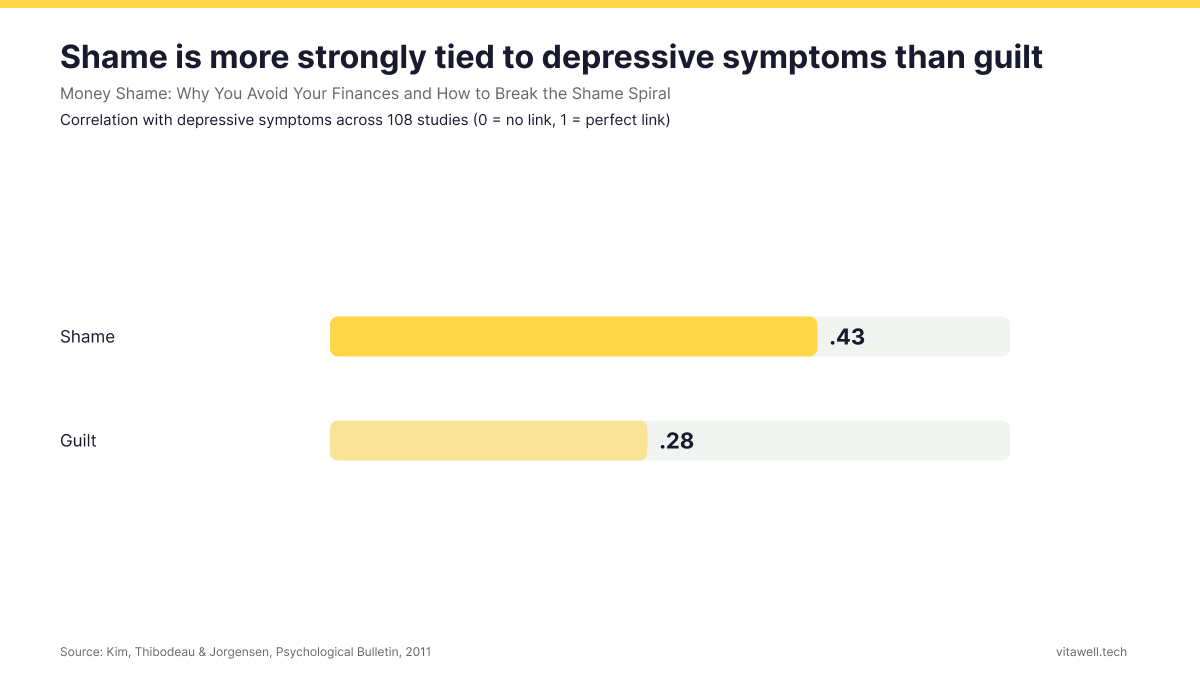
The gap shows up outside money too. A 2011 meta-analysis in Psychological Bulletin by Kim, Thibodeau and Jorgensen pooled 108 studies with 22,411 participants. Shame was more strongly linked to depressive symptoms than guilt was: a correlation of .43 versus .28, on a scale where 0 means no link and 1 means a perfect link. These are correlations, so they do not show that shame causes depression.
In financial data the pattern is sharper. When researchers matched survey answers to real UK bank records, shame predicted counterproductive money decisions and guilt did not (Gladstone et al., 2021, described in the next section).
| Question | Money guilt | Money shame |
|---|---|---|
| What the inner voice says | "I made a bad money decision." | "I am bad with money." |
| What it focuses on | A specific action you can change | Your worth as a person |
| Typical next move | Repair: check the damage, adjust the plan | Withdrawal: avoid statements, hide, change the subject |
| Link to depressive symptoms (meta-analysis, 2011) | Correlation of .28 | Correlation of .43 |
| Link to costly money decisions (bank data, 2021) | No significant link | Significant link |
| What helps first | A concrete fix for the behavior | Naming the feeling, self-kindness and telling someone, then the fix |
A simple decision rule follows from the table. If the sentence in your head starts with "I did," go straight to the practical fix. If it starts with "I am," deal with the feeling first, because the spreadsheet will not get opened until you do.
How the Financial Shame Spiral Works
The best evidence comes from a 2021 paper by Gladstone, Jachimowicz, Greenberg and Galinsky in Organizational Behavior and Human Decision Processes. Across six studies with 9,110 participants in total, the authors describe a loop: financial hardship produces shame, shame produces withdrawal from financial decisions, and withdrawal deepens the hardship.
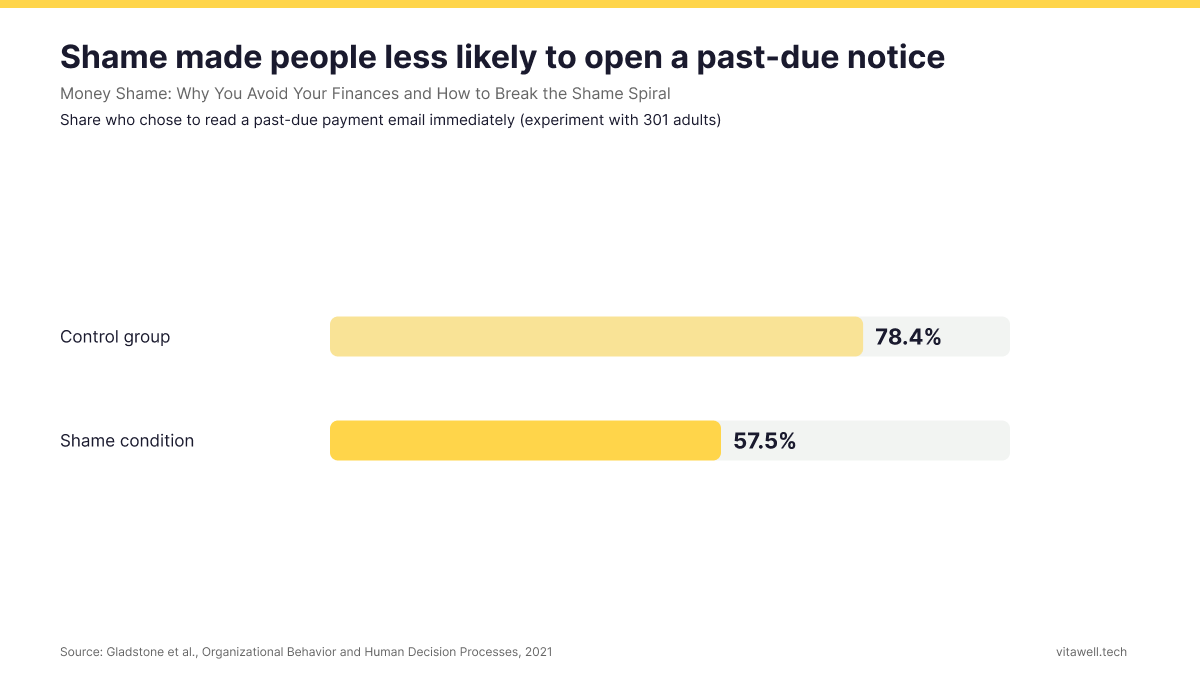
One of the six studies was an experiment with 301 adults. Some were first put into a financial-shame condition and the rest served as controls. Everyone could then choose whether to read a past-due payment email immediately. In the control group, 78.4% chose to read it immediately. In the shame group, 57.5% did.
A second study used bank account records. About a third of the sample (33.4%) had made at least one counterproductive financial decision. Higher shame predicted those decisions and a lower credit score, while guilt did not predict the decisions. This part is observational, so it shows association, not proof of cause.
Withdrawal does not always look like doing nothing. Lassander points out that shopping to feel better can be shame in disguise, which fits what is known about the psychology behind overspending. Common signs of withdrawal include:
- mail, emails or app notifications from lenders left unopened
- not logging in to a bank or card account for weeks
- paying the minimum without looking at the total balance
- changing the subject when money comes up with a partner or friend
- describing yourself as "just bad with money" instead of naming a specific problem
Who Feels Financial Shame Most
No large national survey measures money shame directly, but its neighbors are well tracked. In the FINRA Foundation's National Financial Capability Study, which surveyed 25,539 US adults in 2024, 63% agreed that thinking about their personal finances can make them feel anxious. That is up from 53% in 2018 and 56% in 2021.
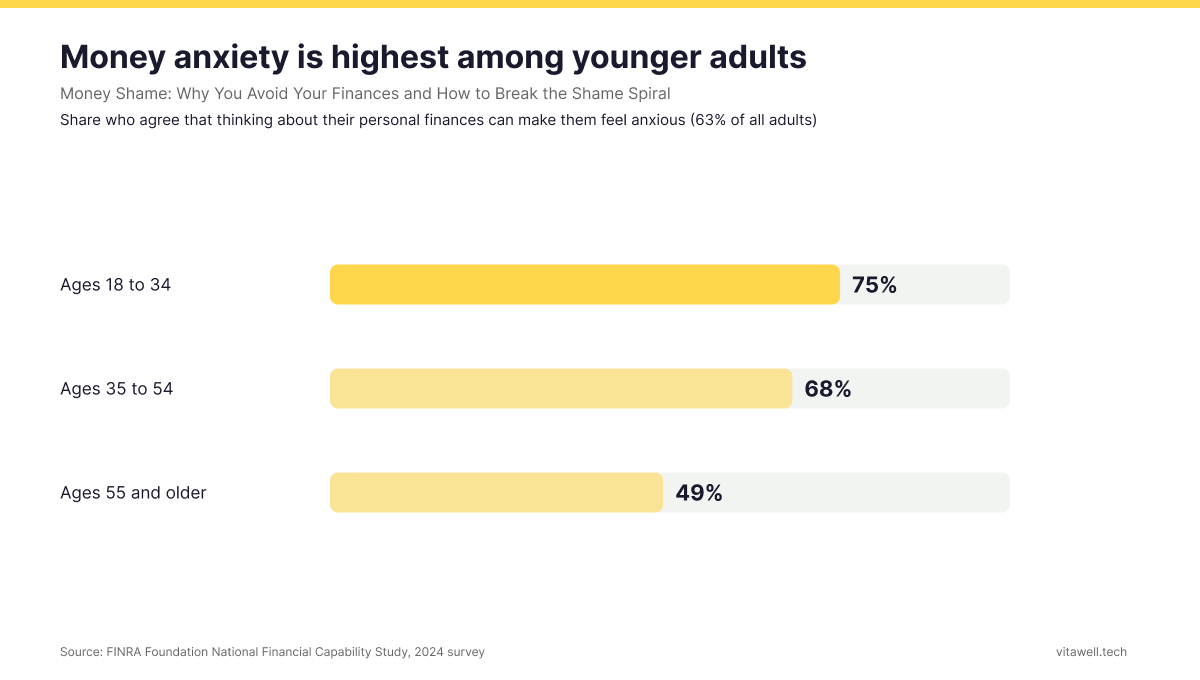
Younger adults report it most: 75% of those aged 18 to 34, 68% of those aged 35 to 54 and 49% of those 55 and older. The American Psychological Association's Stress in America 2023 survey of 3,185 adults found a similar tilt. Among adults aged 18 to 34, 82% named money as a significant source of stress, and 45% of all adults said they feel embarrassed talking about money or their financial situation.
Shame is also not limited to people with low incomes. In a Canadian-led field study of people in debt, participants had an average household income of $86,000, and about one in five worried moderately to extensively about being judged for their debt, according to the Ivey Business School summary of Moorhouse and colleagues' 2023 study.
Two Kinds of Shame Need Different Fixes
Most advice treats money shame as one thing. The research suggests two problems with two different remedies.
Inner shame: the verdict you pass on yourself
In the sixth Gladstone study, 748 participants were given a short writing task. Those who recalled their own past acts of kindness showed a weaker link between shame and financial withdrawal. A standard values-affirmation exercise had no effect. The kindness result was borderline after the authors corrected for multiple comparisons (p = .052), so it is promising, not settled.
Naming the feeling may also help. In a 2007 brain-imaging study by Lieberman and colleagues, 30 adults who put a label on a negative emotion showed a smaller response in the amygdala, a brain region involved in detecting threat. That was a small lab study using emotional images, not bank statements. It costs nothing to try, but it is not proof that labeling fixes money avoidance.
Anticipated stigma: the verdict you expect from others
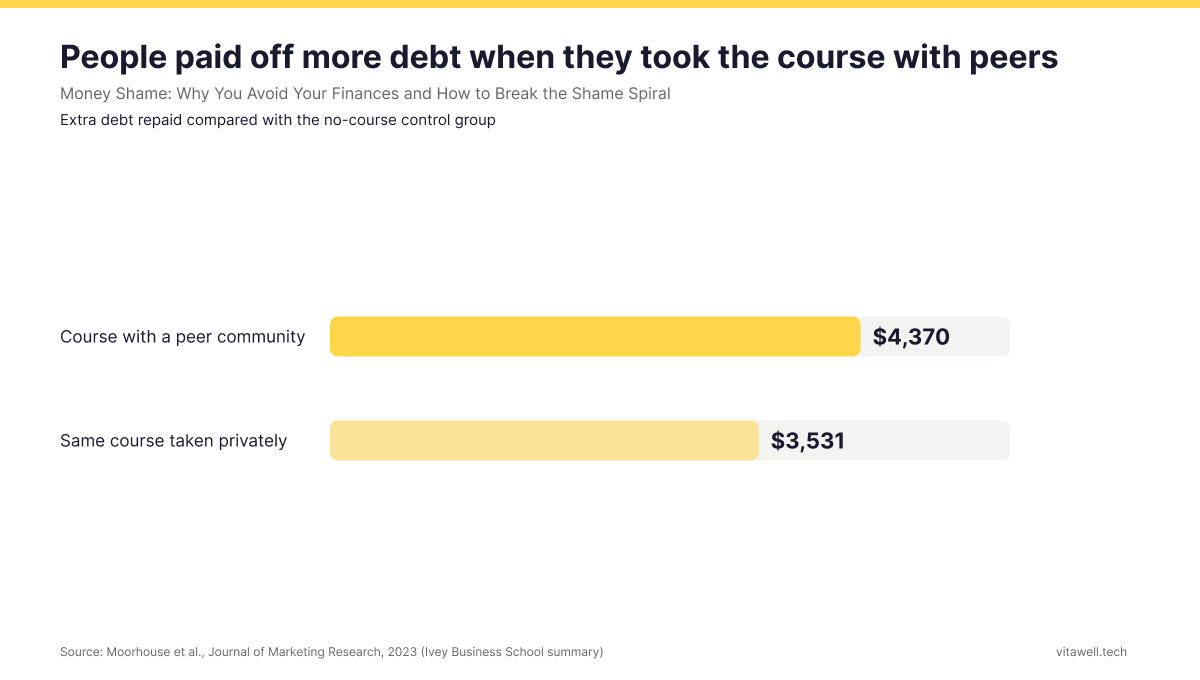
The Moorhouse field experiment, published in the Journal of Marketing Research, worked with a financial education company. People in debt were assigned to a course taken with a community of peers, the same course taken privately, or no course. The community group paid off $4,370 more debt than the control group, and the private group $3,531 more, as reported in the university's summary.
The practical reading: if your main fear is what others will think, working on money alone keeps the fear intact. One safe disclosure does more. That can be a friend, a class, or a planned conversation that follows the basics of talking about money with a partner.
A 10-Minute First Look: How to Overcome Money Shame Step by Step
This plan is our synthesis of the studies above, not a clinically tested program. Its one rule is that looking and fixing happen on different days, because the first look is the step shame blocks.
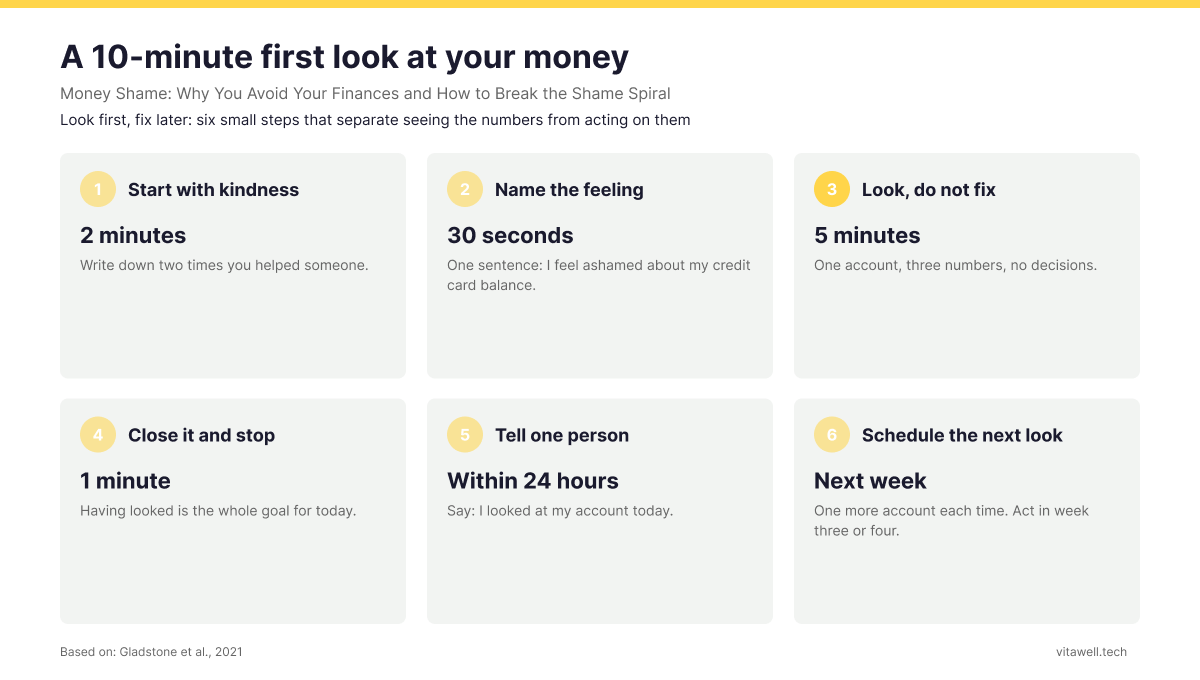
- Start with kindness (2 minutes). Write down two times you helped someone. This is the exercise that weakened the shame-withdrawal link in the 2021 study.
- Name the feeling (30 seconds). Say or write one sentence: "I feel ashamed about my credit card balance." Be specific about what, not about who you are.
- Look, do not fix (5 minutes). Set a timer. Open one account only. Write down three numbers: the balance, the next due date and the minimum due. Make no decisions.
- Close it and stop (1 minute). Shut the app or put the letter away. Having looked is the whole goal for today.
- Tell one person within 24 hours. A single sentence is enough: "I looked at my account today." You do not have to share the numbers.
- Schedule the next look. Same time next week, one more account each time. Only in week three or four pick one action, such as calling a lender, setting up automatic payments or booking a credit counselor.
Once looking feels routine, you can move on to science-backed money habits such as automation and a simple budget.
What the Evidence Cannot Tell You
- Most findings are correlational. Shame and hardship move together, but only the 301-person experiment shows shame causing avoidance, and only for one small decision.
- The kindness exercise was tested once and narrowly missed the corrected significance threshold.
- The labeling study had 30 participants and did not involve money.
- The group-course result comes from one company's customers, and the figures here are from a university summary, not the full paper.
- The national surveys measure discomfort, embarrassment and anxiety about money, which overlap with shame but are not identical to it.
When to Talk to a Professional
Money problems and mental health are closely linked. A 2013 meta-analysis of 65 papers by Richardson, Elliott and Roberts found that people with unsecured debt had about three times the odds of a mental disorder (odds ratio 3.24). The authors caution that the direction of cause is hard to establish.
Consider professional help if:
- low mood, hopelessness or loss of interest lasts most days for two weeks or more
- you have been unable to open financial mail or accounts for more than a month
- you are hiding debt or spending from a partner and it is straining the relationship
- you have thoughts of harming yourself. In the US, call or text 988; elsewhere, contact your local emergency number or crisis line.
A licensed therapist can work on shame and depression. A financial therapist combines counseling with money skills. A nonprofit credit counselor can build a repayment plan and talk to lenders with you.
Frequently Asked Questions
What is the difference between money shame and money guilt?
Guilt is about something you did, such as an impulse purchase. Shame is about who you think you are, such as "I am irresponsible." Guilt usually motivates repair. Shame motivates hiding, and in bank-account research only shame, not guilt, predicted costly financial decisions.
Why do I avoid looking at my bank account?
Avoidance protects you from a painful feeling in the short term. If your balance feels like a verdict on your worth, not checking it brings relief. In one experiment, people placed in a financial-shame condition were less likely to open a past-due notice right away: 57.5% versus 78.4%.
How do I stop feeling ashamed about debt?
Start by separating the debt from your character: name the specific problem, not a flaw. Recall evidence that you are a decent person, look at one number for a few minutes, and tell one trusted person. In a field study, people who tackled debt alongside peers repaid more than those who did not take a course.
What is a financial therapist?
A financial therapist is a professional trained in both mental health or counseling and personal finance. They help with the feelings and habits around money, such as avoidance, conflict or compulsive spending, alongside practical planning. They suit people who know what to do but cannot make themselves do it.
Conclusion
Money shame keeps people away from the information they need most. The research points to a modest, workable sequence: treat the feeling as a feeling, look before you fix, and let one person in. Because money touches every part of life, from health to relationships to rest, lowering shame here tends to free up attention everywhere else. VitaWell is built around that idea of balance across eight life areas; explore the related guides below to keep going.
Related on VitaWell
- Financial Wellness Beyond Numbers — how feelings and values, not only account balances, shape financial well-being.
- Prompts to Build a Healthier Money Mindset and Financial Balance — reflection prompts you can use after your first look to examine the stories you tell about money.
- 6 Proven Ways to Simplify Your Personal Finances and Reduce Financial Stress — practical ways to make your accounts less overwhelming to open.
This article is for general information only and is not financial, medical or mental health advice. Speak with a qualified professional about your own situation.
Sources
- Psychology Today — The Emotion Nobody Mentions When We Talk About Money
- Gladstone, Jachimowicz, Greenberg and Galinsky, 2021 — Financial shame spirals
- Kim, Thibodeau and Jorgensen, 2011 — Shame, guilt, and depressive symptoms: a meta-analytic review
- Ivey Business School, 2023 — summary of Moorhouse, Goode, Cotte and Widney, Journal of Marketing Research
- Lieberman et al., 2007 — Putting feelings into words
- Bankrate, 2025 — Financial Taboos Survey
- FINRA Foundation, 2025 — National Financial Capability Study 2024
- American Psychological Association, 2023 — Stress in America
- Richardson, Elliott and Roberts, 2013 — The relationship between personal unsecured debt and mental and physical health