
How to Listen to Teenagers: Science-Backed Tips That Protect Teen Mental Health
About 4 in 10 high schoolers report persistent sadness. What research shows about listening that helps teens open up — what to say instead of fixing, and when to get help.

To listen to teenagers in a way that protects their mental health, give them your full attention, reflect back what they feel, and hold off on fixing or lecturing until they feel understood. In a 2021 experiment with 1,001 adolescents, attentive listening made teens feel more connected and more willing to open up again. This matters because about 4 in 10 US high school students report persistent sadness or hopelessness, and a teen who talks early is a teen who can get help early.
Key Takeaways
- In the CDC's 2023 survey, 39.7% of high school students reported persistent sadness or hopelessness and 20.4% had seriously considered suicide.
- Teens whose parents knew where they were and who they were with had a 26–49% lower prevalence of most mental health and suicide risk indicators.
- Attentive listening, such as eye contact, nodding and reflecting feelings, makes teens more likely to share difficult things.
- Parents' own mental health is closely linked to their teen's: depressed teens were about five times more likely to have a depressed parent.
- Asking a teen directly about suicide does not plant the idea; reviews of the evidence found no harm from asking.
Why Teen Mental Health Is a Crisis in 2026
The latest national data shows how many teenagers are struggling. The CDC's 2023 Youth Risk Behavior Survey of 20,103 high school students (Verlenden et al., MMWR, 2024) found:
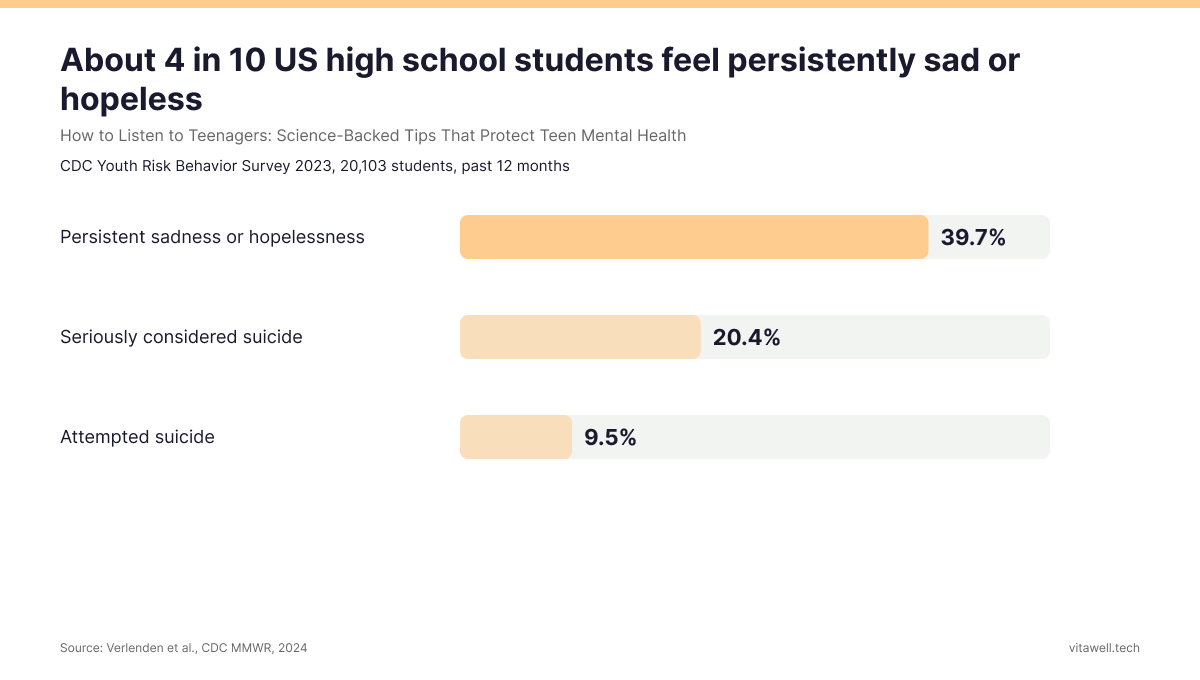
- 39.7% felt persistently sad or hopeless during the past year.
- 20.4% had seriously considered attempting suicide.
- 9.5% had attempted suicide.
Social comparison online, academic pressure and the after-effects of the pandemic years all play a role, and VitaWell's guide to screen time and teen mental health warning signs covers the digital side. Against that background, the parent-teen relationship remains one of the most accessible protective factors a family has.
What the Research Behind the 988 Suicide and Crisis Lifeline Tells Us
In July 2022 the United States launched 988, a three-digit number anyone can call or text in a mental health crisis. A study in JAMA in April 2026, led by Vishal Patel of Harvard Medical School and reported by the Associated Press (2026), modeled expected suicide deaths from 1999–2022 records and compared them with actual deaths:
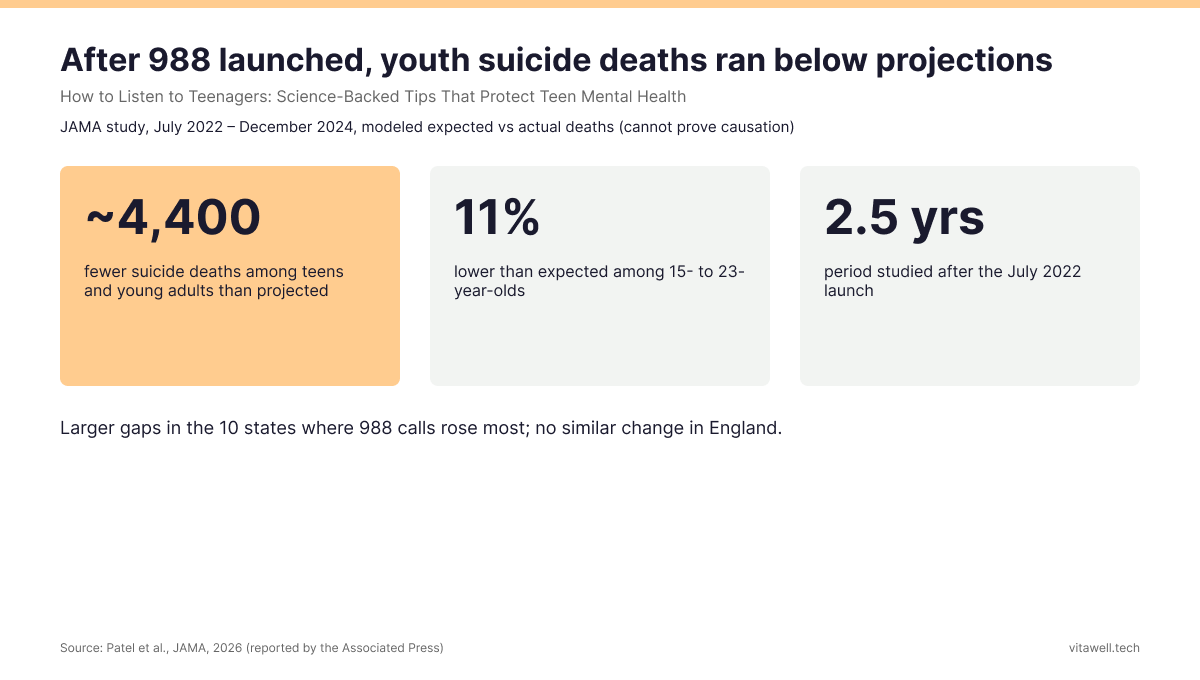
- About 4,400 fewer teens and young adults died by suicide than projected between July 2022 and December 2024.
- Among 15- to 23-year-olds, suicide deaths were 11% lower than expected.
- The gap was larger in the 10 states where calls to 988 rose most, and no similar change appeared in England, which had no comparable line.
The researchers stress that they cannot prove 988 alone caused the decline, and outside experts called for replication. Still, the core of what 988 offers is instructive for parents: a calm, trained person who listens without judgment before trying to fix anything. That skill does not require a clinical license.
How Listening Protects Teen Mental Health
Two lines of research point in the same direction. First, the CDC survey found that high parental monitoring, meaning parents generally know where their teen is and who they are with, was linked to a lower prevalence of most mental health and suicide risk indicators, with adjusted prevalence ratios of 0.51–0.74. In other words, those indicators were roughly 26–49% less common among closely connected teens. This is survey data, so it shows an association rather than proof of cause.
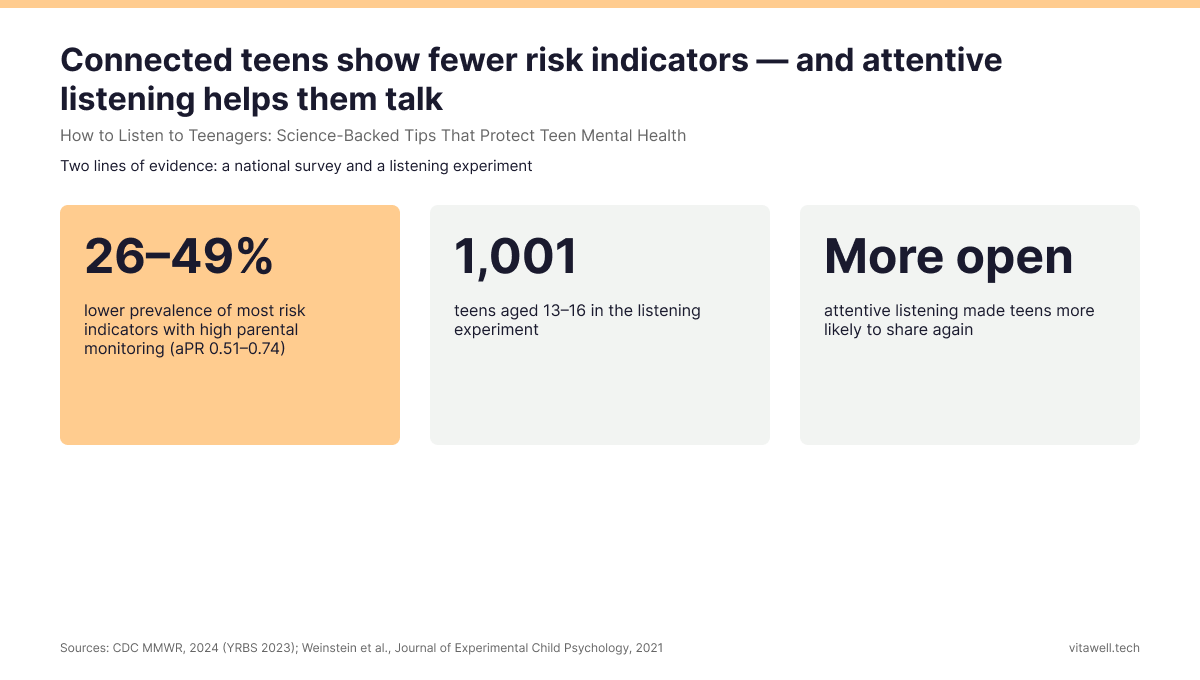
Second, a 2021 experiment by Weinstein, Huo and Itzchakov (University of Reading and University of Haifa) showed 1,001 adolescents aged 13–16 videos of a parent responding to a teen's difficult disclosure, such as admitting to vaping. When the parent listened attentively, with eye contact and nodding, participants said they would feel better about themselves, more connected to the parent and more likely to open up again. The effect was similar across ages and genders, though it measured how teens imagined they would feel, not real conversations.
Listening also models emotional regulation. A parent who can sit with a teen's distress without panicking shows that hard feelings are survivable, which is one of the core skills described in VitaWell's piece on helping kids build emotional intelligence.
Start by Observing and Showing Interest
The first step is often not speaking but noticing. Is your teen more withdrawn than usual, distracted at dinner, sleeping differently? Observation helps with timing: a deep conversation right after a hard day rarely goes well, while "You seem a little off today, rough one?" opens a door without pushing them through it.
Many teens talk more easily side by side than face to face, for example while driving, cooking or walking. Less direct eye contact can lower the pressure to explain. Show interest in their whole world, including friends, music, humor and plans, not just grades and chores.
Listening Is an Active Process
Active listening means engaging deliberately to show "I am here, and what you are saying matters." The core techniques:
- Attention: put the phone face down and turn toward your teen.
- Reflecting back: paraphrase what you heard, including the feeling: "So you felt left out when they made plans without you?"
- Minimal encouragers: short prompts such as "Tell me more" or "What happened next?" keep the story theirs.
Reflecting and Validating
Validation means acknowledging that a feeling makes sense given the teen's experience. It is not the same as agreeing with every choice. "That sounds really painful" lands better than "You'll get over it," and "I can see why you'd feel that way" goes further than "Look on the bright side." Often the need behind the story is not "fix this" but "help me feel less alone with it."
Non-Verbal Cues
Teens read body language quickly. Crossed arms, a glance at the phone or a body angled toward the door signal "not now." An open posture, a calm face and staying physically close signal that you are available. VitaWell's article on why listening is the most underrated skill goes deeper into these basics.
Resist the Urge to Fix
When a teen shares a problem, most parents want to solve it, out of love. But jumping to solutions often ends the conversation and sends the message that your job is to have answers, not to understand. Ask "What do you think you want to do?" before suggesting what they should do. The table translates common moments into listening responses.
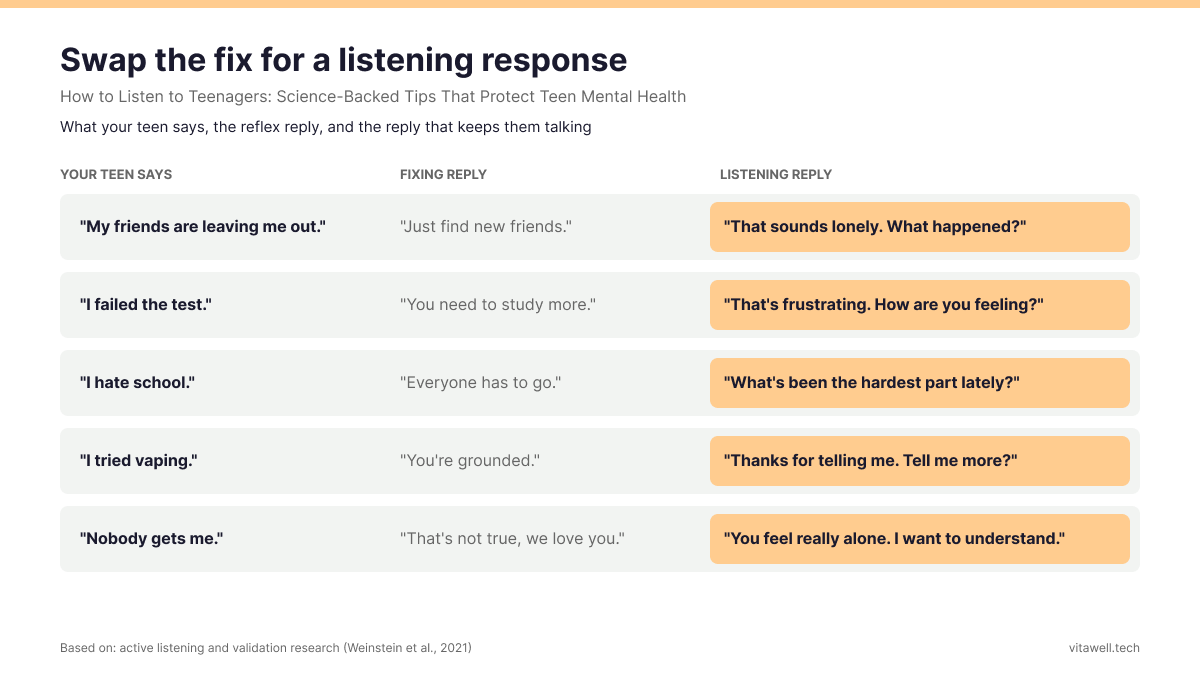
| Your teen says | Fixing response | Listening response | Why it works |
|---|---|---|---|
| "My friends are leaving me out." | "Just find new friends." | "That sounds lonely. What happened?" | Names the feeling and invites the story |
| "I failed the test." | "You need to study more." | "That's frustrating. How are you feeling about it?" | Separates the feeling from the plan |
| "I hate school." | "Everyone has to go to school." | "What's been the hardest part lately?" | Open question instead of a rule |
| "I tried vaping." | "You're grounded." | "Thanks for telling me. Can you tell me more?" | Rewards honesty, so they keep telling you |
| "Nobody gets me." | "That's not true, we love you." | "It sounds like you feel really alone. I want to understand." | Validates before reassuring |
Limits and consequences still matter; the point is order. Listen first, then problem-solve together once your teen feels heard. For hard moments when the words won't come, VitaWell's framework for difficult conversations can help.
The Parent Factor: Your Own Mental Health Matters
A teen's emotional climate is shaped by the adults around them. A 2023 report from Harvard Graduate School of Education's Making Caring Common project, summarized by Harvard's Usable Knowledge (2023), found:
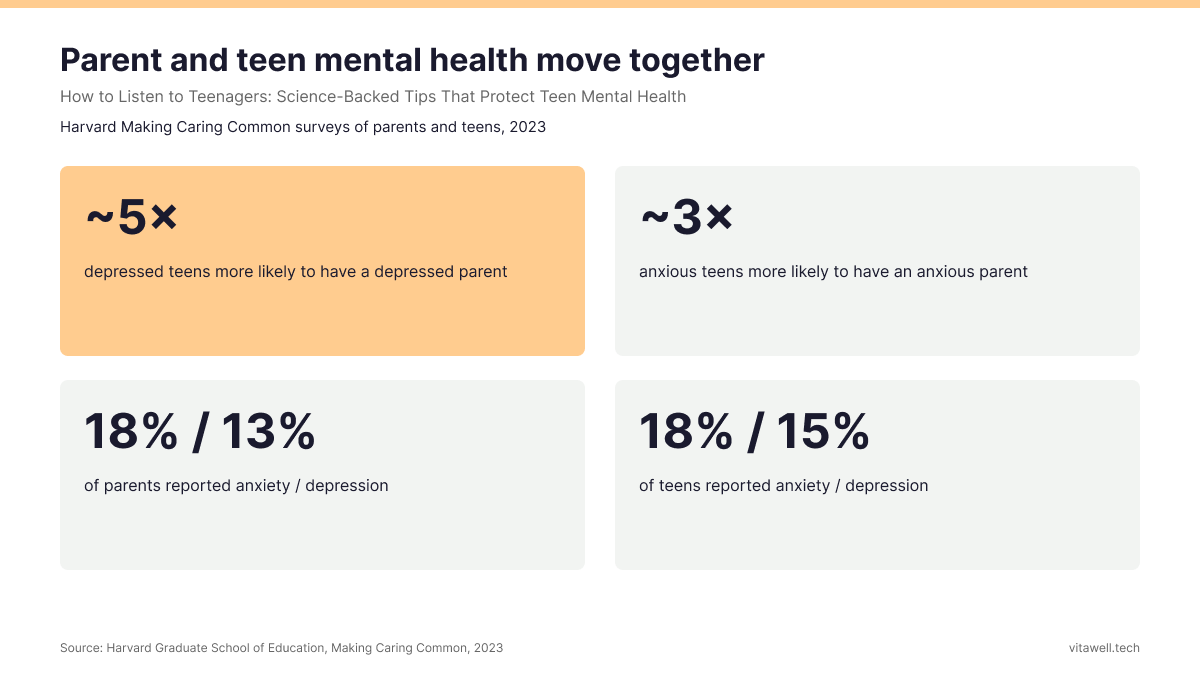
- About 18% of parents reported anxiety and 13% depression, similar to teens (18% and 15%).
- Depressed teens were about five times more likely than non-depressed teens to have a depressed parent.
- Anxious teens were about three times more likely to have an anxious parent.
Shared genes, shared stress and household patterns all likely contribute, and the survey cannot separate them. The practical implication is the same: regulating yourself before a hard conversation, and getting support for your own mental health, is part of supporting your teen.
Know When Additional Support Is Needed
Listening is powerful, but it has limits. Seek help promptly if you notice:
- Statements about wanting to die, not wanting to be alive, or being a burden.
- Withdrawal from friends, family and activities they used to enjoy.
- Marked changes in sleep, appetite or school performance lasting more than two weeks.
- Giving away important belongings.
- A sudden, unexplained calm after a period of visible distress.
If you are worried, ask directly and calmly: "I've noticed you seem really down and I'm worried about you. Are you having thoughts of suicide?" A systematic review and meta-analysis from CHEO Research Institute (Polihronis et al., 2020), which rated 17 studies, found no harmful effect of asking about suicide on suicidal behavior, self-harm or distress.
Professional support extends parenting rather than replacing it. Contact your teen's doctor, a school counselor or a therapist. In the US, the 988 Suicide and Crisis Lifeline is available 24/7 by call or text for teens and for worried parents. Outside the US, contact local emergency services or your national crisis line. If there is immediate danger, call emergency services and stay with your teen.
Practical Tools for Parents
A one-week plan to build a listening habit:
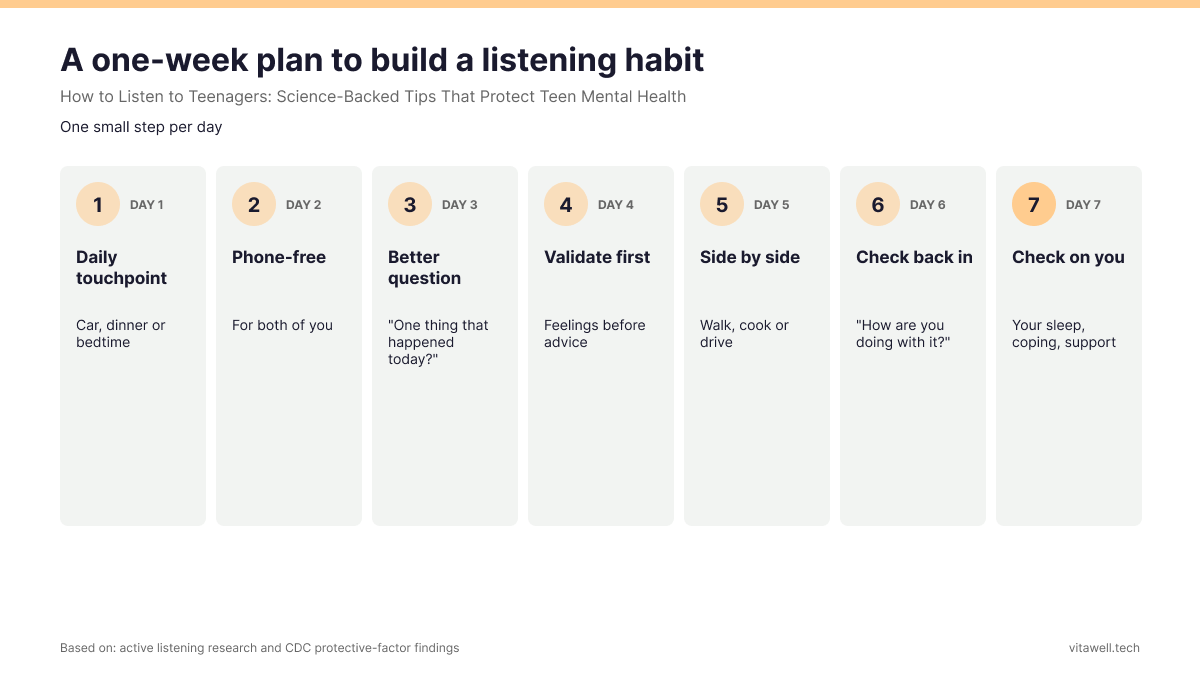
- Day 1: Pick a daily touchpoint, such as the car ride, dinner or before bed.
- Day 2: Make it phone-free for both of you.
- Day 3: Swap "How was school?" for "What was one thing that happened today?"
- Day 4: Reflect and validate for a few minutes before offering any advice.
- Day 5: Try a side-by-side activity: a walk, cooking or a drive.
- Day 6: Check back in on something they shared earlier: "I've been thinking about what you said. How are you doing with it?"
- Day 7: Check in with yourself: how are you sleeping and coping, and who supports you?
Frequently Asked Questions
How do I get my teenager to open up?
Create low-pressure moments, such as car rides or cooking together, and keep them phone-free. Ask open questions about their world, not just school, and respond to what they share with interest rather than judgment. In a study of 1,001 teens, attentive listening made them more likely to open up again.
What is active listening with teens?
Active listening means giving full attention, reflecting back what your teen said and felt, and using short prompts like "tell me more" to keep the story theirs. It also means holding off on advice until they feel understood. It shows that their experience matters, which makes future conversations easier.
What should I do if my teen says they want to die?
Stay calm, take it seriously and thank them for telling you. Ask directly whether they are thinking about suicide, remove access to dangerous items, and get help the same day from their doctor, a crisis line such as 988 in the US, or emergency services if there is immediate danger.
Does asking about suicide put the idea in their head?
No. A systematic review and meta-analysis that rated 17 studies found asking about suicide had no harmful effect on suicidal behavior, self-harm or distress. Asking directly and calmly tells a teen that the topic is safe to talk about and that you want to help.
When should a teen see a therapist?
Consider professional help when sadness, worry, withdrawal or sleep changes last more than two weeks, affect school or friendships, or worry you. Seek help immediately for any talk of suicide or self-harm. Starting with your teen's doctor or school counselor is a practical first step.
Conclusion
Listening is not passive. It means staying present, holding back the urge to fix and showing a teenager that their feelings make sense. The research points the same way from several angles: connected teens show fewer risk indicators, attentive listening makes them more willing to talk, and a calm, non-judgmental listener is at the heart of crisis support. VitaWell's AI life planner can help you build a daily touchpoint into your Community and family goals, so listening becomes a routine rather than something saved for emergencies.
Related on VitaWell
- How Perspective-Taking Makes Kids Better Friends — and Two Benefits Research Confirms — the empathy skill that listening helps teens learn.
- How to Give Feedback Without Hurting: Practical Tips for Friends, Partners, and Children — what to do once it is time to offer guidance.
- How Childhood Coping Habits Are Still Running Your Adult Life — and the Science of Breaking Free — why the emotional habits teens learn at home last.
This article is for informational purposes only and is not medical advice. If you are worried about a young person's safety, contact a healthcare professional, a crisis line or emergency services.
Sources
- Listening to Teens Can Save Lives — Psychology Today
- Verlenden et al., 2024 — Mental Health and Suicide Risk Among High School Students and Protective Factors, YRBS 2023 (CDC MMWR)
- Associated Press via Fortune, 2026 — 988 launch linked to fewer youth suicide deaths (Patel et al., JAMA)
- University of Reading, 2021 — Attentive listening helps teens open up (Weinstein et al., Journal of Experimental Child Psychology)
- Harvard Graduate School of Education, 2023 — The relationship between parent and teen mental health
- Polihronis et al., 2020 — What's the harm in asking? Systematic review and meta-analysis (Archives of Suicide Research)
- 988 Suicide and Crisis Lifeline