
Breaking Up Your Sitting Time With Short Walks May Help Control Blood Sugar — Here's What the Science Says
Nine 5-minute walking breaks spread throughout the day improve blood sugar control more than a single 45-minute workout, a 2026 clinical trial found.

Spreading your daily walk across nine 5-minute hourly breaks improves blood sugar control far more than completing the same 45 minutes in a single bout, according to a 2026 randomized clinical trial published in Obesity. Adults with overweight who used the break strategy spent 94% of their monitored time in a healthy glucose range—up from 82% at baseline—while participants who did one continuous walk saw their time-in-range drop from 89% to 80%. If you have a desk job, this finding may change how you think about exercise.
Key Takeaways
- Nine 5-minute walks spread across a 9-hour workday (45 minutes total) outperformed one continuous 45-minute walk for blood sugar in a 6-week randomized trial.
- The break-walking group's time in a healthy glucose range rose from 82% to 94%; the single-bout group's fell from 89% to 80%.
- The benefit operates through a non-insulin pathway: muscle contractions trigger direct glucose uptake via GLUT4 protein translocation.
- Only the break strategy eliminated prolonged sedentary bouts of 60 minutes or more—an independent risk factor for poor cardiometabolic health.
- Practical start: set a recurring 5-minute walking reminder for every hour during your workday.
The Surprising Finding: Spreading Your Walk Beats One Long Workout
For decades, the standard exercise prescription has focused on accumulating 150 minutes of moderate activity per week—most people interpret this as one or two discrete workout sessions. This 2026 randomized trial from Dr. Audrey Bergouignan's team at the CU Anschutz Health and Wellness Center challenges that model, at least when blood sugar management is the goal.
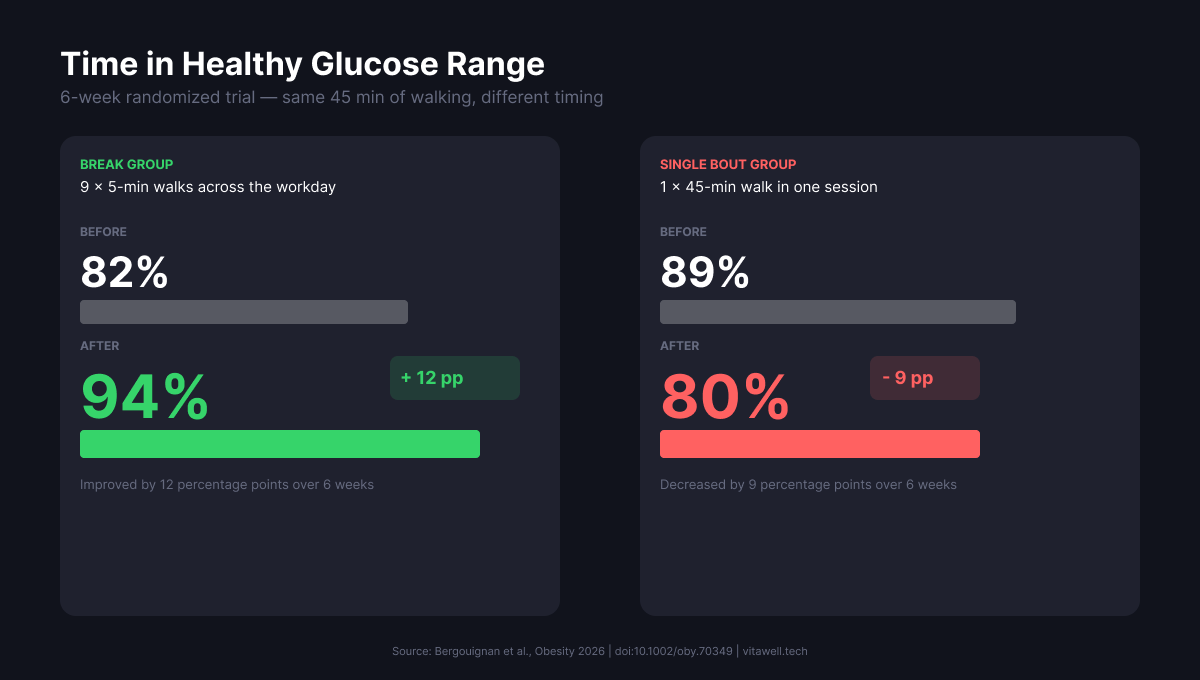
The study compared two groups of sedentary, overweight adults over six weeks. Both groups walked the same total amount— 45 minutes every exercise day—but one group (BREAK) distributed that time as nine 5-minute bouts spread across the workday, while the other (ONE) completed it all in one session. Measured by continuous glucose monitoring (CGM), the results were striking—and, for the single-workout group, counterintuitive.
The BREAK group's time in a healthy glucose range rose from 82% to 94%—a 12-percentage-point improvement over six weeks. The ONE group, despite doing the same total exercise, saw their time-in-range fall from 89% to 80%. Beyond average glucose levels, the BREAK group also showed lower glucose variability, meaning fewer spikes and dips throughout the day, based on intravenous glucose tolerance tests (IVGTT). Neither group showed significant improvement in insulin sensitivity—a finding that points to a distinct mechanism at work.
How the 6-Week Trial Was Designed
The trial enrolled 30 adults with overweight or obesity who were sedentary—meaning they spent most of their day sitting—and were not currently exercising regularly. Researchers used objective measurement tools: accelerometers to track physical activity patterns, the doubly labeled water (DLW) method to measure total daily energy expenditure, IVGTT to assess insulin sensitivity and glucose clearance, and CGM devices to capture real-world blood sugar patterns over the full six weeks.
Participants in both groups walked briskly at moderate intensity five days per week. The BREAK group spread nine 5-minute bouts across a standard 9-hour workday, roughly one bout per hour. The ONE group walked for 45 continuous minutes at a time. The randomized controlled trial (RCT) design is an important strength: it allows researchers to attribute the difference in outcomes to the timing of exercise rather than to individual differences between participants.
Why Brief Walks Work—Even Without Fixing Insulin Resistance
The fact that neither group improved insulin sensitivity—yet the BREAK group still dramatically improved blood glucose control—is scientifically significant. Standard exercise science has long emphasized that aerobic training improves insulin sensitivity over weeks and months. But this study reveals a parallel mechanism: contraction-induced glucose uptake.
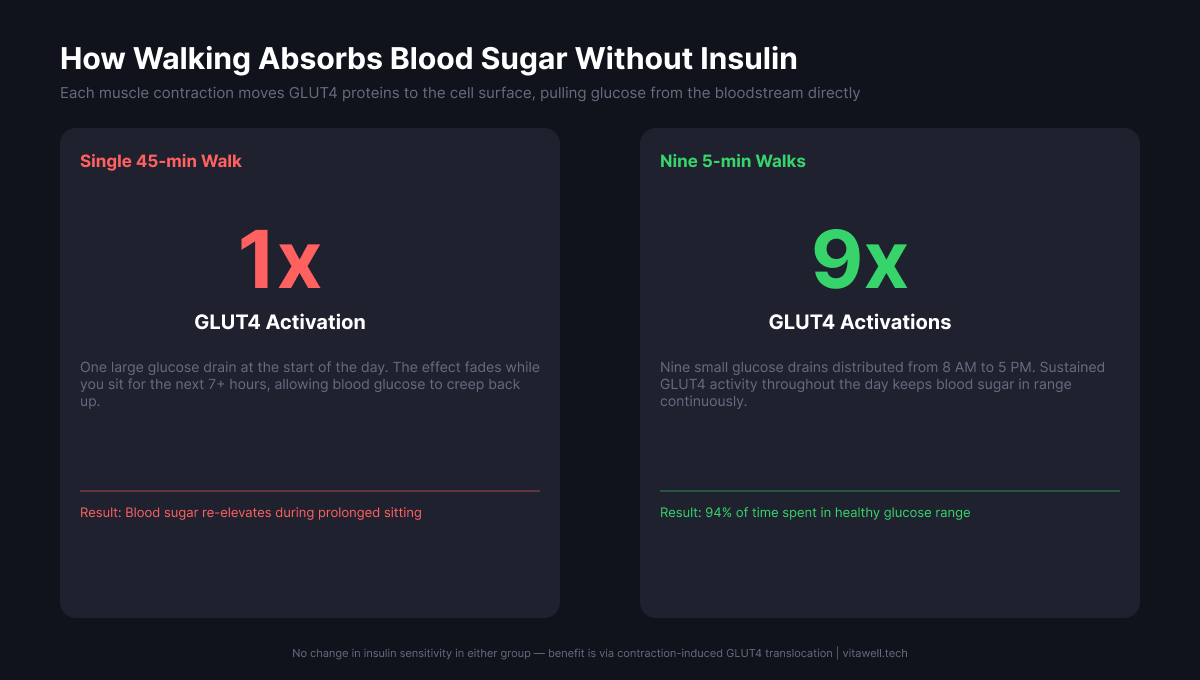
When muscle fibers contract during walking, they activate a protein called GLUT4 (glucose transporter type 4) independently of insulin. GLUT4 moves to the cell surface and pulls glucose out of the bloodstream for immediate use as fuel. This process happens during the activity itself, not hours later. Each 5-minute walking bout essentially acts as a small glucose "drain"—repeated nine times across the day, it creates sustained glucose absorption that keeps blood levels in a healthier range from morning through afternoon.
By contrast, a single 45-minute session triggers a large GLUT4 response once, but the effect diminishes over the following hours while the person sits continuously for the rest of the day. The prolonged sitting reactivates the conditions that elevate blood glucose, partially or fully undoing the morning's work. Research from Dunstan et al. (2012) in Diabetes Care established the foundational evidence: breaking up sitting every 30 minutes reduced postprandial glucose and insulin responses in overweight adults—a finding the 2026 RCT now extends to real-world, free-living conditions over six weeks.
ONE vs. BREAK: A Side-by-Side Comparison
The two protocols used identical exercise volume— 45 minutes of brisk walking per day, five days per week—so the difference in outcomes cannot be explained by one group doing more. Here is how they compared across six key metrics:
| Metric | ONE (single 45-min walk) | BREAK (9×5-min walks) |
|---|---|---|
| Time in healthy glucose range | Decreased: 89% → 80% | Increased: 82% → 94% |
| Glucose variability | No significant improvement | Significantly reduced |
| Insulin sensitivity (IVGTT) | No significant change | No significant change |
| Prolonged sedentary bouts (≥60 min) | Not reduced | Significantly reduced |
| Total daily energy expenditure | Increased similarly | Increased similarly |
| Office/desk worker feasibility | Requires dedicated uninterrupted block | Each bout fits a single work hour |
Both groups increased their moderate-to-vigorous physical activity and total daily energy expenditure to a similar degree—confirming that the difference in glucose outcomes was not due to one group burning more calories. The divergence in blood sugar results comes specifically from how movement was distributed across the day, as confirmed by the companion paper on movement behavior and energy balance.
The Hidden Risk of Sitting Too Long in One Stretch
Epidemiological research identifies prolonged, unbroken sitting as an independent risk factor for poor cardiometabolic health—separate from overall physical inactivity. Even people who exercise regularly but sit for 8 or more hours continuously at work face elevated metabolic risks compared to those who break up their sitting frequently.
Only the BREAK group in this study reduced the amount of time spent in sedentary bouts of 60 minutes or more. The ONE group still spent most of their workday in prolonged sedentary stretches despite completing their daily walk. This finding aligns with the concept that how we distribute physical activity throughout the day may be just as important as how much we do, as lead researcher Dr. Bergouignan has noted. For office workers navigating back-to-back meetings and deep work sessions, chronic sedentary stress may also contribute to burnout—another reason to treat hourly movement as a non-negotiable reset.
Your Hour-by-Hour Walking Schedule for a 9-Hour Workday
The BREAK protocol—nine 5-minute bouts across a 9-hour workday—translates directly into a schedule you can adopt without disrupting your workflow. Each walk takes the same time as a bathroom break.
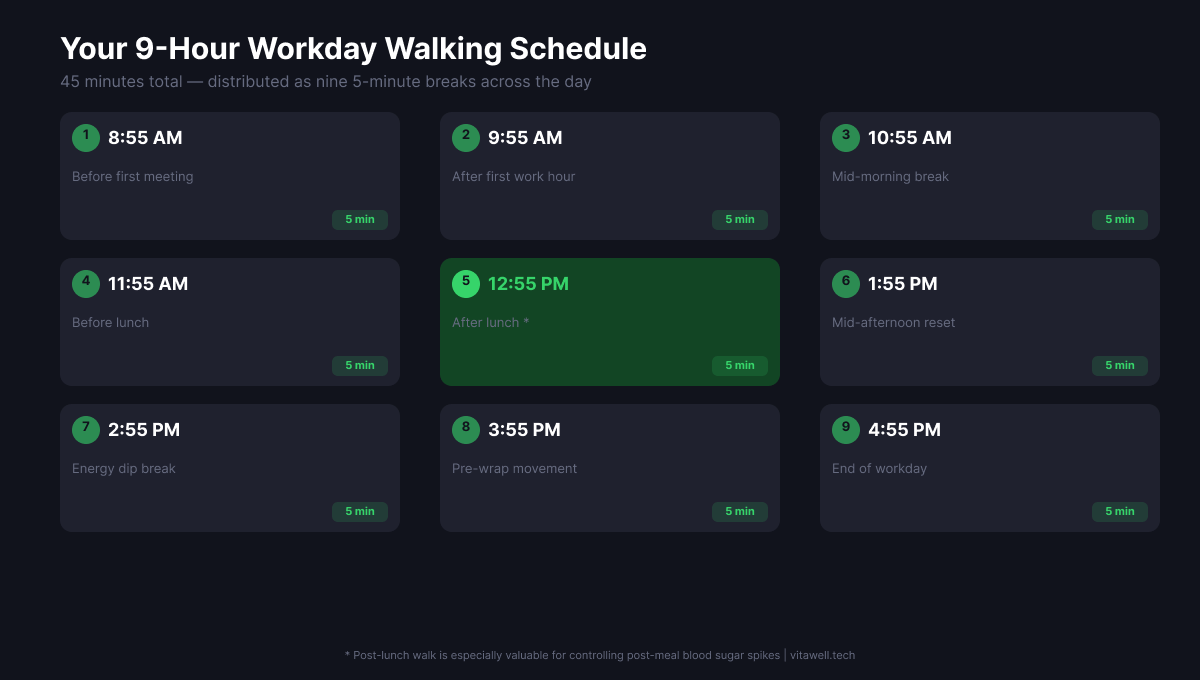
- 8:55 AM — Walk before your first meeting starts
- 9:55 AM — Walk after the first hour of focused work
- 10:55 AM — Walk before or after a mid-morning call
- 11:55 AM — Walk before lunch
- 12:55 PM — Walk after lunch (especially valuable for post-meal glucose)
- 1:55 PM — Walk mid-afternoon
- 2:55 PM — Walk at the mid-afternoon energy dip
- 3:55 PM — Walk before the afternoon wrap-up
- 4:55 PM — Walk before the end of the workday
You don't need to leave the building—walking the hallway, the parking lot, or pacing during phone calls all count. Good companion habits: staying well-hydrated throughout the day supports metabolic function and cognitive performance. If you travel across time zones and lose your movement routine, restoring structured daily movement helps reset your body clock. Set a recurring phone alarm or use a wearable nudge to build the habit until it becomes automatic. Integrating this kind of micro-movement into a balanced daily routine makes it far more sustainable long-term.
What This Means if You Have Prediabetes or Type 2 Diabetes
This study was conducted in adults with overweight or obesity who were sedentary—not in people diagnosed with diabetes. The results cannot be directly extrapolated as a treatment for prediabetes or type 2 diabetes, though the underlying mechanism (contraction-induced GLUT4 activation) operates in people with insulin resistance as well. A 2019 study in Diabetes Care examined free-living glucose management in adults with type 2 diabetes and found that interrupting sitting produced meaningful reductions in hyperglycemia, even at modest activity doses.
For people managing diabetes with medication or insulin, unsupervised changes to exercise patterns can alter blood sugar in unpredictable ways and may interact with medications. The evidence here is promising, but should be treated as a signal for discussion with your healthcare provider—not a standalone protocol.
When to Talk to a Professional
Consult your doctor or a registered dietitian before starting any new physical activity protocol if you have been diagnosed with type 1 or type 2 diabetes, take medications that affect blood sugar, have a cardiovascular condition or joint problems that may be affected by walking, are pregnant or recently postpartum, or use a CGM and notice unexpected glucose patterns when you change your activity habits. A certified diabetes care and education specialist (CDCES) can help you integrate activity-based glucose management into an overall diabetes care plan.
Frequently Asked Questions
How often should I take walking breaks to lower blood sugar?
Based on the 2026 Obesity trial, one 5-minute brisk walk every hour across a 9-hour workday (nine bouts total) produced significant blood sugar improvements after six weeks. Starting with every 90 minutes is a realistic entry point if hourly feels too disruptive, but the evidence supports moving toward hourly breaks over time.
Does breaking up sitting help more than one long workout for blood sugar?
For blood sugar specifically, yes—at least in this 6-week randomized trial. Both approaches used the same total walking time (45 minutes per day), but the distributed bouts improved time-in-healthy-glucose-range from 82% to 94%, while the single-bout group's measure dropped from 89% to 80%.
Can short walking breaks help if I have prediabetes?
The 2026 trial did not specifically study people with prediabetes, but the GLUT4 mechanism operates in people with impaired insulin sensitivity as well. Related research in type 2 diabetes also supports interrupting sitting for glucose management. Talk to your healthcare provider about how to apply this in your specific context.
What is the minimum walking time needed to improve glucose control?
The 2026 trial used 5-minute bouts, and earlier research by Dunstan et al. (2012) showed glucose benefits from 2-minute walking intervals every 20 minutes in overweight adults. A single isolated 5-minute walk is unlikely to produce lasting results; the key is repetition distributed across the day.
Why does breaking up sitting lower blood sugar when insulin sensitivity doesn't improve?
Both groups in the 2026 study showed no change in insulin sensitivity, yet the BREAK group improved blood glucose significantly. The explanation is a parallel pathway: muscle contractions directly move GLUT4 glucose transporters to the cell surface, pulling glucose from the blood without requiring insulin. This insulin-independent uptake resets with each walking bout, creating sustained glucose absorption across the day.
Conclusion
A 2026 randomized controlled trial has made a compelling case that the timing of physical activity—not just the total amount—shapes blood sugar outcomes. Nine 5-minute walks spread across a workday outperformed a single 45-minute session on every glucose metric tested, while also being the only approach that broke up prolonged sitting. The underlying biology is clear: muscle contractions directly absorb glucose, and you need that effect distributed throughout the day, not just concentrated in one session.
For most adults whose jobs are largely sedentary, this is actionable right now. Set an hourly alarm, stand up, and walk for five minutes. For more strategies on building a healthier, more intentional daily structure, explore VitaWell's approach to balanced life planning.
Related on VitaWell
- The Science of Friendship: How Your Friends Literally Shape Your Health and Identity — Social connection and physical health share more biology than most people realize.
- Water: A Science-Based Guide to Hydration — The other daily habit that directly influences metabolic function and energy.
- Burnout Recovery: Why Your Nervous System Still Feels Stuck — Chronic sedentary stress and mental overload often share the same root causes.
This article is for informational purposes only and does not constitute medical advice. Consult a qualified healthcare provider before making changes to your exercise or health routine.
Sources
- MedicalNewsToday — Short walking breaks may offer advantage for blood sugar management
- Bergouignan et al., Obesity 2026 — Interrupting Prolonged Sitting Improves Glucose Regulation More Than Continuous Walking in Adults with Overweight/Obesity
- Bergouignan et al., Obesity 2026 — Frequent Versus Single Active Bouts Differentially Affect Movement Behavior and Energy Balance
- Dunstan et al., Diabetes Care 2012 — Breaking up prolonged sitting reduces postprandial glucose and insulin responses
- Diabetes Care 2019 — Managing free-living hyperglycemia with exercise or interrupted sitting in type 2 diabetes