
Root-to-Tip Eating: Why You Shouldn't Throw Away Your Vegetable Scraps
A 2026 study found that in 10 of 12 produce items, discarded peels and seeds contain more fiber than the flesh. Here's how to eat root-to-tip.
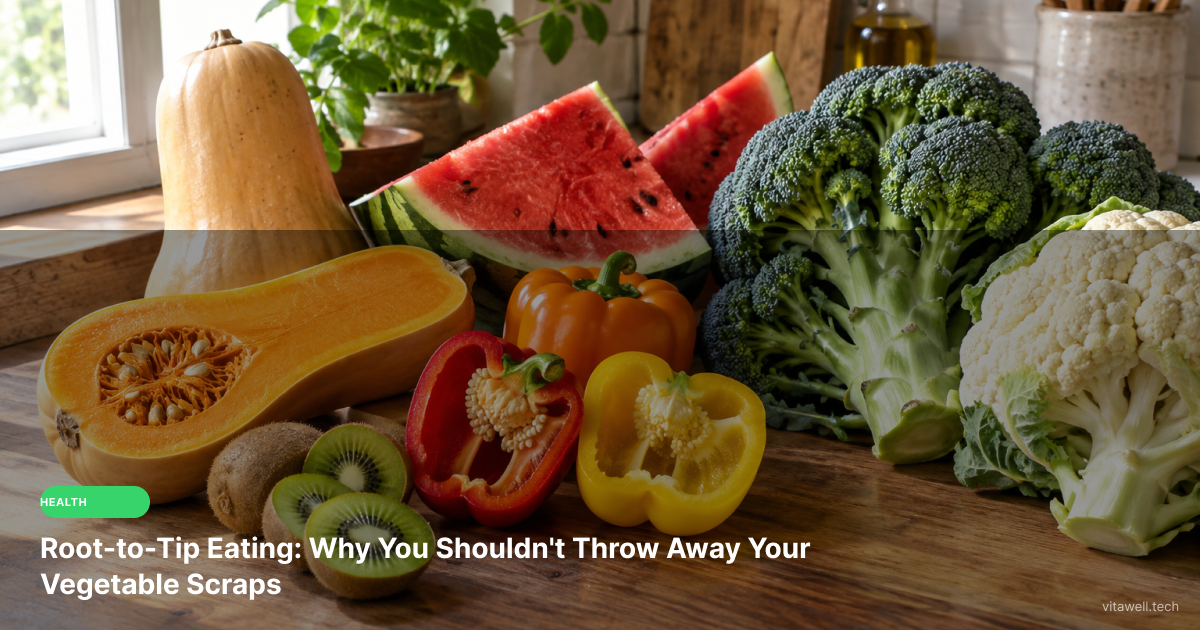
Most of us compost, peel, or bin the parts of fruit and vegetables that happen to have the highest fiber content. A 2026 observational study from King's College London found that in 10 of 12 common produce items tested, the discarded peels, seeds, rinds, and stalks contained significantly more dietary fiber per 100g than the portions we actually eat — in some cases hundreds of percent more King's College London, International Journal of Food Sciences and Nutrition, 2026. Eating root-to-tip costs nothing extra and takes only a few small habit shifts.
Key Takeaways
- 10 of 12 produce items tested had more fiber in their scraps than their edible flesh (King's College London, 2026)
- Butternut squash skins and seeds contain 9.25g of fiber per 100g — 362% more than the flesh
- Only 4% of men and 11% of women in the US currently meet daily fiber recommendations
- Food waste in the US amounts to 60 million tons per year, 45% of which is produce
- Most vegetable scraps are safe to eat with simple washing — pineapple skin should always be cooked first
What Is Root-to-Tip Eating?
Root-to-tip eating means using as much of a fruit or vegetable as possible — skins, seeds, stalks, rinds, cores, and tops — rather than discarding them as waste. It is the plant-based counterpart to the nose-to-tail approach that chefs have applied to meat for decades.
The practice is not new. Before modern food processing standardized what produce “should” look like, using the whole plant was simply how people cooked. Carrot tops went into soups. Watermelon rinds were pickled. Broccoli stalks were eaten alongside the florets. What changed was convenience: packaged, pre-trimmed produce conditioned consumers to see anything outside the ideal edible portion as waste.
Today, the concept is re-emerging — but now backed by data. The 2026 King's College London study is the most rigorous published analysis of fiber content in commonly discarded produce parts, and its findings reframe what “healthy eating” looks like at the grocery-bag level.
The King’s College London Study: What It Found
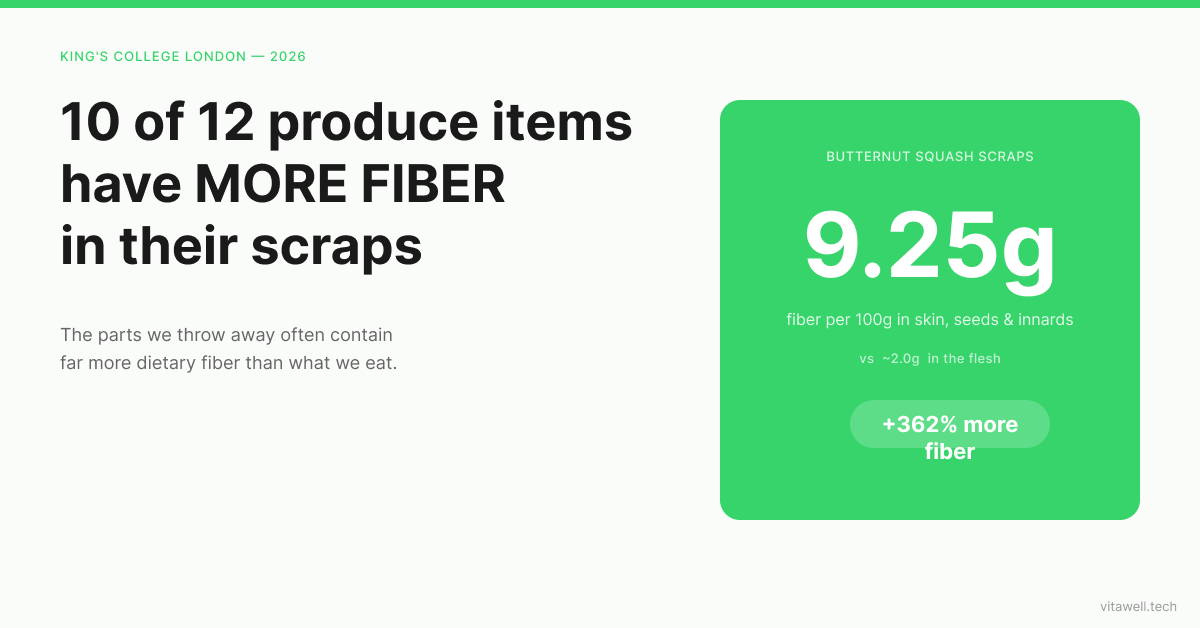
Researchers analyzed 12 common fruits and vegetables: beetroot, bell pepper, broccoli, butternut squash, cauliflower, celeriac, curly kale, fennel, kiwi, leek, pineapple, and watermelon. For each item, they compared the fiber content (per 100g) of the parts people typically eat versus the parts typically discarded — peels, skins, seeds, stalks, rinds, and cores News-Medical.
The result: 10 of the 12 items had more fiber in their discarded portions than in their edible flesh. The two exceptions were broccoli (stalks have 28.4% less fiber than florets) and fennel (fronds and stalks contain less fiber than the bulb). For the other ten, the gap was striking — not marginal.
The discarded parts also made up 25% to 48% of each item's total weight ScienceAlert, meaning a significant portion of the fiber in a head of cauliflower or a whole pineapple sits in the parts most people throw away.
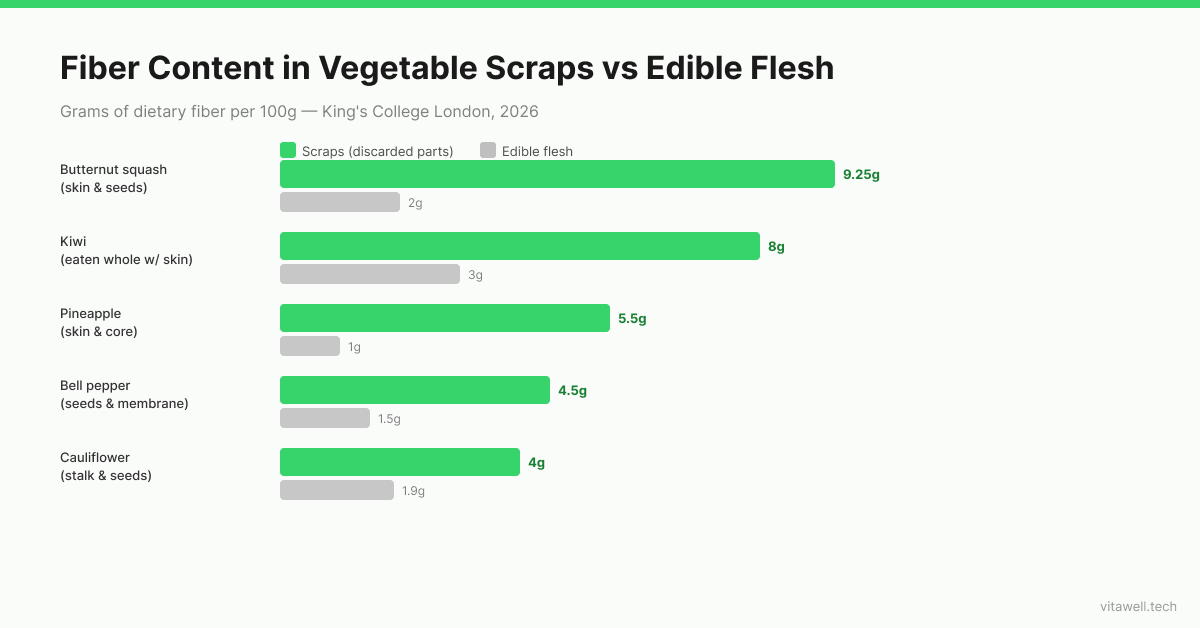
| Produce | Discarded Part | Scrap Fiber (g/100g) | Flesh Fiber (g/100g) | Difference |
|---|---|---|---|---|
| Butternut squash | Skin, seeds, innards | 9.25 | ~2.0 | +362% |
| Pineapple | Skin and core | ~5.5 | ~1.0 | +453.7% |
| Watermelon | Rind | 2.10 | ~0.4 | +425% |
| Cauliflower | Stalk and seeds | ~4.0 | ~1.9 | +112% |
| Bell pepper | Seeds and inner membrane | ~4.5 | ~1.5 | >+200% |
| Kiwi | Skin (eaten whole) | ~8.0 | ~3.0 | +167% |
| Beetroot | Tops/leaves | Higher | — | More |
| Celeriac | Peels | Higher | — | More |
| Curly kale | Stems | Higher | — | More |
| Leek | Green tops | Higher | — | More |
| Broccoli | Stalks | ~1.9 | ~2.6 | −28.4% (exception) |
| Fennel | Fronds and stalks | Lower | — | Less (exception) |
Sources: King's College London, International Journal of Food Sciences and Nutrition, 2026 (DOI: 10.1080/09637486.2026.2734852). Specific g/100g values for beetroot, celeriac, kale, and leek were not published in the press release; “higher/lower” reflects the study's directional finding. Approximate flesh values based on USDA FoodData Central.
The team also ran a focus group of 40 university staff and students who were offered meals using root-to-tip ingredients NutritionInsight. Fiber content was the strongest motivator to try these preparations. The main barriers were discomfort with the unfamiliar textures and poor information about nutrition in scraps online.
Why This Matters: The Fiber Gap
Dietary fiber is one of the most reliably under-consumed nutrients in the Western diet. The recommended intake is 25–38g per day for adults, depending on age and sex Academy of Nutrition and Dietetics. The average American gets roughly 16g — about half the minimum. A 2015 analysis published in Nutrition Today found that 95% of US adults fall below recommendations Nutrition Today, 2015. A US Dietary Guidelines Advisory Committee report found that just 4% of men and 11% of women met their fiber targets Healthline.
This matters because adequate fiber intake is associated with significantly lower risk of cardiovascular disease, type 2 diabetes, colorectal cancer, and obesity, according to a comprehensive review in the NCBI Bookshelf. These are not fringe associations — they appear consistently across meta-analyses of large cohort studies.
Root-to-tip eating will not close the entire fiber gap on its own. But if the scraps on your butternut squash alone contain 9.25g of fiber per 100g — close to a third of the daily minimum — it is a meaningful contribution from something you were going to compost anyway. Research linking fiber intake to brain health, including potential dementia prevention, is detailed in fiber's role in brain health and dementia prevention, and fiber also plays a role in blood sugar regulation and cognitive focus.
The Food Waste Bonus
Using your produce scraps is also a straightforward way to reduce food waste. In the United States, approximately 60 million tons of food are wasted every year, with 45% of that waste being fruits and vegetables, according to ReFED. Globally, the UN World Food Programme estimates that roughly one-fifth of all food produced is lost or wasted.
The King's College study found that the discarded parts it analyzed accounted for 25% to 48% of each produce item's total weight. That means when you throw away a butternut squash peel, you are discarding close to a third of the item — and, in this case, the nutritionally denser third.
None of this requires buying anything new. The scraps are already in your kitchen. The only change is what goes in the bin.
A Practical Guide — Which Scraps to Eat and How
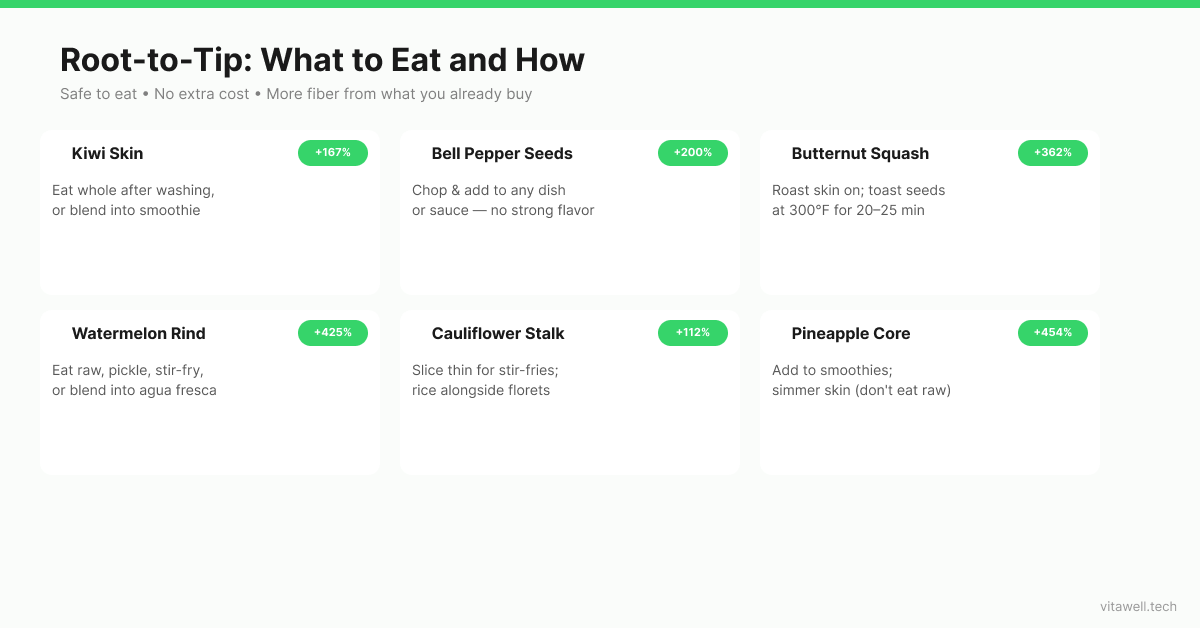
Just as nuts and seeds reward the effort of eating them whole rather than processing them into bland forms, produce scraps reward minimal effort with outsized nutritional return. Here is a produce-by-produce guide based on the King's College findings and standard food safety guidance.
Kiwi skin: Leave it on and eat the kiwi whole after washing. The skin contains significantly more fiber than the flesh alone — roughly 8g per 100g compared with under 3g skinless, based on the King's study. The texture is slightly fuzzy but mild in flavor. If you find it unpleasant, blend the whole kiwi into a smoothie.
Bell pepper seeds and inner white membrane: These are completely safe and edible raw. Chop them into any dish alongside the walls of the pepper. They add no strong flavor and blend into soups, stir-fries, or sauces invisibly.
Butternut squash skin and seeds: Roast the seeds with a little olive oil and salt (they toast at 300℉ for 20–25 minutes). Leave the skin on when roasting cubes or halves — it crisps up and is fully edible. If you prefer a smoother texture in soups, peel the squash but save the seeds separately.
Watermelon rind: The white-green rind is edible raw (mild, slightly bitter, cucumber-like) and excellent pickled, stir-fried, or blended into agua fresca. The rind contains 2.10g of fiber per 100g — 425% more than the pink flesh.
Cauliflower stalk and seeds: Slice the stalk thin and add it to stir-fries, or pulse it in a food processor to rice it alongside the florets. The seeds can be toasted and used as a garnish or added to grain bowls.
Pineapple core: The tough core is edible and high in fiber. Add chunks of it to smoothies where the blender will break down the texture. The pineapple skin, however, should be cooked or simmered before consumption — it contains naturally occurring compounds (including bromelain concentrations and oxalates) that can cause mouth and throat irritation in raw form. Simmer skin in water for a fiber-rich agua de piña.
Broccoli stalks: These are the exception. The King's College study found stalks have 28.4% less fiber than florets, so the usual eating convention here actually favors the florets. Stalks still provide vitamins C and K, however, so they are worth using — slice them thin for stir-fries or into coins for roasting.
Pesticide Safety: How to Eat Peels Without Worry
The most common concern about eating skins and peels is pesticide residue. This is worth taking seriously, but it is manageable with a simple framework.
The Environmental Working Group (EWG) publishes an annual Dirty Dozen list of produce items most likely to carry higher pesticide residues. Items consistently on this list include strawberries, spinach, kale, bell peppers, peaches, nectarines, apples, grapes, and blueberries. If you plan to eat the peel or skin of these items, choosing organic reduces your residue exposure. If organic is not available or affordable, a thorough wash with the protocol below is the practical alternative.
The EWG's Clean Fifteen includes avocados, sweet corn, pineapple, onions, papaya, mushrooms, and asparagus — items with naturally lower surface residues where eating the skin or outer layers carries lower relative risk.
Washing protocol for peels and skins:
- Rinse under cold running water while scrubbing the surface with a vegetable brush for at least 60 seconds.
- For Dirty Dozen items where you plan to eat the skin, soak in a solution of 1 teaspoon baking soda dissolved in 2 cups of water for 15 minutes, then rinse. Research from the University of Massachusetts found this method removes a greater proportion of surface pesticide residue than water alone.
- Pat dry before eating or cooking.
The practical rule: if it is in the Dirty Dozen and you are eating the skin, choose organic or use the baking soda soak.
When to Talk to a Professional
If you have irritable bowel syndrome (IBS), Crohn's disease, or diverticulitis, increasing your fiber intake rapidly — especially from raw peels and skins — can trigger bloating, gas, or discomfort. Introduce high-fiber scraps gradually, one or two items at a time, over several weeks. A registered dietitian can help you set a pace that suits your digestive tolerance and overall dietary plan.
FAQ — Frequently Asked Questions
Is it safe to eat watermelon rind?
Yes. Watermelon rind is completely safe to eat raw or cooked. It has a mild, slightly bitter flavor similar to cucumber. Wash the outer surface well, slice or dice the rind, and use it raw in salads, pickled, or stir-fried. It is a traditional food in many parts of the world and carries no known safety concerns.
Which vegetable parts have the most fiber?
Based on the King's College London 2026 study, butternut squash skins and seeds top the list at 9.25g of fiber per 100g. Bell pepper seeds and inner membrane follow at over 200% more than the edible walls. Cauliflower stalk and seeds provide approximately 4g per 100g — 112% more than the florets. Kiwi skin provides roughly 8g per 100g in total when eaten whole.
Should you cook pineapple skin before eating it?
Yes. Pineapple skin contains concentrated bromelain and other compounds that can irritate the mouth and throat when eaten raw. Simmer the skin in water for 10–15 minutes to make it safe. The resulting liquid can be drunk as a tea or used as a base for agua de piña.
How do you wash vegetable peels to remove pesticides?
Scrub peels under cold running water with a vegetable brush for at least 60 seconds. For produce on the EWG Dirty Dozen list (bell peppers, kale, apples, grapes, peaches), soak the item in a baking soda solution (1 tsp per 2 cups water) for 15 minutes, then rinse. Research shows this removes a greater proportion of surface pesticide residue than rinsing alone.
Does eating vegetable scraps help with weight loss?
Fiber is associated with greater satiety, reduced calorie intake, and lower obesity risk in observational research. Adding high-fiber scraps like butternut squash seeds, kiwi skin, and cauliflower stalks can contribute to your daily fiber intake, which supports weight management as part of a balanced diet. No single food causes or prevents weight loss, but evidence for fiber's satiety effects is robust.
Conclusion
The fiber in your produce scraps is real, measurable, and already paid for. A 2026 King's College London study found that in most of the fruit and vegetables you buy, the parts you throw away contain more dietary fiber than the parts you eat — sometimes by a large margin. Eating root-to-tip is not a dietary overhaul. It is a series of small swaps: leave the kiwi skin on, roast the butternut squash seeds, toss the bell pepper seeds into the pan. Start with one this week. The gap between the fiber you eat and the fiber your body needs is real. Part of the solution is already in your compost bin.
For more evidence-backed approaches to everyday health, explore VitaWell's coverage across all eight life areas.
Related on VitaWell
- Berries as Superfoods: Are Antioxidants the Real Hero? — Another look at the unexpected nutritional power hidden in ordinary produce: how berries punch above their weight, and what the antioxidant evidence actually shows.
- Walking: The Simplest Habit That Improves Your Life — Root-to-tip eating and a daily walk share the same logic: meaningful health gains from zero-cost, low-friction habits already within reach.
- Gardening as a Form of Meditation — If you grow your own vegetables, using them root-to-tip closes the loop: nothing you grew goes to waste, and the mindfulness of gardening carries into the kitchen.
This article is for informational purposes only and does not constitute medical or nutritional advice. Consult a registered dietitian or healthcare professional before making significant changes to your diet, especially if you have a gastrointestinal condition.
Sources
- Healthline — Root-to-Tip Eating May Boost Fiber Intake
- King's College London / Tandfonline — Root-to-tip study, International Journal of Food Sciences and Nutrition, 2026
- News-Medical.net — Discarded fruit and vegetable parts offer overlooked fiber benefits, 2026
- ScienceAlert — There's a surprisingly simple way to get more fiber from your fruits and vegetables, 2026
- NutritionInsight — Peels, seeds and skins pack more fiber than fruit and vegetable flesh, King's study finds, 2026
- Dahl & Stewart — Nutrient-density scores, Nutrition Today, 2015
- Academy of Nutrition and Dietetics — Dietary fiber intake and health outcomes
- NCBI Bookshelf — Dietary fiber: health outcomes and evidence
- ReFED — The food waste problem
- UN World Food Programme — 5 facts about food loss and waste