
How to Protect Your Finances Before the Next Tech Outage: 4 Essential Steps
The next major tech outage could leave you unable to pay for groceries or access your money. These four steps keep your finances working when digital systems don't.
The next major tech outage is a question of when, not if. When payment networks, banking apps, and ATM systems go offline — as they did during the July 2024 CrowdStrike incident that cost Fortune 500 companies $5.4 billion according to an analysis by Parametrix — the people least affected are those who prepared before it happened. These four steps require less than an afternoon and cover every major failure scenario, from a bank app going down to a full regional internet outage.
Key Takeaways
- 42% of US adults go entirely cashless in a typical week (Pew Research, 2026), creating critical vulnerability when digital systems fail
- The CrowdStrike July 2024 outage had a “major and unprecedented impact on banks, fintechs, and payment networks” per CrowdFund Insider
- 24% of Americans have zero emergency savings; 47% cannot cover an unexpected $1,000 expense from savings alone (Bankrate, 2026)
- Cash is the only payment method that works across all three major outage types: bank outage, internet outage, and power outage
- The PREP framework — Physical cash, Records, Emergency fund, Plan B — takes under an hour to set up and covers every scenario
Why Your Finances Are More Fragile Than You Think
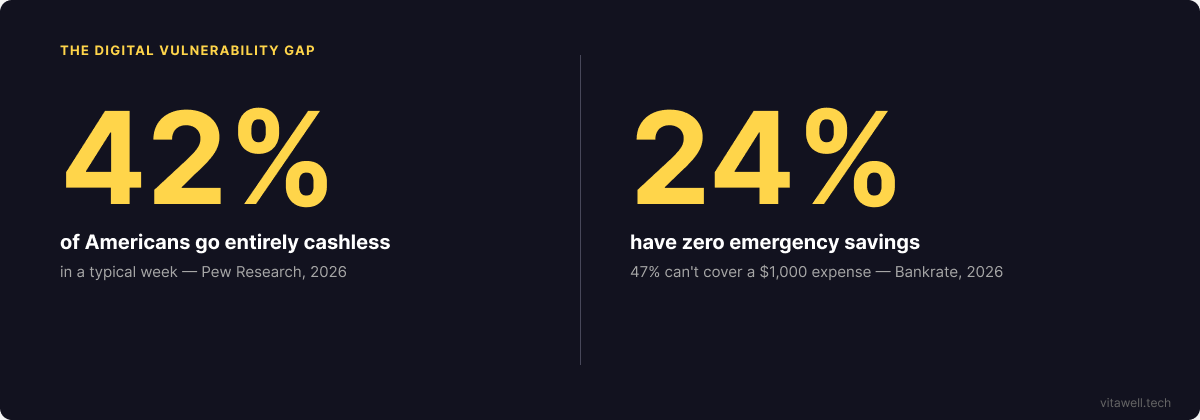
Most people assume that financial fragility means poverty. The data says otherwise. A 2026 Pew Research study found that 42% of US adults now go entirely cashless in a typical week — a figure that has roughly doubled over the past decade according to GCN. At the same time, a January 2026 Bankrate Emergency Savings Survey found that 24% of Americans have no emergency savings at all, and 47% could not cover an unexpected $1,000 expense from savings alone per Bankrate. These two trends together create a compounded vulnerability that did not exist a generation ago: millions of people are now fully dependent on digital payment systems while simultaneously having no financial buffer when those systems fail.
The CrowdStrike outage of July 2024 illustrated the scale of this risk. A single software update caused 8.5 million Windows devices to crash simultaneously, triggering what CrowdFund Insider described as a “major and unprecedented impact on banks, fintechs, payment networks.” Direct losses to Fortune 500 companies reached $5.4 billion in a single day per Parametrix estimates. And CrowdStrike was not a unique event. According to Splunk’s 2026 downtime research, organizations globally lose an estimated $600 billion per year to unplanned IT outages. The question is not whether outages will recur. It is whether your finances will survive the next one.
Understanding what financial wellness means in a digital-first world is the first step — but preparation is what makes it real.
What Actually Fails During a Tech Outage
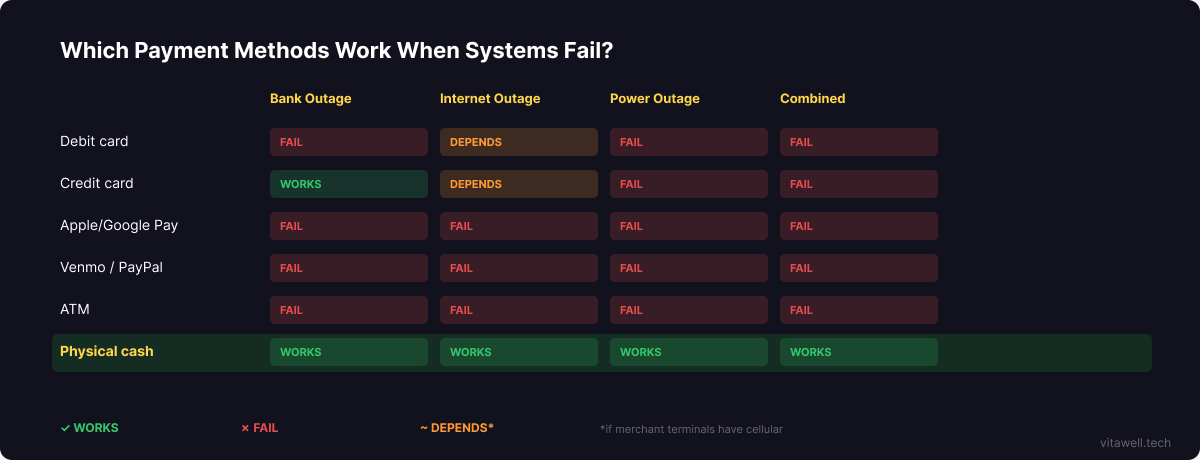
Not all outages are equal. A bank’s internal systems going down is different from an internet service provider failing, which is different from a regional power outage. The table below shows which payment methods remain functional in each scenario, based on how each system works at the infrastructure level.
| Payment Method | Bank/App Outage | Internet Outage | Power Outage | Combined Outage |
|---|---|---|---|---|
| Debit card (chip/swipe) | Fails | Depends* | Fails | Fails |
| Credit card (chip/swipe) | Usually works | Depends* | Fails | Fails |
| Apple Pay / Google Pay | Fails | Fails | Fails | Fails |
| Venmo / PayPal | Fails | Fails | Fails | Fails |
| ATM | Fails | Fails | Fails | Fails |
| Physical cash | Works | Works | Works | Works |
*Card terminal networks (Visa, Mastercard) may still route through cellular if merchant terminals have connectivity. Cash is the only payment method with a perfect record across all four scenarios. The Atlanta Fed’s 2025 Diary of Consumer Payment Choice confirms cash remains the most-used in-person payment method by transaction count — not because people prefer it on average, but because it is the universal fallback.
Step 1 — Keep Physical Cash Ready (The P in PREP)
The most common question about cash preparation is how much. Financial planners and emergency preparedness guides consistently recommend keeping one to two weeks of essential living expenses in cash at home — but a practical minimum is $200–$500, in $20 bills and smaller. Larger bills are harder to make change for during a retailer’s manual transaction; smaller denominations give you flexibility.
Where you store it matters. A fireproof home safe is the standard recommendation. Do not keep all of it in one location, and do not keep it in an unsecured drawer or box — a power outage that lasts more than a few hours can increase opportunistic risk. The goal is accessibility for you and inaccessibility for anyone else. Refresh the cash every 12 months if unused, to avoid keeping bills that might be pulled from circulation.
Step 2 — Maintain Paper Financial Records (The R in PREP)
When systems are down, what you can prove on paper is what you can act on. Print and store the following in a waterproof folder at home — and a copy in a fireproof box or safe-deposit box:
- Bank account numbers and routing numbers for every account
- Customer service phone numbers for each bank, credit card, and brokerage
- Credit card numbers and issuer contact numbers (useful for phone-based transactions if network is partially restored)
- Insurance policy numbers and provider emergency lines
- Investment account numbers and custodian contact information
This takes approximately 30 minutes to compile from your existing account statements. It costs nothing. And it is the difference between being able to call your bank and prove your identity over the phone — versus being entirely unable to act when the app is down.
Step 3 — Build a Liquid Emergency Fund (The E in PREP)
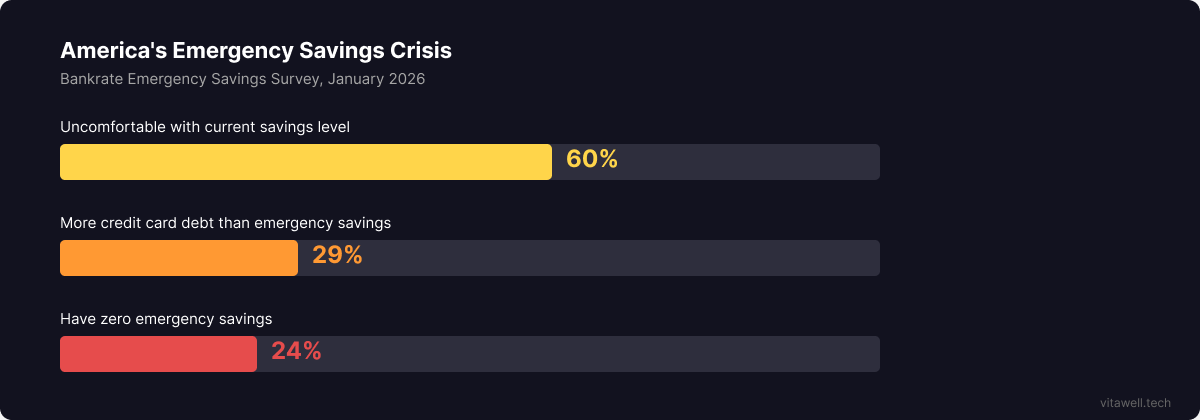
The Bankrate Emergency Savings Survey published in January 2026 found that 60% of Americans are uncomfortable with their current savings level — and the data supports that discomfort: 29% carry more credit card debt than emergency savings, and 24% have nothing saved at all per Bankrate. The Federal Reserve’s 2024 Survey of Household Economics and Decisionmaking found that 6% of US adults remain entirely unbanked per the Fed’s May 2025 report.
An emergency fund in the context of tech outage preparedness has a specific requirement: it must be instantly liquid and held at a stable institution. This means a high-yield savings account or money market account at an FDIC-insured bank — not in a brokerage account, not in a 401(k), and not in a fintech app that may itself go offline during the outage you are preparing for.
The standard target is three to six months of essential expenses. If that feels distant, start with $1,000 as a first milestone — an amount that covers most short-term disruptions. These six tactics for simplifying your finances show specific ways to cut recurring costs and accelerate savings. Setting a SMART financial goal — a specific amount, specific timeline, and specific account — is the most reliable predictor of actually reaching it, according to goal-setting research.
Step 4 — Set Up a Plan B Payment Method (The P2 in PREP)
Debit cards and credit cards process through different networks. During the CrowdStrike outage, many credit card transactions continued processing through Visa and Mastercard rails while some bank-issued debit transactions were interrupted at the authorization step. This is not guaranteed — it depends on where the outage sits in the payment stack — but having a credit card from a different issuing bank than your primary debit card provides meaningful redundancy.
A second bank account at a different institution adds another layer. Many community banks and credit unions operate on independent core banking systems, meaning a CrowdStrike-type event affecting one major vendor may not affect them. Opening a no-fee account at a local credit union and keeping it funded with one month’s expenses is a low-maintenance hedge. A prepaid card, loaded periodically, provides a third fallback that is entirely independent of your banking relationships. Building financial resilience also includes thinking about how the structure of your income affects your outage vulnerability — diversified income sources reduce single-point-of-failure risk.
When to Talk to a Financial Professional
If you carry high-interest consumer debt that prevents building any emergency fund, a certified financial planner or nonprofit credit counselor can help you sequence debt repayment alongside savings. If you are unbanked — a situation affecting 6% of US adults per the Federal Reserve 2024 SHED — a bank or credit union representative can help you access low-fee or no-fee accounts designed for this transition. Neither situation prevents you from starting with the PREP steps that cost nothing: the paper records and the cash on hand.
FAQ
How much cash should I keep at home in case of a bank outage?
Financial planners recommend one to two weeks of essential living expenses — typically $200–$500 for most households. Keep it in $20 bills and smaller for maximum flexibility. Store it in a fireproof safe or other secure location, not in an unsecured drawer. Refresh annually if unused to avoid holding bills pulled from circulation.
What happens to my bank account during a tech outage?
Your money stays in your account. A technology outage affects your ability to access or move funds — through apps, ATMs, and sometimes card transactions — but it does not affect the balance itself. FDIC insurance protects deposits up to $250,000 regardless of system status. The issue is access, not safety.
Can I still use my credit card if payment systems go down?
Sometimes. Credit cards process through networks (Visa, Mastercard) that are separate from your bank’s internal systems. If your bank’s app goes down but the card networks are operational, your credit card may still work at merchant terminals. If the outage is at the card network level — or if merchant systems are down — it will not. Cash is the only universally reliable fallback.
How did the CrowdStrike outage affect banking?
The July 2024 CrowdStrike outage caused 8.5 million Windows devices to crash simultaneously, impacting banks, fintech platforms, and payment processors worldwide. Many customers were temporarily unable to access online banking, make card payments, or use ATMs. CrowdFund Insider described it as having a “major and unprecedented impact on banks, fintechs, payment networks.” Fortune 500 direct losses reached $5.4 billion per Parametrix.
What financial documents should I have printed?
At minimum: bank account numbers and routing numbers, customer service phone numbers for each bank and credit card, credit card numbers and issuer contacts, insurance policy numbers and emergency lines, and investment account numbers. Store originals in a waterproof folder and copies in a fireproof safe or safe-deposit box. This setup takes under 30 minutes.
Conclusion
The PREP framework — Physical cash, Records, Emergency fund, Plan B — is a practical response to a documented and recurring risk. Tech outages that freeze payment systems have already cost Fortune 500 companies $5.4 billion in a single day. The $200 in cash in your safe and the savings account you fund this month cost a fraction of that — and they work precisely when nothing else does. Start with the step you can do today. For more evidence-backed approaches to financial wellness, explore VitaWell’s coverage of the Finances life area.
Related on VitaWell
- Financial Wellness Beyond Numbers — What financial health actually looks like beyond your bank balance: how security, flexibility, and meaning shape your relationship with money.
- 6 Proven Ways to Simplify Your Personal Finances — Practical tactics for eliminating financial friction: automating savings, reducing decision fatigue, and building systems that work without constant attention.
- SMART Goals: Practical Examples for 8 Spheres of Life — How to turn a vague savings intention into a concrete, time-bound goal, with specific examples for the financial sphere.
This article is for informational purposes only and does not constitute financial or professional advice. Consult a certified financial planner or credit counselor before making significant changes to your financial setup.
Sources
- NerdWallet — Prep Your Finances Before a Tech Outage
- CybersecurityNews — CrowdStrike outage cost Fortune 500 companies $5.4B, 2024
- CrowdFund Insider — CrowdStrike outage: unprecedented impact on banks and payment networks, July 2024
- GCN — Pew Research: 42% of Americans now cashless, 2026
- Bankrate — Emergency Savings Report, January 2026
- Federal Reserve — SHED 2024: Economic well-being of US households, May 2025
- Splunk — Cost of Downtime, 2026
- Atlanta Fed — Diary of Consumer Payment Choice, 2025