Irrational Jealousy: The 12 Thinking Traps Behind It and How to Stop Them
Irrational jealousy runs on predictable thinking traps. Learn the 12 distortions Leahy describes, why checking backfires, and a 5-step routine for jealous moments.

Irrational jealousy is jealousy triggered by ambiguous or neutral events rather than real evidence, and it is usually driven by predictable thinking traps such as mind reading, catastrophizing and emotional reasoning. Psychologist Robert Leahy describes 12 of these traps in a 2026 clinical paper. The way out is not to suppress the feeling but to spot the trap, drop checking and reassurance habits, and test your assumptions against facts.
Key Takeaways
- Irrational jealousy reacts to perceived threats, not observed ones, and it tends to grow with reassurance instead of settling.
- Leahy's 2026 emotional schema model names 12 jealousy distortions, from mind reading to blaming, and treats checking and interrogating as "safety behaviors" that keep jealousy going.
- In a 2019 YouGov survey of 1,236 US adults, 19% had gone through a partner's phone without permission.
- In a study of 477 undergraduates, attachment anxiety predicted jealousy, while attachment avoidance did not.
- CBT, the approach behind most jealousy techniques, is a reliable first-line treatment for anxiety problems, according to a review of 269 meta-analyses.
What Irrational Jealousy Is — and How It Differs From Healthy Jealousy
Jealousy is the fear of losing a valued relationship to a rival. In its healthy form it responds to something real and fades once the issue is talked through. Irrational jealousy fires on ambiguous cues, such as a slow reply or a coworker's name, and does not calm down when the facts are checked.
- Healthy jealousy: based on observable facts, proportionate, prompts a direct conversation, and settles after it.
- Irrational jealousy: triggered by neutral or unclear events, intense, drives checking, accusations or withdrawal, and returns despite reassurance.
The feeling is real either way. The difference is whether the story behind it matches the evidence, and that is where thinking traps come in.
Why Checking Makes Jealousy Worse
Checking a partner's phone or social media feels like a way to settle the doubt. In practice it often feeds it. In a 2019 YouGov survey of 1,236 US adults, 19% said they had gone through a partner's phone without permission, including 33% of millennial women and 23% of millennial men. Among those who snooped, 33% said they found something they already suspected, 18% found something unexpected, and 73% said they did not regret it.
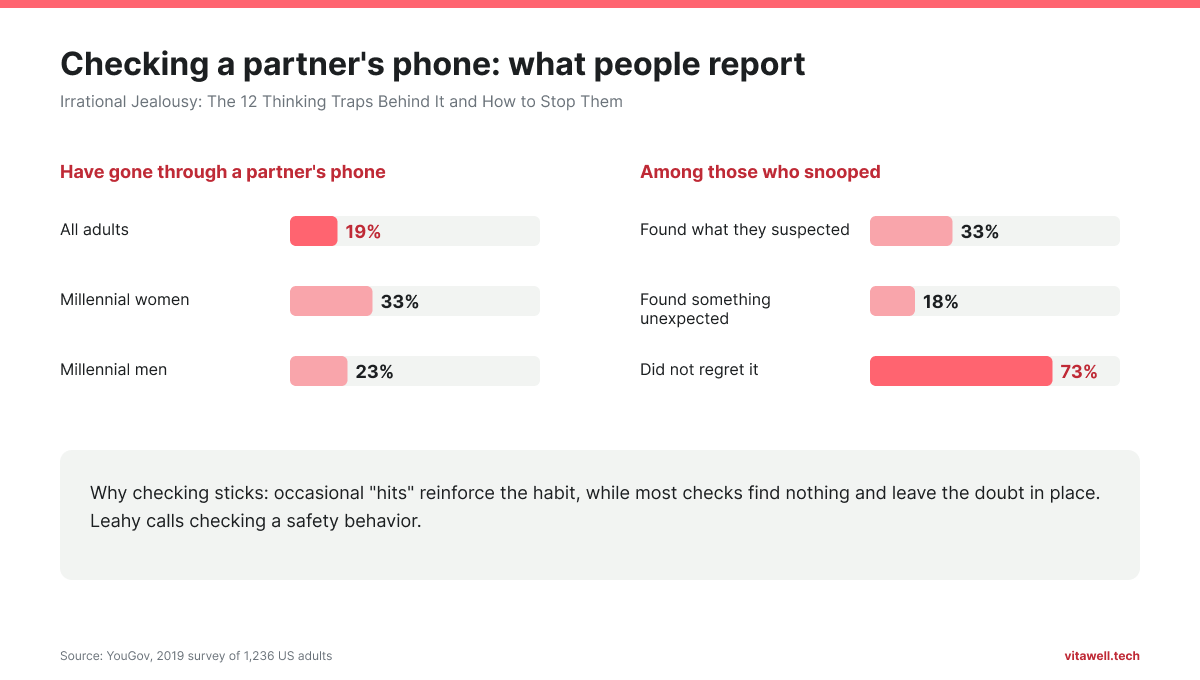
That mix explains why checking is so sticky: sometimes it seems to "work," which reinforces the habit, while most checks find nothing and still leave the doubt in place. Social media can speed up the loop. Amy Muise and colleagues at the University of Guelph (CyberPsychology & Behavior, 2009) found that young adults who spent more time on Facebook reported more jealousy toward their partners, which led to more checking and more jealousy-provoking information.
Leahy calls behaviors like checking, interrogating and seeking reassurance safety behaviors: they bring short-term relief but teach the brain that the threat was real.
The 12 Jealousy Distortions Leahy Describes
In "Jealousy: An Emotional Schema Model" (Journal of Clinical Psychology, 2026), Robert Leahy of Weill Cornell Medical College sets out an approach called emotional schema therapy, a form of CBT that looks at both jealous thoughts and beliefs about jealousy itself. The paper is a clinical model built around a case, not a trial, so it describes patterns therapists see rather than measuring how often they occur.
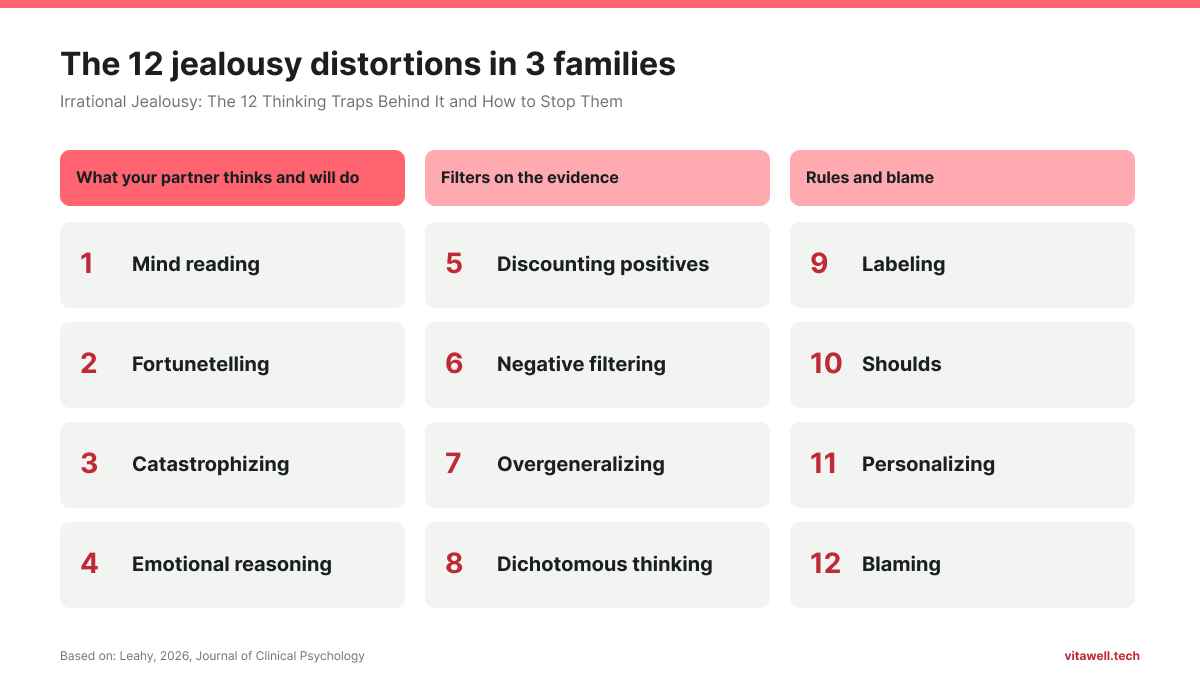
The 12 distortions fall into three families: guesses about what your partner thinks and will do, filters that distort the evidence, and rigid rules and blame. The next three sections cover each family with a challenge question for every trap.
Distortions About What Your Partner Thinks and Will Do
1. Mind reading
Assuming you know what your partner is thinking: "He's thinking about her." Challenge: What do I actually know? List two other explanations before acting on the first.
2. Fortunetelling
Predicting the worst with certainty: "They're going to leave me." Acting on this prediction, through clinging or preemptive anger, can help bring it about. Challenge: Rate your confidence from 0 to 100 and note what evidence would change it.
3. Catastrophizing
Treating a painful possibility as unbearable: "If they leave, I'll never recover." Challenge: Even if the worst happened, what support and strengths would I have?
4. Emotional reasoning
Using the feeling as proof: "I feel jealous, so something must be going on." Challenge: What triggered this feeling, and is the trigger evidence or just ambiguous?
Distortions That Filter the Evidence
5. Discounting positives
Dismissing signs of commitment: "They said they love me, but people say that." When every reassurance is discounted, nothing can ever be enough. Challenge: Write down five specific things your partner has done that show care, and read them when the doubt rises.
6. Negative filtering
Focusing only on the one cue that fits the fear, such as a short reply, while ignoring the rest of the day. Challenge: What else happened today that the filter left out?
7. Overgeneralizing
Turning one event into a rule: "My last partner cheated, so this one will too." Challenge: What is the evidence about this person, not past ones?
8. Dichotomous thinking
Seeing only extremes: "Either they're completely devoted or they don't care." Finding someone attractive is not the same as leaving. Challenge: Can both be true at once?
Distortions About Rules and Blame
9. Labeling
Reducing a person to one word: "They're a flirt," or "I'm too insecure to be loved." Challenge: Describe the specific behavior instead of the label.
10. Shoulds
Rigid rules: "They should never find anyone else attractive." Reality will always break such rules. Challenge: Swap "should" for "I would prefer," which keeps the need without the demand.
11. Personalizing
Assuming you are the cause: "They're quiet, so they must be pulling away from me." Challenge: Name three reasons for the behavior that are not about you.
12. Blaming
Putting all fault on your partner, a rival or yourself. Blame gives a sense of control but blocks problem-solving. Challenge: Ask what you need and how to request it directly. When jealous thoughts loop for hours, VitaWell's guide on how to tell if you are overthinking can help you spot rumination.
How Attachment Anxiety Feeds Jealousy
Attachment anxiety is a chronic fear that partners will withdraw or leave, often learned in earlier relationships. Deng Min and colleagues (Frontiers in Psychology, 2023) surveyed 477 undergraduates and found that attachment anxiety predicted jealousy, while attachment avoidance did not. Self-differentiation, the ability to stay emotionally steady and separate within a close relationship, partly explained the link.
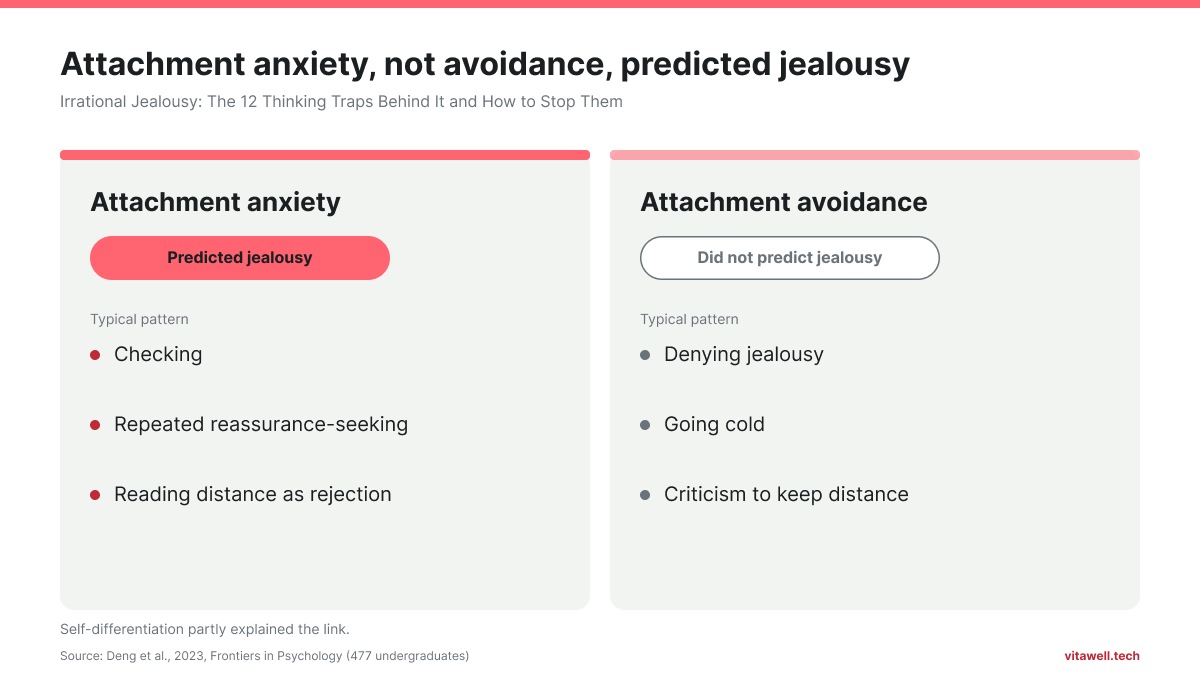
Anxious attachment tends to show up as checking, repeated reassurance-seeking and reading distance as rejection. Avoidant attachment looks different: denying jealousy, going cold or using criticism to keep distance. VitaWell's guide to attachment styles and what they mean for love covers both patterns.
Jealous Thought or Real Problem? A Decision Guide
Not all jealousy is irrational. The guide below helps separate thinking traps from situations that need a real conversation or more.
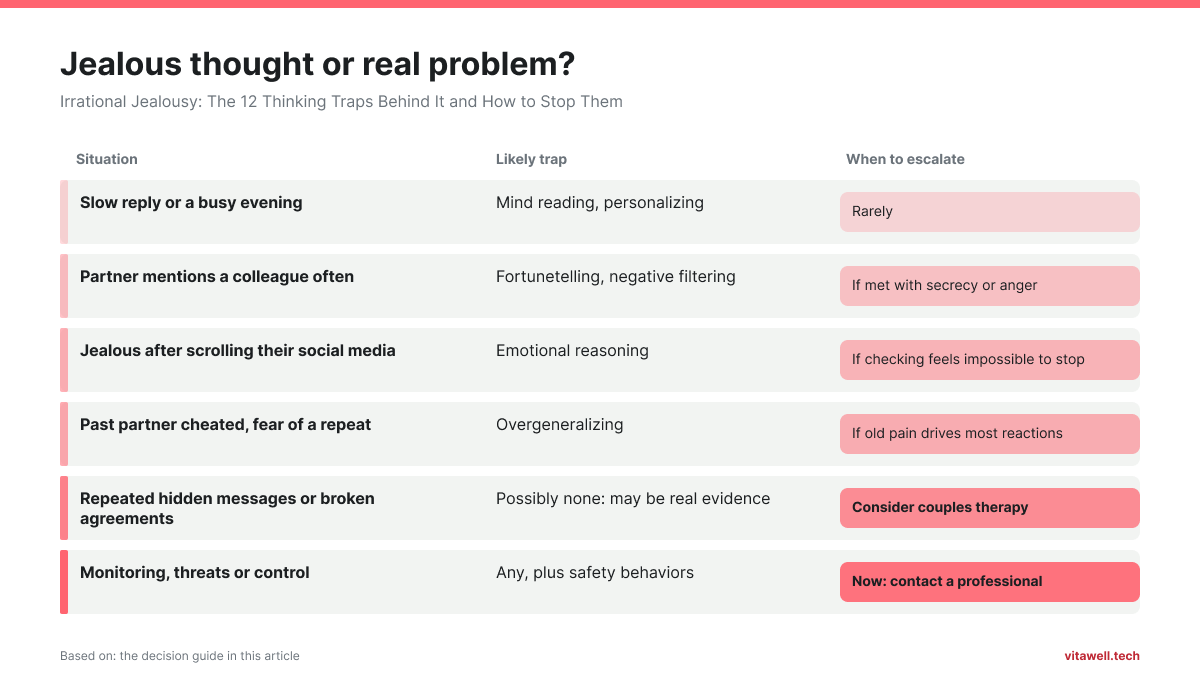
| Situation | Likely trap | Most useful response | When to escalate |
|---|---|---|---|
| Slow reply or a busy evening | Mind reading, personalizing | Name the trap and wait before reacting | Rarely; only if it is part of a wider pattern |
| Partner mentions a colleague often | Fortunetelling, negative filtering | Ask with curiosity, not accusation | If questions are met with secrecy or anger |
| You feel jealous after scrolling their social media | Emotional reasoning, comparison loop | Pause checking for a week and note what changes | If checking feels impossible to stop |
| Past partner cheated and you fear a repeat | Overgeneralizing | Separate this person's record from the past | If old pain drives most of your reactions |
| Repeated hidden messages or broken agreements | Possibly none; this may be real evidence | Have a direct conversation about trust and agreements | Consider couples therapy |
| Jealousy leads to monitoring, threats or control | Any, plus safety behaviors | Stop the behavior and seek individual help | Now; contact a professional |
If a breach is real, rebuilding trust is a separate process; VitaWell's article on rebuilding trust after a conflict covers it.
A 5-Step Routine for a Jealous Moment
CBT has strong support: a review by Stefan Hofmann and colleagues (Cognitive Therapy and Research, 2012) examined 269 meta-analyses and called it a reliable first-line approach for anxiety disorders. Jealousy-specific trials are scarce, so the steps below adapt standard CBT methods rather than a tested jealousy protocol.
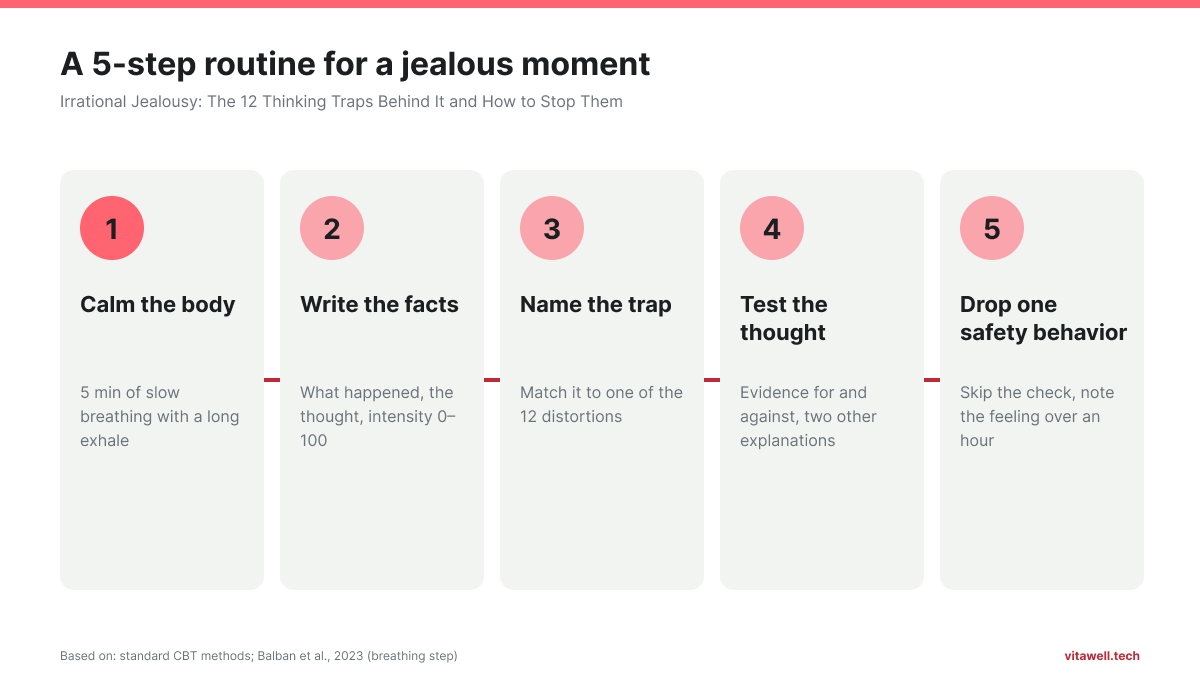
- Calm the body first (5 minutes). Try slow breathing with a long exhale. In a study of 108 adults, Balban and colleagues (Cell Reports Medicine, 2023) found 5 minutes a day of cyclic sighing improved mood.
- Write the facts. Note what happened, without interpretation, then the thought that followed and how intense the feeling is from 0 to 100.
- Name the trap. Match the thought to one of the 12 distortions: "That's mind reading."
- Test the thought. List evidence for and against, and two other explanations. Ask what you would tell a friend with the same thought.
- Drop one safety behavior. Skip the check or the extra reassurance question for this episode, and note how the feeling changes over the next hour.
Treating the jealous thought as a passing event rather than a fact is a core skill here. VitaWell's piece on how you relate to your thoughts explains this approach, often called decentering.
When to Talk to a Professional
- Jealousy has shown up in every relationship you have had.
- It has led to monitoring, tracking, threats or controlling your partner's contacts.
- You have become verbally or physically aggressive during a jealous episode.
- Checking or reassurance-seeking takes up hours of your day.
- Your partner says the jealousy is becoming intolerable.
- You feel unsafe because of a partner's jealousy; in that case contact a domestic violence helpline or local emergency services.
Individual CBT, emotional schema therapy and couples therapy all address these patterns.
Frequently Asked Questions
Why am I so jealous for no reason?
Jealousy without clear evidence usually comes from thinking traps, such as mind reading or emotional reasoning, combined with fear of loss. Past betrayals and attachment anxiety make these traps more likely: in one study of 477 students, attachment anxiety predicted jealousy. Checking and reassurance-seeking then keep the cycle going, even when nothing is wrong.
Is jealousy a sign of love?
Mild, occasional jealousy is common in close relationships and reflects that the relationship matters. Intense or constant jealousy, however, is more closely tied to insecurity and fear than to love, and it can damage trust. Love shows up more reliably in care, respect and honest communication than in jealous reactions.
How do I stop being jealous in a relationship?
Calm your body first, then write down what actually happened, name the thinking trap, and test the thought against evidence. Gradually drop safety behaviors like checking the phone or asking for reassurance repeatedly. If jealousy keeps driving your behavior after a few weeks of practice, work with a CBT-trained therapist.
Is jealousy linked to attachment style?
Yes. Research links attachment anxiety, a chronic fear of abandonment, to stronger jealousy. A 2023 study of 477 undergraduates found attachment anxiety predicted jealousy while avoidance did not. People with avoidant attachment may deny jealousy or respond with coldness instead. Understanding your style helps you choose which habits to work on.
When is jealousy a red flag?
Jealousy becomes a red flag when it leads to monitoring, controlling who a partner sees, threats or aggression. These behaviors are associated with abusive relationships. If you see them in yourself, seek professional help. If you see them in a partner and feel unsafe, contact a domestic violence service or emergency services.
Conclusion
Irrational jealousy is not proof that something is wrong or that you are unlovable. It is a set of learned thinking traps and habits that can be named, tested and changed. Start with the one distortion you recognize most, name it when it fires this week, and drop one safety behavior. VitaWell's AI life planner can help you track the routine in your Relationships area.
Related on VitaWell
- The 15-Minute Weekly Habit That Research Says Prevents Most Couple Conflicts — a safe format for talking about worries before they grow.
- Why Lying to Protect Your Partner Is Quietly Damaging Your Relationship — how honesty builds the trust that calms jealousy.
- Evolutionary Mismatch: Why Your Stone Age Brain Struggles With Modern Life — why threat-detection instincts overfire in a world of constant information.
This article is for informational purposes only and is not a substitute for professional mental health advice.
Sources
- Psychology Today — 12 Things People Think When They Get Jealous
- Leahy, 2026 — Jealousy: An Emotional Schema Model (Journal of Clinical Psychology)
- YouGov, 2019 — Snooping on a partner's phone
- Muise, Christofides and Desmarais, 2009 — Facebook and jealousy (University of Guelph)
- Deng et al., 2023 — Insecure attachment and undergraduates' jealousy (Frontiers in Psychology)
- Hofmann et al., 2012 — The efficacy of cognitive behavioral therapy: a review of meta-analyses
- Balban et al., 2023 — Brief structured respiration practices enhance mood (Cell Reports Medicine)