When Your Career Superpower Stops Being Special — The Psychology of Staying Valuable in a Changing World

Imagine you spent years becoming the best in your field. You mastered a skill others didn't have, built a reputation around it, and watched the recognition and opportunities flow in. Then, one day, the world shifted. Not because you got worse. Not because you stopped working hard. The world simply changed — and what you were known for stopped being special. This is one of the most disorienting experiences in professional life, and it happens far more often than most career advice prepares us for.
The Skill That Once Set You Apart — and Why It Won't Last Forever
Dr. Ashley C. Jordan, a professor of psychology at the University of Arizona, describes this experience from her own career. Early on, she carved out a niche as the 'online guru' — the go-to expert in online course development and instructional technology at a time when the field was exploding. Job offers, promotions, and recognition followed. Then the pandemic hit. Suddenly, everyone was an expert in online teaching and learning. What had been niche became mainstream, and her competitive advantage evaporated overnight.
Her conclusion: possessing a unique skill does not mean the skill will be permanently valuable. This is not a cynical observation — it is a structural feature of how markets, technology, and organizations work. Every generation of expertise has a shelf life. The question is not whether your skill will eventually be commoditized, but what you will do when it is.
History is full of examples. Coding, once an elite and highly compensated skill, is increasingly commoditized as AI generates large portions of working code in seconds. DVD rental stores gave way to streaming. Long-form blogs gave way to social media, which gave way to short-form video. Data entry, once a viable career, has been almost entirely automated. The loss of a 'special' skill is not a personal failure — it is the natural rhythm of economic and technological change.
How Markets, Technology, and Organizations Continuously Reshape What's Valuable
Understanding the forces that erode skill value is the first step in building resilience against them. There are four primary drivers:
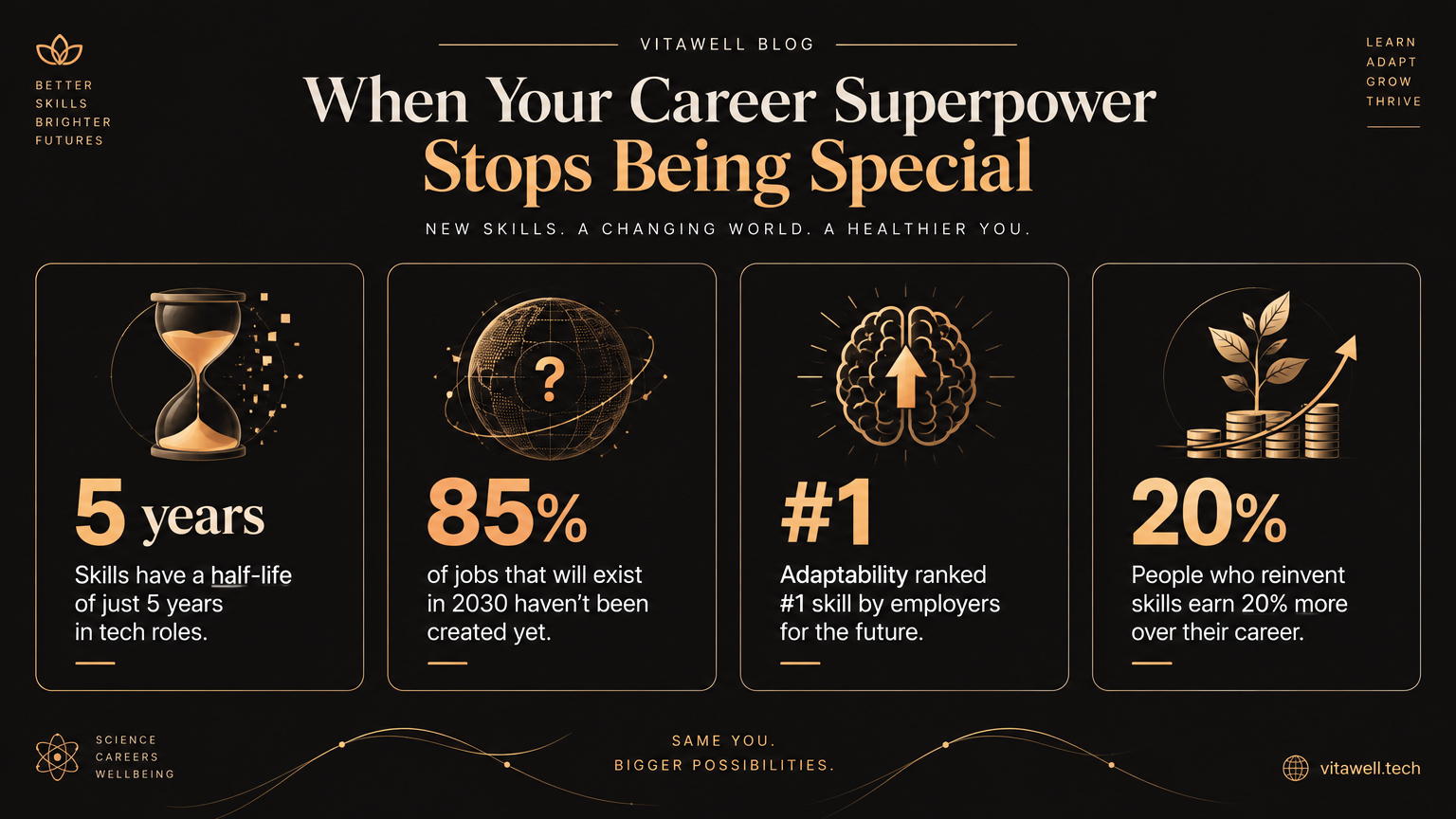
- Technology changes. AI, automation, and software continuously absorb tasks that previously required specialized human expertise. Roles that seem indispensable today may look very different in five years — or may not exist at all.
- Economic conditions shift. During recessions, companies freeze hiring, reduce spending, and eliminate positions that were once considered essential. Skills that are valued during growth cycles are often the first to be cut during contraction.
- Organizations reorganize. A new CEO arrives, strategic priorities change, departments merge, and suddenly the work that earned you praise and promotion last year is no longer what the organization values. The skill set didn't change — the context did.
- Consumer habits evolve. Every shift in how people consume information, entertainment, or services reshapes the skills those industries need. Platform shifts are career disruptions in disguise.
As Dr. Jordan puts it: markets don't care how hard you worked to master yesterday's 'hot' skill. Effort is admirable, but it does not guarantee relevance. The skill that consistently survives these forces is not any particular technical expertise — it is the ability to adapt.
What Cognitive Flexibility Is and Why It Predicts Career Resilience
In psychology, this ability to adapt is known as cognitive flexibility — the capacity to adjust your thinking, consider new perspectives, and change strategies when circumstances change. It is one of the most well-researched components of executive function, the brain's system for goal-directed behavior.
Adele Diamond's landmark 2013 paper in the Annual Review of Psychology established cognitive flexibility as a core executive function, alongside working memory and inhibitory control. People with high cognitive flexibility don't cling to 'the way we've always done it.' They recognize when old approaches no longer fit the situation and are willing to experiment with new ones. They can shift their mental frame when evidence demands it — and they experience this as energizing rather than threatening.
The contrast is cognitive rigidity: the tendency to hold onto established patterns of thinking even when circumstances have changed. Cognitively rigid professionals double down on their existing expertise when it's challenged, interpret change as a threat, and struggle to see new opportunities that don't map onto their existing strengths.
The Research Behind Adaptability
Research published in BMC Psychology (Nakhostin-Khayyat et al., 2024) confirms that self-regulation, cognitive flexibility, and resilience are structurally interlinked. Developing one tends to reinforce the others. Career adaptability research consistently shows a positive correlation between adaptability and both general and professional wellbeing — and adaptability explains unique variance in wellbeing beyond what self-regulation and buoyancy alone account for. In plain language: being adaptable is good for your career and for your psychological health.
How AI, Economic Shifts, and Reorganizations Eliminate Yesterday's 'Hot' Skills
The three forces most actively reshaping careers right now deserve closer examination. AI and automation are the most visible. Tasks that required specialized training — writing first drafts, basic coding, data summarization, routine customer service — are increasingly handled by AI tools. This does not necessarily eliminate jobs, but it does fundamentally change what is valued within them. Professionals who adapt by using AI as a tool while developing the judgment, creativity, and relationship skills that AI cannot replicate will be more valuable. Those who compete with AI on its own terms will struggle.
Economic disruption creates a different kind of vulnerability. Skills that are rewarded during expansion — growth hacking, aggressive hiring, exploratory R&D — may be the first to be deprioritized during contraction. Career resilience requires understanding not just what your skills are worth, but under what conditions they are valued.
Organizational change is perhaps the most underappreciated threat. A new leadership team can render an established professional's expertise peripheral overnight, not through any change in the market, but simply through a shift in strategic priority. The psychologically healthy response is not resentment but adaptation: understanding what the new priorities require and finding ways to contribute to them.
The uncomfortable truth in all of this: skills that earned you promotion and recognition can become irrelevant without any failure on your part. Recognizing this in advance — rather than discovering it in the aftermath of disruption — is the beginning of career resilience.
How Great Leaders Build Teams That Thrive Through Change
The most adaptable professionals don't develop their flexibility in isolation — they are often shaped by the environments in which they work. Great leaders understand this. They don't simply reward today's expertise; they create conditions in which continuous learning is expected, experimentation is encouraged, and people feel safe admitting they don't know something yet.
A learning culture at work includes:
- Professional development as a structural priority, not a perk
- Psychological safety — employees feel safe raising concerns, taking risks, and admitting gaps in knowledge
- Recognition for growth and learning, not just for current performance
- Cross-functional exposure — team members regularly work outside their immediate expertise
- Honest conversations about emerging skill needs before they become urgent
The contrast is a static team culture: one that rewards existing expertise, treats change as disruption, and creates environments where admitting uncertainty feels risky. These cultures produce professionals who are highly capable within their current context — and highly vulnerable the moment that context changes.
Keep One Foot in the Future — The Continuous Learning Mindset
One of the most practical pieces of career advice in Dr. Jordan's research is deceptively simple: don't wait until your skill becomes obsolete to learn something new. Always be learning something adjacent. Always have one eye on what's coming next.
This is sometimes called staying in the 'adjacent possible' — building skills that are one step ahead of where you currently are, so that when the market shifts in that direction, you're already there. This doesn't require dramatic pivots or abandoning existing expertise. It requires consistently investing a portion of your professional energy in learning something that doesn't yet feel essential, but probably will.
Practically, this looks like: taking an online course in an adjacent field, joining a professional community outside your immediate specialty, reading broadly across disciplines, or taking on a side project that stretches your capabilities. The psychological benefit is significant: continuous learners experience considerably less anxiety about disruption because they are already in motion. Change doesn't threaten their identity — it confirms their strategy.
Building Transferable Skills That Outlast Any Technological Shift
While specific technical skills have shelf lives, transferable skills — competencies that apply across industries, roles, and technological eras — have proven remarkably durable. Career adaptability research consistently identifies soft skills as among the most resilient assets a professional can have, because they address the fundamentally human dimensions of work that technology cannot fully replicate.
The transferable skills worth cultivating most deliberately include:
- Communication. The ability to articulate ideas clearly, listen with genuine attention, and adapt your message to different audiences survives every technological shift.
- Critical thinking. The ability to evaluate information, identify assumptions, and reason toward sound conclusions becomes more valuable as information becomes more abundant and AI-generated.
- Leadership and influence. The ability to move people toward shared goals — through trust, vision, and relationship — is irreducibly human.
- Emotional intelligence. Self-awareness, empathy, and skill in navigating relationships are foundations of effective collaboration that no technology replaces.
- Problem-solving under uncertainty. The ability to make good decisions with incomplete information is increasingly rare and increasingly valued.
Investing in these skills is not a fallback for professionals who can't master technical ones — it is the highest-leverage investment in long-term career durability that most professionals can make.
Cultivating Curiosity as Your Most Durable Career Asset
Underlying all of the above is a psychological trait that may be the most durable career asset of all: curiosity. Technical skills come and go, but curiosity ensures you're always moving toward the next relevant thing. Where curiosity is present, learning is continuous. Where it's absent, even the best technical skills gradually calcify into irrelevance.
Psychological research on curiosity links it to greater openness to experience, increased resilience, higher intrinsic motivation, and better performance under conditions of uncertainty. Curious professionals ask better questions, seek out discomfort as a learning signal rather than a warning to retreat, and find meaning in the process of exploration rather than only in the achievement of mastery.
The practical shift is from an expert mindset — 'I am someone who knows' — to a learner mindset — 'I am someone who learns.' This is not the same as abandoning expertise. It means holding expertise lightly, remaining open to revision, and staying genuinely interested in what you don't yet know.
Separating Your Identity from Your Job Title
One of the most psychologically important — and most neglected — aspects of career resilience is the relationship between identity and role. When professionals tie their sense of self tightly to a specific job title or area of expertise, they become acutely vulnerable when that role is disrupted. Losing the 'special' skill doesn't just feel like a professional setback; it feels like an identity crisis.
Psychologists refer to identity foreclosure as the state of having committed to an identity without exploring alternatives — often resulting in a brittle sense of self that cannot absorb change. The antidote is what researchers call identity exploration: actively defining yourself in terms that transcend any particular role or skill set.
You are not your job title. You are a set of values, ways of thinking, and ways of showing up — and these survive any professional transition. A useful exercise: try to articulate who you are in professional terms without using your job title, your current employer, or any specific technical skill. What problems do you love solving? What kinds of thinking energize you? What do you stand for? The answers are your portable professional identity — the one that accompanies you through every career transition.
How to Embrace Professional Reinvention — and Why It's a Gift, Not a Loss
When Dr. Jordan lost her 'special' skill, she writes, it felt like a workplace existential crisis. The thing she was known for, the thing she was best at, had been stripped away. What remained? And what was the point of working so hard at something that just slipped away?
With time and perspective, she arrived at a different answer. Losing her niche was not the loss she had initially thought it was — it was a gift. It forced her to become something much more valuable: someone who could learn again, adapt to change, and rise above disruption. The professionals who emerge from skill obsolescence most successfully are not the ones who avoided it. They're the ones who went through it and came out more adaptable on the other side.
If you find yourself at a professional reinvention point, these steps can help:
- Acknowledge the loss. It is real. The skill mattered. The recognition mattered. Allow yourself to grieve it briefly and genuinely — skipping this step tends to extend rather than shorten the disruption.
- Audit your transferable skills. Make a list of everything you can do that is not specific to your current or most recent role. You likely have more than you think.
- Identify what's emerging in your field. What are employers starting to ask for? What skills are appearing in job descriptions that weren't there a year ago?
- Build one new adjacent skill. Choose one thing that is adjacent to your existing expertise and begin learning it. One specific skill, not five. Depth over breadth.
- Update your professional identity narrative. How you describe yourself professionally should reflect who you are becoming, not just who you were.
Nothing lasts forever. Not industries. Not technologies. Not organizations. Not job descriptions. But the ability to adapt — to think flexibly, stay curious, build transferable skills, and reinvent without losing yourself in the process — becomes more valuable every single time the world changes. That is the career superpower worth building.