Why Treating AI Agents Like Employees Backfires — And What to Do Instead
Giving AI agents names, roles and teammate status reduced accountability and review quality in a 2026 experiment, without boosting adoption. Here is a better way to work with agents.

Treating AI agents like employees backfires because human-style framing quietly shifts responsibility away from people. A randomized experiment reported in Harvard Business Review in May 2026 found that giving AI agents names, roles and teammate status reduced individual accountability, increased escalation and lowered the quality of human review, without meaningfully raising willingness to adopt the tools. The better approach is to treat agents as powerful systems that a named person supervises and answers for.
Key Takeaways
- Humanizing AI agents shifted accountability away from individuals, increased escalation, lowered review quality and eroded professional identity, according to BCG Henderson Institute researchers.
- The teammate framing did not meaningfully increase employees' intent to adopt the technology.
- Agents are spreading fast: 62% of organizations were at least experimenting with AI agents in 2025, but only 23% were scaling them.
- Gartner expects over 40% of agentic AI projects to be cancelled by the end of 2027, largely for unclear business value.
- Courts already treat organizations as responsible for what their AI says: Air Canada lost its argument that its chatbot was a "separate legal entity."
The Rise of AI 'Employees' — A Corporate Experiment Gone Mainstream
Companies now give AI systems names, personas and job titles, and some place agents on organizational charts. Agentic AI means systems that can plan and carry out multi-step tasks with limited human input, rather than only answering prompts. Framing them as colleagues seemed a natural way to make the technology feel less threatening.
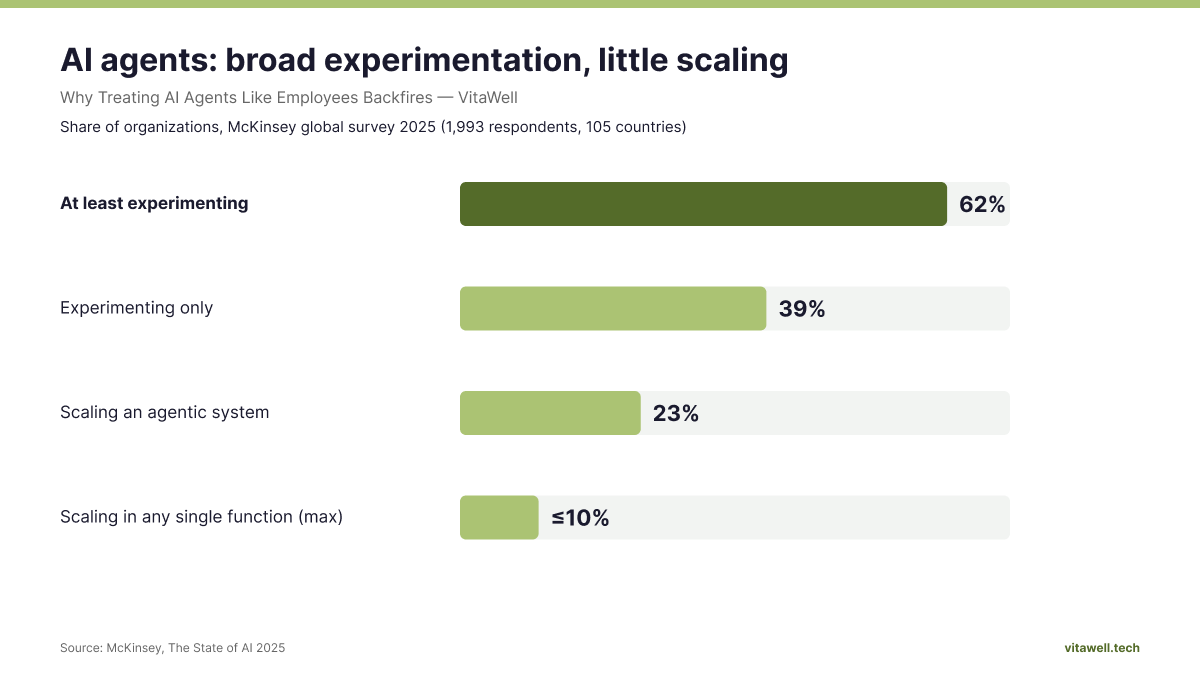
Adoption is broad but shallow. In McKinsey's 2025 global survey of 1,993 respondents in 105 countries, 23% said their organization was scaling an agentic AI system somewhere and 39% were experimenting, a combined 62%; in any single business function, no more than 10% reported scaling agents, according to McKinsey's State of AI (2025). Most organizations are therefore still deciding how agents fit into work, which makes the framing question urgent.
What the Research Actually Found
Researchers from the BCG Henderson Institute and Boston University's Questrom School of Business, including Matthew Kropp, Julie Bedard and Emma Wiles, ran a randomized experiment comparing AI framed as a human-like teammate with AI framed as a tool. As summarized by the BCG Henderson Institute (2026), humanizing the AI produced four effects:
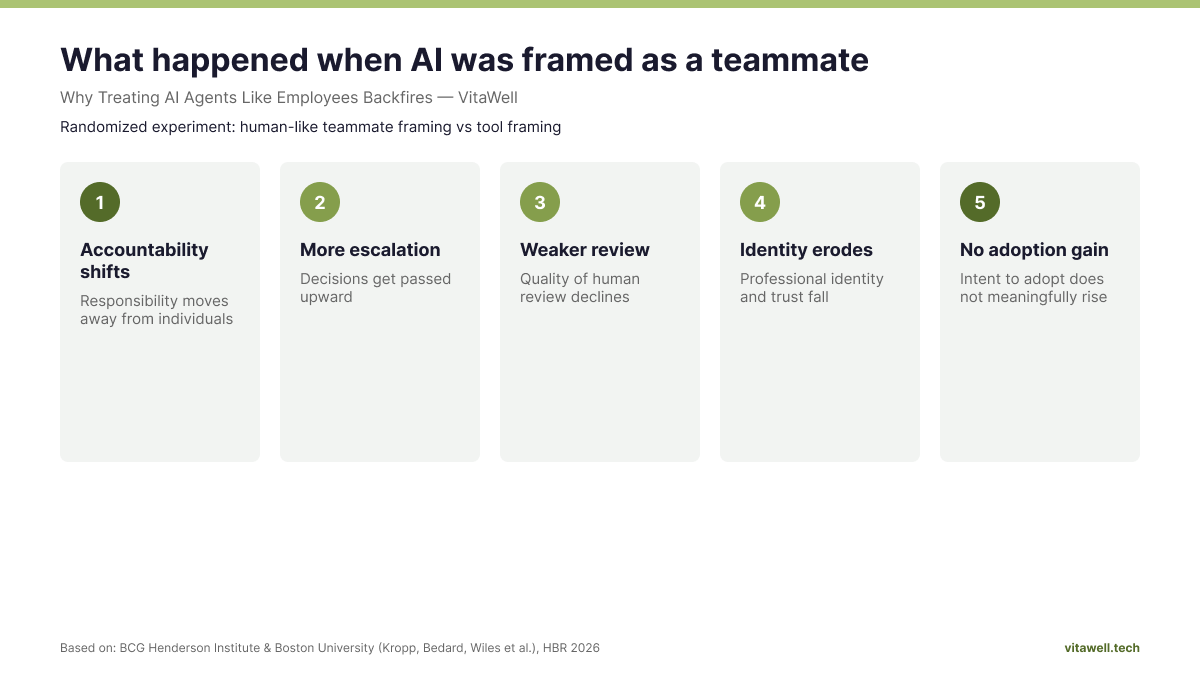
- Accountability shifted away from individuals.
- Escalation of decisions increased.
- The quality of human review declined.
- Professional identity and trust eroded.
Crucially, intent to adopt the technology did not meaningfully increase, so the framing carried costs without its intended benefit. The published summary does not report sample size or effect sizes, so the strength of each effect cannot yet be judged; the direction is consistent across all four outcomes.
The 4 Hidden Costs of Treating AI Like a Teammate
1. Reduced Individual Accountability
When an agent is presented as a colleague who "made" a recommendation, the human who acts on it feels less ownership. This mirrors diffusion of responsibility, the well-known tendency for people to feel less personally responsible when a task is shared.
2. Increased Unnecessary Escalation
When an AI teammate is involved, people pass more decisions upward instead of using their own judgment. That slows work down, the opposite of what agents are meant to deliver.
3. Lower Review Quality
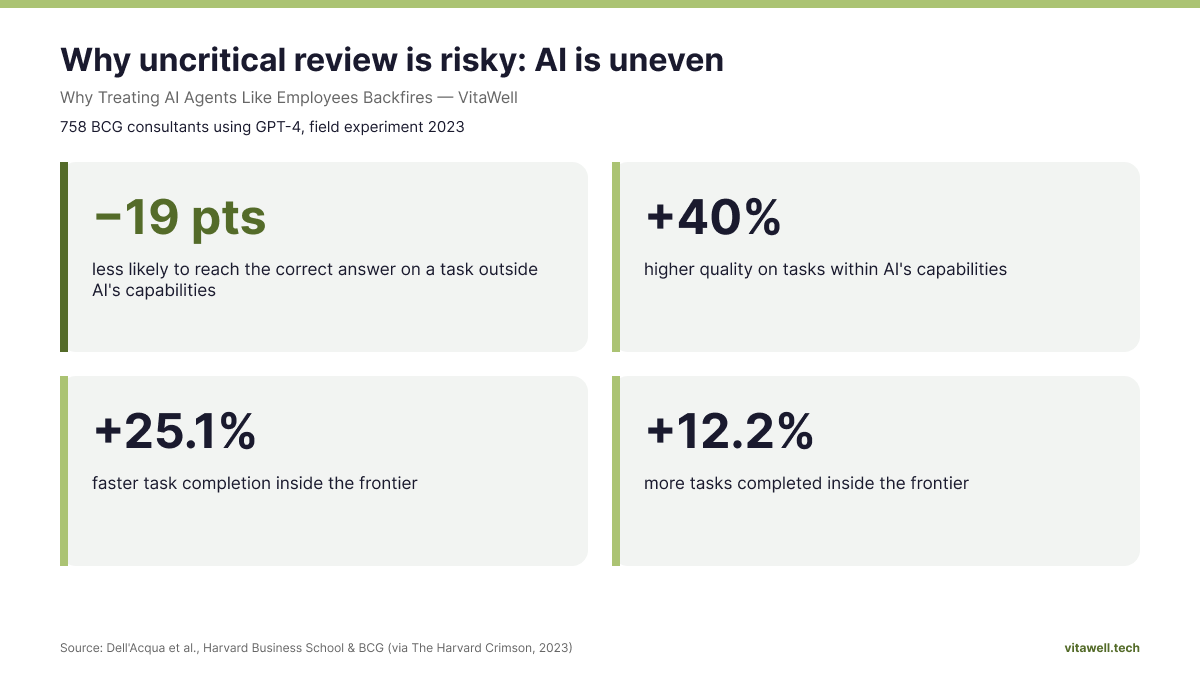
People soften scrutiny of a colleague's work, and that norm appears to carry over to AI framed as one. Uncritical acceptance is costly because AI is uneven. In a 2023 field experiment with 758 BCG consultants led by Harvard Business School researchers, those using GPT-4 completed 12.2% more tasks, 25.1% faster and with 40% higher quality on tasks within the AI's capabilities, but were 19 percentage points less likely to reach the correct answer on a task outside them, as reported by The Harvard Crimson (2023).
4. Heightened Role Uncertainty
Sharing titles and org-chart positions with software blurs what human judgment is for. Employees unsure of their value are less likely to challenge outputs or invest in distinctly human skills. VitaWell's piece on staying resilient amid AI career uncertainty covers how to handle that anxiety.
The Moral Hazard — How AI Anthropomorphism Erodes Professional Ethics
Anthropomorphism means attributing human traits, intentions or responsibility to non-human things. Applied to AI at work, it creates a moral hazard: if the agent feels like a responsible colleague, blame for errors can drift onto software that cannot be held accountable.
The law does not accept that drift. In Moffatt v. Air Canada (February 2024), the airline argued its chatbot was a "separate legal entity" responsible for its own statements after it gave a customer wrong refund information. British Columbia's Civil Resolution Tribunal rejected this, held the airline responsible for all information on its website and awarded about C$650 plus interest and fees, according to the American Bar Association (2024).
The Real Problem Is Governance and Design, Not AI Capability
The researchers argue the main challenge is how agents are integrated into workflows, not whether to use them. Industry forecasts point the same way. Gartner predicts over 40% of agentic AI projects will be cancelled by the end of 2027 because of rising costs and unclear business value, and estimates only about 130 of the thousands of vendors offering "agentic" products are genuine, a practice it calls agent washing, according to Allwork.Space's report on Gartner (2025).
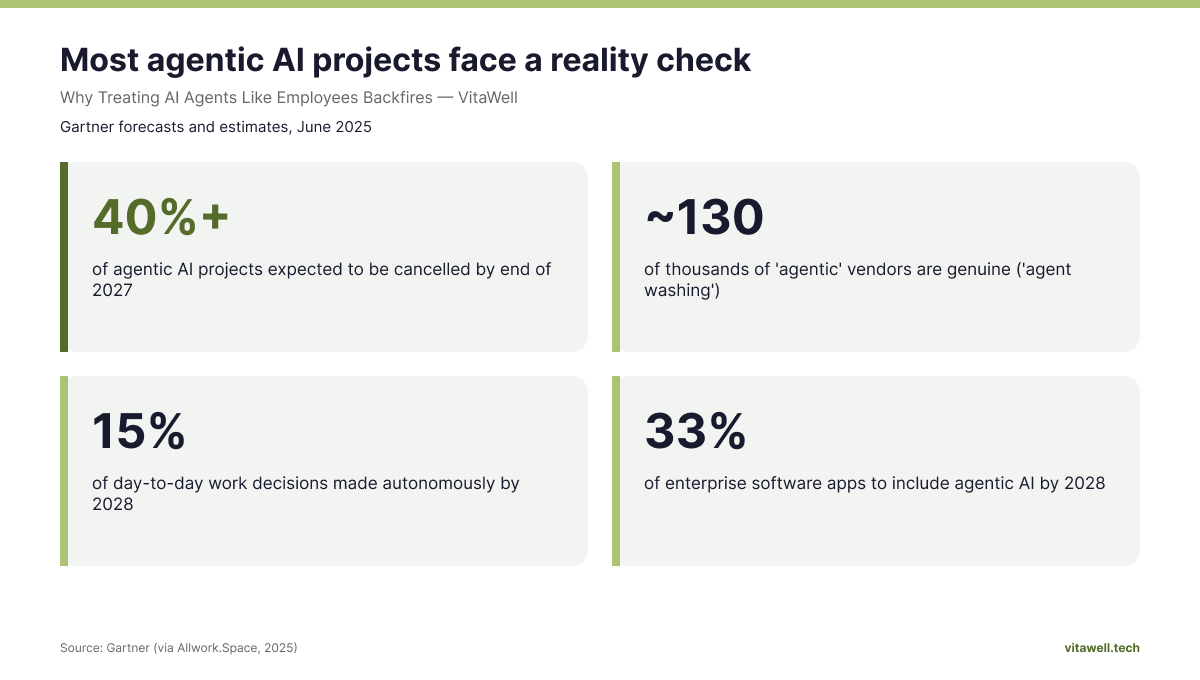
Gartner also expects at least 15% of day-to-day work decisions to be made autonomously by 2028, and 33% of enterprise software to include agentic AI. As autonomy grows, clear human ownership matters more, not less. VitaWell's article on leading the human-AI organization looks at how HR leaders are preparing.
A Better Mental Model — AI as Systems to Supervise, Not Teammates to Trust
A cleaner frame is to treat agents as instruments: programmable, bounded and dependent on human judgment for design, deployment and oversight. No one calls their CRM a colleague; an agent is a far more capable system, but the logic of ownership is the same. This frame encourages rigorous review, clear accountability and use of AI to multiply human judgment rather than replace it.
Tool vs. Teammate Language: A Practical Guide
The table turns the research into everyday choices about how agents are described and governed.
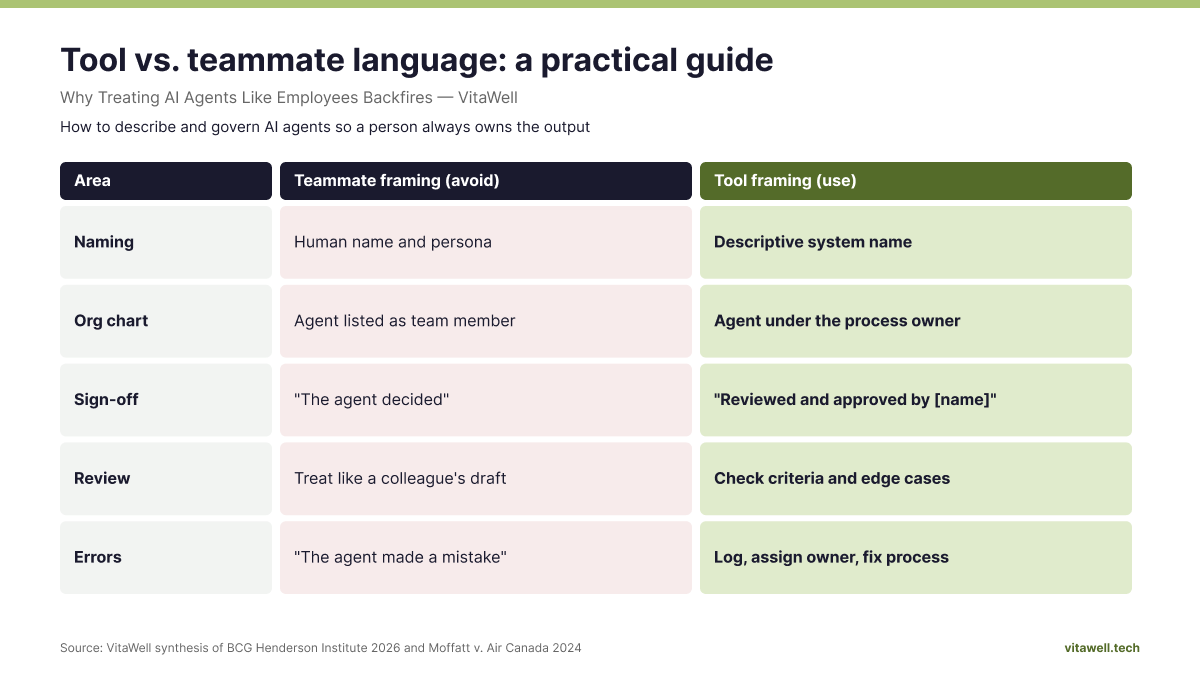
| Area | Teammate framing (avoid) | Tool framing (use) | Why it matters |
|---|---|---|---|
| Naming | Human name and persona | Descriptive system name ("invoice-matching agent") | Keeps clear that a person owns the output |
| Org chart | Agent listed as a team member | Agent listed under the process owner | Prevents role confusion |
| Sign-off | "The agent decided" | "Reviewed and approved by [name]" | Preserves individual accountability |
| Review | Treat output like a colleague's draft | Check against criteria and edge cases | Catches errors outside the AI's strengths |
| Errors | "The agent made a mistake" | Log, assign owner, fix process | Organizations remain legally responsible |
How to Redesign Your Workflow for Agentic AI
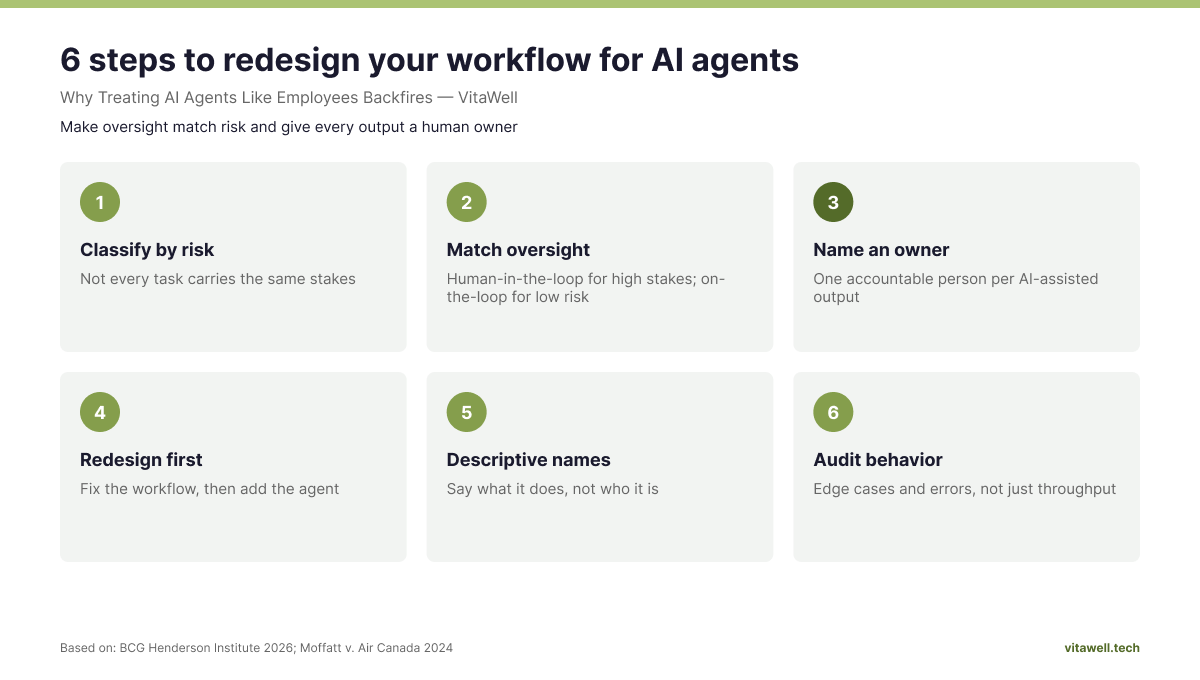
- Classify tasks by risk before deployment. Not every task carries the same stakes.
- Match oversight to risk. Use human-in-the-loop approval for legal, financial, medical or safety decisions, and human-on-the-loop monitoring for low-risk work.
- Name one accountable person for every AI-assisted output. No output should leave without an owner.
- Redesign the workflow, then add the agent. Automating a broken process produces broken results faster.
- Use descriptive, non-human names. Describe what the system does, not who it is.
- Audit behavior, not just throughput. Review how the agent handles edge cases and errors, not only how much it completes.
What This Means for You as an Individual Professional
The governance gap starts with individual habits. The core question: do you supervise your AI tools, or defer to them? Constant deference also drains energy, a pattern described in VitaWell's piece on AI brain fry. Ask yourself:
- Do I review AI outputs as rigorously as my own work before sharing them?
- Is a named person accountable for every AI-assisted output on my team?
- Can I explain my reasoning for an AI-assisted decision without saying "the AI said so"?
- Am I escalating more decisions since agents were introduced?
Judgment, critical review and the ability to explain decisions are among the human skills that grow in value as AI spreads, as covered in VitaWell's guide to skills that AI-proof a career.
Frequently Asked Questions
Why shouldn't you treat AI agents like employees?
A randomized experiment reported in Harvard Business Review in 2026 found that human-like framing of AI shifted accountability away from people, increased escalation, lowered review quality and eroded professional identity. It did not meaningfully raise adoption intent, so the framing adds risk without the benefit it was meant to provide.
What is anthropomorphizing AI?
Anthropomorphizing AI means giving it human traits, such as a name, personality, job title or apparent intentions. At work it can make people treat AI outputs like a colleague's judgment, softening scrutiny and blurring who is responsible when something goes wrong.
Who is responsible when an AI agent makes a mistake?
The organization and the people who deploy and approve the agent's work. In Moffatt v. Air Canada (2024), a tribunal rejected the airline's claim that its chatbot was a separate legal entity and held the airline liable. Internally, every AI-assisted output should have a named human owner.
What is human-in-the-loop for AI agents?
Human-in-the-loop means a person reviews and approves an AI agent's action before it takes effect, used for high-stakes decisions. Human-on-the-loop means people monitor the agent and can intervene, used for lower-risk tasks. Matching the level of oversight to risk keeps workflows fast and safe.
Are AI agents actually delivering results?
Results are mixed. In 2025, 62% of organizations were at least experimenting with agents but only 23% were scaling them, and Gartner expects over 40% of agentic AI projects to be cancelled by the end of 2027. Success depends more on workflow design and governance than on the technology itself.
Conclusion
How an organization talks about its AI agents shapes how people work with them. The evidence shows teammate framing weakens accountability, review and professional confidence without improving adoption. The better path is clear: describe agents as systems, give every output a human owner, match oversight to risk and redesign workflows before automating them. VitaWell's AI life planner can help you build these review habits into your weekly goals in the Career area.
Related on VitaWell
- AI Is Reshaping Your Career — Not Replacing It: What the Latest Research Means for You — the bigger picture of how AI changes roles.
- Why Adaptability Is the Most Valuable Career Skill in the Age of AI — how to stay valuable as tools change.
- Why AI Makes You Work More, Not Less — and What to Do About It — the workload side of AI adoption.
This article is for informational purposes only and is not legal or professional advice.
Sources
- Research: Why You Shouldn't Treat AI Agents Like Employees — Harvard Business Review
- BCG Henderson Institute, 2026 — Why you shouldn't treat AI agents like employees (Kropp, Bedard, Wiles et al.)
- McKinsey, 2025 — The state of AI: agents, innovation and transformation
- Allwork.Space, 2025 — Gartner predicts over 40% of agentic AI projects will be cancelled by 2027
- American Bar Association, 2024 — Moffatt v. Air Canada: companies remain liable for AI chatbot information
- The Harvard Crimson, 2023 — Dell'Acqua et al., Navigating the jagged technological frontier (HBS/BCG)