Music for Anxiety: How Many Minutes Actually Help, According to a Clinical Trial
A 2026 clinical trial tested 12, 24 and 36 minutes of music with auditory beats for anxiety. Here is what each length did, how big the effect is, and how to test it on yourself.
If you use music for anxiety, timing matters. In a 2026 randomized trial of 144 adults already taking anxiety medication, calm music layered with auditory beat stimulation (ABS) lowered anxiety more than pink noise after 12, 24 or 36 minutes of listening. The 24-minute session produced the largest drop in worry and physical tension, while 36 minutes produced the largest drop in negative mood and 12 minutes helped least. The benefit is short-term relief that sits on top of treatment, not a replacement for it.
Key Takeaways
- Music for anxiety worked better than pink noise at every length tested, with medium effect sizes (d 0.45 to 0.72 for anxiety).
- About 24 minutes gave the strongest drop in worry, tension and arousal; 36 minutes gave the strongest drop in negative mood.
- The differences between 12, 24 and 36 minutes on anxiety itself were not statistically significant, so treat 24 minutes as a sensible default, not a magic number.
- Across dozens of trials, music interventions reduce anxiety by a small-to-medium amount, and the effect tends to fade once listening stops.
- The trial was partly funded by the company that makes the music, and every participant was already on medication, so results may not transfer to everyone.
What the 2026 Trial Actually Tested
Researchers from Goldsmiths, University of London, the University of Roehampton and Toronto Metropolitan University published the trial in PLOS Mental Health in January 2026. They pre-screened 1,310 people online through the research platform Prolific and randomized the 144 who qualified. Everyone had to be taking an anti-anxiety medication and score in the moderate range for trait anxiety, meaning a stable tendency to feel anxious rather than a passing state.
Participants were aged 19 to 73 (average 37.6), and 66 of them were taking an SSRI, one of the most commonly prescribed medication classes for anxiety. They were split into four groups:
- 24 minutes of pink noise, a steady waterfall-like hiss used as the control (36 people)
- 12 minutes of music with ABS (41 people)
- 24 minutes of music with ABS (33 people)
- 36 minutes of music with ABS (34 people)
Before and after listening, everyone rated their state anxiety (how anxious they felt right then) on a scale that separates cognitive symptoms such as worry from somatic symptoms such as a racing heart. A second questionnaire measured positive and negative mood. Participants were asked to wear headphones and close their eyes, at home, on their own devices.
Pink noise matters here. Because the control group also heard a continuous sound for 24 minutes, a simple "anything is better than silence" explanation is less likely to account for the gap between groups.
The Results, Minute by Minute
All three music groups beat pink noise on both kinds of anxiety and on negative mood. The table below pulls the effect sizes from the paper into one view. Cohen's d is a standard way to express how big a difference is: about 0.2 is small, 0.5 is medium and 0.8 is large.
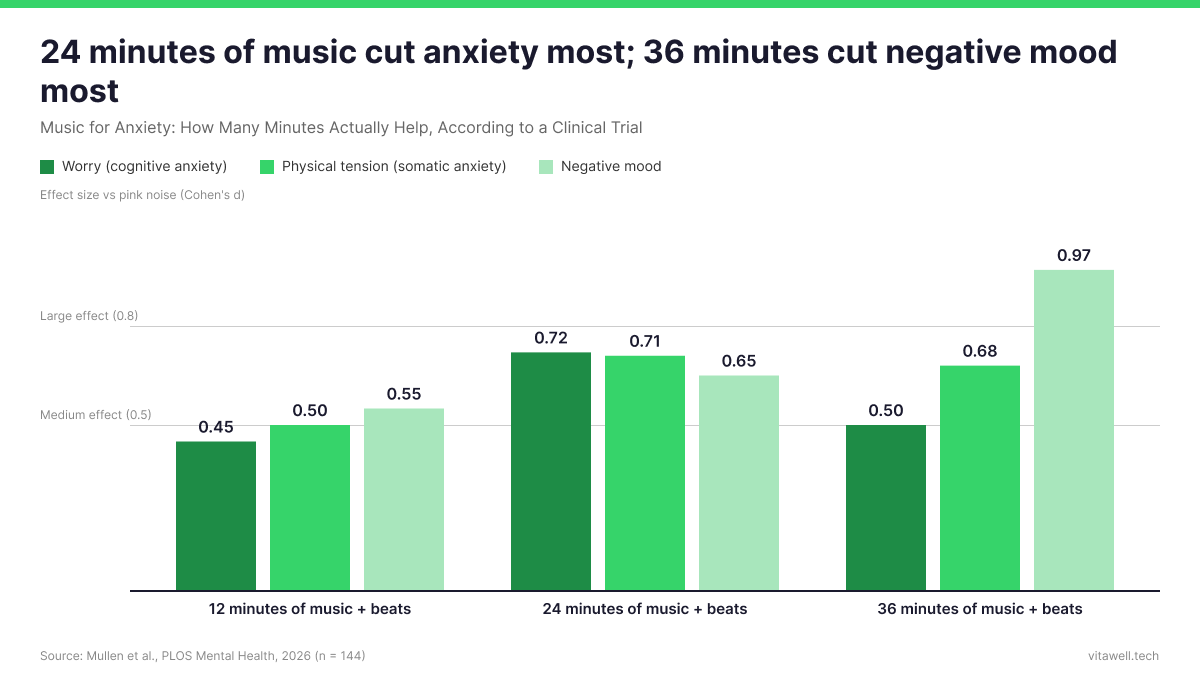
| Listening time (music + ABS) | Worry (cognitive anxiety), d vs pink noise | Physical tension (somatic anxiety), d vs pink noise | Negative mood, d vs pink noise | Practical reading |
|---|---|---|---|---|
| 12 minutes | 0.45 | 0.50 | 0.55 | Helps, but the weakest version |
| 24 minutes | 0.72 | 0.71 | 0.65 | Best all-round session for anxiety and arousal |
| 36 minutes | 0.50 | 0.68 | 0.97 | Best when low mood or irritability is the main problem |
Two more findings sharpen the picture. Self-rated arousal (how "wound up" people felt) fell most in the 24-minute group, by 0.73 points on a 5-point scale versus no change with pink noise, and that drop was significantly bigger than in the 12- and 36-minute groups. For negative mood, 36 minutes beat 12 minutes outright (p = 0.024, d = 0.55), which is the only statistically clear dose effect in the study.
What did not change matters too. Positive mood did not rise in any group, so the music calmed people down more than it cheered them up.
What Auditory Beat Stimulation Is
Auditory beat stimulation layers two tones of slightly different pitch so the listener hears a gentle pulse at the difference between them. When each ear gets a different tone, the pulse is created inside the brain and is called a binaural beat; when both tones reach both ears, it is a monaural beat. This trial used beats in the theta band (roughly 4 to 8 pulses per second), a range that earlier studies linked most consistently to lower anxiety.
The music itself followed the iso-principle, an old music-therapy idea: start with music that matches the listener's current mood and energy, then shift it gradually toward calm. The company LUCID built 75 playlists so each participant's starting track matched their self-rated mood and energy.
The proposed mechanism is that steady pulses nudge brain rhythms toward a calmer pattern and help switch off the body's alarm response, the same system described in our guide to why your body reacts to stress so fast. This trial measured no brain activity, though, so "brainwave entrainment" remains a hypothesis here, not a finding.
How Big Is This Effect? Putting the Numbers in Context
A single-session effect of d 0.7 sounds impressive, so it helps to line it up against larger bodies of evidence:
- The predecessor trial (Mallik and Russo, PLOS ONE, 2022) gave 163 medicated adults one 24-minute session. In people with moderate trait anxiety, physical anxiety fell more with music plus ABS (effect size 0.83) than with music alone (0.52), compared with pink noise.
- A 2019 meta-analysis of binaural beats pooled 22 studies and found an overall medium effect (g = 0.45), though it mixed anxiety with memory, attention and pain outcomes. Longer exposure tended to work better.
- A 2025 meta-analysis in eClinicalMedicine covering 51 music therapy trials found a medium effect on anxiety overall (g = 0.36) and on self-reported anxiety (g = 0.41).
- A 2021 meta-analysis of 32 randomized trials with 1,924 participants found music therapy reduced anxiety right after treatment (SMD -0.36), but the benefit was no longer significant at follow-up (SMD -0.23).
The pattern is consistent: music reliably takes the edge off anxiety in the moment, by a small-to-medium amount, and the effect weakens once sessions stop. Single-session trials with self-report scales tend to show bigger numbers than long-term studies, so expect the 24-minute result to shrink somewhat in independent replications.
Why Longer Is Not Automatically Better
Headlines framed the study as "36 minutes resets an anxious brain," but the data point somewhere more nuanced. On worry and physical tension, 24 minutes did at least as well as 36, and arousal dropped most at 24 minutes. Only negative mood kept improving with time.
The authors offer one possible reason: SSRIs can cause emotional blunting, a flattening of emotional responses, so people on these drugs may need longer before music shifts their mood. They also note a practical warning sign from piloting: a 36-minute pink noise group was dropped after only half of participants stuck with it and one reported nausea and dizziness. Long sessions of any sound are not effortless.
The useful rule that falls out of this: pick the length by the symptom you want to change, and stop when the extra minutes stop paying off.
Which Music for Anxiety Fits Which Goal
This decision guide combines the 2026 trial with the meta-analyses above. It is a starting point for self-experiment, not a treatment plan.
| Your goal right now | Best-supported option | Session length | Strength of evidence | Watch out for |
|---|---|---|---|---|
| Racing thoughts before a task or meeting | Calm music with theta beats, eyes closed | About 24 minutes | Two RCTs in medicated adults, medium effects | Do not use while driving or when you need to stay alert |
| Physical tension, fast heartbeat | Calm music with theta beats | 24 to 36 minutes | Two RCTs, medium effects on somatic anxiety | Persistent chest symptoms need a medical check |
| Lingering irritability or low mood after a hard day | Calm music with beats | About 36 minutes | One RCT, large effect on negative mood | No lift in positive mood was found |
| Winding down before sleep | Calm music you like, no beats needed | As part of a screen-free routine | Not tested in these trials | Keep volume low; see our digital-free evening routine |
| Ongoing anxiety that affects daily life | Therapy and/or medication, with music as an add-on | Daily sessions alongside care | Meta-analyses: small-to-medium, fades at follow-up | Music alone is not a treatment for an anxiety disorder |
Your listening style matters too: some people calm down best alone with headphones, others with shared music, as our article on how personality shapes the way you listen to music explains.
A 7-Day Protocol to Test It on Yourself
Because effects vary between people, the most reliable way to know whether this works for you is a short, structured self-test:
- Pick one recurring anxious moment, such as late afternoon or the hour before bed, and use it every day.
- Before each session, rate your worry and your physical tension from 0 to 10 and write both numbers down.
- Use over-ear or in-ear headphones; binaural beats need a separate signal in each ear, and phone speakers cannot deliver that.
- Days 1 to 3: listen to calm music with theta beats for 24 minutes, sitting or lying down with eyes closed.
- Days 4 and 5: try 36 minutes on a day when mood, not worry, is the main problem; try 12 minutes on a busy day.
- Days 6 and 7: listen to calm music without beats for 24 minutes to see whether the beats add anything for you.
- After each session, rate both numbers again. On day 7, compare average drops and keep the version that moved your numbers most.
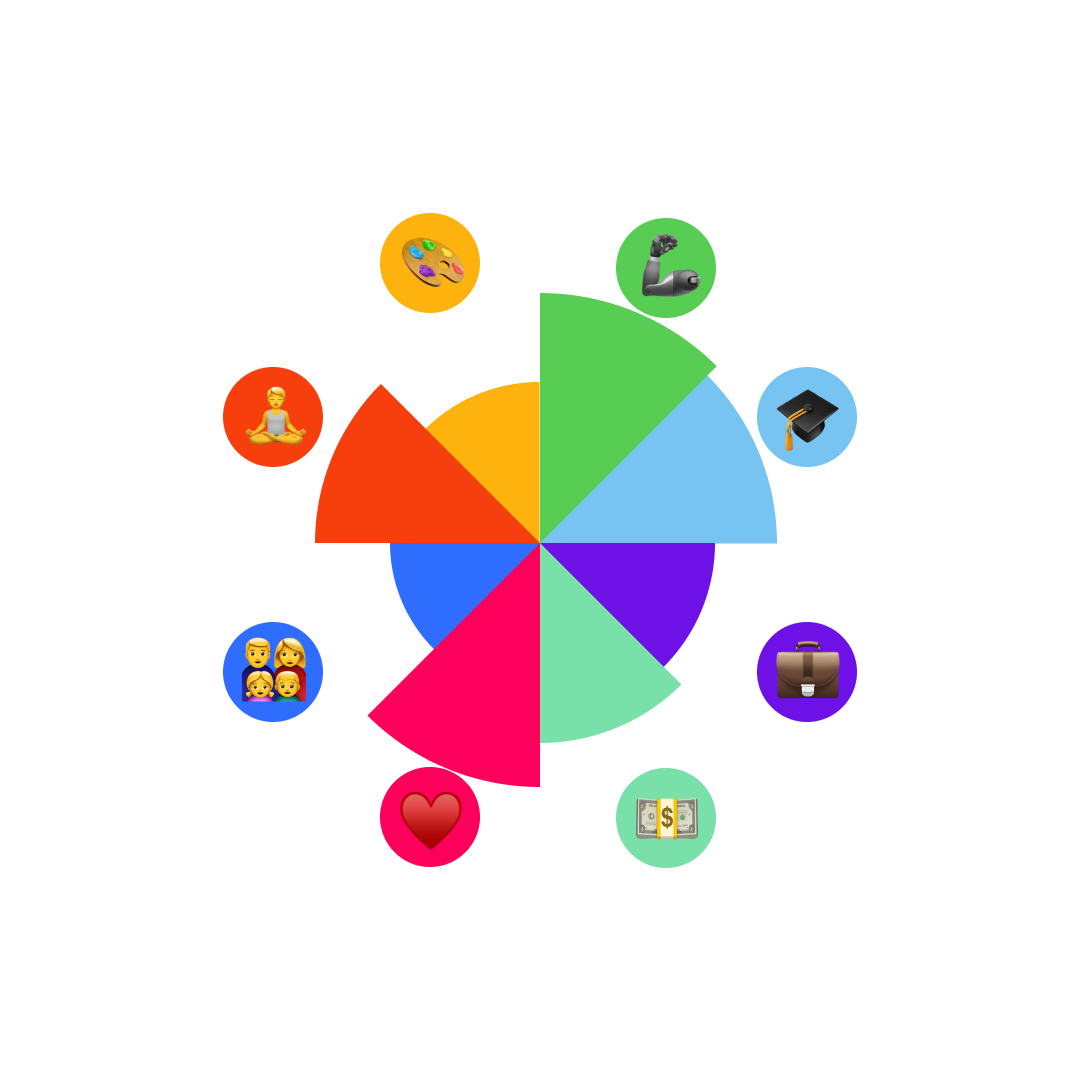
If music turns out to be your lever, it can sit next to other low-cost tools such as creative expression as self-therapy. In VitaWell, this fits naturally into the Rest and Health areas of your plan.
What This Study Cannot Tell You
- Funding and conflicts of interest. The trial was partly funded by LUCID, which makes the music, and the senior author is LUCID's Chief Science Officer with stock options. The authors disclosed this and state the funder did not shape the analysis.
- Only short-term effects. Anxiety was measured right before and right after one session; nothing is known about the next day or the next month.
- No beats-only group. Without it, the study cannot say how much of the benefit came from the beats rather than the music.
- Home conditions. Headphone use and eyes-closed listening were requested but could not be verified online.
- Narrow sample. Everyone was on medication with moderate trait anxiety; medication doses and formal diagnoses were not recorded.
- Self-report only. No heart rate, cortisol or brain measures were taken, and the trial was registered after it was run.
When to Talk to a Professional
Anxiety disorders are the most common mental health conditions worldwide, affecting an estimated 359 million people in 2021, yet only about 1 in 4 receive treatment, according to the World Health Organization. Talk to a doctor or mental health professional if anxiety lasts most days for several weeks, disrupts sleep, work or relationships, comes with panic attacks or chest symptoms, or leads you to avoid places and people.
Keep taking prescribed medication as directed and discuss any change with your prescriber first. If you have epilepsy or a seizure disorder, ask your doctor before using rhythmic audio stimulation, and stop any session that causes dizziness, nausea or headache.
FAQ
Do binaural beats really work for anxiety?
The evidence is promising but modest. A 2019 meta-analysis found a medium overall effect, and two randomized trials found music with beats reduced anxiety more than pink noise in medicated adults. A 2025 study of monaural beats also found that only beats combined with music reduced anxiety significantly.
How long should you listen to music to reduce anxiety?
About 24 minutes is a well-supported default. In the 2026 trial, it produced the strongest drop in worry, tension and arousal, while 36 minutes was best for negative mood and 12 minutes helped least. Because the differences between lengths were not all significant, test what works for you.
Can music replace anxiety medication?
No. Every participant in the key trials was already taking medication, and music was tested as an add-on. Meta-analyses show music reduces anxiety during treatment, but the effect fades at follow-up. Never stop or change medication without talking to your prescriber, even if music helps noticeably.
Do you need headphones for binaural beats?
Yes, for binaural beats. They rely on each ear receiving a slightly different tone, which speakers mix together before it reaches you. Monaural beats can work through speakers, but the 2026 trial asked everyone to use headphones, so headphones match the tested conditions most closely.
The Bottom Line
A well-designed 24-minute session of calm music with gentle beats is one of the cheapest, lowest-risk ways to take the edge off an anxious moment, and the evidence now suggests rough dosing rules. It works best as one tool among several, alongside sleep, movement, connection and professional care when needed. If you want help building that kind of balanced routine across the eight areas of your life, VitaWell can turn small experiments like this one into a plan you actually follow.
This article is for informational purposes only and is not medical advice. Talk to a qualified healthcare professional about your symptoms and treatment.
Sources
Medical News Today — Can 36 minutes of specially tuned music 'reset' an anxious brain?