
How the Best Leaders Turn Stress Into a Strength — Harvard Business Review's 6 Science-Backed Stress Profiles

Every leader knows what it feels like to be under pressure. But knowing how you respond to that pressure — and being able to change it in real time — is a skill most leaders have never been trained to develop. Harvard Business Review's research into leadership stress profiles offers a groundbreaking framework for understanding why some leaders thrive under duress while others quietly unravel, and what any leader can do to expand their range.
Why Leaders Today Face More Stress Than Ever
Post-pandemic leadership has not returned to pre-pandemic norms. If anything, the sustained demands of hybrid work, geopolitical instability, technological disruption, and workforce transformation have created a new, heavier baseline of chronic stress for leaders at every level. Researchers studying executive burnout note that the cumulative nature of this stress — unlike the acute, event-driven stress of a crisis — is particularly insidious because it erodes capability gradually, often before leaders recognize what's happening.
How Chronic Stress Erodes Judgment and Narrows Perspective
Chronic stress progressively limits the cognitive resources available for complex decision-making. Under sustained pressure, leaders tend to narrow their focus to immediate threats, reduce consideration of long-term consequences, become less creative, and rely more heavily on familiar patterns even when those patterns no longer work. The irony is that the conditions that most demand adaptive, nuanced leadership are the same conditions that make it hardest to access those capabilities.
The Invisible Cost: How a Leader's Stress Response Affects the Entire Team
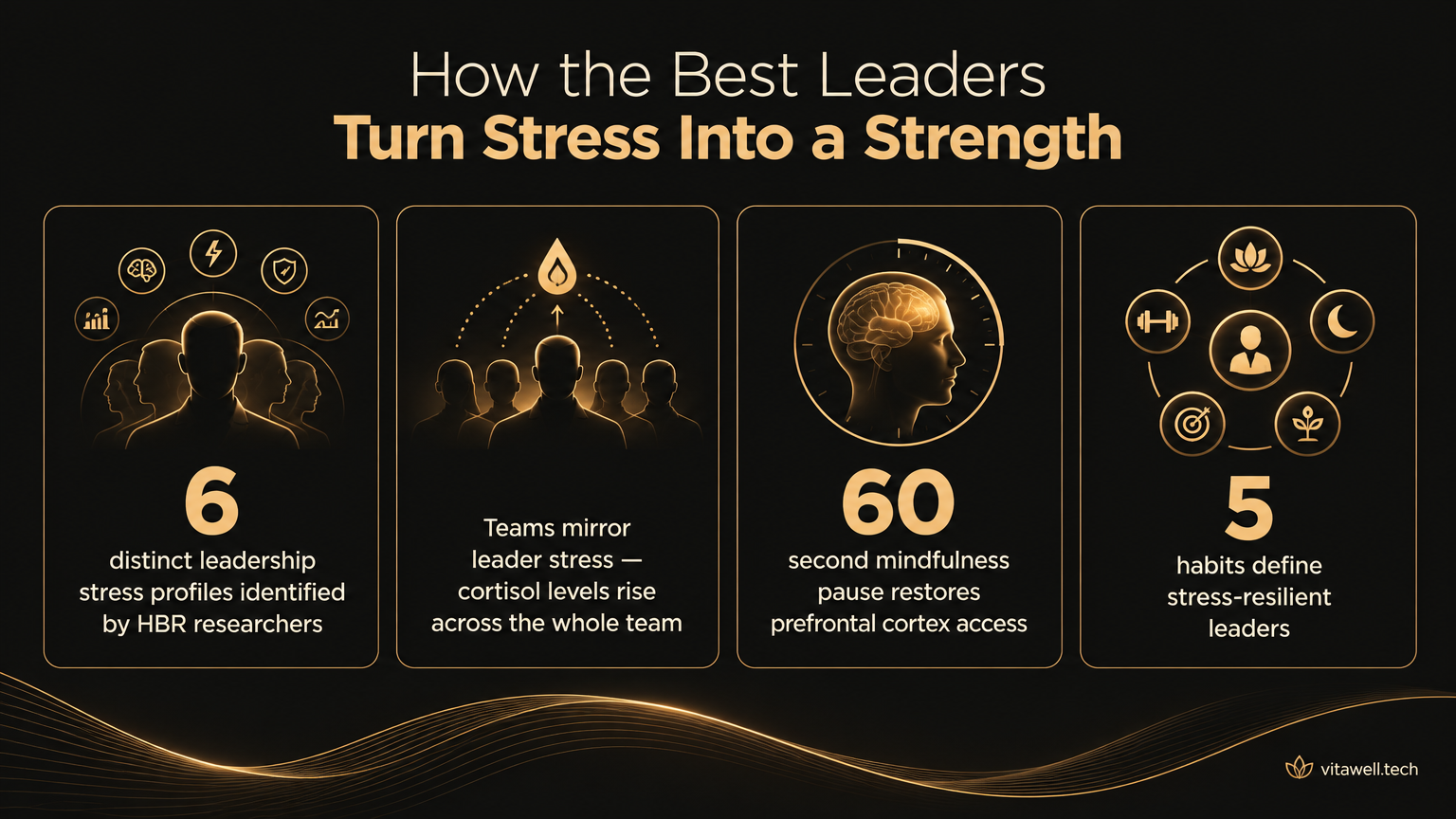
Leadership stress is contagious. Research on emotional contagion consistently shows that team members unconsciously mirror the emotional states of their leaders — and that teams led by visibly stressed, reactive leaders show significantly higher cortisol levels, lower psychological safety, and reduced discretionary effort. When a leader's stress response goes unmanaged, it doesn't stay personal. It becomes organizational.
The Science of Stress Response: What Happens in Your Brain and Body Under Pressure
Under threat, the brain's amygdala fires before the prefrontal cortex — the seat of rational decision-making — can fully engage. This neurological sequence, often called the "amygdala hijack," floods the body with cortisol and adrenaline, primes the muscles for fight-or-flight, and temporarily reduces access to complex reasoning, empathy, and perspective-taking. For brief, physical threats, this is adaptive. For the sustained, socially complex challenges of modern leadership, it can be profoundly disruptive.
Why High Performers Aren't Immune to Stress Dysregulation
High performance under normal conditions provides no immunity to stress-induced impairment. In fact, some research suggests that high achievers with strong internal standards experience more acute distress when performance feels threatened — making the ability to regulate stress responses even more critical for top performers than for average ones. The capacity that separates exceptional leaders isn't the absence of a stress response; it's the ability to work with it.
Acute Stress vs. Chronic Stress: Why the Distinction Matters
Acute stress — a sharp deadline, a critical presentation, an emergency decision — can actually enhance performance by increasing focus and mobilizing energy. It's time-limited and recoverable. Chronic stress — sustained over months or years without adequate recovery — damages the prefrontal cortex, disrupts sleep and immune function, and progressively degrades the executive capabilities leaders depend on. Learning to manage the first without accumulating the second is the central challenge of sustainable leadership.
The 6 Leadership Stress Profiles — HBR's Research
HBR's researchers identified six distinct patterns in how leaders habitually respond to stress. These profiles aren't fixed personality types — they are trained, default responses that can be both recognized and expanded. Every leader has a primary profile, and every profile has genuine strengths alongside specific blind spots that become liabilities under sustained pressure.
The Calm Lighthouse
This leader projects stability and steadiness under pressure. Teams find them reassuring, and they excel at helping others regulate during crises. Blind spot: can appear emotionally distant or disengaged; may suppress their own stress to the point that authentic connection suffers. Teams may feel they can't bring real problems to them.
The Alchemist
The Alchemist reframes challenges as opportunities, finding meaning and momentum in adversity. They energize teams during difficulty and generate creative solutions under constraint. Blind spot: may minimize genuine risks in pursuit of the silver lining; can frustrate team members who need their concerns validated before moving forward.
The Firefighter
The Firefighter moves fast, takes decisive action, and thrives in acute crises. Their bias for action is an asset in time-sensitive situations. Blind spot: in chronic stress environments, constant fire-fighting creates its own exhaustion and can crowd out strategic thinking. May solve symptoms rather than root causes.
The Stoic
The Stoic maintains emotional composure through rationality, compartmentalization, and intellectual distance. They are resistant to panic and excellent at analytical problem-solving under pressure. Blind spot: may come across as cold or inaccessible; teams under emotional strain may feel unsupported. Stoic leaders may also internalize stress rather than processing it.
The Diplomat
The Diplomat prioritizes harmony and cohesion under stress, working hard to maintain relationships and reduce conflict. They are skilled at de-escalation and building consensus during difficult periods. Blind spot: may avoid necessary difficult conversations or hard decisions to preserve peace; can delay action when speed is essential.
The Container
The Container absorbs team stress, shielding members from organizational turbulence. They create a protective environment that allows their team to focus and perform. Blind spot: takes on disproportionate personal load, which is unsustainable; eventually burns out or becomes a bottleneck. The shielding that helps in the short term can prevent the team from developing their own resilience.
How to Identify Your Own Stress Profile
Self-awareness is the foundation. The following behavioral signals can help you identify your default profile:
- Under pressure, do you instinctively slow down and project calm? (Calm Lighthouse)
- Do you look for the opportunity inside the challenge? (Alchemist)
- Do you immediately start fixing things, taking action to regain control? (Firefighter)
- Do you intellectualize and analyze, keeping emotions at a distance? (Stoic)
- Do you focus on people, managing relationships and reducing friction? (Diplomat)
- Do you absorb and shield, protecting your team from the pressure you're carrying? (Container)
Your honest answers — especially under real rather than theoretical pressure — will reveal your dominant pattern.
How to Expand Your Range: Moving Beyond Your Default Profile
The goal is not to change who you are but to build a larger repertoire. Leaders who can access multiple profiles — choosing the right response for the specific situation — significantly outperform those locked into a single default mode. Here are evidence-based practices for expanding your range:
- Name your state before you act. Even a few seconds of internal labeling ("I'm feeling reactive right now") engages the prefrontal cortex and reduces amygdala dominance.
- Practice physiological reset techniques. Slow exhale breathing (4 counts in, 6-8 counts out) activates the parasympathetic nervous system within seconds, reducing cortisol and restoring cognitive access.
- Seek feedback on your stress behaviors. Ask a trusted colleague to tell you what they observe in you under pressure. External perspective reveals blind spots that self-reflection often misses.
- Deliberately practice non-default responses in low-stakes situations. If you're a Firefighter, practice the Diplomat's approach in a minor team conflict. If you're a Stoic, practice the Alchemist's framing in a mild setback.
- Build recovery into your schedule. Cognitive recovery is a prerequisite for expanded range. Without it, leaders default to their most primitive stress response regardless of training.
Real-Time Self-Regulation Techniques
In-the-moment regulation requires practiced, accessible techniques. Research-validated approaches include: tactical breathing, brief mindfulness pauses (even 60 seconds), physical movement to metabolize stress hormones, and deliberate slowing of speech rate — which both signals calm to your nervous system and to the people around you.
Sharing the Cognitive Load: The Team Dimension of Stress Leadership
Individual stress regulation, while necessary, isn't sufficient. High-performing teams under sustained pressure require systems that distribute the stress load rather than concentrating it in one person. When leaders carry all organizational stress themselves, they become both a bottleneck and a burnout risk.
Psychological Safety and Stress Distribution
Teams with psychological safety — the belief that members can speak up, raise concerns, and admit mistakes without punishment — distribute stress more effectively than teams without it. When team members can share uncertainty and difficulty openly, collective problem-solving replaces individual stress hoarding. The leader's role shifts from absorbing all stress to facilitating the team's shared capacity to process and respond to it.
Structures and Habits That Reduce Collective Stress Load
Practical team-level interventions include: regular structured check-ins that normalize acknowledgment of pressure, explicit clarity about roles and decision rights to reduce ambiguity stress, deliberate celebration of small wins to restore dopamine and momentum, and rotation of high-intensity responsibilities so no single person carries disproportionate load.
Building a Stress-Resilient Leadership Identity
The ultimate goal is to integrate stress literacy into how you lead every day — not just in exceptional moments of crisis. The five habits that characterize stress-resilient leaders are:
- Knowing their profile: they understand their default stress response and its blind spots
- Regulating before responding: they pause to self-regulate before reacting under pressure
- Distributing load: they actively share cognitive and emotional burden across the team
- Recovering intentionally: they build recovery into their routines, not as a luxury but as performance infrastructure
- Modeling transparency: they appropriately name their own stress in ways that normalize it for their teams without destabilizing them
Conclusion: Stress Is Trainable
Stress in leadership is not a character flaw or a sign of inadequacy. It is a physiological reality that the modern leadership environment imposes on every person who leads. The difference between leaders who thrive under sustained pressure and those who don't is not resilience as a fixed trait — it's resilience as a practiced skill. Identifying your profile, expanding your range, and building team-level systems for sharing the load are concrete, learnable capabilities.
The best leaders don't avoid stress. They understand it, work with it, and use it to sharpen rather than narrow their leadership. That skill, more than any strategic capability, may be the defining leadership competency of our time.