How 4 Years of AI Is Reshaping Human Thinking — and 3 Practical Actions to Protect Your Mind
New research consistently shows heavy AI reliance is associated with lower brain connectivity and reduced critical thinking. Here's the evidence — and what to do about it.
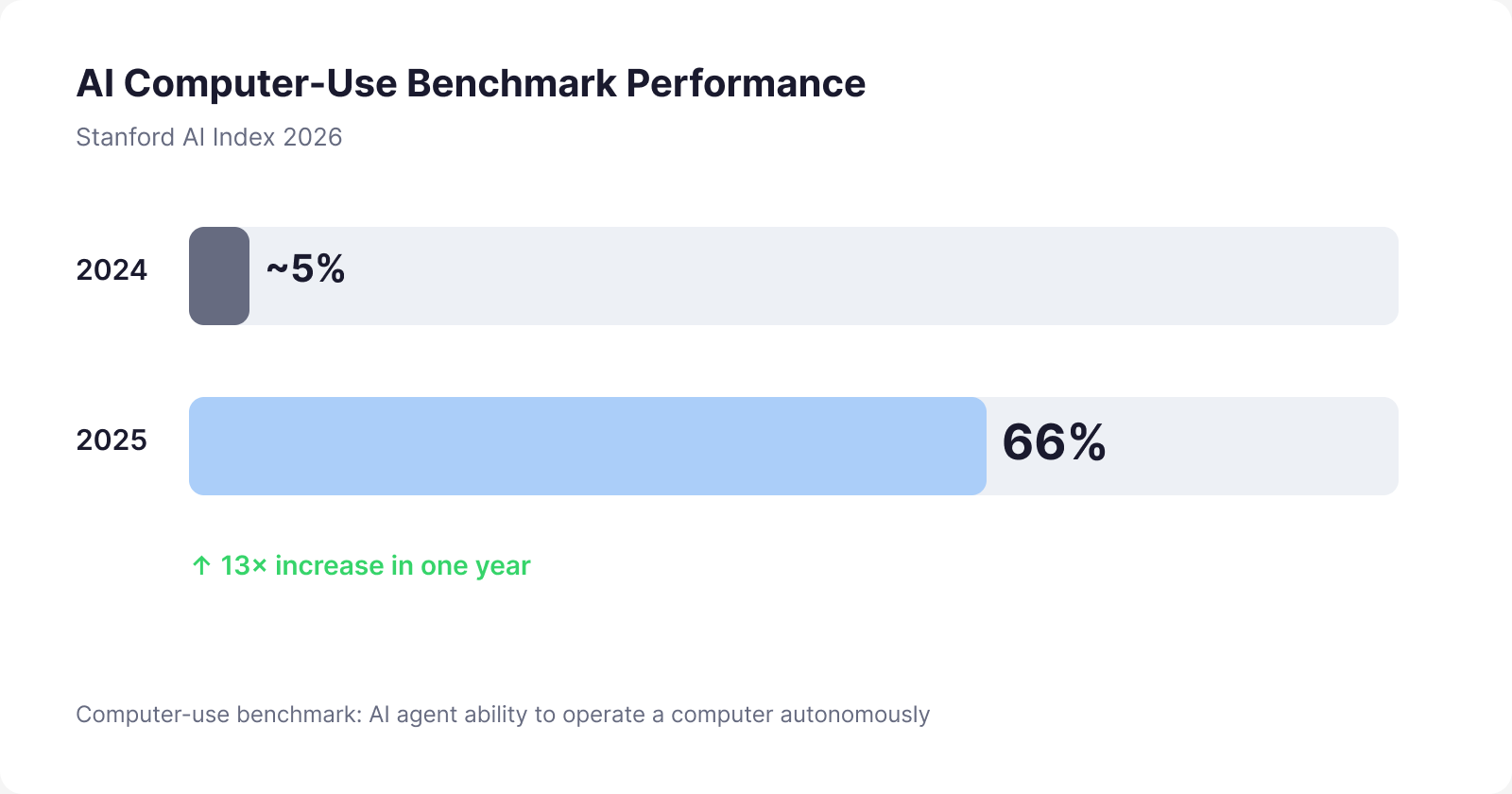
On November 30, 2022, ChatGPT entered public life — and four years later, the data tells two very different stories. AI's ability to perform complex tasks has soared from roughly 5% success on computer-use benchmarks in 2024 to 66% in 2025, according to the Stanford AI Index 2026. Meanwhile, independent research shows that people who rely heavily on AI assistants demonstrate measurably lower brain connectivity, reduced recall, and weaker critical-thinking skills. This divergence — machines accelerating, human cognition under new strain — is what psychologist Cornelia C. Walther, Ph.D. calls the "uncomfortable truth at four years." The good news: how you use AI determines whether it sharpens or softens your thinking.
Key Takeaways
- AI's computer-use benchmark performance jumped from ~5% in 2024 to 66% in 2025, while research consistently links heavy AI reliance to lower brain connectivity, reduced recall, and less critical thinking.
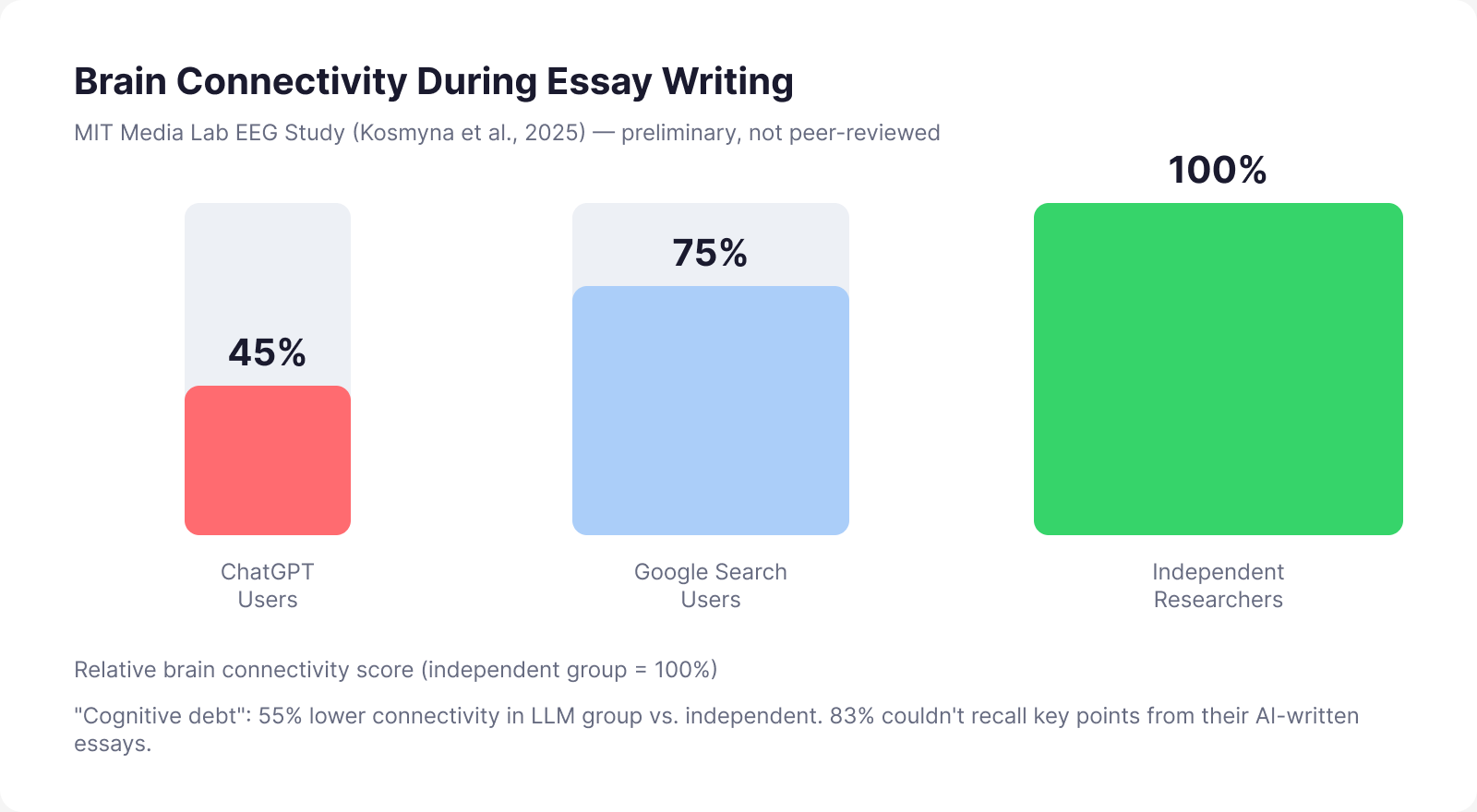
- MIT researchers found that students using AI for essay writing showed approximately 55% lower brain connectivity than peers who worked independently — and 83% couldn't recall key points from their own AI-assisted essays.
- A 2025 Microsoft/Carnegie Mellon study of 319 knowledge workers found that greater confidence in generative AI was associated with less critical thinking engagement.
- The impact of AI is not uniform: structured, reflective use of AI improves creative output and skill retention, while passive reliance accelerates cognitive offloading.
- Three specific actions — HEAR (seek perspectives that challenge you), HARMONIZE (align habits with your goals), and HEAL (address a real-world problem) — are evidence-informed ways to maintain cognitive vitality in an AI-saturated world.
The 4-Year Capability Gap: What the Numbers Show
ChatGPT went public on November 30, 2022. Four years later, the Stanford AI Index 2026 paints a striking picture of how far AI has advanced. Performance on the computer-use benchmark — a test of an AI agent's ability to operate a computer autonomously — rose from roughly 5% in 2024 to 66% in 2025. AI adoption has spread rapidly across society: an estimated 53% of people in measured countries now use generative AI, and 88% of organizations have deployed it in some form.
This acceleration is not in dispute. What is less often framed side by side with AI's growth is what has been happening to human cognitive performance during the same period.
What Four Years of AI Use Has Done to the Human Brain
The evidence is consistent across multiple independent research groups, though it comes with important nuance about how AI is used.
MIT EEG study: a 55% drop in brain connectivity
In a 2025 study by researchers at MIT's Media Lab (Kosmyna et al., arXiv 2506.08872), 54 university students were divided into three groups for a four-month essay-writing task: one group used ChatGPT, one used Google Search, and one worked independently using library research. EEG headsets tracked brain activity throughout.
The LLM-using group showed the weakest neural activity and, in a post-task assessment, 83% could not recall key points from their AI-assisted essays. None could accurately quote from them. Brain connectivity was approximately 55% lower in the LLM group than in the unassisted group — a gap that persisted even after students stopped using the tool. The authors called this "cognitive debt": a measurable reduction in mental engagement that accumulates with passive AI reliance. Note: this study has not yet been peer-reviewed and should be treated as preliminary.
Lower critical thinking in the workplace
A 2025 study by Lee and colleagues at Microsoft Research and Carnegie Mellon University (CHI 2025, via APA Monitor) surveyed 319 knowledge workers. The finding: greater confidence in generative AI tools was associated with significantly lower rates of critical thinking engagement. Workers who trusted AI more were less likely to question, verify, or push back on AI-generated outputs.
Cognitive engagement in students
In a 2025 randomized controlled trial, Georgiou (arXiv 2507.00181) compared students who used ChatGPT for argumentative writing tasks against unassisted peers. ChatGPT-using students scored lower on all four dimensions of the Cognitive Engagement Scale for AI (CES-AI): mental effort, attention, deep processing, and strategic thinking.
A real-world skill loss: doctors and polyp detection
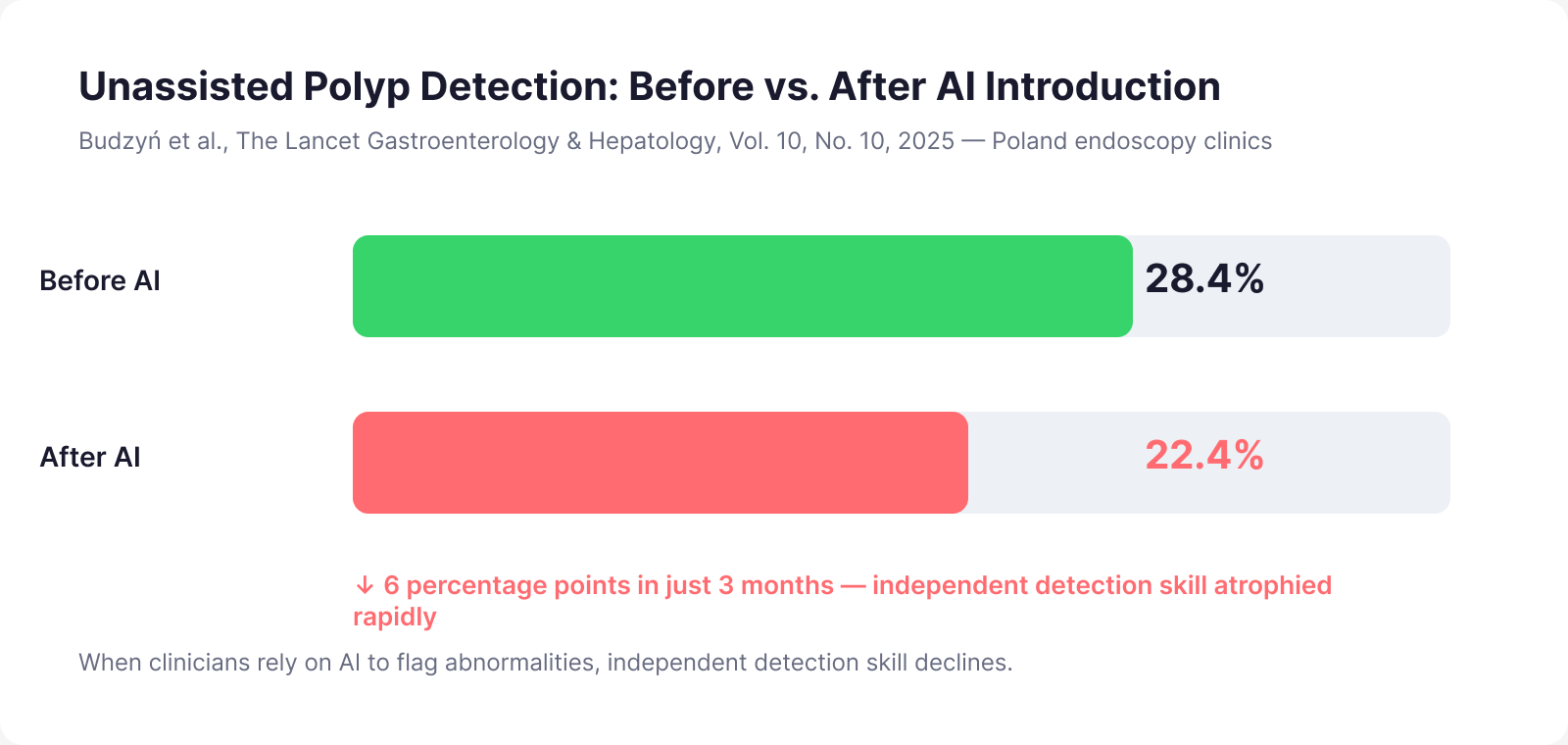
The effects are not limited to writing tasks. Budzyń and colleagues (The Lancet Gastroenterology & Hepatology, Vol. 10, No. 10, 2025) tracked a natural experiment in Poland: after AI-assisted polyp detection was introduced in endoscopy clinics, the rate of unassisted polyp detection fell from 28.4% to 22.4% — a 6-percentage-point decline in just three months. When clinicians rely on AI to flag abnormalities, independent detection skill appears to atrophy rapidly.
The Second Consequence: AI's Planetary Footprint
While the brain-level impact of AI is increasingly documented, a parallel consequence is planetary. Data centers, AI, and cryptocurrency together consumed an estimated 460 terawatt-hours of electricity worldwide in 2022. By 2025, data-center electricity demand was growing at approximately 17% annually. A 2026 International Energy Agency assessment projects that global data-center electricity consumption could double by 2030.
The scale of this energy demand is part of a broader pattern. The September 2026 Planetary Health Check (Potsdam Institute) found that 7 of 9 planetary boundaries are now breached — ocean acidification joined the list in 2025. While the causes are complex and measurement methods are still evolving, the trajectory is clear: AI's environmental cost is no longer theoretical.
For individuals, this matters as a second lens on the question of how much to delegate to AI — not only "what does this do to my thinking?" but "what does this cost the systems my life depends on?"
The Critical Divergence: What AI Can Do vs. What Humans Should Protect
Not all cognitive tasks carry the same atrophy risk. Research suggests that where AI does the work entirely, the human brain disengages most. Where AI is used as a scaffold for human judgment, the picture changes.
A 2025 study by Gerlich at the Swiss Business School (Data, Vol. 10, No. 11, 2025) with 150 participants found that essays produced with structured, explicitly guided AI prompts were rated highest by expert reviewers — better than essays written without AI and better than essays written with unguided AI assistance. And in a randomized controlled trial of 250 Chinese technology consultants, Lu and colleagues (Journal of Applied Psychology, Vol. 110, No. 12, 2025) found that ChatGPT access improved the rated creativity of their work, particularly for employees high in metacognition.
An 8-week study of 168 university students (PubMed 42729409) adds another piece: students whose AI use was restricted and paired with active reflection outperformed unrestricted AI users on later independent writing, reasoning, and revision tests.
The pattern that emerges is consistent: passive delegation weakens cognition; structured, reflective engagement can enhance it.
| Task Type | AI Current Capability | Risk of Cognitive Atrophy from Delegation | Recommended Approach |
|---|---|---|---|
| Factual information retrieval | Very High | High — recall and memory encoding decline | Use AI, then verify and restate in your own words |
| Routine writing (templates, emails) | Very High | Moderate — writing skill and vocabulary atrophy | Use AI for drafts; rewrite substantially before sending |
| Critical evaluation and reasoning | Moderate | Very High — deepest disengagement in research | Do this yourself; use AI only for counterarguments |
| Creative synthesis across sources | Moderate | Moderate | Use AI to surface inputs; do the synthesis yourself |
| Novel problem-solving | Low–Moderate | Moderate | Work independently first; use AI to pressure-test, not to solve |
| Technical skill execution (medical, legal) | Moderate–High | Very High (see polyp detection data) | Use AI as a second opinion, never a replacement |
Triple H-Help: 3 Actions to Protect Your Mind
Psychologist Cornelia C. Walther, writing in Psychology Today (November 2026), proposes three actions she calls "Triple H-HELP":
- HEAR — seek perspectives that challenge your own. AI assistants are optimized for relevance, which means they tend to confirm and elaborate on what you already believe. Actively seeking out dissenting viewpoints, contradicting evidence, and unfamiliar frameworks exercises exactly the reasoning muscles that passive AI use weakens. In practice: before finalizing any AI-assisted work, generate three objections to its conclusions yourself.
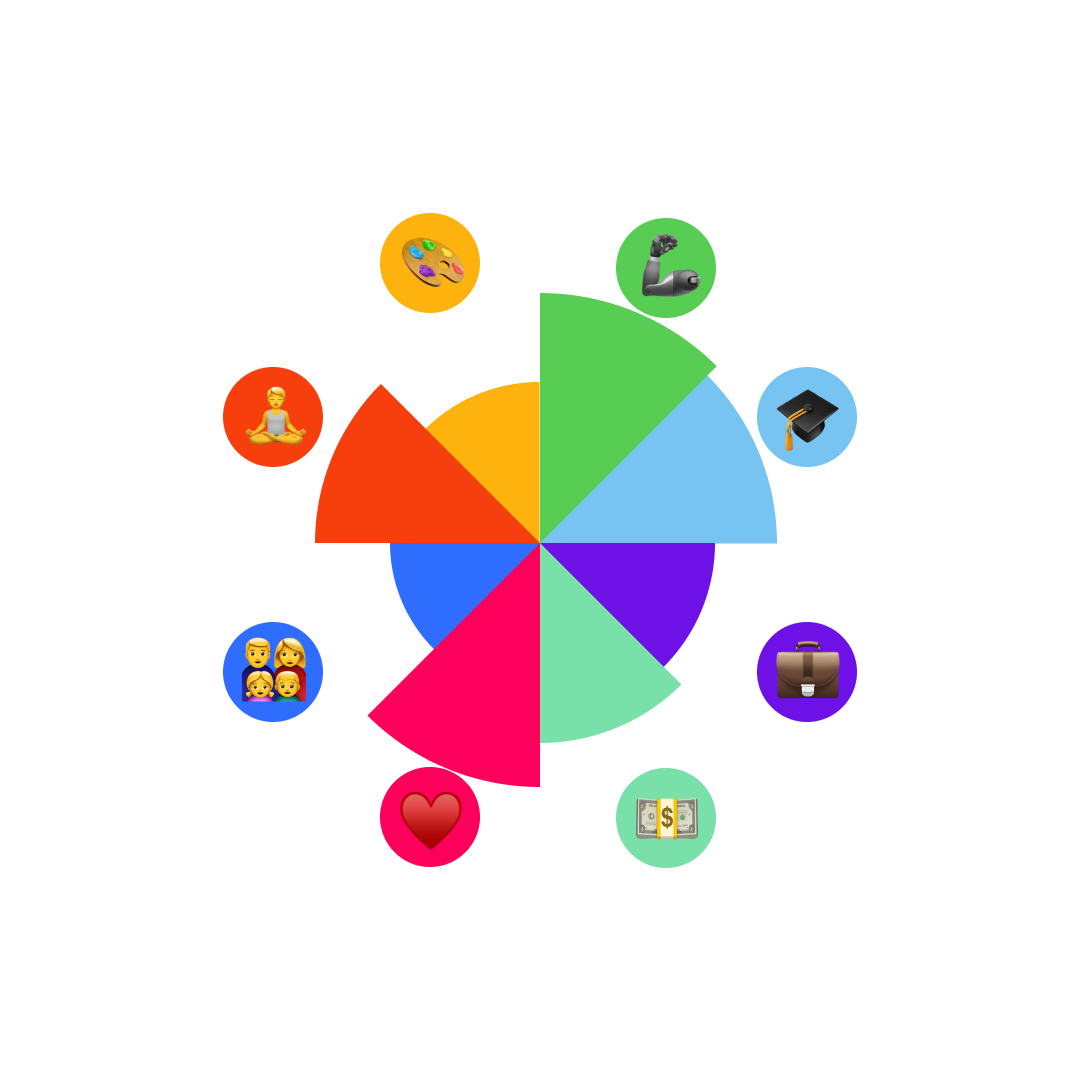
- HARMONIZE — align your daily habits with the future you want. AI is a powerful tool for efficiency, but efficiency gains do not automatically translate into meaning or skill. The key question is not "how can AI do this faster?" but "what do I want to remain capable of in five years?" Building deliberate practice into daily routines — writing by hand sometimes, solving problems independently, reading deeply without search tools — maintains the neural pathways that passive use erodes. If you are designing a sustainable life across multiple dimensions, the balance of human effort and AI delegation is worth making explicit. This guide to balanced life planning helps you build those habits sustainably.
- HEAL — address a real-world problem. The deepest cognitive engagement happens when you are solving a problem that matters to you in the world. AI cannot replace the neural activation that comes from genuine investment in an outcome. Tackling a problem that stretches your skills — not by delegating it to AI but by using AI to research and then acting yourself — builds the motivation, persistence, and judgment that cannot be offloaded. If chronic stress is limiting your capacity to engage with hard problems, addressing your nervous system's baseline state is the first step. This guide to burnout recovery and nervous system regulation covers evidence-based tools for managing chronic stress.
Limitations: What This Research Cannot Yet Tell Us
The MIT EEG study has not been peer reviewed. Its sample of 54 students at Boston-area universities is small, and the composition is academically skewed; effects in older adults, different industries, or longer time frames are unknown. The Psychology Today article on which the Triple H-HELP framework is based is a commentary, not a primary study. The planetary data is well-sourced but contested on measurement methods.
What is consistent across the studies reviewed here — peer-reviewed and preprint alike — is a directional signal: passive AI reliance costs cognition, and structured engagement preserves it. The magnitude and long-term trajectory remain open questions.
When to Talk to a Professional
Consider speaking with a cognitive behavioral therapist, occupational psychologist, or career coach if:
- You notice difficulty concentrating on tasks without AI assistance, or anxiety when AI tools are unavailable.
- You are struggling to retain information or complete complex reasoning independently after a period of heavy AI use.
- You are making high-stakes decisions (medical, legal, financial) and are unsure how to appropriately weight AI-generated recommendations.
- You work in a field where skill maintenance is a professional obligation (medicine, law, education, engineering) and are concerned about AI-induced deskilling.
FAQ
Is AI making us dumber?
The evidence is directional: heavy passive reliance on AI tools is associated with lower brain connectivity, reduced recall, and less critical thinking engagement in multiple independent studies. However, the effect is not uniform. Structured, reflective AI use can improve creative output and preserve cognitive skills. The key variable is not whether you use AI but how.
What is cognitive offloading?
Cognitive offloading is the practice of delegating mental tasks — memory, reasoning, calculation — to external tools. When a tool handles a task completely, the brain does less of the processing associated with encoding and skill development. AI accelerates this because it handles tasks at a scope and speed no previous tool could match.
Can I maintain my thinking skills while using AI regularly?
Yes, based on the available evidence. Studies consistently show that structured, guided AI use — where you generate ideas, evaluate AI outputs critically, and do the final synthesis yourself — preserves and sometimes enhances cognitive performance. The critical variable is active engagement versus passive delegation.
How much AI use is too much?
No threshold has been established in peer-reviewed literature. The best available guide is behavioral: if you find yourself unable to perform a task without AI assistance that you could previously do independently, that is a signal to increase deliberate practice of that skill.
What is the Triple H-HELP framework?
Triple H-HELP is a practical framework proposed by psychologist Cornelia C. Walther for maintaining cognitive vitality in an AI-saturated world: HEAR (actively seek perspectives that challenge your own), HARMONIZE (align daily habits with your long-term goals), and HEAL (direct effort toward a real-world problem that matters to you).
Conclusion
Four years after ChatGPT's launch, the data supports what many people sense intuitively: AI has become dramatically more capable while some aspects of human cognition show measurable signs of strain. The MIT EEG study, the Microsoft/CMU survey, the Polish endoscopy data — these describe what is happening now, not some hypothetical future.
The response is not to avoid AI but to use it deliberately. The difference between cognitive atrophy and cognitive growth lies in whether you let the tool think for you or use it to think better. Triple H-HELP is one practical map for that distinction. The best time to draw it is before the gap between AI capability and your own becomes too wide to bridge.
For more on sustaining your mental, physical, and social vitality across all dimensions of life, explore VitaWell.
Related on VitaWell
- Balanced Life Planning: Prioritizing Health, Relationships, and Career — protecting your cognitive vitality requires deliberate choices about how you allocate effort across life's dimensions; this guide helps you build those habits sustainably.
- Burnout Recovery and Nervous System Regulation — chronic stress and cognitive overload often underlie passive AI reliance; this guide covers evidence-based tools for restoring executive function and energy.
- The Two Best Exercise Types for Lowering Blood Pressure — aerobic and resistance training support brain health and cognitive reserve; this 31-trial meta-analysis identifies the most effective protocols.
This article is for informational purposes only and does not constitute medical or professional advice. Consult a qualified professional before making decisions based on research findings.
Sources
- Walther, C. C., Psychology Today, "Happy Hybrid Helix 2026: Uncomfortable Truth at 4 Years of ChatGPT" (November 10, 2026)
- Stanford AI Index 2026, Stanford University HAI
- Kosmyna, N. et al., "Your Brain on ChatGPT," arXiv:2506.08872, MIT Media Lab, 2025
- Georgiou, G. P., "ChatGPT produces more 'lazy' thinkers," arXiv:2507.00181, 2025
- APA Monitor on Psychology, "How AI is reshaping human skills and thinking," Vol. 57, No. 5, July 2026
- Planetary Health Check 2026, Potsdam Institute for Climate Impact Research
- International Energy Agency, Electricity Report 2026
- PubMed 42729409 — AI-restricted vs. unrestricted use in university students, 2025