How Estrogen Protects Your Brain: New Research Links Longer Reproductive Life to Healthier Brain Blood Vessels
New research links longer reproductive lifespan and hormone therapy to significantly lower brain vessel damage—here's what it means for your cognitive future.

Women who menstruate for more years show significantly less cerebral small vessel disease—a leading driver of dementia—according to a 2026 Swedish cohort study of 352 women. Each additional year of reproductive life was linked to 8% lower odds of CSVD burden on brain MRI (Marseglia et al., Neurology 2026). Women who used menopausal hormone therapy had 59% less CSVD burden than non-users. While researchers do not yet recommend hormones solely for brain protection, this research reshapes how we understand estrogen's lifelong role in brain vessel health.
Key Takeaways
- Each extra year of reproductive lifespan (menarche to menopause) is linked to 8% lower odds of cerebral small vessel disease on MRI.
- Women using menopausal hormone therapy had 59% less CSVD burden than non-users in this cohort.
- Cerebral small vessel disease—tiny damage patterns in the brain's blood vessels—is a primary driver of vascular dementia and cognitive decline.
- The APOE4 gene variant increases brain vulnerability; the timing of estrogen exposure appears to matter most for APOE4 carriers.
- Lifestyle habits (blood pressure control, exercise, sleep, diet) remain the highest-evidence interventions for brain vessel protection.
What Is Cerebral Small Vessel Disease — and Why It Matters for Your Brain
Cerebral small vessel disease (CSVD) is an umbrella term for damage to the tiny blood vessels that supply deep brain structures. These capillaries and arterioles are too small to be treated with stents or bypass surgery, yet they are responsible for roughly 25% of all strokes and are a primary driver of vascular dementia, the second most common form of dementia after Alzheimer's disease (Pantoni, Lancet Neurology 2010). Most people with CSVD have no symptoms until damage is extensive.
The Four MRI Markers That Define CSVD
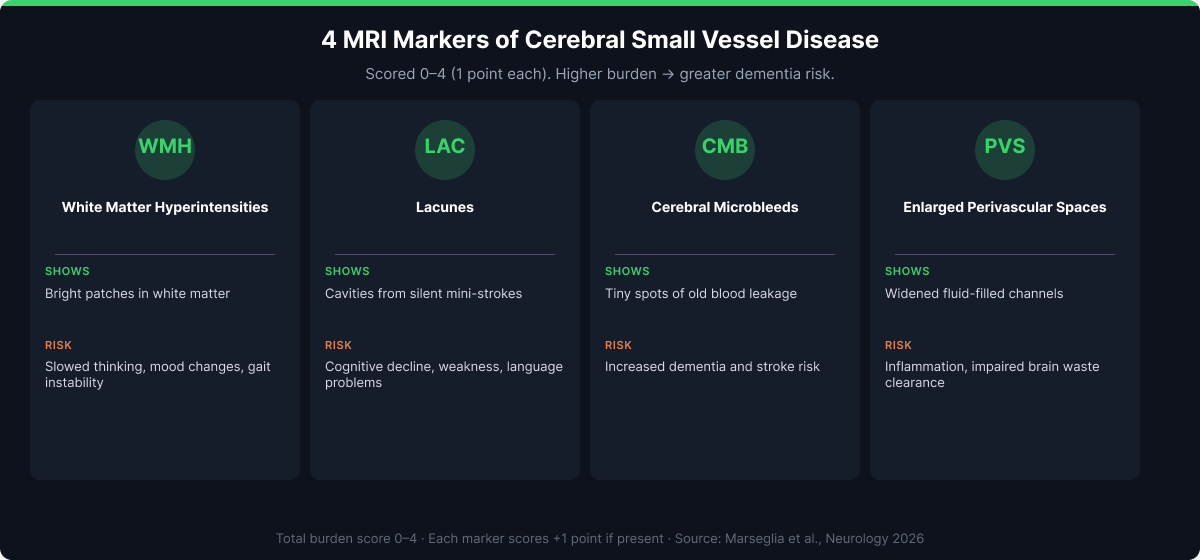
Researchers quantify CSVD severity by scoring four patterns visible on brain MRI. Together they form the CSVD burden score used in the Marseglia 2026 study, with each marker adding 0 or 1 point for a total range of 0–4.
| Marker | What It Shows | What It Causes | Scored in This Study |
|---|---|---|---|
| White matter hyperintensities (WMH) | Bright patches in the brain's white matter | Slowed thinking, mood changes, gait instability | Yes (Fazekas scale grade ≥2) |
| Lacunes | Small cavities left by silent mini-strokes | Cognitive decline, weakness, language problems | Yes (≥1 lacune present) |
| Cerebral microbleeds | Tiny spots of old blood leakage | Increased dementia and stroke risk | Yes (≥1 present) |
| Enlarged perivascular spaces | Widened fluid-filled channels around vessels | Inflammation, impaired brain waste clearance | Yes (grade ≥2) |
Understanding these markers matters because they don't appear only in dementia patients — they begin accumulating in midlife, and the degree of accumulation strongly predicts future cognitive trajectory.
The 2026 Neurology Study: What 352 Swedish Women Revealed
The study, published in Neurology in January 2026 (Marseglia et al., DOI: 10.1212/WNL.0000000000218706), drew from the Gothenburg H70-1944 Birth Cohort, a population-based sample of Swedish women born in 1944 and examined around age 70.

How Reproductive Lifespan Was Measured
Researchers defined reproductive lifespan as the interval between age at first menstruation (menarche) and age at final menstrual period (menopause). The 352 participants had an average reproductive lifespan of 37 years. Hormone exposure history was obtained via interview: 73% had ever used oral contraceptives (OC) and 61% had ever used menopausal hormone therapy (MHT). Of the original cohort, 205 women returned five years later for a follow-up MRI, allowing the team to track CSVD progression over time.
What the Brain Scans Showed
After adjusting for age, education, cardiovascular risk factors, and lifestyle variables, every additional year of reproductive lifespan was associated with 8% lower odds of a higher CSVD burden score (odds ratio 0.92; 95% CI: 0.86–0.98). This association held after accounting for oral contraceptive and MHT use, suggesting that the total duration of endogenous estrogen exposure — not just supplemental hormones — plays a protective role in brain vessel health.
Hormone Therapy and CSVD: A 59% Difference in Brain Vessel Health
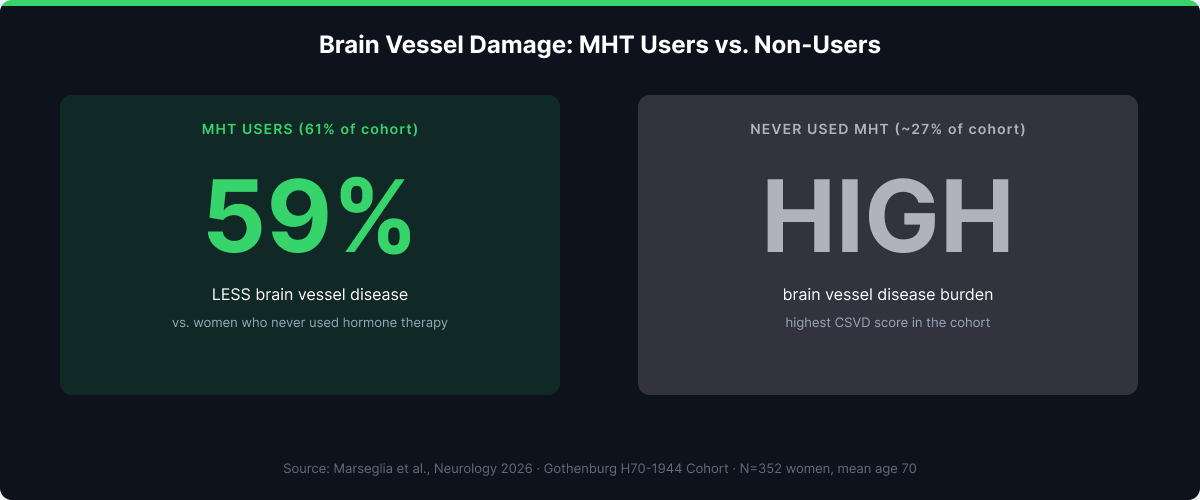
The most striking finding involved menopausal hormone therapy. Women who had ever used MHT showed 59% less CSVD burden compared with women who had never used hormone therapy — a clinically meaningful difference in brain vessel integrity. Oral contraceptive use alone was not independently associated with reduced CSVD burden after controlling for the other variables.
| Group | Proportion of Cohort | Key CSVD Finding | Notes |
|---|---|---|---|
| OC use only (never MHT) | ~12% of cohort | No significant independent association with CSVD | Association absorbed by reproductive lifespan variable |
| MHT use (ever) | 61% | 59% lower CSVD burden vs. never-users | Most robust finding in the analysis |
| No hormone use | ~27% | Highest CSVD burden in the cohort | Included women with early menopause |
Why Researchers Urge Caution Despite the Numbers
The study authors are explicit: this observational design cannot establish causation. Women who chose to use MHT may differ from non-users in systematic ways — health-conscious behavior, socioeconomic status, access to care — that explain part of the difference. Additionally, estrogen type, dose, timing, and route of administration were not standardized. As Marseglia and colleagues wrote in Neurology: there is "insufficient evidence to recommend MHT solely for brain protection." The finding is hypothesis-generating, not prescriptive.
The APOE4 Factor: Why Some Women's Brains Are at Higher Risk
Women account for approximately two-thirds of all dementia cases globally (Alzheimer's Research UK, 2023). Biology, longevity, and the APOE4 gene all contribute. APOE4 — present in roughly 25% of the general population and 40% of Alzheimer's patients — doubles the lifetime dementia risk in one-copy carriers and increases it four-fold in two-copy carriers. Critically, the risk difference between APOE4-positive and APOE4-negative individuals is larger in women than in men, possibly because estrogen modulates APOE4's toxic effects on the brain's lipid metabolism and vascular integrity.
A 2026 University of East Anglia and University of Exeter study of more than 180,000 postmenopausal UK women — the largest analysis of its kind to date — found that HRT users had a 16% lower risk of developing Alzheimer's than non-users (Minihane et al., UK Biobank 2026). The greatest benefit appeared in women with the lowest lifetime estrogen exposure: those with early menopause or late menarche — exactly the phenotype the Marseglia study shows carries the highest CSVD burden. This aligns with the “critical window” hypothesis: estrogen exposure appears most protective early in the menopause transition, not decades later. The Marseglia 2026 study did not stratify by APOE4 status, leaving this interaction as an important open question for future trials.
For now, knowing your APOE4 status — obtainable through consumer genetic tests or through a clinician — can inform the conversation with your doctor about the timing and type of hormone therapy during perimenopause.
7 Evidence-Based Steps to Protect Your Brain Blood Vessels
Regardless of reproductive history or hormone therapy decisions, these seven habits carry the strongest evidence for preserving brain vessel integrity across the lifespan.
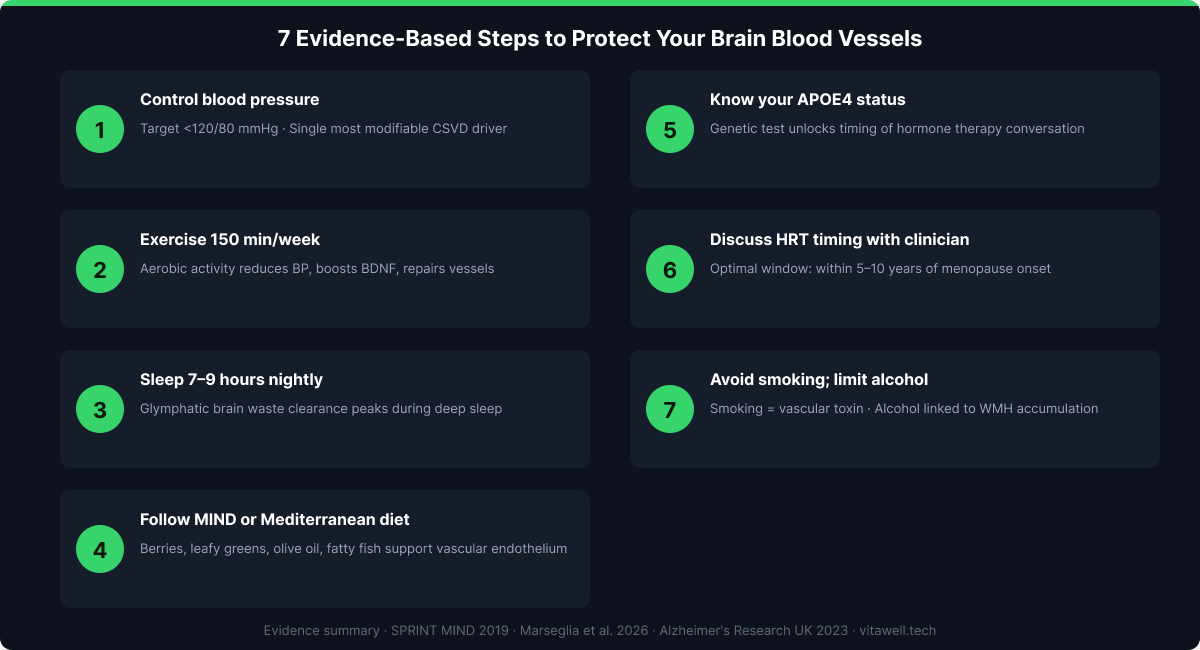
- Control blood pressure — target below 120/80 mmHg. High blood pressure is the single most modifiable driver of CSVD. The SPRINT MIND trial (2019) found that intensive BP control (target <120 mmHg systolic) reduced the risk of probable dementia by 17% and mild cognitive impairment by 19% compared with standard control. Read what a 31-trial meta-analysis found about the two most effective exercise types for lowering blood pressure.
- Exercise 150 minutes per week at moderate intensity. Aerobic exercise reduces BP, improves endothelial function in small vessels, and raises brain-derived neurotrophic factor (BDNF), which supports vascular repair. Even brisk walking counts.
- Sleep 7–9 hours per night and treat sleep apnea. The glymphatic system — the brain’s waste-clearance network — operates mainly during deep sleep. Insufficient sleep increases CSVD markers; untreated obstructive sleep apnea is independently associated with white matter hyperintensities.
- Follow the Mediterranean or MIND diet. The MIND diet (Mediterranean-DASH Intervention for Neurodegenerative Delay) was associated with slower cognitive decline in observational studies. Its richest antioxidant sources — berries, leafy greens, olive oil, fatty fish — directly support vascular endothelium. See why berries stand out as brain-protective foods.
- Know your APOE4 status. Consumer genetic tests (23andMe, AncestryDNA) and clinical panels can determine whether you carry APOE4. If you do, the conversation about perimenopausal hormone therapy timing becomes more urgent — and earlier preventive action on all other risk factors pays larger dividends.
- Discuss hormone therapy timing with your clinician if you are perimenopausal. Based on the available evidence, the clearest window of potential benefit appears to be within 5–10 years of menopause onset, not decades later. Only a clinician familiar with your complete health profile can weigh the risks and benefits for you individually.
- Avoid smoking; limit alcohol to no more than 1 drink per day. Smoking is a direct vascular toxin and accelerates CSVD across all age groups. Alcohol, even at moderate levels, is associated with cortical thinning and WMH accumulation in imaging studies published since 2022.
Chronic stress also damages small vessels via cortisol-driven inflammation. If stress recovery feels elusive even after rest, the underlying nervous system dynamic is worth addressing. This guide to burnout recovery and nervous system regulation covers evidence-based tools for managing chronic stress.
Limitations: What This Study Can and Cannot Tell Us
The H70-1944 cohort is a strength (deep phenotyping, population-based design) and a limitation (Swedish women, all born in 1944, examined at a single age). The observational design means unmeasured confounders remain possible. Hormone history was self-reported, and details on estrogen type, dosage, timing, and route of administration were not available. The 59% reduction in CSVD burden associated with MHT is striking, but until randomized trial data confirm this relationship, it cannot be interpreted as a causal treatment effect.
When to Talk to a Professional
Consult your doctor or a menopause specialist if:
- You are approaching or have recently reached menopause and want to discuss the risks and benefits of hormone therapy for symptom management and potentially for brain health.
- You have a family history of dementia, particularly early-onset dementia, or you know you carry the APOE4 gene variant.
- You experience symptoms such as word-finding difficulties, repeated forgetfulness, or changes in concentration that interfere with daily functioning — these warrant formal cognitive evaluation.
- You have cardiovascular risk factors (high blood pressure, elevated cholesterol, diabetes, smoking history) that may accelerate CSVD.
FAQ
Does estrogen protect the brain from dementia?
Estrogen appears to support brain blood vessel health, with observational data suggesting that longer reproductive lifespans and menopausal hormone therapy use are associated with less cerebrovascular damage. However, clinical trials have not yet confirmed that estrogen prevents dementia, and researchers do not currently recommend hormone therapy solely for brain protection.
What is cerebral small vessel disease?
Cerebral small vessel disease (CSVD) refers to damage in the tiny blood vessels supplying deep brain structures. It is detected on MRI as white matter changes, lacunes (small stroke cavities), microbleeds, and enlarged perivascular spaces. CSVD is a leading cause of vascular dementia and contributes to cognitive decline.
Does hormone therapy reduce dementia risk?
Evidence is mixed. The 2026 Marseglia study found 59% less CSVD burden in women who ever used menopausal hormone therapy, but this was an observational finding. Randomized trial data, particularly the Women’s Health Initiative Memory Study, showed increased dementia risk with certain hormone formulations started late in menopause. Timing, type, and individual risk profile all appear to matter.
What does reproductive lifespan mean for brain health?
Reproductive lifespan — the years between first menstruation and menopause — represents the period of sustained endogenous estrogen exposure. The 2026 study found each additional year was associated with 8% lower odds of brain vessel damage, suggesting that longer natural estrogen exposure may protect the brain’s small blood vessels over decades.
What can women do to protect their brain blood vessels?
Controlling blood pressure, exercising regularly, sleeping 7–9 hours, following the MIND or Mediterranean diet, limiting alcohol, and not smoking are all evidence-based steps for brain vessel protection. For women approaching menopause, discussing hormone therapy timing with a clinician — especially those with APOE4 — may also be warranted.
Conclusion
The Marseglia 2026 study adds meaningful evidence to a growing picture: estrogen is not just a reproductive hormone — it appears to be a vascular guardian of the brain. Women with longer natural estrogen exposure and those who used menopausal hormone therapy showed significantly less brain vessel damage in their seventh decade of life. What we cannot yet claim is causation, and no woman should take or forgo hormone therapy based on this finding alone. What we can say is that brain vessel health is shaped by decades of choices, and the best time to act on the seven protective steps above is now — before CSVD accumulates silently.
For more on living well across all eight dimensions of health, explore VitaWell.
Related on VitaWell
- The Two Best Exercise Types for Lowering Blood Pressure — What a 31-Trial Meta-Analysis Says — blood pressure is the single most modifiable driver of CSVD; this meta-analysis shows the two exercise types with the strongest clinical trial evidence.
- Tea and Health: Green, Black, and Beyond — tea polyphenols support vascular endothelial health and may complement the dietary side of brain vessel protection across the lifespan.
- Balanced Life Planning: Prioritizing Health, Relationships, and Career — protecting brain vessel health requires a whole-life approach; this guide helps integrate evidence-based health habits into a sustainable daily structure.
This article is for informational purposes only and does not constitute medical advice. Decisions about hormone therapy or any medical treatment should be made in consultation with a qualified healthcare provider.
Sources
- Marseglia A et al., Neurology 2026 (DOI: 10.1212/WNL.0000000000218706)
- Pantoni L, Cerebral small vessel disease: from pathogenesis and clinical characteristics to therapeutic challenges, Lancet Neurology 2010
- SPRINT MIND Investigators, Effect of Intensive vs Standard Blood Pressure Control on Dementia, JAMA 2019
- Alzheimer's Research UK, Dementia Statistics Hub 2023
- Minihane AM et al. (UEA/Exeter), HRT and dementia risk in 180,000+ postmenopausal women, UK Biobank 2026