
Corporate Culture Is Dead — What Data and a 75-Year Case Study Reveal About What Actually Keeps Employees Loyal

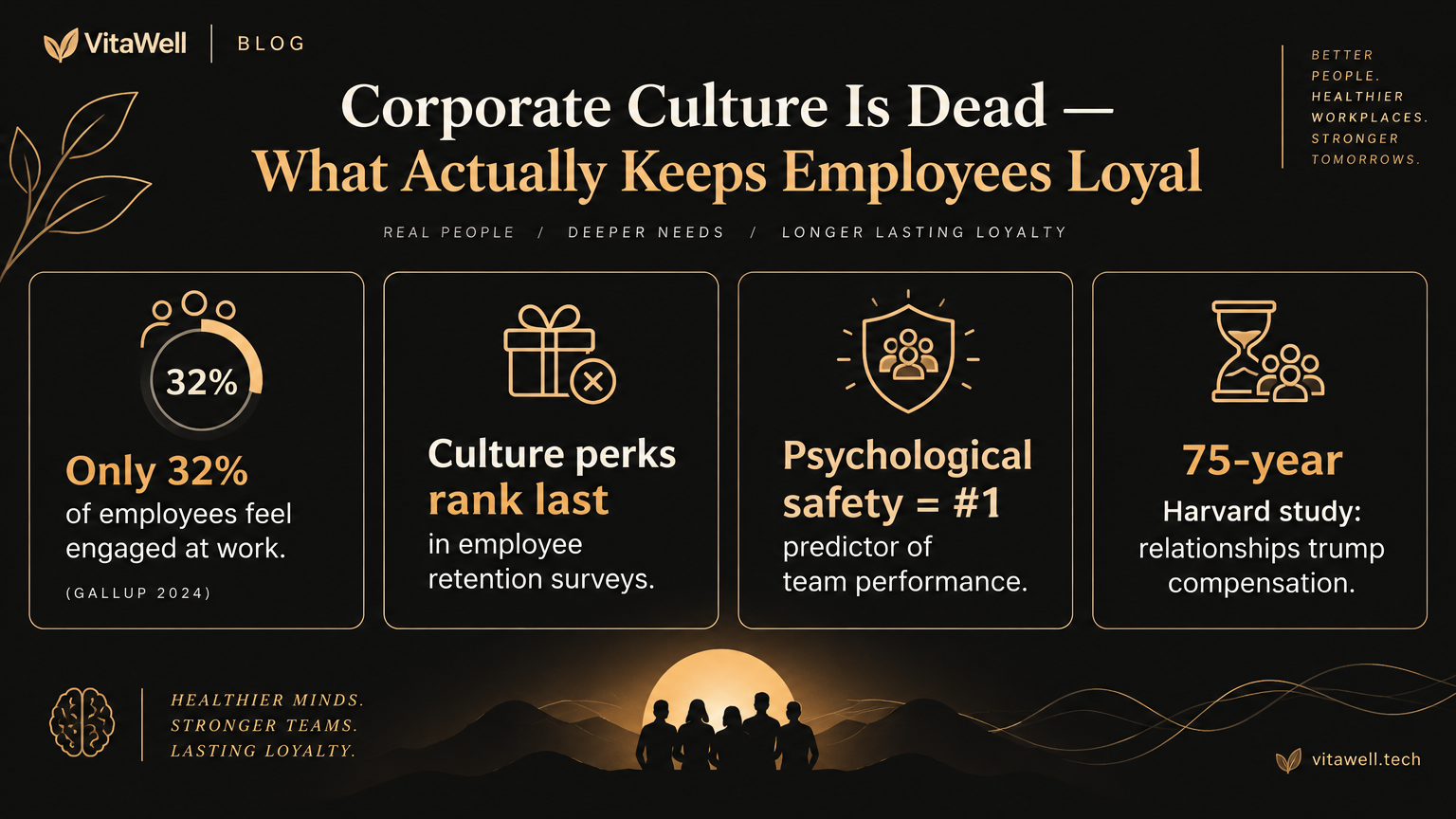
Most companies spend thousands of dollars on office redesigns, ping-pong tables, free lunches, and mission statements carefully crafted to inspire their teams. And yet, despite this investment, global employee engagement just hit a 10-year low. According to Gallup's 2025 State of the Global Workplace report, only 31% of employees in the United States are actively engaged at work — the lowest figure in a decade. Something isn't working. And the data suggests the culprit may be the very concept that companies have been counting on to fix it: corporate culture.
The term "corporate culture" dominated business thinking for 20 years. Leaders hired culture consultants, hosted company retreats, published elaborate values decks, and built entire HR functions around it. But interest in corporate culture — as measured by Google Trends — has fallen by roughly 90% since its peak in 2004. The search index, once at 100, now sits near 10. A concept that once defined a generation of management thinking has become, for many employees, background noise.
So what happened? And more importantly: what do employees actually need from their organizations to stay engaged, loyal, and motivated?
The Quiet Death of "Corporate Culture" — What the Data Shows
The decline of interest in corporate culture is not a sudden crash. It's a slow erosion — two decades of accumulated evidence that the concept, as typically implemented, doesn't deliver what it promises.
From Buzzword to Background Noise — Google Trends Evidence
When Tom Peters and Robert Waterman popularized the idea of organizational culture in their 1982 book In Search of Excellence, it launched a movement. Culture became the answer to almost every business problem: employee retention, productivity, innovation, and loyalty. By the early 2000s, companies were investing heavily in culture as a strategic differentiator.
But Google Trends data tells a different story about where that investment has led. "Corporate culture" as a search term peaked around 2004 at an index of 100 and has fallen steadily since, reaching roughly 10 by 2024. That's a 90% decline in public interest over 20 years. Business leaders, journalists, and employees alike have largely stopped searching for the concept — which may reflect a growing sense that it no longer holds the answers it once promised.
Gallup's Engagement Paradox — More Culture Spending, Less Engagement
The paradox of the current moment is striking: organizations are spending more on culture than ever before, yet engagement is falling. Gallup's 2025 report found that US employee engagement stands at just 31% — a 10-year low. Globally, the figure is even lower, at 21%. Some key data points:
- Only 31% of US workers are actively engaged (Gallup, 2025)
- Global engagement fell to 21% in 2024, down from 23% in 2023
- Organizations that rank highest on trust outperform the S&P 500 by a factor of nearly 3x
- Yet companies continue to increase culture budgets even as these numbers fall
The disconnect is real: culture programs are growing, but the outcomes they're supposed to produce — engagement, loyalty, and performance — are declining. This points to a structural problem, not a messaging problem.
Why Employees Stopped Trusting "Culture"
Culture doesn't fail because leaders don't care. It fails because employees have learned, through hard experience, that cultural messaging often doesn't match organizational behavior. When the rhetoric of "people are our greatest asset" meets the reality of mass layoffs, the gap becomes impossible to ignore.
The AI Disruption Effect on Workplace Trust
The rise of AI-driven automation has fundamentally altered the psychological contract between employers and employees. According to data from Challenger, Gray & Christmas, over 54,000 US jobs were eliminated due to AI in 2025 alone. For employees watching colleagues lose their jobs to algorithmic efficiency, corporate culture messaging sounds hollow.
The psychological impact is measurable. Research found that workers who were worried about AI-related job loss were nearly twice as likely as those without those fears to say that extra effort at work is pointless — 49% versus 27%. As one behavioral scientist put it: "They conserve effort because the psychological contract has weakened. The organization still asks for commitment, but employees no longer believe commitment will be reciprocated."
The Leadership Trust Gap — What Leaders Believe vs. What Employees Feel
A striking data point from PwC's US workforce survey captures the heart of the problem: 86% of executives say they highly trust their employees, but only 60% of employees say they feel that trust from their employers. That 26-point gap represents a massive disconnect — one that no ping-pong table or company retreat can bridge.
The Edelman Trust Barometer 2025 found that employer trust fell three points, with 75% of employees trusting their employer to "do what is right." Trust in direct managers has fallen even more sharply: from 46% in 2022 to just 29% in 2024, according to DDI's research. Meanwhile, fear of workplace discrimination surged 10 percentage points to a record high of 63%.
The Revenue-First Trap
A critical driver of culture's decline is the dominance of the revenue-first mindset, particularly in the era of AI efficiency. When executives face pressure from shareholders to demonstrate AI-driven productivity gains, the path of least resistance is to cut headcount and reallocate those resources to automation. The short-term balance sheet improves. The long-term psychological contract crumbles.
This creates what researchers describe as the "revenue-first trap": organizations spend money on culture communication while simultaneously making structural decisions that undermine it. Employees are not fooled. They watch what organizations do, not what they say — and increasingly, what organizations do is prioritize quarterly efficiency over long-term people investment.
What Comes First — Revenue or Employee Well-Being?
The framing of revenue versus employee well-being as opposing priorities is itself part of the problem. The most successful organizations in the data don't choose between people and profit — they build structures where people-first decisions produce better financial outcomes.
The False Binary That's Hurting Your Business
Most organizations operate as if investing in employees is a cost that must be justified by near-term financial returns. If culture spending doesn't immediately move the revenue needle, it gets cut. But this short-term framing misses the compounding effect of trust on business performance. Great Place to Work's research consistently finds that companies with high trust cultures dramatically outperform their industry peers on revenue growth, stock performance, and employee retention. The investment in people isn't charity — it's compounding interest on human capital.
From "Culture" to "Structure" — The Real Difference
The key insight emerging from the data is that culture — understood as values, messaging, and programs — is not enough on its own. What employees actually respond to is structure: the concrete, observable ways an organization organizes its decisions, resources, and commitments. An organization can have the best values statement in the industry and still destroy trust through consistent structural decisions that contradict those values. Conversely, an organization with simple, consistent structural commitments to its people can build extraordinary loyalty without spending a dollar on culture consulting.
The Gund Company Model — Zero Layoffs in 75 Years and What It Teaches Us
The Gund Company is the kind of case study that makes culture consultants uncomfortable. It doesn't win employee loyalty through perks or programs. It wins it through structure — and the results speak for themselves.
Who Is the Gund Company?
The Gund Company is a specialty manufacturer of high-performance engineered materials. Founded in 1951 by Ed Gund, it has operated as a third-generation family business for over 75 years. Today it employs more than 1,300 people and is partially employee-owned through an Employee Stock Ownership Plan (ESOP) that gives team members 30% ownership of the company. In 75 years of operations, the Gund Company has never laid off an employee.
What Makes the Gund Model Work
The Gund Company's approach isn't accidental. It's built on a set of structural commitments that create genuine alignment between the organization and its employees:
- Employee Ownership (ESOP): With 30% of the company owned by employees, team members have a direct financial stake in performance outcomes. This isn't just a motivational metaphor — it's a legal and financial reality.
- Deming Quality Philosophy: The company's management approach is rooted in the work of W. Edwards Deming, who argued that quality and efficiency come from system design, not individual pressure or fear.
- Toyota Production System: The operational framework prioritizes continuous improvement, waste reduction, and worker involvement in problem-solving — systems that give employees agency and responsibility.
- Long-Term Planning Horizon: Rather than optimizing for quarterly earnings, the Gund Company makes decisions with multi-year time horizons. Zero-layoffs is only possible if you plan for downturns rather than reacting to them.
- Structural Job Security: The zero-layoff commitment forces leaders to manage demand fluctuations through training, redeployment, and reduced hours — rather than cutting people.
Why This Model Produces Loyalty
When employees are owners, the psychological contract isn't aspirational — it's real. The ESOP means that when the company does well, employees directly benefit. The Gund Company reports consistent double-digit annual growth and a 9.0 out of 10 employee economic engagement score. These aren't culture-survey vanity metrics — they reflect a workforce that genuinely believes in the organization's structural commitment to their well-being.
Perceived Institutional Trust — The New Currency of Employee Loyalty
The concept emerging to replace corporate culture is what researchers and practitioners are calling "perceived institutional trust." It's not a slogan or a program. It's a judgment employees make about whether an organization's structures, decisions, and behaviors actually align with its stated commitments.
What Is Perceived Institutional Trust?
Perceived institutional trust is the degree to which employees believe that an organization's observable behaviors — how it makes decisions, how it treats people during hard times, how it allocates resources — genuinely reflect a commitment to their well-being. It's different from culture in one critical way: it's earned through consistent structural behavior, not communicated through messaging.
5 Signals Employees Use to Judge Institutional Trust
Employees may not use the language of "institutional trust," but they evaluate it constantly. The five primary signals they look for:
- Job security practices: Does the organization protect jobs during hard times, or does it cut people as the first response to financial pressure?
- Transparency in decision-making: Are employees informed about strategic decisions that affect them, or do they learn about layoffs from press releases?
- Fair compensation structures: Does the compensation philosophy reflect genuine investment in employee well-being, or does it maximize executive pay at workers' expense?
- Ownership and voice: Do employees have meaningful input into decisions that affect their work, or is "feedback culture" performative?
- Consistency between stated values and actual behavior: When the organization faces a real test of its values, does it hold? Or does it revert to pure financial optimization?
What Leaders Can Do Differently Starting Today
Rebuilding institutional trust is not about overhauling your culture program. It's about making structural commitments that employees can observe and evaluate over time. Here are five concrete starting points:
- Communicate transparently about AI strategy. Employees fear what they don't know. Leaders who proactively explain how AI is being implemented — including how it will affect roles — reduce uncertainty and build credibility.
- Make explicit job security commitments where possible. Even limited commitments signal genuine structural intent and reduce the anxiety that drives disengagement.
- Explore profit-sharing or ownership models. Even small ownership stakes change the psychological relationship between employees and the organization.
- Follow through consistently on stated values. Every time an organization's behavior contradicts its stated values, it makes a withdrawal from the trust account. Consistency over time is the only path to rebuilding.
- Hold managers accountable for trust metrics. Include employee trust and psychological safety in manager performance reviews. What gets measured gets managed.
Conclusion
Corporate culture as a concept hasn't disappeared — it has evolved into something harder to fake. The companies winning employee loyalty today aren't the ones with the most elaborate values decks or the most creative perks programs. They're the ones whose structures prove their words, year after year, decision after decision.
The Gund Company's 75-year track record of zero layoffs isn't magic, and it isn't luck. It's the result of treating people as the system — not a resource to be managed within it. When employees become owners, when quality philosophy replaces fear management, and when long-term planning replaces quarterly optimization, the result is an organization that employees genuinely trust.
The question for every leader isn't whether your company has a good culture. It's whether your company's structural decisions, over time, have earned the right to be believed.
Sources
Why Is Corporate Culture Declining in Importance? — Psychology Today