Being Single Is Not a Problem to Solve: What Science Says About Singlehood and Wellbeing
Singlehood is common and valid. What research on 4,835 singles, marriage and singlism shows about wellbeing — and why pressure and fear matter more than status.

Being single is not a problem to solve: research suggests that how people feel about their single status, and how much pressure they face, matters more for wellbeing than the status itself. In a 2025 study of 4,835 American singles, the least satisfied were those under high pressure, while relaxed singles, including many who were not dating at all, did well. Singlehood is also becoming more common, with 29% of US households now made up of one person.
Key Takeaways
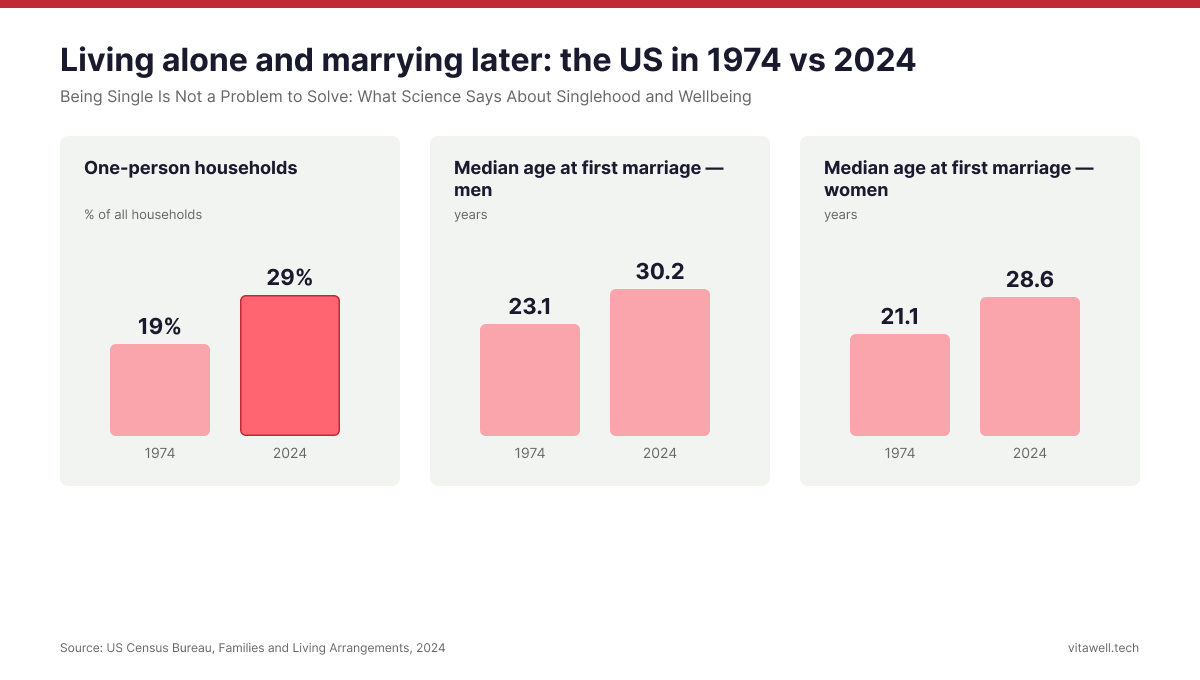
- One-person households rose from 19% of US households in 1974 to 29% in 2024, and the median age at first marriage is now about 30 for men and 29 for women.
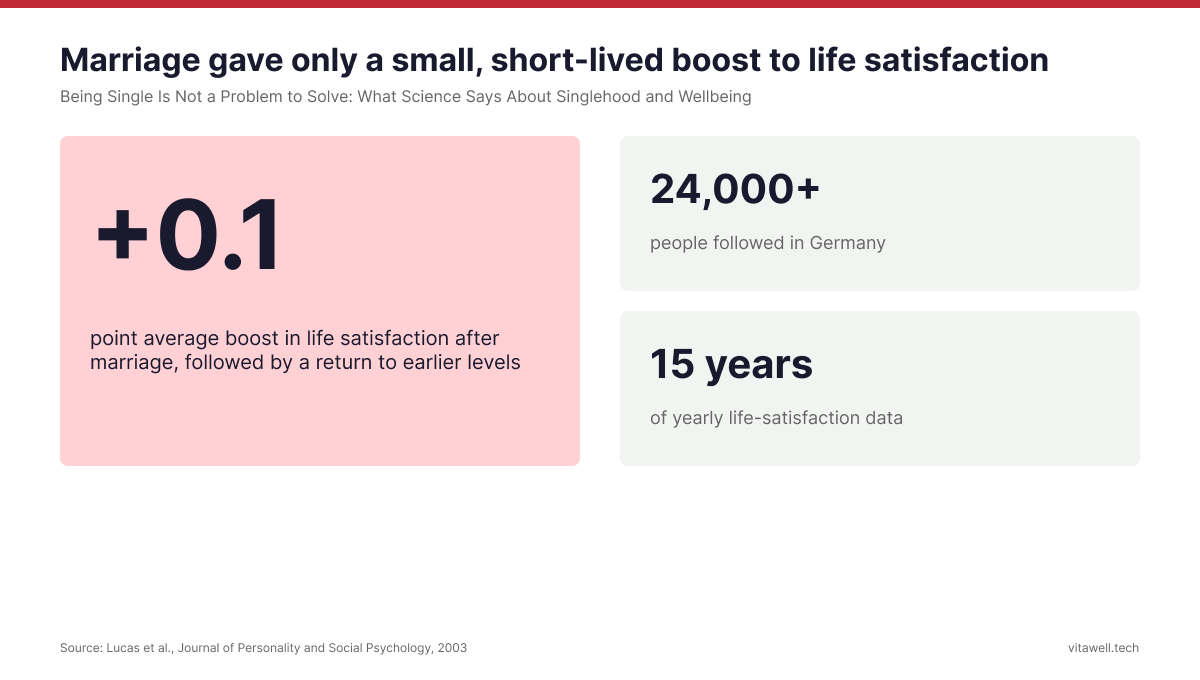
- In a 15-year study of more than 24,000 people, marriage gave only a small, short-lived boost to life satisfaction before people returned to their usual level.
- Among 4,835 US singles, life satisfaction tracked pressure and goals: low-pressure singles scored highest and high-pressure non-daters lowest.
- Fear of being single predicts settling for less in relationships, for men and women alike.
- People who have always been single tend to be more connected to parents, siblings, friends and neighbors than married people.
Singlehood by the Numbers
Single life is no longer a short gap between relationships for most adults. According to the US Census Bureau (2024), there were 38.5 million one-person households, 29% of all households, up from 19% in 1974. The median age at first marriage rose from 23.1 to 30.2 for men and from 21.1 to 28.6 for women over the same period, and 34% of adults aged 15 and over had never married.
The trend is not a straight line. Pew Research Center (2025) found that 42% of US adults were unpartnered, meaning neither married nor living with a partner, in 2023, slightly down from 44% in 2019. Among adults aged 25 to 39, the share was 42%.
Attitudes are shifting too, especially among the young. In a German panel study of 2,936 people, Tita Gonzalez Avilés and colleagues at the University of Mainz (Personality and Social Psychology Bulletin, 2024) found that single adolescents aged 14 to 20 were more satisfied with being single in 2018–2021 than the same age group ten years earlier. Satisfaction did not change among adults aged 24 to 40.
Does Marriage Make People Happier?
The popular belief is that partnership is the route to lasting happiness. The long-term data are more modest. Richard Lucas, Ed Diener and colleagues followed more than 24,000 people in Germany for 15 years, and their 2003 study in the Journal of Personality and Social Psychology found that marriage raised life satisfaction by only about one tenth of a point on average. Most people then returned to their earlier level.
The study also found that people who married and stayed married were already more satisfied before the wedding. That suggests some of the "married people are happier" gap reflects who marries, not only what marriage does. Individual experiences vary widely, so averages are a starting point, not a verdict on any one life.
Three Ways to Be Single: The Identity Framework
"Single" covers very different lives: a 25-year-old dating actively, a 45-year-old who never wanted a partner, a widowed 70-year-old. Sociologist Eran Kislev of the Hebrew University of Jerusalem (2023) proposes treating singlehood as a social identity, like other group identities, and describes three positions.
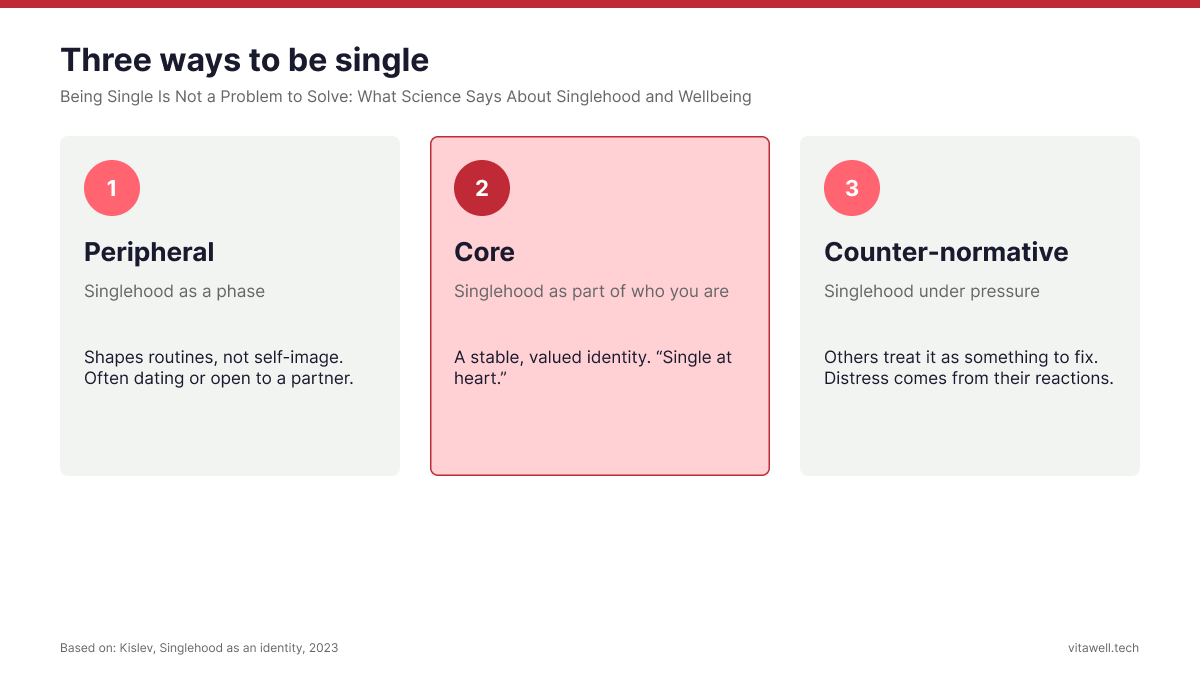
Peripheral: singlehood as a phase
Being single shapes daily routines but not how you see yourself. You may be dating or open to a partner, and the status feels temporary and fluid.
Core: singlehood as part of who you are
Being single is a stable, valued part of your identity. Psychologist Bella DePaulo calls people in this position "single at heart": solo life is a preference, not a waiting room.
Counter-normative: singlehood under pressure
Your singlehood is judged by others as abnormal or something to fix. Distress here comes less from being single and more from the reactions of family, friends or colleagues.
A quick self-check: Do you think of being single as temporary (peripheral), as yours (core), or as something you have to defend (counter-normative)? Kislev argues that these positions can help explain why research on singles' wellbeing has produced mixed results.
Who Does Singlehood Best? What 4,835 Singles Reveal
A large 2025 study offers the clearest picture yet. Calen Horton, Lisa Walsh and colleagues (Frontiers in Psychology, 2025) grouped 4,835 single American adults aged 18 to 65 by their relationship goals and the social pressure they felt. They found nine distinct profiles.
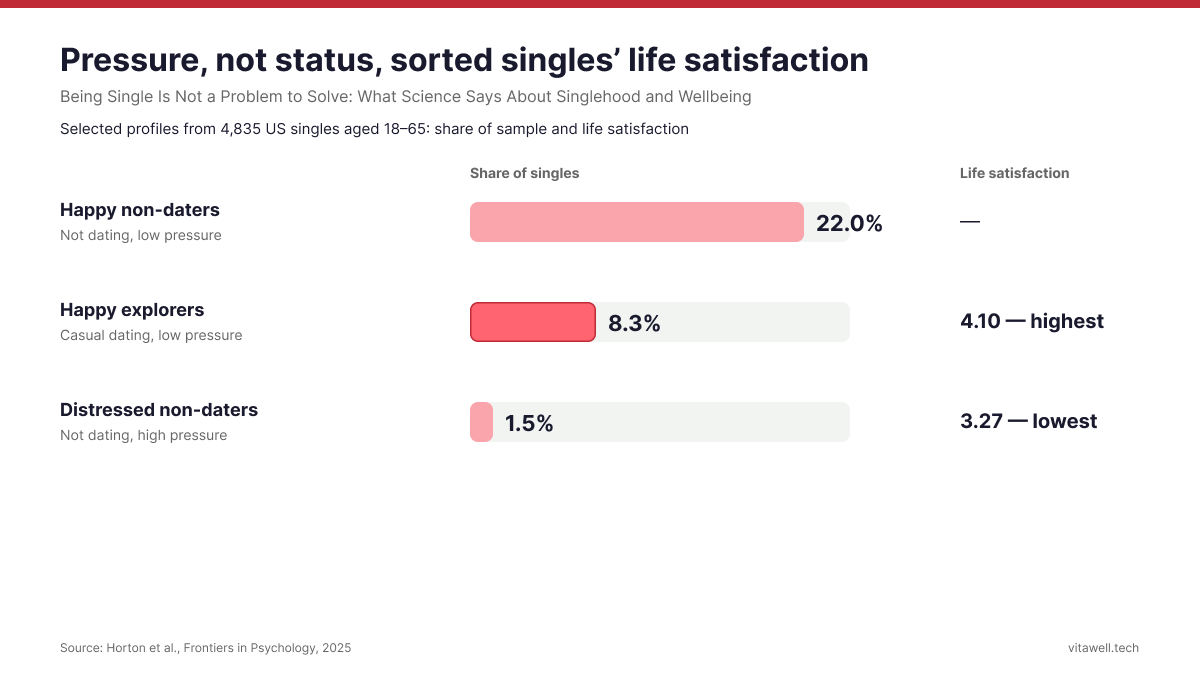
- Happy non-daters were the largest group, at 22.0%: not dating, low pressure, generally doing well.
- Happy explorers, low-pressure casual daters (8.3%), reported the highest life satisfaction (4.10 on the study's scale).
- Distressed non-daters, high-pressure singles who were not dating (1.5%), reported the lowest life satisfaction (3.27).
The pattern is the key insight: wellbeing tracked pressure and goals far more than whether someone was dating. The study is cross-sectional, so it shows associations at one point in time rather than cause and effect.
Fear of Being Single Is the Real Risk
If pressure hurts, fear of being single may hurt most. In a series of studies with North American adults, Stephanie Spielmann, Geoff MacDonald and colleagues at the University of Toronto (Journal of Personality and Social Psychology, 2013) found that people who feared being single were more willing to settle for less in relationships. They were more likely to stay in unsatisfying relationships and to pursue partners who were not good for them, and men and women reported similar levels of this fear.
Fear of being single often links to how secure people feel in close relationships in general. VitaWell's guide to attachment styles and what they mean for love explains that connection.
Singlism: The Bias Most People Don't Notice
Social psychologist Bella DePaulo coined the term singlism for the stereotyping, stigma and discrimination aimed at single people, and matrimania for the over-celebration of marriage and couples. Common examples include:
- Assuming single people are lonely, immature or self-centered.
- Expecting single colleagues to cover holidays, late shifts or last-minute work.
- Seating, pricing and invitations built around couples.
- Tax, housing and benefit rules that favor married households in many countries.
- Repeated questions about when you will "settle down."
The loneliness stereotype in particular does not hold up. In an analysis of two large US surveys summarized by DePaulo in Psychology Today, sociologists Natalia Sarkisian and Naomi Gerstel (2015) made 40 comparisons across 10 measures of connection. In all 40, people who had always been single were the most connected to parents, siblings, friends and neighbors. VitaWell's article on how friendship shapes health and identity shows why those ties matter.
Singlehood Myths vs. Evidence
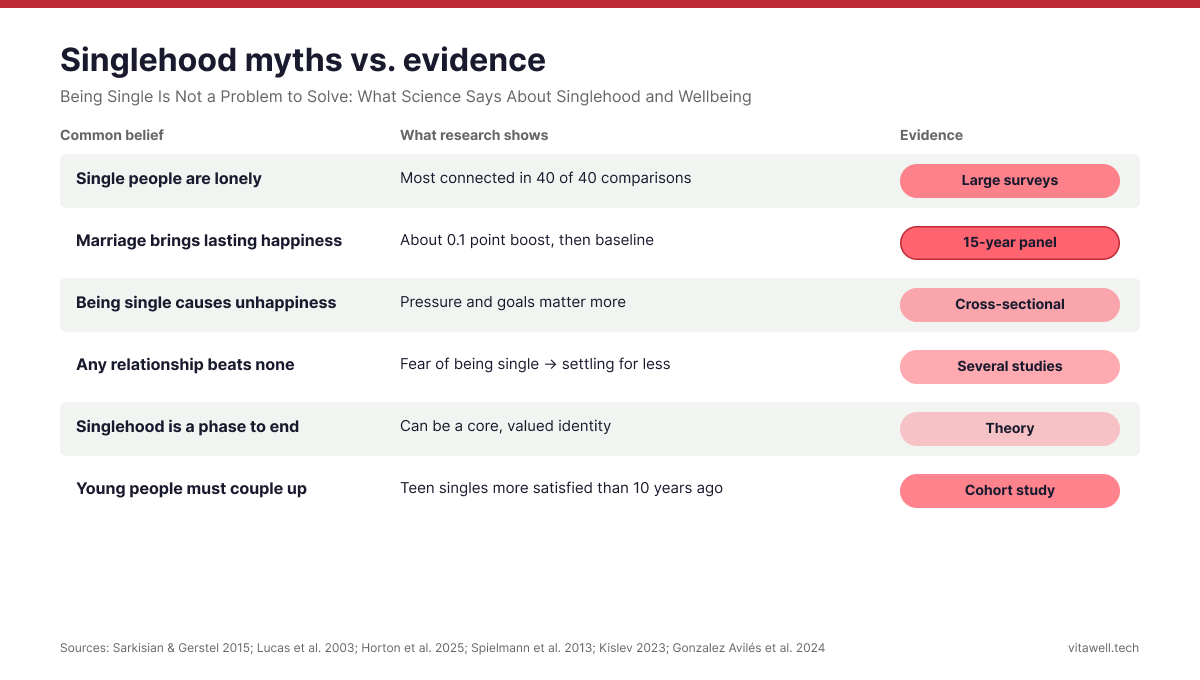
The table sets common beliefs about single people against what the research shows and how strong that evidence is.
| Common belief | What research shows | Key study | Evidence strength |
|---|---|---|---|
| Single people are lonely and isolated | Always-single people were the most connected in 40 of 40 comparisons | Sarkisian and Gerstel, 2015 | Large surveys, observational |
| Marriage makes people lastingly happier | About 0.1 point boost, then a return to baseline | Lucas et al., 2003 | 15-year panel, 24,000+ people |
| Being single is what makes singles unhappy | Pressure and goals sort wellbeing more than status | Horton et al., 2025 | Cross-sectional, 4,835 singles |
| Any relationship beats being alone | Fear of being single predicts settling for less | Spielmann et al., 2013 | Several survey and lab studies |
| Being single is a phase everyone wants to end | Singlehood can be a core, valued identity | Kislev, 2023 | Theoretical framework |
| Young people are desperate to couple up | Teen singles are more satisfied than a decade ago | Gonzalez Avilés et al., 2024 | Cohort study, 2,936 people |
A 30-Day Plan for a Full Single Life
Use one focus per week. Each step draws on the research above.
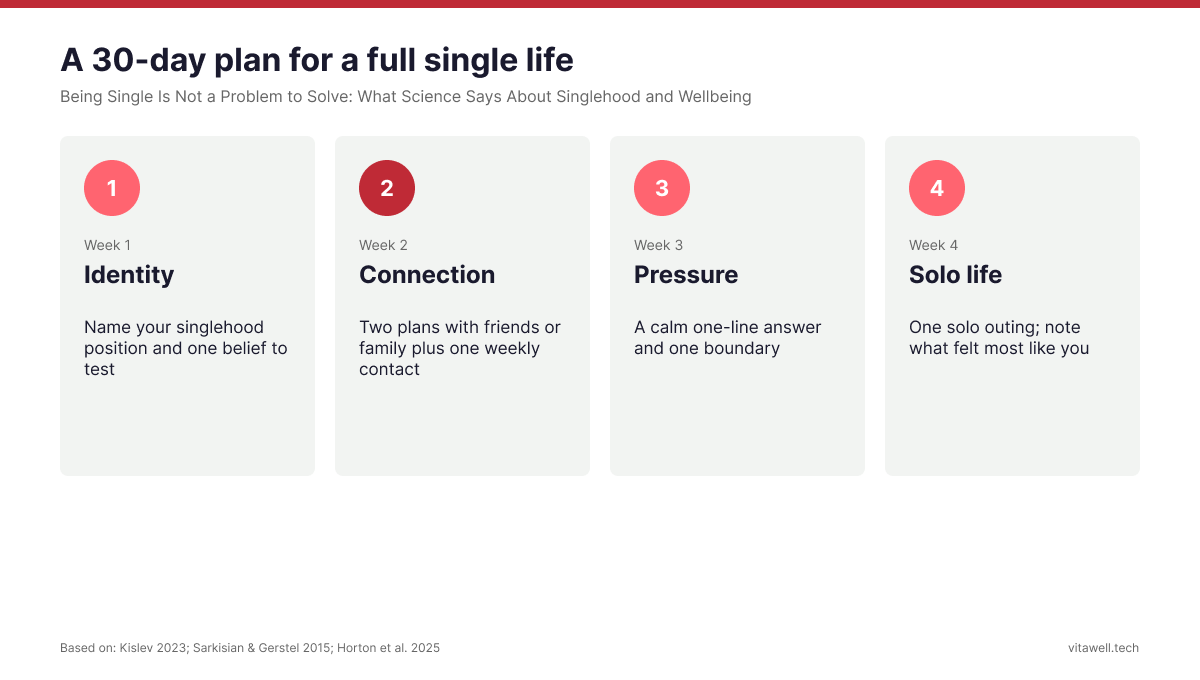
- Week 1 (identity): Write down whether your singlehood feels peripheral, core or counter-normative, and one belief about being single you want to test.
- Week 2 (connection): Schedule two plans with friends or family and one regular weekly contact. VitaWell's tips on staying close with friends as an adult can help.
- Week 3 (pressure): Prepare a calm, one-line answer for "Are you seeing anyone?" and set one boundary with a person who adds pressure.
- Week 4 (solo life): Plan one solo outing or trip you would enjoy. VitaWell's guide to enjoying your own company has ideas. End the month by noting what made you feel most like yourself.
When to Talk to a Professional
- Loneliness, low mood or anxiety has lasted more than two weeks and affects sleep, work or relationships.
- Fear of being single keeps you in relationships that feel unhealthy or unsafe.
- Family or social pressure about your relationship status is causing ongoing distress.
- You have thoughts of harming yourself; in that case contact local emergency services or a crisis line right away.
A therapist can help with attachment worries, self-worth and setting boundaries, with or without a partner in your plans.
Frequently Asked Questions
Is it normal to be single for a long time?
Yes. In 2023, 42% of US adults were neither married nor living with a partner, and 29% of US households were one person living alone in 2024. Long periods of singlehood are common at every age, and many people stay single by choice. Length of time single says little about wellbeing on its own.
Are single people happier than married people?
On average, married people report slightly higher life satisfaction, but the gap is small and partly reflects who marries. A 15-year study found marriage gave only a brief boost of about 0.1 point. Among singles, those under little pressure, including many not dating, report satisfaction comparable to people who are doing well in relationships.
What is singlism?
Singlism is a term coined by social psychologist Bella DePaulo for stereotypes, stigma and discrimination aimed at single people. Examples include assuming singles are lonely or immature, expecting them to cover extra work, and policies that favor couples. Because it is rarely named, many people practice it without noticing.
How do I stop fearing being single?
Start by noticing where the fear comes from: family pressure, social media, or your own beliefs. Strengthen friendships and routines that meet your needs for connection, and test one belief about being single each week. If the fear keeps you in unhealthy relationships, a therapist can help you work on attachment and self-worth.
Is it healthy to be single?
For many people, yes. Health and wellbeing depend strongly on social connection, purpose and low chronic stress, all of which single people can have. Research shows always-single people are often more connected to friends and family than married people. The main risks come from isolation or ongoing pressure, not the status itself.
Conclusion
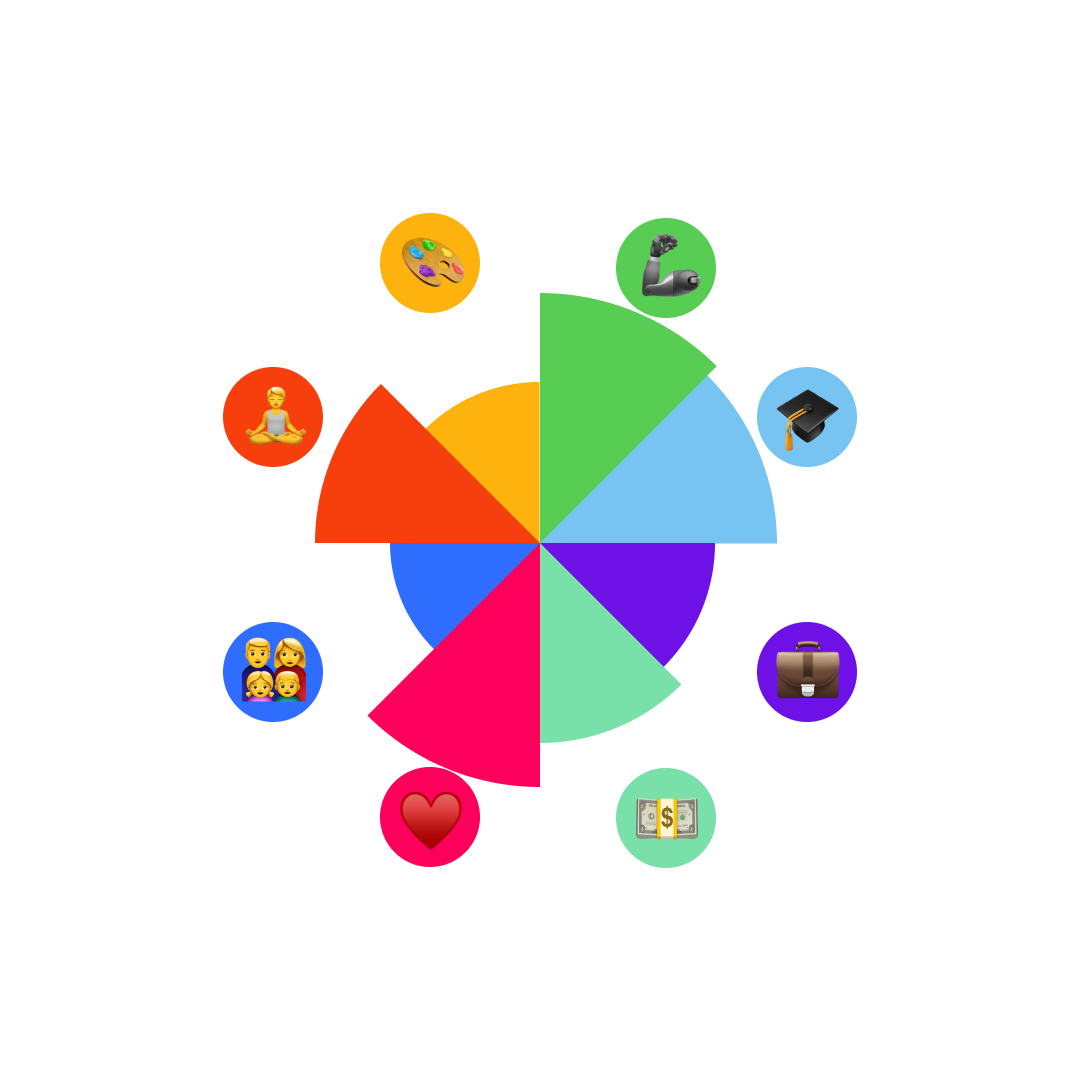
The research points in one direction: singlehood is a common, valid way to live, and the biggest threats to single people's wellbeing are pressure, fear and isolation rather than the absence of a partner. If you are single for a season or for life, invest in your connections, purpose and routines on your own terms. VitaWell's AI life planner can help you track those across your Relationships, Community and Growth areas.
Related on VitaWell
- Why You Can Feel Lonely Even in a Relationship — a reminder that partnership alone does not guarantee connection.
- What Is Soft Socializing? — low-pressure ways to build the social ties that help singles thrive.
- How to Connect with Your Core Values — a practical way to build a life around what matters to you, with or without a partner.
This article is for informational purposes only and is not a substitute for professional mental health advice.
Sources
- Psychology Today — Singlehood Is Becoming a Social Category, Not Just a Status
- US Census Bureau, 2024 — Families and living arrangements
- Pew Research Center, 2025 — Share of US adults living without a romantic partner
- Gonzalez Avilés et al., 2024 — Adolescents today are more satisfied with being single (University of Mainz)
- Lucas et al., 2003 — Are married people happier? (American Psychological Association)
- Kislev, 2023 — Singlehood as an identity (Hebrew University of Jerusalem)
- Horton et al., 2025 — Who does singlehood best? A latent profile analysis (Frontiers in Psychology)
- Spielmann et al., 2013 — Settling for less out of fear of being single (University of Toronto)
- DePaulo, 2015 — Summary of Sarkisian and Gerstel's study on singles' social ties