Your Cat Can Feel Your Stress — And You Feel Theirs: The Science of Human-Pet Oxytocin Synchrony
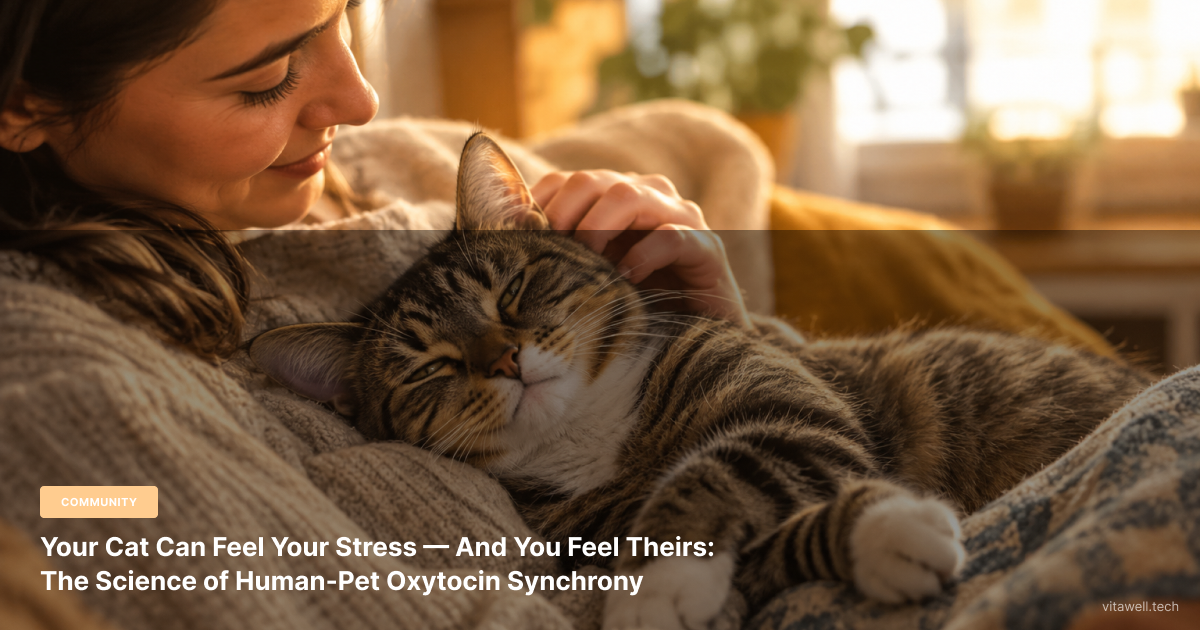
Most cat owners have a feeling their cat "gets them" — that their pet somehow senses when they're having a rough day, gravitating closer during stress or sitting quietly nearby when things feel hard. For years, science struggled to explain this. Cats, after all, have long been stereotyped as aloof, independent creatures who care little about human emotional states. A landmark study published in iScience in late 2026 turns that narrative on its head entirely — and in doing so, reveals something extraordinary about the bond between humans and their cats.
The Study That Changed What We Know About Cats
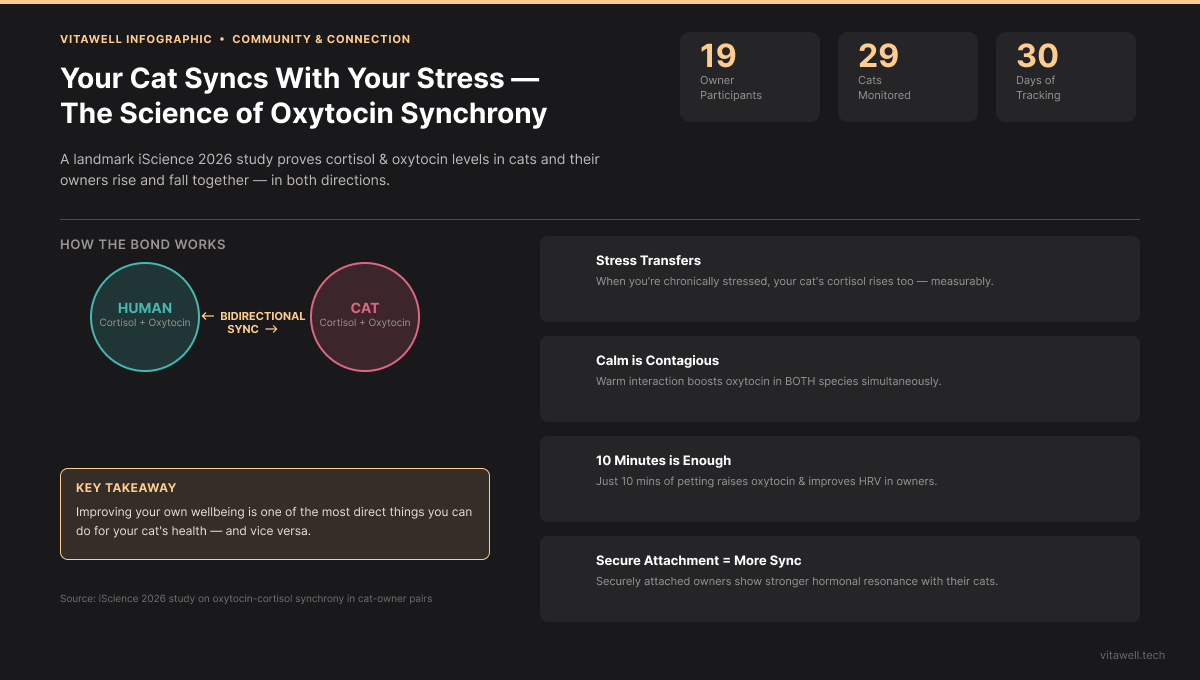
Researchers set out to investigate something that pet owners had long suspected but scientists had rarely studied: whether the hormonal states of cats and their owners actually mirror each other. To find out, they recruited 19 cat owners and 29 cats and monitored them for an entire month. The methodology was rigorous — both owners and cats provided regular urine samples, which were analyzed for two key hormones: oxytocin, often called the "bonding hormone," and cortisol, the body's primary stress marker. What they found was striking. The oxytocin and cortisol levels of cats and their owners correlated significantly — meaning they rose and fell together, in both species. This is not simply a case of cats reacting to owners. The relationship was bidirectional. When owners were stressed, their cats showed elevated cortisol. When owners relaxed and engaged in warm, playful interactions with their cats — what researchers call "affiliative behaviors" — both the owner and the cat showed increased oxytocin.
What They Measured and How
Oxytocin and cortisol were chosen because they represent opposite poles of the physiological stress-bond axis. Cortisol is released by the adrenal glands in response to stress, preparing the body for fight-or-flight. Oxytocin, produced in the hypothalamus, is released during positive social interactions — nursing, touch, eye contact, play — and promotes feelings of trust, calm, and connection. By tracking both hormones simultaneously in owner-cat pairs over 30 days, researchers captured how their emotional and physiological states intertwined over time, not just in a single snapshot lab setting.
What the Results Showed
The correlations were statistically significant across both hormones. Cats living with high-stress owners showed consistently elevated cortisol over the monitoring period. Cats in calmer, more bonded households showed elevated oxytocin during and after affiliative interactions. Crucially, this bidirectionality had previously been documented mainly in dogs — this study is the first to rigorously demonstrate it in cats, a species whose emotional inner life has long been underestimated.
Oxytocin — The Hormone Behind the Bond
To understand why this matters, it helps to understand what oxytocin actually does. In humans, oxytocin is released during skin-to-skin contact, breastfeeding, sexual intimacy, and positive social interactions. It reduces anxiety, lowers cortisol, promotes generosity, and strengthens the neural pathways associated with trust and attachment. It is, in many ways, the chemical language of love and belonging. Cats, like all mammals, also have an oxytocin system — and research now shows it responds to human interaction in ways that closely parallel the human experience.
How Petting Your Cat Triggers Oxytocin in Both of You
A 2023 study published in Animals (MDPI) brought owners and their cats into a controlled setting and measured what happened physiologically during interaction. After just 10 minutes of cat petting, owners showed significant increases in salivary oxytocin and significant decreases in cortisol. Their heart rate variability (HRV) — a key marker of parasympathetic nervous system activity and stress resilience — also improved measurably. This is not a placebo effect. A brief, warm interaction with your cat is not just emotionally pleasant — it is a verifiable biological reset that shifts your nervous system from stress-activation toward recovery and repair.
The Evolutionary Basis of Human-Cat Oxytocin Bonding
The fact that cats and humans share a hormonal bonding system is not an accident. Cats and humans have lived together for approximately 10,000 years — long enough for mutual selection pressures to have shaped the relationship at a deep level. Cats who were better at reading human emotional states, and responding in ways that humans found comforting, were more likely to thrive in human settlements. Humans who bonded more deeply with their cats derived tangible benefits — pest control, company, stress relief — and provided food and shelter in return. Over millennia, this mutual dependence may have literally wired both species to bond with each other at a hormonal level.
Your Stress Is Your Cat's Stress — And Vice Versa
The practical implication of the iScience findings is uncomfortable for many cat owners: your chronic stress may be making your cat chronically stressed. Elevated cortisol over weeks and months is not just unpleasant — in both humans and cats, it is associated with impaired immune function, digestive issues, cardiovascular strain, and behavioral changes. When you are going through a prolonged difficult period, your cat may be absorbing that at a hormonal level, day after day.
How Cats Read Human Emotional Cues
Cats are more perceptive of human emotional signals than most people realize. Research in animal cognition has found that cats respond differently to happy versus threatening or neutral human facial expressions. They orient toward stressed owners in different ways than relaxed owners — sometimes becoming clingier, sometimes more withdrawn, depending on the individual cat's temperament. Cats can distinguish between calm and tense vocal tones, and they are highly attuned to changes in a person's body language, movement patterns, and even subtle shifts in scent that accompany emotional states. The neuroscience of cat perception suggests these are not random behaviors but evolved skills for tracking human emotional states.
Signs Your Cat Is Absorbing Your Anxiety
If you are under sustained stress, watch for these signals in your cat:
- Increased hiding or withdrawal from spaces they normally inhabit
- Over-grooming — excessive licking that leads to fur thinning or skin irritation
- Changes in appetite, eating less or more than usual
- Unusual clinginess or following you from room to room
- Increased vocalization, more meowing or yowling than usual
- Litter box issues with no medical explanation
- Disrupted sleep patterns in a cat who normally sleeps soundly
These behaviors are worth taking seriously, both for your cat's sake and as a signal about your own stress levels.
Your Attachment Style Shapes the Bond
Not all cat-owner relationships produce equal amounts of oxytocin synchrony, and a 2025 study in Applied Animal Behaviour Science helps explain why. Researchers examined how human attachment style — the deep relational template formed in early childhood — modulated the oxytocin response to cat interaction. The results were clear: people with secure attachment styles showed stronger, more consistent oxytocin responses when interacting with their cats. Those with avoidant attachment styles showed measurably weaker hormonal synchrony, even when their self-reported affection for their cat was high.
What This Means for You Personally
Attachment theory describes how early bonding experiences with caregivers shape our capacity for intimacy throughout life. Securely attached individuals — those who had reliably responsive caregivers — tend to find it easier to trust, be physically close, and bond deeply. Avoidantly attached individuals often unconsciously distance themselves from emotional closeness, even when they want it. The discovery that this pattern extends to cat-human oxytocin bonds is both humbling and hopeful. If you have struggled to feel deeply connected to your pet despite genuinely caring for them, it may reflect these deeper relational patterns rather than a character flaw — and working gently toward more secure attachment can shift these patterns over time.
The Mental Health Benefits Beyond Oxytocin
The oxytocin-cortisol synchrony research sits within a much larger body of evidence on the mental health benefits of cat ownership. While the iScience 2026 study is groundbreaking in its scope and methodology, it builds on decades of research showing that cat-human interaction is genuinely therapeutic across multiple dimensions of wellbeing.
Cats as Unofficial Therapists
Research consistently links cat ownership to reduced anxiety, decreased loneliness, lower rates of depression, and improved cardiovascular health. A large-scale epidemiological study found that cat owners had a significantly lower risk of dying from cardiovascular events compared to non-pet owners. The HRV improvements documented in the MDPI 2023 study suggest a mechanism: regular parasympathetic nervous system activation through positive cat interaction builds cardiovascular resilience over time. Animal-assisted therapy (AAT) programs increasingly include cats, and studies on their use in care homes, hospices, and pediatric hospital wards document significant reductions in distress, agitation, and pain perception in participants.
The Bidirectionality Advantage
What makes the iScience finding particularly significant for mental health is the bidirectionality. Watching a nature documentary about animals is pleasant, but it does not create a true physiological feedback loop. Your cat's emotional response to you — the purring, the slow blink, the choosing to sit with you over any other spot in the house — is itself a signal that feeds back into your own oxytocin system. This reciprocity is what distinguishes genuine bonding from passive comfort, and it is what makes pet ownership distinctively therapeutic rather than merely pleasant.
How to Deepen the Oxytocin Connection With Your Cat
Understanding the science of human-cat oxytocin synchrony opens up practical possibilities for intentionally deepening the bond. Here are evidence-based practices that strengthen the relationship and maximize positive hormonal outcomes for both you and your cat:
- Practice slow blinking. Research found that slow blinking — mirroring the "cat smile" — is recognized and reciprocated by cats and helps establish trust and positive emotional exchange. Try it during calm moments together.
- Engage in structured daily play. Scheduled play sessions with wand toys or laser pointers give cats a sense of agency and achievement. The shared focus and positive arousal boost oxytocin in both of you.
- Pet in the right places. Cats prefer being touched at the head, cheeks, chin, and base of the tail — areas where scent glands are located. Touch the cat genuinely enjoys (not merely tolerates) is what drives oxytocin release.
- Use a calm, low voice. Cats respond to vocal tone more than words. Speaking gently, especially while making eye contact, activates the affiliative bonding response in both of you.
- Respect their autonomy. Allowing cats to choose when and how they interact predicts stronger bonding. Owners who do not force interaction report cats who seek them out more voluntarily — and voluntary interaction is where the deepest oxytocin exchange happens.
- Create a consistent routine. Predictable feeding times, play sessions, and human presence reduce ambient cortisol levels in cats, keeping their baseline stress lower — and yours more regulated in the process.
- Spend quiet, co-present time together. Simply being in the same space, calm and unstimulated — reading, working quietly, meditating — creates a low-intensity bonding field that sustains the oxytocin connection without requiring active interaction.
- Manage your own stress proactively. Given what we now know about cortisol synchrony, investing in your own stress management — sleep, exercise, mindfulness — is also a direct act of care for your cat's wellbeing.
When the Bond Becomes Therapeutic: Cats in Clinical Settings
The science of human-cat oxytocin synchrony is not just useful for pet owners at home. Clinical researchers are increasingly interested in formal animal-assisted interventions (AAI) using cats. Studies document beneficial effects in elderly care settings, where cat visits reduce agitation in dementia patients; in oncology wards, where patients report lower pain and anxiety during and after cat interactions; and in therapeutic settings for children with autism, where the non-verbal, non-judgmental presence of a cat creates a unique space for social and emotional development. Cat cafes, which have proliferated globally since originating in Japan, can be understood as a modern, informal extension of this therapeutic tradition — offering urban dwellers access to the oxytocin-boosting benefits of cat interaction without permanent pet ownership.
Conclusion
The iScience 2026 study settles something many cat owners have always felt intuitively: your cat is not indifferent to you. They feel your stress. They share your calm. They bond with you on a hormonal level that is now measurably, scientifically real. The oxytocin connection between you and your cat is not a projection or a comforting illusion — it is a biochemical fact, forged over 10,000 years of coevolution and expressed in the quiet moments when your cat chooses to be with you, purrs against your chest, or sits nearby when you are having a hard day. Understanding this changes everything about how we think about our cats — and perhaps, about ourselves. The next time your cat presses close while you are stressed, consider: they are not just being cute. They are responding to you, and their presence is working on your biology in real time. That is a remarkable thing to share with another species.
Sources
Psychology Today — Your Cat's Brain Chemistry Is Closely Linked to Yours