
Why Your Relationship Problems Won't Go Away — The Psychology of Secondary Gain in Couples

Have you ever wondered why the same argument keeps happening in your relationship, no matter how many times you seem to resolve it? Or why your partner's anxiety, depression, or chronic stress seems immune to all attempts at help? Psychoanalytic theory offers a counterintuitive but clinically powerful answer: sometimes problems persist not in spite of your efforts to fix them, but because the problem is doing a job that you don't yet know how to do any other way. The concept that explains this is called secondary gain — and understanding it might be the most important shift you make in how you think about your relationship.
Why Some Relationship Problems Refuse to Disappear
Most people assume that when a problem persists in a relationship, it means someone isn't trying hard enough, doesn't care enough, or is too set in their ways to change. Couples argue, make resolutions, and find themselves back in the same pattern weeks later. The frustration builds. So does the blame. But clinical experience tells a different story. Sometimes problems persist not because of insufficient effort but because the problem itself is serving a hidden function — one that neither partner may be fully aware of. Understanding this distinction changes everything about how you approach relationship difficulties.
What Is Secondary Gain? The Concept and Its Origins
The term secondary gain was first introduced by Sigmund Freud in his early work on neurotic symptoms. Freud observed that psychological symptoms — anxiety, conversion disorders, psychosomatic complaints — were remarkably resistant to treatment, even when patients consciously wanted to get better. His explanation was that the symptoms weren't simply random. They were serving two distinct kinds of functions, which he called primary gain and secondary gain.
Primary gain is internal. The symptom provides intrapsychic relief by keeping disturbing wishes, fears, or impulses out of conscious awareness. It reduces anxiety at the level of the individual's inner world. This process is almost entirely unconscious — the person doesn't choose to develop the symptom; it arises because some part of the psyche finds it useful.
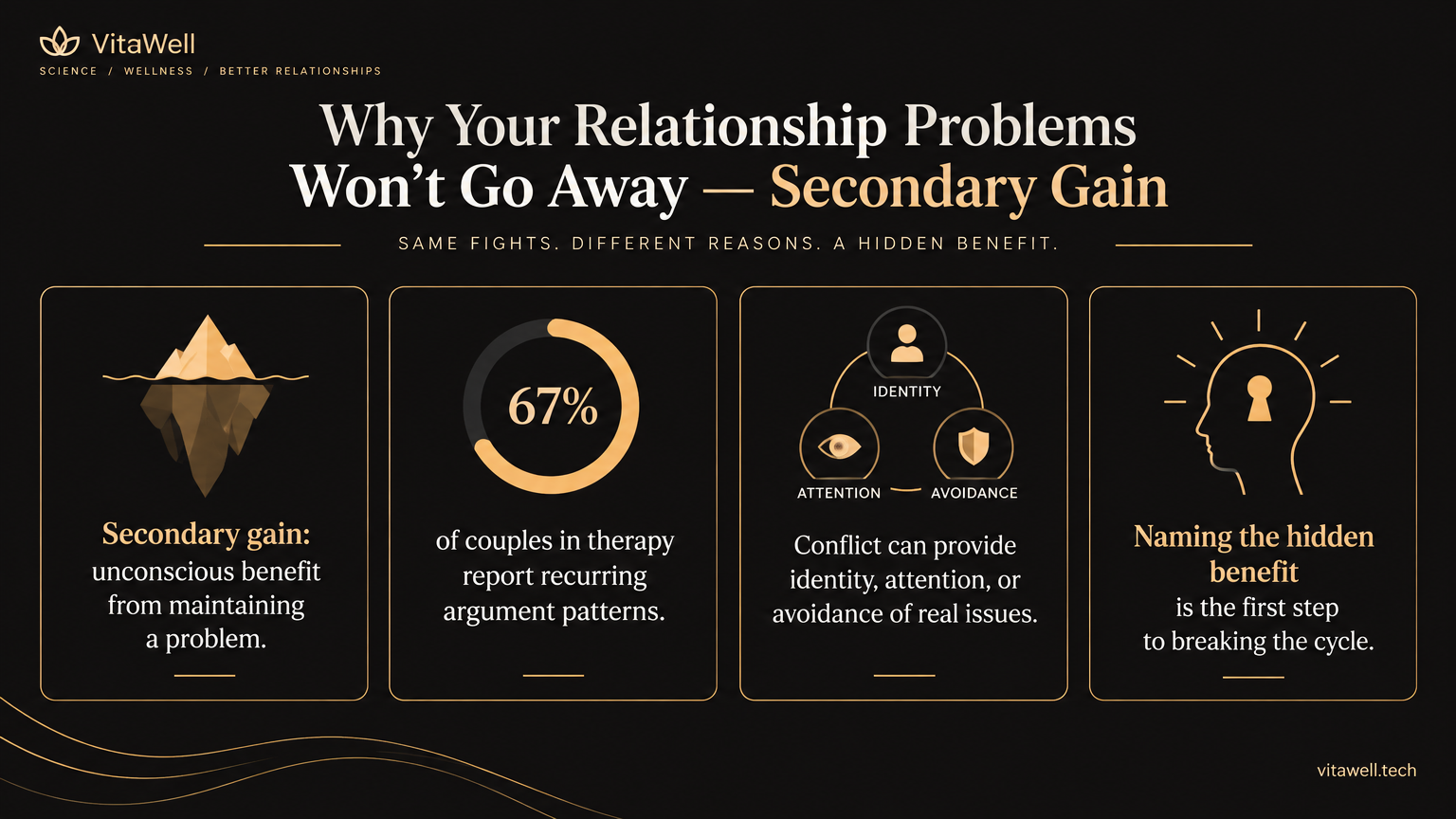
Secondary gain is interpersonal. It refers to the external benefits that accumulate because the symptom exists: getting more attention and care from others, being excused from obligations, receiving protection from performance expectations, being allowed to withdraw from situations that trigger shame or conflict. Secondary gain is not the cause of the symptom but follows it — and once established, it creates powerful incentives, often unconscious, to maintain the symptom rather than relinquish it.
Freud's Framework — Primary vs. Secondary Gain Explained
In Freud's model, symptoms are compromise formations. They simultaneously express a forbidden or distressing impulse and protect the person from the anxiety that impulse would generate if it became fully conscious. This dual function is what makes symptoms so stable: removing them would expose the individual to whatever they were designed to avoid. Primary gain is the result of this internal compromise — the anxiety reduction achieved by keeping disturbing material unconscious.
Secondary gain operates at a different level. It is the social and relational world reorganizing itself around the symptom. When someone develops chronic anxiety, their partner may begin handling tasks the anxious person finds overwhelming. When someone becomes depressed, their family may reduce expectations and offer extra support. These accommodations arise from genuine love and concern — but over time, they create a new equilibrium in which the symptom has become structurally integrated into how the relationship operates.
Is Secondary Gain Always Unconscious — or Can We Be Aware of It?
This is where the concept becomes nuanced. Freud viewed secondary gain as rooted in unconscious processes, and for most people, this remains true: the benefits associated with their difficulties are not things they are consciously pursuing or even clearly seeing. However, contemporary clinical literature acknowledges that secondary gain may sometimes become consciously recognizable. A person might notice, on some level, that being unwell excuses them from things they find frightening — even without deliberately engineering that outcome.
What secondary gain is not is malingering or deliberate deception. Research by Fishbain cautions clinicians against conflating the two. When secondary gain is mistakenly interpreted as manipulation or conscious exploitation, the therapeutic relationship breaks down and the person who is struggling loses access to the empathy and curiosity they need in order to change. A more accurate picture recognizes that people can be simultaneously suffering, experiencing genuine secondary benefits, and losing important things — all at the same time. Secondary losses (loss of social roles, income, autonomy, self-respect) frequently accompany secondary gains, making the overall picture complex and rarely one-sided.
How Psychological Symptoms Reshape Relationship Dynamics
Psychological symptoms rarely stay contained within the individual who experiences them. They radiate outward, reshaping the entire relational landscape. When one partner experiences depression, the other typically takes on more household responsibility, offers more emotional support, lowers expectations for shared activities, and adjusts the relationship's emotional climate to accommodate the struggling partner's state. These are not pathological responses — they are expressions of love and care. But over time, something important happens: the relationship's structure adapts to the symptom's presence.
Now change — which would mean the symptom reducing or disappearing — threatens to destabilize a structure that both partners have grown to rely on, even unconsciously. The partner who has been unwell may fear losing the care and accommodation they've come to depend on. The partner who has been caretaking may find their role and identity threatened if that role is no longer needed. Both people have adapted to the problem, and both people have, in different ways, learned to need it.
Secondary Gain in Intimate Partnerships — What Research Shows
The clinical literature documents a consistent range of secondary gains associated with illness and psychological distress in relationships:
- Increased dependency and care: receiving more attention, help, and emotional support from a partner
- Relief from performance expectations: being excused from contributions, responsibilities, or achievements that feel threatening or overwhelming
- Overprotection: a partner stepping in to manage situations that provoke anxiety or shame
- Legitimized withdrawal: being able to avoid demanding social situations, family obligations, or workplace pressures with a socially acceptable reason
- Avoidance of deeper conflict: having a surface-level problem that distracts from more threatening questions about the relationship itself
Partners often participate in these dynamics entirely unintentionally. Their caretaking behaviors arise from genuine concern, not calculation. But the effect, over time, is to reinforce the pattern rather than dissolve it.
When Chronic Conflict Becomes the Glue That Holds a Couple Together
One of the most counterintuitive insights from psychoanalytic work with couples is that chronic conflict can function as a form of connection. When a couple argues repeatedly about the same things — money, parenting, priorities, intimacy — the conflict feels disruptive and painful on the surface. But beneath the surface, it is providing something both partners may be unconsciously relying on: structure, predictability, emotional engagement, and a way of being close without having to confront more threatening questions.
What are those more threatening questions? They might be: Is this relationship right for me? Do I still want this? Would I even know who I am without this dynamic? Are we fundamentally incompatible in ways we haven't acknowledged? Chronic conflict keeps those questions at bay. It gives the couple something to focus on, something to fight about, something that keeps them engaged with each other without requiring either of them to sit with the deeper uncertainty. Family systems researchers describe this as the system 'colluding' to maintain the distress — not through conscious agreement, but through the accumulated habits and accommodations of two people adapting to a pattern that keeps the relationship stable, however painfully.
This is what therapist Diana Tutschek, M.S., describes as deceptive glue: disruptive on the surface, cohesive underneath. The conflict is not what's breaking the relationship. It may be what's holding it together.
The Costs That Coexist With the Gains — Why People Stay Stuck Despite Suffering
It is essential to be clear about one thing: secondary gain does not negate or minimize suffering. The person whose relationship problem is serving a hidden function is not pretending. They are not comfortable. They are not getting a good deal. They are suffering — sometimes profoundly — even as the problem simultaneously provides benefits they may not consciously recognize.
The costs are real and often substantial. People caught in secondary gain dynamics frequently experience significant secondary losses: a diminished sense of self-worth, loss of meaningful roles in work or community, reduced autonomy, damaged self-esteem, and relationship distance that grows even as the dynamic holds the relationship in place. The reason the economy of gains and losses is so hard to untangle is that both are genuinely present at the same time. Simplistic judgments — that the person is 'choosing' to stay stuck, or is 'getting something out of it' in a trivial sense — miss this complexity entirely.
What Secondary Gain Tells Us About What Partners Really Need
Behind every stuck pattern in a relationship is an unmet need. This is the core clinical insight that secondary gain makes visible. When conflict keeps recurring despite genuine attempts to resolve it, the conflict is pointing to something underneath: a need for care that isn't otherwise available, a need for safety that can't be directly asked for, a need for connection that can only be expressed through the friction of disagreement.
Reframing relationship problems through this lens transforms the experience from frustration to curiosity. The question is no longer 'Why won't this person change?' but 'What does this pattern make possible that isn't available any other way?' The distress is not the enemy — it is a signal pointing to needs that deserve to be met in a different, more direct, and less costly manner.
How Couples Therapy Uses Secondary Gain to Break the Cycle
Understanding secondary gain is not just a theoretical exercise. It is a practical clinical tool that changes how therapists work with stuck couples. The key therapeutic shift is in the question being asked. Instead of working to eliminate the symptom or the conflict, effective couples therapy first asks: What is this problem doing in this relationship? What function is it serving?
Explored with curiosity rather than accusation, this inquiry illuminates the hidden architecture beneath the surface conflict. It reveals the dependency patterns, unmet needs, and relational compromises that keep couples locked in place. Once those become visible, they become workable. Therapist Tutschek describes her approach this way: the goal is not to fix the symptom, but to help couples discover and meet their underlying needs — for care, safety, connection, or anything else — without requiring the relationship to remain 'sick' in order to access them.
Shifting the Frame — From 'Why Won't This Change?' to 'What Job Is This Problem Doing?'
This shift in framing can be practiced outside of therapy too. When you notice a recurring pattern in your relationship, instead of asking 'Why does this keep happening?' try asking 'What does this pattern make possible?' or 'What need does this conflict help meet — even imperfectly?' These questions are harder to answer, but they lead somewhere genuinely new. They bypass blame and defensiveness and go straight to the underlying architecture of what's actually happening between you and your partner.
The answers are often uncomfortable. They might reveal that you've been getting your need for closeness met through conflict because closeness feels too vulnerable when expressed directly. Or that staying unwell has been the only way you knew to get care and attention you couldn't ask for. Or that the problem fills a silence that both of you are afraid to sit in. None of these answers are causes for shame — they are causes for compassionate curiosity and the beginning of real change.
Practical Steps — Meeting Underlying Needs Without Keeping the Relationship 'Sick'
Whether you're working with a therapist or beginning to explore this on your own, here are practical steps for moving from stuck patterns toward genuine change:
- Name the pattern without blame. Observe what recurs in your relationship without assigning fault. 'We always get stuck here' is more useful than 'You always do this.'
- Ask what the pattern makes possible. What does the conflict or symptom allow to happen that might not happen otherwise? What does it protect either of you from facing?
- Identify the underlying need. What is each partner really seeking? Care? Safety? Attention? Permission to opt out of something overwhelming? Validation?
- Find new vehicles. How can those needs be met directly, in ways that don't require distress to unlock them? This is the most creative and often the most rewarding part of the process.
- Consider couples therapy. Secondary gain dynamics are deeply embedded and often invisible from inside the relationship. A skilled therapist can help surface them safely and guide the process of building new patterns.
Understanding secondary gain in your relationship is not about assigning blame or pathologizing normal human behavior. It is about developing a more honest, more compassionate, and ultimately more effective relationship with the problems that persist — and with each other. When you stop asking 'Why won't this change?' and start asking 'What job is this problem doing?' you open a door that has probably been closed for a long time.
Sources
Psychology Today: When Problems Paradoxically Hold a Couple Together