
Why the Most Intelligent People Change Their Mind Mid-Argument — The Science Behind 2 Habits That Look Like Weaknesses But Aren't

We have a fixed mental picture of what high intelligence looks like: crisp opinions delivered with confidence, decisive answers, and the ability to hold firm under pressure. The "smart person" in the room walks in already knowing the answer. But research increasingly tells a different story. The habits that most reliably signal genuine cognitive ability often look, on the surface, like weaknesses. Two in particular get highly intelligent people misread on a daily basis — and understanding them changes how we evaluate everyone around us, including ourselves.
The Mental Image of Intelligence We Have Got Wrong
For most of us, intelligence is associated with certainty. When someone changes their mind mid-conversation, we instinctively read it as indecisiveness. When someone over-explains a simple question, we feel patronized or overwhelmed. These reactions are understandable — but they are consistently backwards. What looks like intellectual weakness is often the visible expression of a mind operating at a higher level. Two specific habits illustrate this most clearly, and both are grounded in solid research.
Habit #1 — Changing Their Mind Mid-Argument
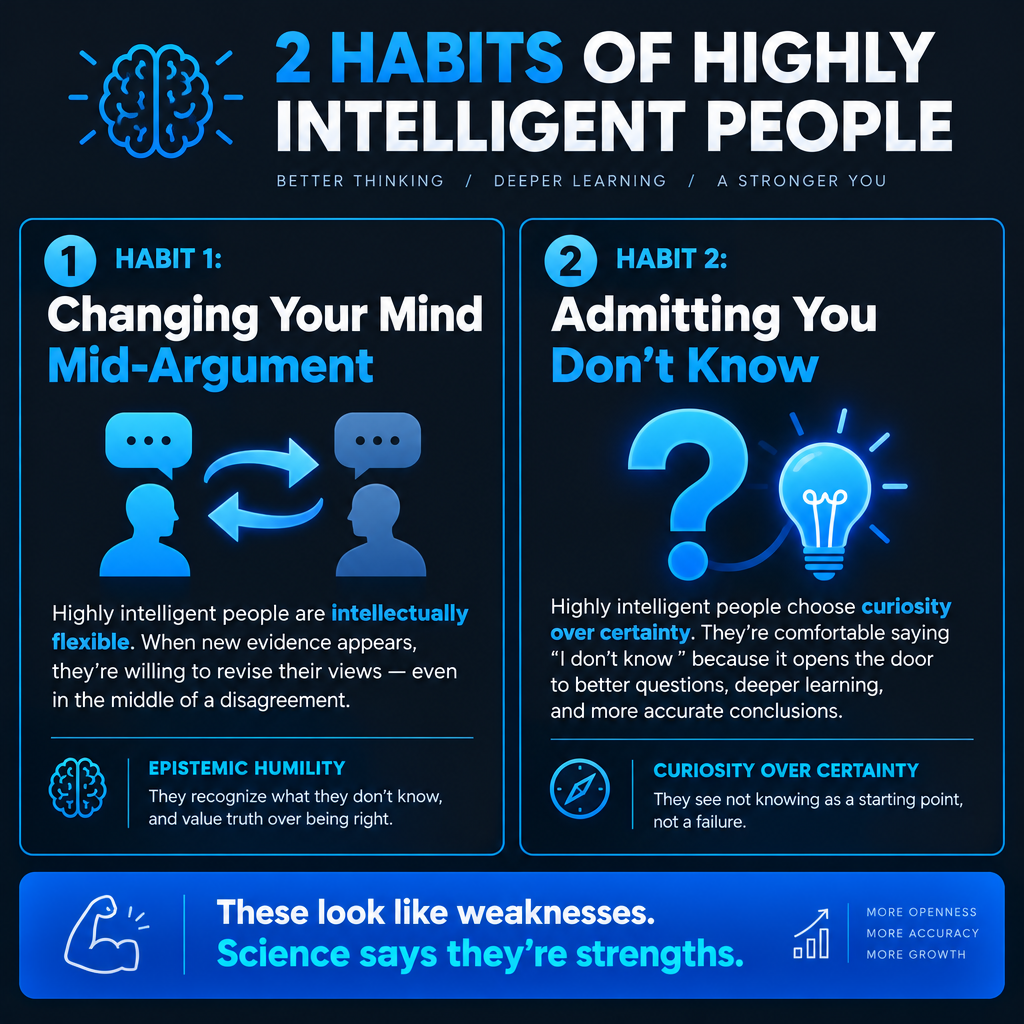
What Belief Updating Actually Is
When a highly intelligent person stops mid-sentence and says, “Actually, I think I was wrong about that,” the room often deflates. Colleagues read it as confusion. In arguments, it reads like surrender. In meetings, it can cost credibility. But what it actually represents is one of the most consistent behavioral markers of high cognitive ability: belief updating.
Belief updating is the willingness to revise a held position when confronted with new or better evidence — even when that confrontation happens in real time, in public, and at social cost. It is distinct from indecisiveness or fence-sitting. The person is not backing down because of social pressure. They are changing their position because the evidence warrants it. That distinction, small as it sounds, marks the difference between intellectual strength and intellectual weakness.
The 2024 Study: Fluid Intelligence and Attitude Revision
A 2024 study published in Cognitive Research: Principles and Implications by researchers at the University of Würzburg found consistent evidence that individuals with higher fluid intelligence changed their attitudes more readily in response to corrections, while those with lower reasoning ability showed a stronger tendency to persist with misinformation even after receiving a correction message.
Crucially, the researchers also found that need for cognition — a person’s motivation and enjoyment of effortful thinking — did not predict attitude change. This is a significant finding: it is not enough to be motivated to think deeply. The raw capacity to reason is what drives genuine intellectual flexibility. Wanting to engage with complexity is different from being able to update your beliefs based on it.
The Neuroscience of Changing Your Mind
Brain imaging research confirms that genuine belief change is not a passive or low-effort process. Studies have identified specific brain regions activated when people authentically revise their views: the inferior frontal junction, the anterior insula, the anterior cingulate cortex, and the dorsolateral prefrontal cortex. These are areas associated with cognitive control, emotional processing, and higher-order reasoning — not regions we associate with confusion or weakness.
Research on cognitive flexibility also shows that greater ability to change one’s mind is linked to better life outcomes, stronger social functioning, and reduced cognitive decline with age. The brain that changes its mind well is a healthy, high-functioning brain.
Belief Updating vs. Fence-Sitting — A Critical Distinction
The important nuance here is the difference between genuine belief updating and chronic fence-sitting. They can look similar from the outside, but they are mechanically opposite:
- Belief updating is responsive to evidence. It moves because something new and better has entered the picture. It is a sign of cognitive strength.
- Fence-sitting is responsive to social pressure. It moves — or refuses to move — based on who is watching and what is socially safer. It can signal cognitive avoidance.
In practice, the person who changes their view mid-argument and explains why is almost certainly doing the former. The person who nods along and never commits to a position under any circumstances is more likely doing the latter. The frustrating part is that in everyday settings, both get labeled the same way: unreliable.
Habit #2 — Giving Too Much Unnecessary Context
The Curse of Knowledge
The second habit is the tendency to over-explain — to begin a simple answer three layers before the point, to provide caveats, historical context, exceptions to exceptions, and background the listener never asked for. From the outside, it feels exhausting. From the inside, the person genuinely cannot see why the context is unnecessary.
This is not a social awareness failure. It is a well-documented cognitive phenomenon known as the Curse of Knowledge. The term was coined in a 1989 paper by economists Colin Camerer, George Loewenstein, and Martin Weber. The core finding: once we know something deeply, we lose access to the cognitive state of not knowing it. We cannot reliably simulate the experience of someone who lacks our background.
The classic demonstration comes from Elizabeth Newton’s 1990 doctoral research at Stanford. Participants were asked to “tap out” the rhythm of well-known songs. Tappers predicted that listeners would identify around 50% of songs. In reality, listeners identified only 2.5%. The tappers literally could not imagine what it felt like not to hear the melody they were already hearing in their heads.
How Expertise Builds Invisible Scaffolding
When a highly intelligent person has mastered a topic — over years of thinking, reading, and practising — they build elaborate mental scaffolding around it. Concepts that seem foundational to an outsider are, for them, so deeply internalized that they are invisible. When they try to explain something, they dismantle this scaffolding from the top down — starting with the architecture the listener does not yet have.
This is why the researcher answers “what do you work on?” with a 10-minute tour of their entire field. It is why the engineer responds to “how does this feature work?” by explaining the underlying system from first principles. The intention is almost always generosity: they want to give you the real answer, the full picture, the thing that actually makes sense of the question. The social effect, unfortunately, is frequently the opposite.
Why Over-Explaining Resists Awareness
One of the most troubling aspects of the Curse of Knowledge is how resistant it is to correction. Research has found that the bias persists even when people are explicitly warned about it and even when they are offered financial incentives to overcome it. It has been documented across medicine, law, education, business, and politics. It is, at its core, a tax on deep knowledge.
This does not mean over-explaining should be excused indefinitely. Over time, calibrating your communication to your audience is a genuine skill worth developing. But understanding the origin of the behavior matters enormously: when someone over-explains to the point of frustration, the more useful question is not “why can’t they read the room?” It is “how much do they actually know about this?” The answer, often, is more than they can easily compress.
The Social Cost of Being Highly Intelligent
Both of these habits create real friction in everyday life and professional settings. The person who updates their beliefs mid-conversation is read as indecisive. The person who over-explains is read as patronizing. Both perceptions are unfair, but they are also predictable. The cognitive behaviors that drive effective long-term thinking are often penalized in short-term social environments that reward certainty, brevity, and sticking to your position.
This creates a quiet disadvantage for highly intelligent people in contexts that value surface-level confidence over actual rigor. They may be passed over for leadership roles because they “couldn’t make up their mind” or “overcomplicate things.” The irony is that both complaints are, in many cases, evidence of the very qualities that make them valuable thinkers.
What This Means for How We Work Together
If You Recognize These Habits in Yourself
If you are someone who frequently updates beliefs in real time or struggles to give concise explanations without layers of context, consider these approaches:
- When you change your position mid-conversation, name it explicitly: “I want to revise what I said earlier because...” This signals intellectual integrity, not confusion.
- Practice bottom-line-first communication: lead with the conclusion, then offer the supporting context only if asked. This preserves the depth of your thinking without burdening your listener.
- When explaining complex topics, ask your audience what they already know before calibrating how much background to give.
If You Work With Someone Who Does This
If a colleague or team member shows these patterns, consider reframing how you interpret them:
- When someone changes their view mid-discussion, ask what changed for them rather than marking it as indecision. You may be watching intellectual rigor in real time.
- When someone over-explains, it is often an invitation to redirect with a specific question: “Can you give me the one-sentence version?” This is far more productive than silent frustration.
- Recognize that depth of expertise and clarity of communication are different skills, and try not to penalize the former for deficits in the latter.
How to Develop These Cognitive Strengths Yourself
The good news is that intellectual flexibility and the ability to calibrate knowledge are learnable. Research on cognitive flexibility and the Curse of Knowledge offers several practical approaches:
- Cultivate tolerance for ambiguity: practice holding open questions without immediately reaching for resolution. Start small — when you catch yourself wanting a definitive answer, pause and sit with the uncertainty for a moment.
- Practice arguing the other side: this is one of the most reliable ways to update beliefs. When you can articulate the strongest version of a position you disagree with, you’re much more likely to revise your own view when evidence warrants it.
- Use the “explain to a child” technique: the inability to explain something simply is a signal that you haven’t fully internalized it — or that you’ve become so expert that you can no longer locate the entry point. Regular practice at simple explanation reveals exactly where your scaffolding begins.
- Actively seek corrective feedback: create environments where being wrong is safe. People who receive regular, honest feedback are better at revising their beliefs because the social cost of doing so has been reduced.
Conclusion
The habits that make highly intelligent people appear indecisive or unnecessarily complex are, in most cases, the visible expression of cognitive strengths: the ability to genuinely update beliefs based on evidence, and the depth of knowledge that makes simple answers feel dishonest. These are not flaws to be corrected. They are markers of rigorous, honest thinking.
The next time someone changes their mind mid-argument or gives you more context than you asked for, consider the possibility that you are not watching a person fail at communication. You may be watching a person who takes the truth seriously enough to keep revising their understanding of it.
Sources
2 Frustrating Habits of the Most Intelligent People — Psychology Today