
Why a Successful Surgery Can Still Feel Traumatic — And What to Do About It

The surgery was a success. The doctor said so. Your charts look good, the stitches are healing, and everyone around you is relieved. So why do you feel worse than you expected — not in your body, but somewhere deeper? If you have had surgery and found yourself struggling emotionally in the weeks or months that followed — anxious, numb, disconnected, or quietly falling apart — you are not alone, and you are not imagining it. What you may be experiencing is postoperative traumatic stress, a real and surprisingly common phenomenon that medical culture rarely prepares patients for.
When a Successful Outcome Doesn’t Mean Full Recovery
Modern medicine excels at fixing bodies. Surgeons repair hearts, remove tumors, replace joints, and restore function with extraordinary precision. What medicine is less equipped to address is what happens inside the nervous system during and after that process.
The assumption embedded in surgical care is often this: fix the physical problem, and the person will be fine. But psychological recovery and physical recovery are not the same thing. They do not move on the same timeline, and they are not measured by the same instruments.
Research supports this. According to a 2019 study by El-Gabalawy and colleagues, approximately 20 percent of patients develop clinically significant traumatic stress symptoms following surgery. That is one in five people. Yet routine post-surgical follow-up rarely includes any assessment of psychological wellbeing beyond basic questions about pain and mobility.
This gap matters — not just clinically, but personally. When your body heals but you still feel wrong, the absence of an explanation can make things worse. You may start to wonder if something is uniquely broken about you. It is not. Your nervous system is doing exactly what nervous systems do: responding to an overwhelming experience.
How Surgery Registers as Trauma in the Nervous System
To understand why surgery can be traumatic, it helps to understand what trauma actually is. Trauma is not simply a terrible event. Trauma is what happens in the nervous system when an experience exceeds its capacity to process and integrate what is happening.
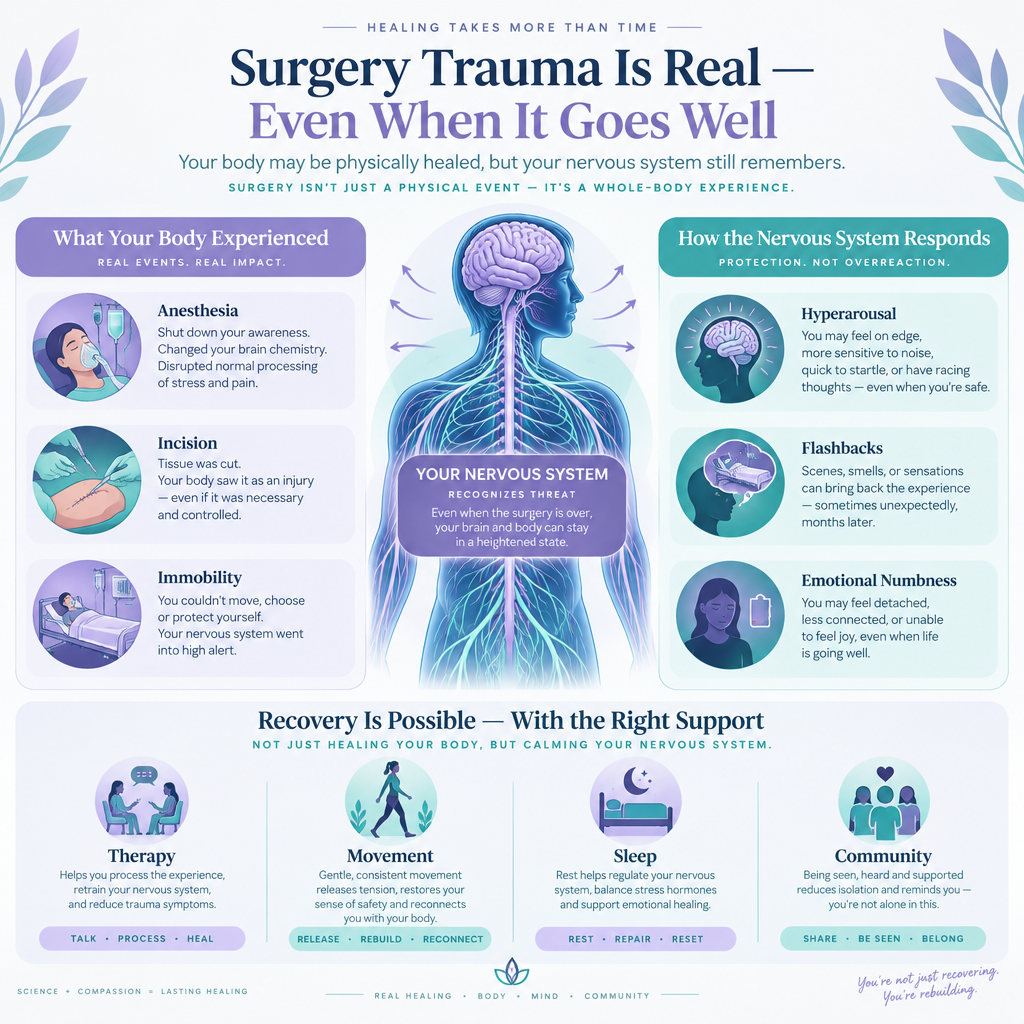
Immobilization, Anesthesia, and Loss of Control
Consider what surgery involves from the perspective of your body’s threat-detection system. You are placed on a table. You cannot move. Strangers wearing masks are working on you with sharp instruments. You are rendered unconscious, unable to respond, unable to flee, unable to protect yourself.
Your prefrontal cortex — the reasoning, rational part of your brain — knows this is necessary and good. But your amygdala and brainstem, which govern survival responses, do not speak the language of medical reasoning. They detect: immobilized body, loss of consciousness, physical intrusion, pain signals. The response that often follows is the same as it would be to any threatening experience: a flood of stress hormones, heightened nervous system activation, and a survival state that can persist long after the procedure ends.
Medical Trauma vs. External Trauma: What Makes It Different
Medical trauma has a particularly confounding quality that distinguishes it from other forms of trauma. With external trauma — an accident, an assault, a natural disaster — the threat comes from outside. With medical trauma, the threat, however well-intentioned, comes from something that is supposed to help you. In many cases, it comes from your own body — a diagnosis, a failing organ, a complication.
This creates a profound sense of betrayal that is difficult to articulate. Your body was not safe. The place you live could not protect you. That is a different kind of terror than being threatened by something outside, and it can be harder to process because there is no clear external enemy to eventually feel safe from.
The Role of Pre-Surgical Emotional State
One aspect of surgical trauma that deserves far more attention is the impact of what you bring into the operating room. Research and clinical experience consistently show that the emotional and nervous system state you are in when you go under anesthesia significantly shapes what you experience in recovery.
Anesthesia suppresses consciousness — but it does not reset the nervous system. If you entered surgery terrified, overwhelmed, or already carrying unresolved stress, that state does not simply disappear once the anesthetic takes effect. In some cases, it gets locked in. This is one reason why psychological preparation before surgery is not a luxury. Practices that help calm the nervous system before a procedure may substantively reduce your risk of post-surgical trauma.
What Post-Surgical Trauma Actually Looks Like
When most people hear PTSD, they picture dramatic flashbacks or nightmares. Post-surgical trauma can look like that — but more often, it looks quieter and harder to name.
Beyond Flashbacks: The Quiet Symptoms
Post-surgical trauma symptoms frequently include:
- Emotional numbness — feeling flat, muted, or disconnected from life
- Difficulty feeling close to people you love
- Not reacting emotionally to things that used to matter
- Fatigue that persists well beyond what the surgery itself would explain
- Anxiety in medical settings, triggered by smells, sounds, or clinical environments
- Heightened startle response
- Avoidance of follow-up appointments or physical reminders of the surgery
- A vague but persistent sense that something is wrong
Why Emotional Numbness Is Often More Alarming Than Anxiety
Of all the post-surgical trauma symptoms, emotional numbness is the one that tends to confuse and frighten people most. The nervous system, when faced with an experience it cannot fight or flee from, has a third option: shut down. This freeze or dissociative response is adaptive in the moment — it dampens sensation when sensation would be overwhelming. But when it persists, it creates a strange kind of suffering: not too much feeling, but too little.
People describe this as watching life from behind glass. Unlike anxiety, which tends to push people toward help-seeking, numbness tends to push people inward — toward silence, isolation, and a quiet belief that this is just who they are now.
When These Symptoms Go Unrecognized
Post-surgical PTSD often goes unrecognized because medical follow-up focuses on wound healing, lab values, and mobility. Patients often feel they should be grateful, and the vocabulary to describe the inner experience of medical trauma is simply not widely available. The result is that people suffer in silence, sometimes for years, without connecting their symptoms to their surgical experience.
Three Things to Know If You’re Struggling After Surgery
1. Expect Both Physical and Emotional Recovery
The first and perhaps most important reframe is this: physical healing and emotional healing are separate processes. Setting this expectation reduces the self-blame that arises when the body heals but the mind does not follow. It gives your nervous system permission to be on its own timeline and opens the door to actively supporting emotional recovery rather than waiting for it to happen automatically.
2. Resist Interpreting Every Physical Sensation as a Sign of Danger
Post-traumatic hypervigilance causes the nervous system to treat every internal sensation as potentially threatening — a twinge near the surgical site, unusual fatigue, or an elevated heartbeat. The practice of noticing sensation without immediately interpreting it is a skill. It means learning to pause between the sensation and the story the mind tells about it. “There is a sensation in my chest” is different from “something must be wrong.”
3. Talk About Your Experience, Not Just Your Outcome
In post-surgical conversation, the focus almost universally falls on outcome: how did the surgery go, are you feeling better, will you be back to normal? What gets crowded out is the emotional story — the fear before going under, the pain of waking up, the grief of a body that has been altered, the weeks of helplessness. Narrating that inner experience is one of the primary ways the nervous system integrates and moves through overwhelming events.
Approaches That Help: From Talk to Body-Based Therapy
Not all effective approaches to post-surgical trauma require verbal recounting of the experience. Several evidence-supported approaches are worth knowing about:
- Somatic Experiencing (SE): A body-based trauma therapy that works directly with the nervous system. Focuses on completing interrupted survival responses — the incomplete fight, flight, or freeze still cycling through the body after surgery.
- Trauma-Focused Cognitive Behavioral Therapy (TF-CBT): Helps identify and reframe trauma-related thought patterns. Particularly effective when rumination and catastrophic thinking are prominent.
- EMDR: Increasingly used for medical trauma; helps reprocess distressing memories so they lose their emotional charge.
- Nervous system regulation techniques: Breathwork, grounding practices, and polyvagal-informed self-regulation tools can support the nervous system’s return to baseline between therapy sessions.
Institutions like UCLA Health now run dedicated post-discharge PTSD screening programs for surgical patients, and the National Institute of Mental Health explicitly acknowledges that PTSD can follow medical events. This institutional recognition shifts the narrative from “something is wrong with you” to “something happened to you.”
When to Seek Help — and What to Say
If your emotional symptoms after surgery have lasted more than a few weeks, are intensifying rather than fading, or are interfering with your relationships, work, or daily life, it is time to seek support. When you do, framing matters. You might say: “I had surgery a few months ago, and I haven’t felt like myself since. I’ve been emotionally flat, anxious, and disconnected — and I think it may be related to the surgery.” That is enough. Post-surgical trauma is a physiological injury, not a failure of character, gratitude, or resilience.
Conclusion
A successful surgery is not the end of the story. It is the beginning of a process that has both a physical and an emotional dimension. When those two dimensions fall out of sync — when the body heals faster than the mind — that is not failure. That is the reality of how nervous systems work.
If you are in that space right now: your experience is real, it is recognized, and there is a path through it. Emotional recovery from surgery is possible. You deserve care for the whole experience — not just the part that shows up on a scan.
Sources
Why a Successful Surgery Can Still Feel Traumatic — Psychology Today