
When "Too Much" Becomes Your Story: The Science of ADHD, Shame, and How to Rewrite Your Self-Narrative

If you were recently diagnosed with ADHD as an adult, you may have felt an initial wave of relief. The puzzle pieces finally connected. But alongside that clarity, something else often arrives: grief. And then, for many people, a slow recognition of just how deeply a particular story has been carved into their identity. The story that they are somehow "too much."
Why an ADHD Diagnosis Doesn’t Automatically Heal the Shame
The Gap Between Knowing and Feeling
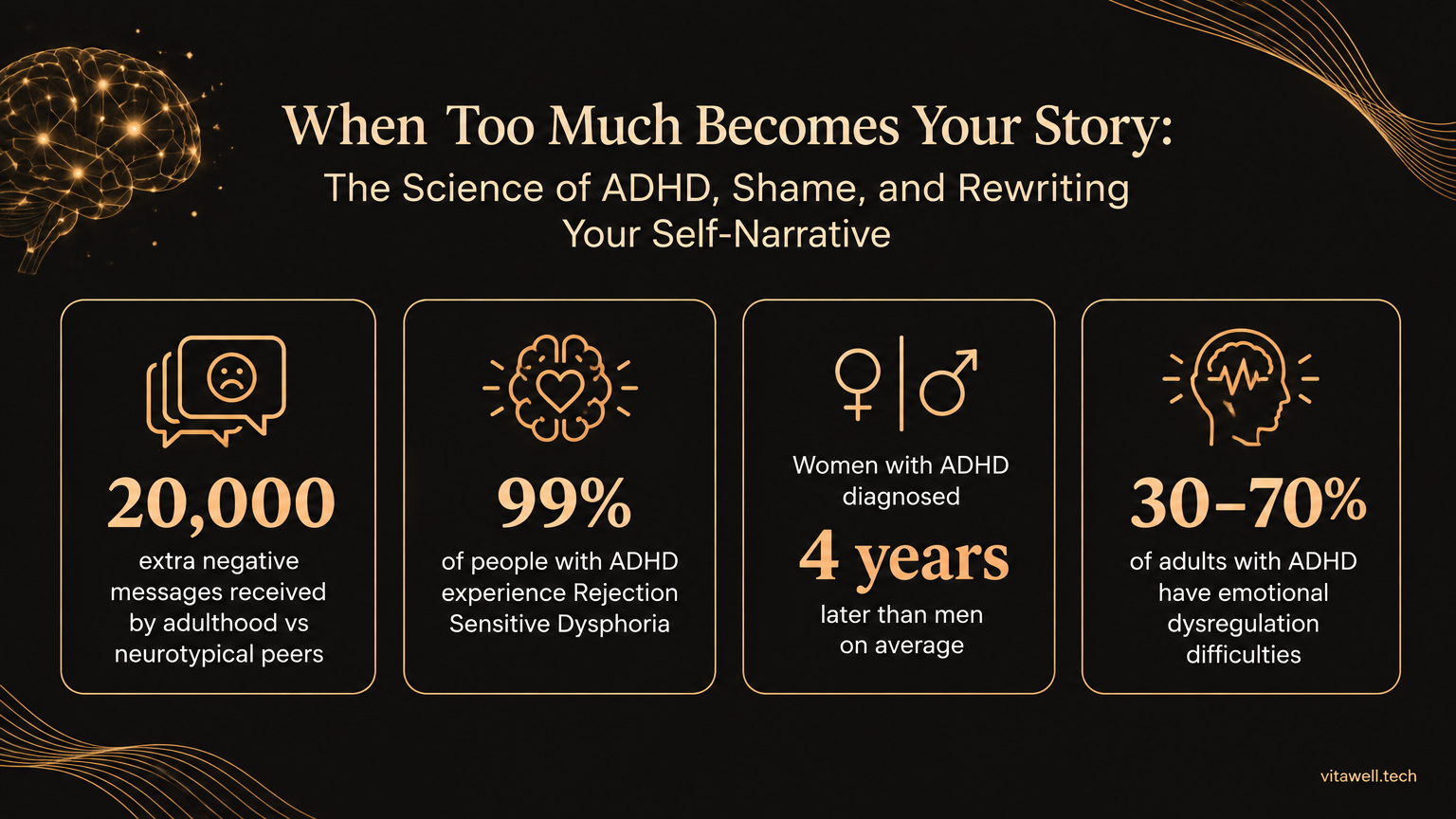
Understanding your ADHD intellectually is one thing. Healing from it emotionally operates on a completely different timeline. You can know, in your rational mind, that the times you cried at work or talked too fast or forgot again were not failures of character. And still feel the shame when it happens. By the time a person with ADHD reaches adulthood, research estimates they have received approximately 20,000 more negative messages than their neurotypical peers. That is not just information. That is conditioning.
Grief as a Normal Part of Late Diagnosis
For adults diagnosed later in life, the diagnostic moment often triggers a specific kind of grief. Common realizations include:
- Recognizing how hard you worked simply to function at a level others achieved with less effort
- Seeing that many of your coping strategies — perfectionism, over-preparation, hypervigilance — were responses to a brain that was never given the right tools
- Understanding that some of your most painful moments were entangled with an undiagnosed condition
- Mourning an earlier version of yourself who carried all of this without any framework to understand it
Rejection Sensitive Dysphoria — The Hidden Engine of ADHD Shame
Rejection Sensitive Dysphoria (RSD) is one of the most common and least talked-about dimensions of ADHD. It refers to intense, sudden emotional pain triggered by perceived or actual rejection, criticism, or failure. Research estimates that 99% of individuals with ADHD experience RSD at some point in their lives. Approximately one-third consider it the single most challenging aspect of living with ADHD. Between 30% and 70% of adults with ADHD experience clinically significant emotional dysregulation.
How RSD Rewires Everyday Interpretation
RSD shapes how the brain interprets ambiguity. An unanswered text becomes evidence of abandonment. A colleague’s brief tone becomes proof of disapproval. These interpretations happen fast — faster than conscious thought — and they feel entirely real.
- A message left on read: “They’re angry with me”
- Constructive feedback at work: “They think I’m incompetent”
- Not being invited to a social event: “I was excluded on purpose”
- A missed deadline: “I am fundamentally unreliable”
RSD vs. Ordinary Sensitivity — Key Differences
- RSD responses are sudden and overwhelming, not gradual
- They feel disproportionate even to the person experiencing them
- They are often triggered by perceived, not necessarily actual, rejection
- The emotional intensity typically passes within minutes to hours
- They are neurological in origin, not primarily psychological
The Hidden Cost of Masking
Masking is the practice of suppressing or compensating for ADHD traits to appear neurotypical. It is intelligent, strategic — and exhausting. It is also one of the primary ways shame becomes embedded in daily life.
What Masking Looks Like in Daily Life
- Rehearsing sentences before speaking to avoid saying the “wrong thing”
- Over-apologizing preemptively for mistakes that haven’t happened yet
- Monitoring your own body language and volume constantly
- Suppressing fidgeting, interrupting, or emotional reactions in real time
- Preparing extensively for situations neurotypical peers navigate spontaneously
- Over-explaining yourself to compensate for perceived inadequacy
Why Women and Girls Are Disproportionately Affected
Women and girls are significantly more likely to internalize their ADHD symptoms, developing sophisticated coping strategies that hide the condition even from clinicians. Women with ADHD are diagnosed, on average, approximately four years later than men. Many are first diagnosed with anxiety, depression, or chronic fatigue. Longitudinal data confirms: people who mask heavily have significantly higher rates of depression and anxiety than those who do not.
When Masking Becomes Self-Sabotage
Masking works in the short term. But it works by convincing your nervous system that your authentic self is the problem. Over time, that belief stops being an adaptation and starts being a prison. Chronic masking is directly linked to ADHD burnout — a state of profound mental, emotional, and physical exhaustion. Recovery requires, above all, putting down the mask. Which is only possible when you believe you are safe to do so.
Where the Shame Story Comes From
Shame is not born fully formed. It is constructed from repeated experiences that deliver the same verdict: something is wrong with you. For most adults with ADHD, that construction happened in childhood — in classrooms, in homes, in friendships where their intensity pushed people away.
Separating Traits, Coping Strategies, and Narrative
One of the most useful frameworks for working with ADHD shame is the distinction between three things that are often collapsed together:
- Neurological traits — the actual features of your ADHD brain: how it processes dopamine and norepinephrine, its sensitivity to reward and novelty, its executive functioning profile. These are not flaws.
- Coping strategies — everything you developed to manage your traits in environments not designed for your brain. Masking, perfectionism, over-preparation, people-pleasing. These were intelligent responses to a real challenge.
- The self-narrative — the story your younger self constructed to explain why life was so hard. “I am too much.” “I am lazy.” “I am broken.” This story is not your diagnosis. It is your interpretation of experiences you didn’t have the tools to understand.
Shame’s Language — Recognizing the Old Script
Shame speaks in absolutes. These are signals that you are not hearing present-tense reality — you are hearing an old recording:
- “I always mess this up”
- “I never get it right”
- “I’m too sensitive”
- “Nobody actually wants to be around me”
- “I should have figured this out by now”
Rewriting the Script — Practical Steps to a New Narrative
Step 1 — Notice and Name the Pattern
Before you can change a narrative, you have to see it. Start by developing the capacity to notice when shame is active. Physical signals often come first: a tightening in the chest, a sudden urge to apologize, a drop in energy, a pull toward isolation. Naming what is happening — “This is shame; this is RSD; this is an old story” — creates distance between you and the experience.
Step 2 — Introduce Curiosity Instead of Conclusions
The ADHD brain moves very quickly from event to interpretation. The intervention is not to stop that movement but to slow it down enough to introduce an alternative. When the unanswered message arrives, try asking: “What else could be true?” People are busy. Phones die. Notifications get missed. The alternative doesn’t have to feel more true to be useful. It just has to interrupt the automaticity of the shame response.
Step 3 — Get Specific Instead of Global
Shame lives in global statements. “I am too much” is a statement about your entire identity. But what is actually true? Perhaps: “I feel things intensely.” “I talk fast when I’m excited.” “I need reassurance in uncertain situations.” These describe behaviors and experiences rather than condemning a person. Specificity restores your humanity.
Step 4 — Create Space Between Event and Interpretation
Developing even a two-second pause between what happens and what you conclude about it is a meaningful neurological practice. Some ADHD adults use physical anchors — a breath, a specific phrase, pressing their feet into the floor — to create that pause. The goal is not to eliminate the emotional reaction. It is to give yourself enough space to choose your response rather than be determined by your history.
The Science of Self-Compassion for ADHD Adults
What Self-Compassion Actually Is (and What It Isn’t)
Self-compassion is widely misunderstood, particularly by people who have spent years being told they aren’t trying hard enough. Common misconceptions:
- It is self-pity (it isn’t — self-pity isolates; self-compassion connects)
- It is letting yourself off the hook (it isn’t — self-compassion actually increases motivation and accountability)
- It is only for people who have “earned” it (it is a practice, not a reward)
Kristin Neff’s Three Pillars — Applied to ADHD
Dr. Kristin Neff’s research identifies three core components of self-compassion, each with a specific relevance for adults with ADHD:
- Self-kindness — Responding to your own struggles with warmth rather than harsh criticism. When you forget something important, speak to yourself the way you’d speak to a colleague who made the same mistake.
- Common humanity — Recognizing that difficulty and imperfection are universal human experiences, not personal failures. Your struggles are not evidence that you are uniquely broken.
- Mindfulness — Holding painful thoughts and feelings in balanced awareness. Noticing “I’m feeling the shame spiral starting” without immediately either pushing it down or believing it completely.
What the Research Shows
A 2022 study in the Journal of Clinical Psychology found that self-compassion significantly mediates the relationship between ADHD traits and mental health outcomes — meaning it partially explains why some adults with ADHD experience better mental health than others with similar symptom profiles. Neuroimaging research adds another dimension: practicing self-compassion activates care-giving and self-awareness regions of the brain that are typically under-active in ADHD. This is not just psychology — it is neuroscience.
Building a Life That Supports a New Narrative
Neurodiversity-Affirming Environments
Not all therapy is equally helpful for adults with ADHD. Look for clinicians who understand neurodivergence, who distinguish between ADHD traits and character flaws, and who approach your nervous system with curiosity rather than pathology. The same applies to workplaces, friendships, and romantic relationships. Being in environments where different ways of thinking are genuinely valued changes what your nervous system learns is acceptable.
The Role of Peer Connection
There is something specific that happens when adults with ADHD connect with other adults with ADHD. The experience of being understood without explanation — of having your intensity, your distractibility, your emotional depth recognized as normal — is deeply corrective. What has felt like evidence of your brokenness begins to look like a familiar pattern in a larger community.
Growth Is Not Linear — And That’s Okay
Adults with ADHD often measure their growth with the same rigid standards that produced shame in the first place. A more useful frame: growth with ADHD looks like a gradually rising average, not a straight upward line. The bad days are not evidence that the good days weren’t real. They are data. And they pass.
Conclusion
You are not “too much.” You are someone whose nervous system responds quickly, and whose history taught you to brace for rejection before it arrived. The shame you carry is not your truth. It is a story your younger self told to survive. With the right support, the right tools, and a willingness to question your oldest stories, those patterns can soften — and what you once worked so hard to hide may turn out to be what makes you most fully, irreducibly yourself.