
What Is Fraysexuality? Understanding the Sexual Orientation Where Desire Fades With Intimacy

Most people assume that desire grows deeper as relationships do. We build emotional closeness, learn who someone really is, and the expectation is that wanting them should intensify alongside that knowledge. For fraysexual people, this assumption is simply wrong — and that inversion is not a flaw or a fear of intimacy. It is a distinct and recognized sexual orientation that sits within the asexuality spectrum, one that deserves to be understood rather than pathologized.
What Is Fraysexuality? The Core Definition
Fraysexuality describes a pattern of sexual attraction in which desire is felt most strongly toward people who are not yet known — strangers, acquaintances, or those in the early, undiscovered phase of a potential connection. As emotional closeness deepens, that sexual attraction fades. The word itself is derived from "fray," suggesting something that unravels at the edges; in this case, desire that unravels as intimacy forms.
The term emerged from online LGBTQ+ communities on Tumblr around 2014, initially as a way for people who had long struggled to name their experience to finally have language for it. Though not yet part of mainstream clinical vocabulary, fraysexuality is recognized within the broader asexuality and sexual diversity community and is increasingly being discussed in therapeutic and academic contexts.
Critically, fraysexuality is not a pathology. It is not avoidant attachment, a fear of closeness, or unresolved trauma — though it can be confused with all of these. It is a stable pattern of attraction that some people simply experience throughout their lives, and understanding it begins with accepting it as it is.
Desire Without Intimacy: How Fraysexuality Works
The fraysexual experience can be described as attraction that is front-loaded. When someone is unknown — when there is mystery, novelty, and the particular electricity of not quite knowing who they are — desire is present and sometimes intense. As the relationship progresses and emotional intimacy develops, that desire diminishes. It is not that the person becomes less appealing as a human being; it is that the growing closeness itself reduces the specific quality that generated sexual attraction in the first place.
This can feel profoundly disorienting, particularly in a culture that expects desire and love to move in the same direction. Fraysexual people often find themselves genuinely in love with a partner — emotionally close, committed, deeply connected — while simultaneously experiencing little or no sexual desire for them. These two things can coexist, and they frequently do.
Where Fraysexuality Fits in the Asexual Spectrum
Fraysexuality sits within the asexuality spectrum, a broad range of orientations characterized by reduced or absent sexual attraction under various conditions. At one end is asexuality — little or no sexual attraction in any context. Gray-asexuality describes people who experience sexual attraction rarely or only weakly. Demisexuality describes people who experience sexual attraction only after a strong emotional bond has formed. Fraysexuality is in some sense the inverse of demisexuality: desire exists before the emotional bond and diminishes as it forms.
These orientations are distinct but often confused with one another and with more commonly understood patterns of sexuality. Understanding where fraysexuality fits is essential for self-identification, and equally important for the therapists, counselors, and partners who need to understand what they're actually working with.
Fraysexuality vs. Demisexuality: The Mirror Image of Desire
The clearest way to understand fraysexuality is in contrast to demisexuality, since the two are often described as mirror images of each other. A demisexual person experiences little or no sexual attraction to someone until a deep emotional bond has formed. A casual encounter, a first date, even months of regular contact may produce no desire until something clicks at the level of genuine emotional intimacy. For demisexuals, closeness is the prerequisite for desire.
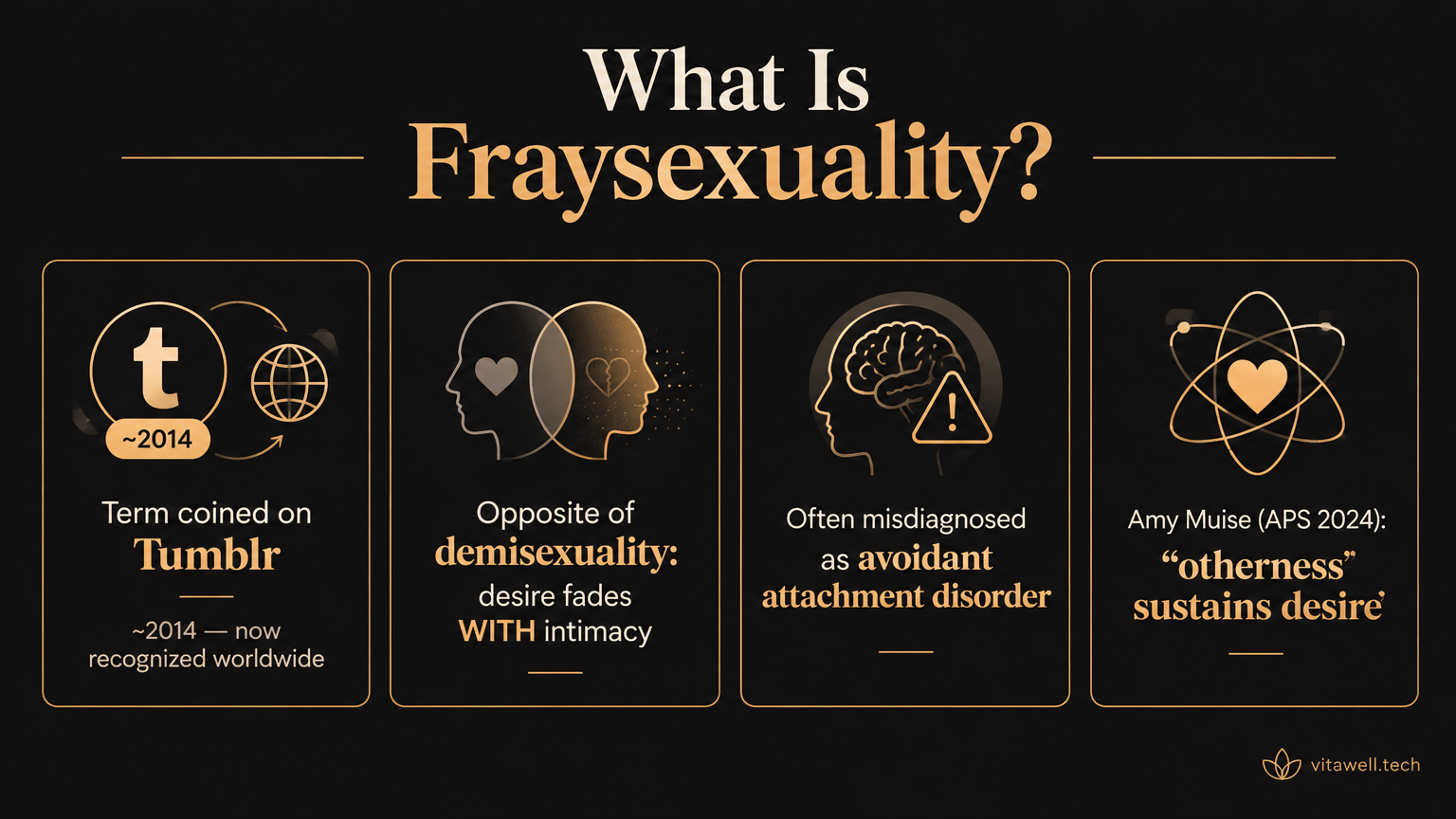
A fraysexual person experiences the reverse. Sexual attraction is present and often strong before closeness develops. It is the newness, the unfamiliarity, the sense of discovery that generates desire. As that sense of discovery resolves into genuine knowing — as the person becomes emotionally familiar rather than unknown — sexual attraction fades.
Relationship therapist and sex therapy specialist Silva Neves has noted that understanding both ends of this spectrum is essential for providing affirming care to people who experience attraction in non-normative patterns. Conflating these orientations, or assuming desire must follow a standard developmental arc from stranger to intimate partner, is a source of real harm in both clinical and personal contexts.
Why Understanding the Difference Matters
Misidentifying fraysexuality as demisexuality leads people to expect that sexual attraction will eventually arrive once a bond deepens enough — leading to confusion and self-blame when desire doesn't develop as the relationship matures, but instead recedes. Getting the direction right is not a semantic point. It changes everything about how a person understands their own experience and what they can realistically expect from their relationships.
What It Feels Like to Be Fraysexual: Real Experiences
People who identify as fraysexual often describe a particular kind of grief — not grief over losing someone, but grief over losing something within themselves as a relationship deepens. They wanted this person intensely, and now they don't, even though everything about the relationship itself has improved. The person is kinder, more known, more loved. And somehow that is precisely the problem.
The Stranger Paradox: Attraction That Fades With Knowing
Therapist Brandy Chalmers, LPC, working with individuals on identity and relationship concerns, has described this as the stranger paradox: the very qualities that build healthy, lasting relationships — trust, familiarity, emotional availability — are the qualities that reduce sexual desire for fraysexual people. This is not resolvable through effort or intention. It is not that the fraysexual person is trying to feel less desire; the diminishment is automatic, a feature of their orientation rather than a choice.
Many fraysexual people describe the early phase of a relationship as the most alive and charged they ever feel — and then experience a kind of leveling as that phase ends. This is not unique to them (many people experience a natural decline in novelty-driven desire over time), but for fraysexual people it is more complete, arriving sooner, and not replaced by a different kind of desire as the relationship matures.
Maintaining Romantic Relationships Without Sexual Desire
A common misconception about fraysexuality is that it makes committed relationships impossible. This is not accurate. Many fraysexual people are romantically oriented — they want deep emotional partnerships, want to build lives with someone, want love in its fullest relational sense. What they do not necessarily experience is ongoing sexual desire within those partnerships once emotional closeness has formed.
As sex educator Liz Talago has noted, the absence of sexual desire in this context has nothing to do with how much a partner is valued. Fraysexual people are not withdrawing because they love their partner less. They are navigating the particular reality of an orientation that runs counter to the most common expectations about how love and desire should interact.
Why Fraysexuality Gets Misunderstood — and Misdiagnosed
Fraysexuality is one of the least recognized orientations within the asexuality spectrum, and that invisibility has real consequences. Without the language to name what they experience, fraysexual people frequently spend years in confusion, in damaging relationships, or in therapy offices where their orientation is misread as a symptom of something else entirely.
The Avoidant Attachment Confusion
The most common misdiagnosis involves avoidant attachment. Avoidant attachment describes a relational pattern — typically rooted in early childhood experiences — in which a person has learned to suppress emotional needs and withdraw from closeness to protect themselves from perceived threat. Because fraysexual people experience a reduction in desire as emotional closeness grows, their behavior can superficially resemble avoidant attachment: they may seem less engaged as relationships deepen, may become less physically initiating, may appear to pull back.
But the distinction is fundamental. Avoidant attachment is about emotional connection — the whole relational dynamic. Fraysexuality is specifically about sexual attraction, not emotional closeness. A fraysexual person does not withdraw emotionally. They remain deeply emotionally engaged with their partner. What fades is specifically the sexual dimension of desire. Treating one as the other causes real harm.
- Fraysexual people typically want emotional closeness and may actively pursue it; avoidantly-attached people resist it.
- The pattern in fraysexuality is specifically sexual, not relational; avoidant attachment affects the whole relational dynamic including friendship and family.
- Fraysexuality is stable across relationships and throughout life; avoidant attachment responds to therapeutic work and can shift with relationship safety.
- Fraysexual people are often not distressed by emotional intimacy itself — only by the social and relational consequences of reduced sexual desire within that intimacy.
What Mental Health Professionals Need to Know
Clinicians who pathologize fraysexuality — treating reduced sexual desire within intimate relationships as inherently disordered — risk causing significant harm. They may push clients toward treatments that are not only ineffective but that reinforce shame. An affirming clinical approach recognizes fraysexuality as a valid orientation, helps the client understand their experience clearly, and focuses on how to build a satisfying relational life given this reality — rather than attempting to change something that is not, in itself, a problem.
The Science of Desire and Familiarity
Fraysexuality is a subjective experience, but research on the relationship between desire and familiarity offers scientific context for understanding why some people's attraction may diminish with closeness — and why this pattern, while not universal, reflects something real about how desire works.
Otherness and Self-Expansion in Relationships
Research presented by Amy Muise of York University at the 2024 Association for Psychological Science annual conference explored the role of otherness in sustaining desire within relationships. Muise's work suggests that sexual desire is partly driven by a sense that one's partner remains in some way distinct, surprising, or expansive — that they represent possibility and growth. When a partner becomes fully known and emotionally familiar, that sense of otherness diminishes, and desire can follow.
Muise's framework of self-expansion — the idea that attraction is partly about the possibility of becoming more through connection with another person — is particularly resonant for fraysexual people. The discovery phase, when someone is still unknown, may be precisely when self-expansion potential feels highest. As the relationship matures and that potential is realized rather than remaining as promise, the drive that generated desire may resolve.
Why Familiarity Can Reduce Desire for Some
Relationship therapist Esther Perel has argued that desire and security exist in fundamental tension — that the domestication of a relationship, while deeply comforting, can erode the erotic charge that novelty and mystery provide. For most people, some balance between the two can be maintained over time. For fraysexual people, this tension may be more absolute: security and sexual desire may be genuinely incompatible states, with one displacing the other as the relationship matures.
This does not make fraysexual experience pathological. It makes it a more pronounced version of something that research suggests many people experience to some degree. The difference is one of intensity and threshold, not of kind.
Navigating Relationships as a Fraysexual Person
Understanding one's fraysexuality is clarifying. But understanding it is just the beginning. The harder work is in building relational structures that honor both the fraysexual person's reality and the needs of their partners.
Communication and Setting Expectations
Early, honest communication is essential. Many fraysexual people find that conversations about their orientation work best when introduced relatively early in a relationship — not on a first meeting, but before investment has deepened to the point where the information becomes more painful to receive. The framing matters enormously: this is information about who the person is and how their desire functions, not a prediction that the relationship will fail or that the partner is insufficient. The absence of sexual desire is not evidence of emotional absence.
Ethical Non-Monogamy as a Structural Solution
Some fraysexual people find that ethical non-monogamy (ENM) offers a workable structure: a stable, emotionally intimate primary relationship alongside the freedom to experience the novelty-driven desire that fuels their attraction in its early phase with other people. This is not a universal solution, and it requires the genuine agreement and ongoing wellbeing of all partners involved. But it is a commonly discussed option within the fraysexual community because it directly addresses the structural mismatch between the kind of desire fraysexual people experience and the kind most monogamous relationships expect.
Building Deep Intimacy Without Sexual Expression
Intimacy is not reducible to sexual desire. Emotional intimacy — the experience of being deeply known, accepted, and chosen — can flourish independently of sexual attraction. Fraysexual people in committed long-term relationships often report finding profound satisfaction in the emotional and intellectual dimensions of partnership, in physical affection that is non-sexual, and in the security of being consistently chosen by someone who understands their orientation and loves them as they are. These are not consolation prizes. They are real and substantial forms of intimacy.
Supporting a Fraysexual Partner: What Experts Recommend
For partners who are not fraysexual, the experience of watching desire fade as emotional closeness grows can be acutely painful. It is natural to interpret reduced sexual interest as personal inadequacy, diminished attraction, or waning love. Working with this experience requires both information and ongoing support. Therapists working in this area consistently recommend:
- Understand the mechanism before internalizing the message. Declining sexual desire in a fraysexual partner is a feature of their orientation, not a verdict on your attractiveness or your value to them.
- Separate sexual desire from love and commitment. Fraysexual people can be deeply committed, emotionally present, and genuinely in love. These capacities are not dependent on sexual desire being present.
- Seek information together, ideally with a therapist who is knowledgeable about the asexuality spectrum. A shared framework changes the conversation from "what's wrong with us" to "how do we build something that works."
- Discuss what intimacy means for both of you, in concrete and ongoing terms. Relationships can be deeply satisfying with many different sexual and non-sexual configurations, as long as both partners are genuinely on board with what they're agreeing to.
- Avoid trying harder as a strategy. Attempting to reignite desire in a fraysexual partner through enhanced attractiveness, romantic effort, or sexual technique is unlikely to work and may add additional pressure and shame to an already complex dynamic.
Conclusion: Desire Is Not One Thing
Fraysexuality challenges one of our most deeply held assumptions about intimacy — that desire and love should move in the same direction, deepening together as a relationship matures. For fraysexual people, that assumption simply does not apply. Their desire is genuine, their love is real, and their orientation is valid. Understanding this expands our collective picture of what desire is, how it works, and how many different forms a full and meaningful relational life can take.
For fraysexual people who have spent years feeling broken or confused, having the word at all is often a profound relief. For their partners, understanding fraysexuality can be the difference between internalizing a wound and recognizing a reality. And for the clinicians and therapists who serve them, awareness of fraysexuality is not an optional extra. It is a basic requirement of affirming, effective care.
Sources
Psychology Today — What Is Fraysexuality? (Silva Neves)
Rula — Fraysexuality: What It Means and How to Navigate It (Liz Talago / Brandy Chalmers LPC)
Psychology Today — Fraysexuality: When Desire Fades With Familiarity (McQuillan)