
What Cultural Humility Really Means and Why It Can Transform Your Relationships

Most of us believe we're open-minded. We've traveled, we have friends from different backgrounds, we follow the news. But open-mindedness isn't the same as cultural humility — and the difference between the two is precisely what determines whether our relationships across difference truly connect or subtly miss. Cultural humility is a concept that has quietly moved from academic psychology into clinical practice and now into everyday conversation, and once you understand it, you start seeing its presence — or absence — everywhere.
What Cultural Humility Really Means
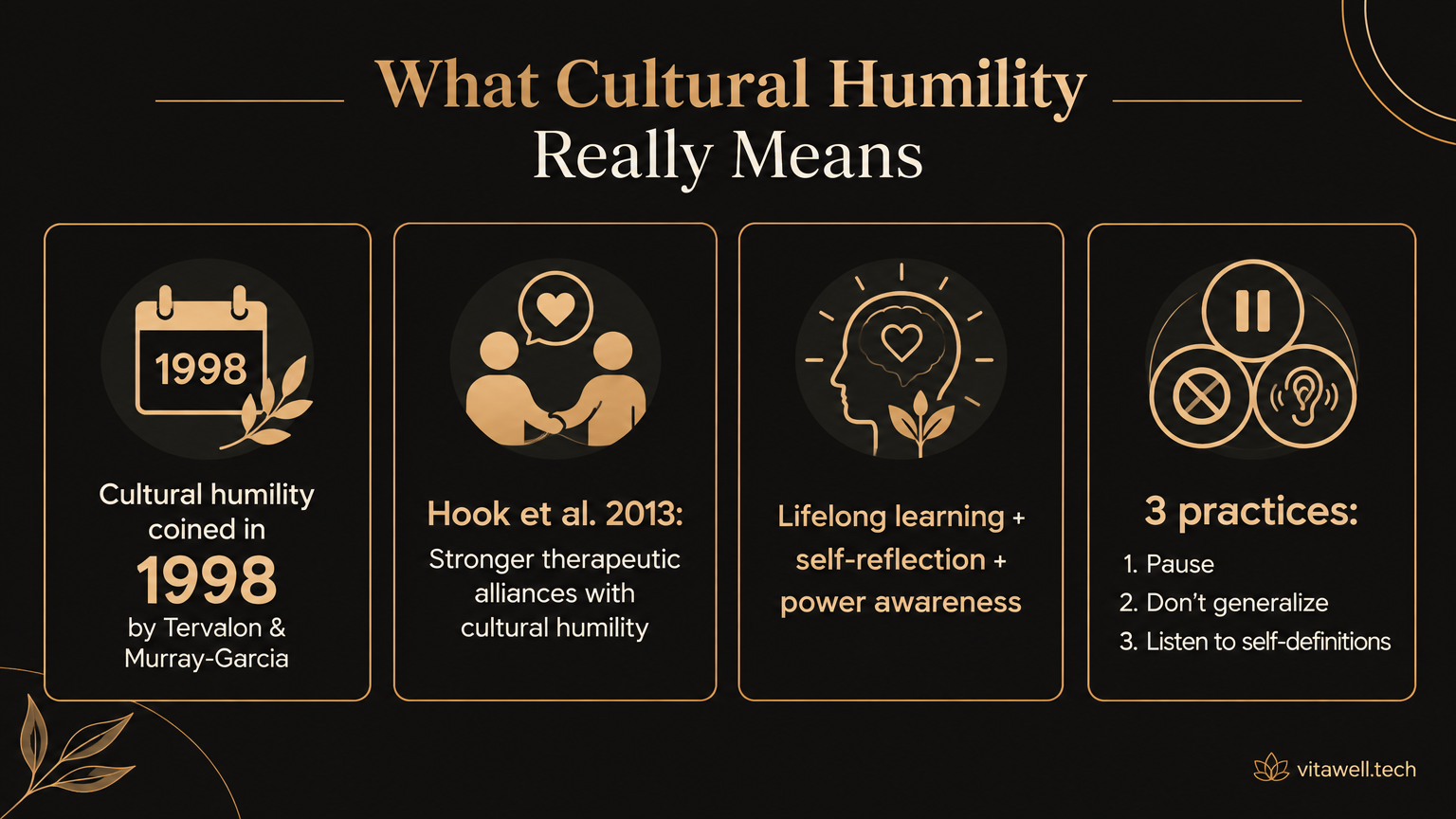
The term was introduced by physicians Melanie Tervalon and Jann Murray-García in 1998, in a paper arguing that the dominant healthcare model of "cultural competence" — the idea that you could master a fixed body of knowledge about different groups and thereby become culturally skilled — was fundamentally flawed. What they proposed instead was cultural humility: an ongoing orientation toward one's own limitations, a commitment to lifelong learning, and a genuine deference to the other person's self-definition.
Where cultural competence treats culture as a subject to be mastered, cultural humility treats it as a practice to be sustained. The key shift is directional: instead of positioning yourself as the one who knows, you position yourself as the one who is still learning — and who accepts that you will always be still learning.
Cultural Humility vs. Cultural Competence: What's the Difference?
The distinction matters because cultural competence, however well-intentioned, can quietly generate overconfidence. If I've read about a culture, attended a training, or traveled to a country, I may come away believing I understand its people. Cultural humility challenges that conclusion. It says: you have learned something, and that learning is valuable — but it does not give you authority over how any individual member of that culture defines themselves, what they value, or how they wish to be understood.
Cultural humility involves three interlocking commitments: lifelong learning and critical self-reflection about one's own cultural background and biases; recognizing and challenging power imbalances in relationships across difference; and institutional accountability — the idea that organizations, not just individuals, must actively address cultural inequities. In practice, it means entering cross-cultural encounters with curiosity rather than certainty, and centering the other person's self-knowledge rather than your prior knowledge about their group.
The Moment Cultural Humility Becomes Real
The World Cup offers a vivid illustration of when cultural assumptions are quietly at work — and what it looks like to either follow or resist them. When viewers watch a national team and are surprised by the racial diversity they see, something revealing happens. The surprise itself is data: it means a mental model has been violated. Someone expected a team representing a particular nation to look a certain way — based on that country's history as they understood it, media portrayals, perhaps family assumptions — and reality didn't conform.
That moment of surprise is not a failure. It is, as therapist and author Chandra Davis argues, a doorway to growth. The question is what happens next. One option is to rationalize the surprise away, to decide that the unexpected players are somehow anomalies. The other is to pause and ask: what assumption was I carrying? Where did it come from? What do I still need to learn?
Surprise as a Gateway to Growth
This is where cultural humility shows up in practice. It doesn't require you never to hold assumptions — assumptions are cognitively unavoidable, the product of patterns accumulated over a lifetime of exposure to media, family conversations, school curricula, and culture. What it requires is that you notice the assumption when it surfaces, treat the discomfort of having it challenged as useful information, and move toward curiosity rather than defensiveness.
Psychologists call this experience cognitive dissonance — the discomfort that arises when new information contradicts an existing mental model. Most people resolve dissonance by discounting the new information. Cultural humility inverts this: it asks you to hold onto the dissonance long enough to let it reveal something true about the limits of what you thought you knew.
The Science Behind Cultural Humility in Relationships
Cultural humility isn't just a philosophical stance — it has measurable effects on the quality of relationships and care. Research by Hook and colleagues, published in the Journal of Counseling Psychology (2013), found that cultural humility on the part of therapists was associated with stronger therapeutic alliances and more positive outcomes, particularly for clients from cultural minority backgrounds. When clients perceived their therapists as genuinely open, curious, and willing to defer to the client's own self-knowledge, they reported feeling more respected and more understood — and their outcomes improved accordingly.
This finding generalizes beyond therapy. The same quality of attentive, non-presumptuous openness that improves therapeutic relationships appears to improve personal and professional relationships across cultural difference more broadly. When people feel that their identity is not being filtered through someone else's preconceptions — that the person in front of them is genuinely trying to understand rather than categorize — something fundamental shifts in the quality of connection possible between them.
Social Identity and the Need to Be Seen
Social psychologists Henri Tajfel and John Turner developed social identity theory in 1979, arguing that people derive significant parts of their self-concept from group membership — and that feeling your group identity is recognized and respected by others matters enormously for psychological wellbeing. When cultural humility is practiced, it creates the conditions under which people can present and explore their own identities rather than simply having external categories imposed on them.
For children and young people in particular, seeing their own backgrounds and identities reflected and respected in the world around them shapes their sense of who belongs and what is possible. Davis notes that athletes who represent national teams with which younger viewers can identify help expand the imaginative space of belonging — a small but meaningful form of representation that cultural humility in everyday conversation can reinforce or undermine.
How Cultural Assumptions Form — and Why They're Hard to See
Understanding cultural humility requires understanding how cultural assumptions form in the first place. No one arrives at adulthood as a blank slate. We absorb images of what different nationalities, ethnic groups, and communities "look like" through years of accumulated exposure: family conversations, school curricula written from a particular cultural perspective, media that reflects the assumptions of its producers, and historical narratives that emphasize some stories while erasing others.
These accumulated images function as mental maps — cognitive shortcuts that help us navigate a complex world by generating predictions. The problem is that mental maps can be spectacularly wrong, especially across the rapid changes of a globalized world. Nations that were relatively homogeneous a generation ago may now have dramatically diverse populations due to migration, colonial legacies, and global movement of people. The United Nations Department of Economic and Social Affairs reports that international migration has reshaped the demographics of nations in ways that many longstanding cultural images simply don't reflect.
Cultural humility is, in part, a practice of updating those maps — and of holding them more lightly, recognizing that any particular map is a simplification rather than a truth.
Three Practices That Build Cultural Humility in Daily Life
The abstract commitment to cultural humility becomes concrete in specific practices. The following three, drawn from both the academic literature and clinical practice, are foundational.
Pause When You Notice Surprise
Surprise in a cross-cultural context is a signal worth attending to. When you're startled by something that doesn't match your expectations — an identity that doesn't fit your image, a cultural practice that seems unexpected, a person whose background doesn't align with your assumptions — that moment of surprise reveals an assumption you were carrying without fully knowing it. The practice is not to bypass the surprise but to investigate it: what did I expect? Why? What was that expectation based on, and how solid is that foundation?
This isn't self-flagellation — it's data gathering. You are learning something about the limits of your map, which is exactly the kind of information cultural humility asks you to stay open to.
Don't Make One Person the Representative of Their Group
One of the most common — and most exhausting — forms of cultural insensitivity is treating an individual as a spokesperson for their entire background. When someone becomes the person who is expected to explain their ethnicity, religion, or nationality to everyone else in the room, they've been reduced from a whole person to a cultural resource. Cultural humility asks you to recognize that no individual can speak for an entire group, and that the expectation that they should is itself a form of presumption.
If you're curious about a cultural background that isn't your own, there are books, articles, films, documentaries, and community resources that can carry the educational load — rather than placing it on the individual in front of you.
Listen to How People Describe Themselves
Identity is not only assigned from the outside. How people describe their own identities — the words they use, the combinations they claim, the affiliations they emphasize — is real information that takes precedence over external categorization. Someone who describes themselves as "British-Nigerian," "third-generation Moroccan-French," or "mixed" is offering you a self-definition that may not fit any simple category you hold. Cultural humility means receiving that definition on its own terms rather than resolving it into something simpler or more familiar.
This is not just politeness — it is epistemically more accurate. The person describing themselves knows themselves better than your prior categories do.
Cultural Humility in Relationships: Why It Changes Everything
Applied to personal relationships, cultural humility shifts the entire dynamic of how people across different backgrounds connect. Without it, cross-cultural relationships often develop a particular pattern: the person from the more culturally dominant group unconsciously assumes their frame of reference as the default, and the person from a minority background either accommodates that assumption or carries the invisible labor of constantly explaining and contextualizing themselves.
With cultural humility, something different becomes possible: a relationship in which both people's perspectives are genuinely on the table, neither frame of reference is treated as the unmarked default, and curiosity flows in both directions. This is not only better for the person from a minority background — it makes the relationship richer for everyone involved. Contact with genuinely different perspectives, when approached with humility rather than resistance, is one of the most reliable drivers of expanded thinking and reduced stereotyping that social psychology has identified.
Researcher Felicia Pratto and colleagues have found that the conditions under which intergroup contact reduces prejudice include equal status between the groups, genuine personal interaction, and the absence of threat. Cultural humility creates precisely these conditions: it equalizes the epistemic standing of both parties, makes space for genuine exchange, and signals safety rather than judgment.
Building Cultural Humility: Where to Start
Cultural humility is not a destination but a practice — which means there is no point at which it is finished. What there is, instead, is a direction of travel: toward greater self-awareness, more genuine curiosity, and an increasingly sophisticated ability to hold your assumptions lightly. Some practical starting points:
Begin with the histories you haven't been taught. Most formal education reflects particular cultural perspectives and omits others. Reading histories of countries and communities whose perspectives have been underrepresented in your own education is one of the most direct ways to start updating cultural maps that may be outdated or partial.
Seek out media produced from perspectives different from your own. Films, journalism, literature, and documentary work produced by people from cultural backgrounds you're less familiar with expand your imaginative and factual understanding in ways that secondhand descriptions cannot replicate.
Develop the habit of reflecting on your own cultural positioning. The assumption that you have no cultural background — that your perspective is simply "normal" while others have "culture" — is itself a cultural assumption, and usually a reflection of occupying a majority position within your society. Everyone has a cultural background that shapes what they see and what they miss.
And, in direct interaction: lead with questions rather than conclusions. Ask how people describe themselves before assigning them a category. Listen for what surprises you, and use it as a prompt for reflection rather than dismissal. These habits, practiced consistently, build the relational soil in which genuine cross-cultural connection can grow.
Conclusion: Humility as the Beginning of Connection
Cultural humility is not about knowing everything — it is about being honestly aware that you don't. It is not about performing openness — it is about practicing a particular quality of attention: curious rather than presumptive, decentered rather than self-referential, willing to be surprised and willing to let that surprise teach you something.
In a world where cultural diversity is increasing, where the faces of nations are changing faster than many people's mental maps can keep up, and where relationships across difference are both more common and more fraught than at any previous moment in history, the capacity for cultural humility is not an optional upgrade. It is foundational infrastructure for the kind of connection that makes relationships — and communities — genuinely work. The World Cup, in this sense, is just one large mirror in which that need becomes briefly, brilliantly visible.
Sources
Psychology Today — What the World Cup Can Teach Us About Cultural Humility (Chandra Davis)
Talkspace — What Cultural Humility Means in Mental Health Care