Science Says You're Wrong About Talking to Strangers — How Being a Little More Social Can Improve Your Health, Happiness, and Relationships

Most of us know, somewhere in our minds, that relationships are one of the most important sources of health and happiness in a human life. And yet, every day, we pass by dozens of opportunities to connect — we look away when a stranger catches our eye on the subway, we stay silent in the elevator, we pick up our phones instead of talking to the person sitting next to us. We know connection matters, and we consistently avoid it. A growing body of research has identified exactly why this happens — and why the cost is higher than almost anyone realizes.
The Paradox at the Heart of Human Connection
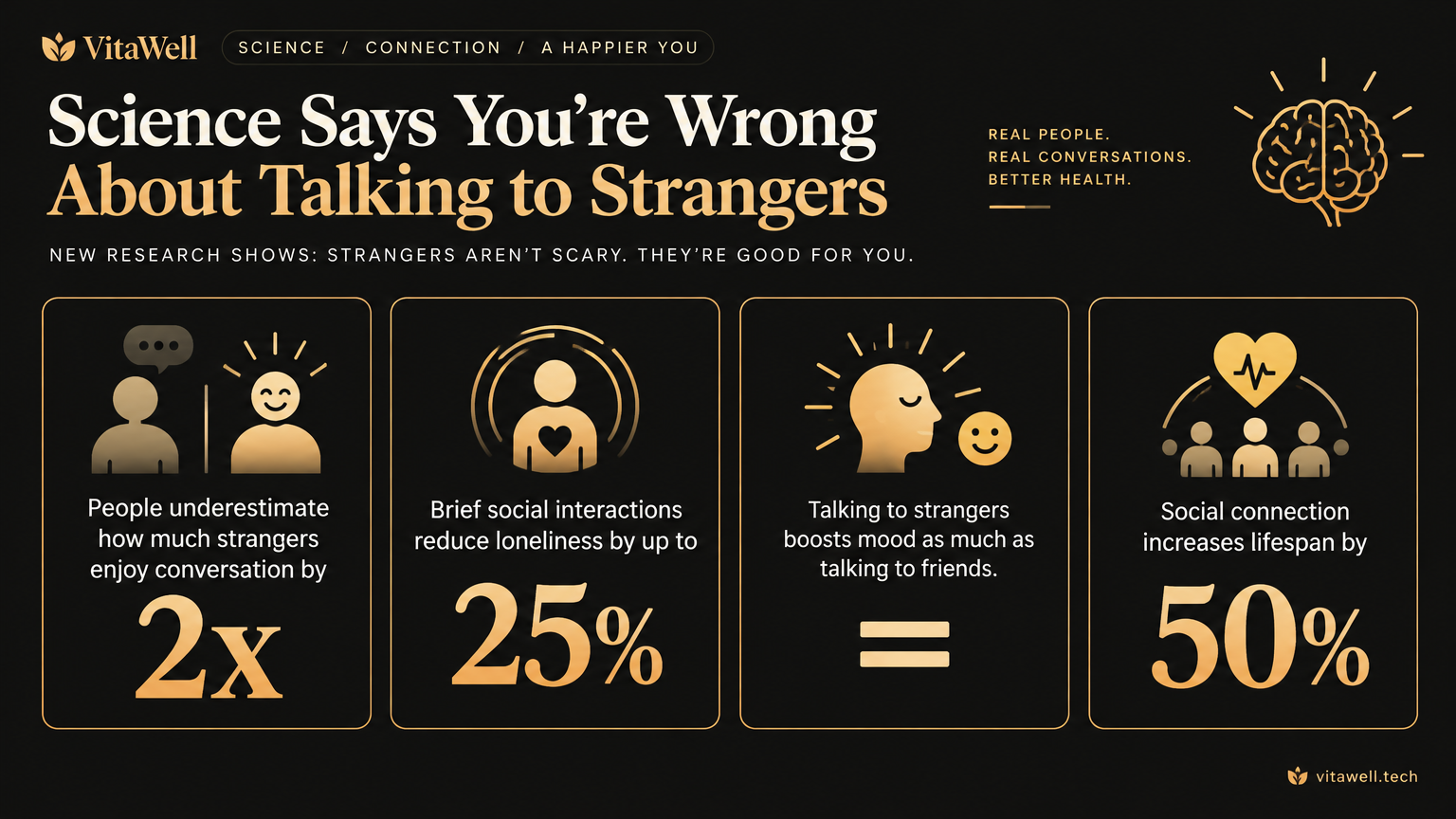
The puzzle is not that people dislike connecting with others. Study after study shows the opposite: people genuinely enjoy social interaction, even with complete strangers. They just consistently predict that they won't. The gap between knowing connection is valuable and actually seeking it is not a gap in values — it is a gap in prediction. We misjudge what will happen when we reach out, and because our expectations are inaccurate, our behavior follows them rather than reality.
This is the central insight of University of Chicago behavioral scientist Nicholas Epley, whose 2026 book A Little More Social synthesizes decades of research on why we underconnect and what happens when we don't. His findings are both unsettling and encouraging: the barriers to human connection are real, but almost all of them are based on systematic errors in how we predict social outcomes.
What Nicholas Epley's Research Actually Shows
We Consistently Underestimate the Benefits of Connecting
Across dozens of studies, Epley and his colleagues have placed participants in one of two conditions: social (talk to someone) or solitary (stay to yourself). Participants in the social condition consistently reported significantly more positive experiences than those in the solitary condition — more often than the participants themselves had predicted before the interaction began.
This held true across a remarkable variety of contexts: on trains and buses, in waiting rooms, in laboratories, in professional settings. The people who talked to others — even strangers they would never see again — felt better, learned more, and reported more meaning than those who stayed silent. And in virtually every study, the participants had not expected this result.
We Also Underestimate How Much Others Want to Connect
The miscalculation runs in both directions. Not only do we underestimate how much we'll enjoy reaching out — we also systematically underestimate how positively others will respond. This matters because it reinforces the reluctance. If you expect someone to be uninterested, closed-off, or uncomfortable, you are far less likely to start the conversation. But the evidence shows that most people respond warmly to warm approaches. The reciprocity principle is strong: treat someone like a friend, and they tend to respond like one.
“Unlike more punishing self-improvement goals like exercising more or eating better, practicing to become a little more social is a surprisingly positive experience,” writes Epley — and the data backs this up, even for introverts.
The 3 Psychological Barriers That Keep Us Isolated
Epley's research identifies three specific cognitive patterns that systematically prevent people from reaching out, even when connection would benefit them. Understanding these barriers is the first step to dismantling them.
Barrier #1 — Exaggerated Uncertainty
We dislike uncertainty, and social interactions carry uncertainty. We cannot predict exactly how an opening conversation will go. What Epley's research shows, however, is that this uncertainty is almost always exaggerated. Social interactions tend to unfold consistently with how they begin. If you approach someone with warmth and genuine interest, they are highly likely to respond in kind. The worst-case scenarios we imagine — the awkward silence, the eye-roll, the cold rejection — occur far less often than we expect and far less catastrophically when they do. The future we fear is not the future we tend to actually encounter.
Barrier #2 — Mismatched Perspectives
When thinking about initiating contact, we tend to evaluate ourselves through the lens of competence: are we being interesting enough? Knowledgeable enough? Articulate enough? The problem is that others are evaluating us primarily through the lens of warmth — are we friendly, genuine, and approachable? These are entirely different criteria, and our focus on competence leads us to drastically underestimate how positively our overtures will land. A warm “hello” from someone who doesn’t say anything particularly clever is, in most people's experience, much more welcome than silence from someone who is waiting to sound impressive.
Barrier #3 — Confusing Environments
The third barrier is perhaps the most self-reinforcing. When pessimism prevents us from testing our assumptions about social interaction, we never accumulate evidence that the assumptions are wrong. Avoidance becomes its own data source, confirming the story we already believe. By not reaching out, we never learn that reaching out would have gone well. The result is a closed loop in which our fears about connection become self-perpetuating — not because they are accurate, but because we never give reality a chance to correct them.
Why Voice Beats Text for Real Connection
What Talking Actually Creates That Texting Cannot
In an era when most social contact happens through screens, Epley’s research on communication medium offers a bracing corrective. When he and his colleagues compared voice-based and text-based communication — both with friends and with strangers — they found that people who connected by voice felt significantly more closeness, despite predicting in advance that voice would feel more awkward than text.
The reason is in the texture of real-time vocal exchange. When you hear someone’s voice, you receive instant feedback, emotional tone, the subtle cues of timing and emphasis that carry enormous social information. You enter a rhythm of synchrony with another person. Text strips most of this away, leaving a flatter, less connecting exchange that feels easier but produces less of what we are actually looking for from social contact.
The Hidden Cost of Digital-First Socializing
Most of us choose text and social media for social contact not because it is more connecting but because it is lower effort and lower risk. The cost is invisible in the moment: each text message or social media exchange feels fine. But over time, choosing the ease of digital communication over the richness of voice-based connection means consistently settling for a lower-quality version of the thing we actually need. We end up less informed about the people in our lives, less close, and less satisfied — without quite understanding why.
The Health Stakes — Why This Matters More Than You Think
Loneliness Kills — By the Numbers
The public health consequences of chronic social disconnection are no longer abstract. In June 2025, the WHO Commission on Social Connection released a landmark report documenting the scale of the problem: 1 in 6 people worldwide is affected by loneliness, and loneliness is linked to an estimated 871,000 deaths annually — roughly 100 deaths every hour. Chronic social isolation has been compared, in its health impact, to smoking 15 cigarettes a day and is associated with a 26% increased risk of premature death.
The mechanisms are not mysterious. Loneliness triggers chronic inflammation, disrupts sleep architecture, impairs immune function, and activates stress response systems in ways that compound over time. The body, as researchers have established, registers social exclusion as a genuine threat — and responds accordingly.
Connection Protects — What the Evidence Shows
The reverse is equally well-documented. Strong social connections reduce inflammation, lower the risk of cardiovascular disease and premature death, and protect mental health across the lifespan. Even weak-tie connections — the cashier you chat with, the neighbor you greet, the fellow commuter you share a smile with — contribute meaningfully to daily well-being. These brief, low-stakes moments of human contact are not trivial. They are, in aggregate, part of the infrastructure of a healthy life.
The WHO’s Landmark 2025 Response
In May 2025, the World Health Assembly adopted the first-ever global resolution on social connection, formally recognizing loneliness as a public health crisis and urging member states to develop evidence-based policies to address it. The WHO Commission identified five strategic areas: policy, research, interventions, measurement, and community participation. The fact that the world’s leading health authority is now treating human connection as a priority health intervention is a signal worth taking seriously.
Conversations Across Divides
One of the most consequential findings in Epley’s research concerns what happens when people talk — really talk — across perceived social, political, or cultural divides. His studies show that voice-based exchange humanizes even in the presence of disagreement. Participants who hear each other’s voices while discussing polarizing topics are more likely to recognize the other person’s humanity, feel less animosity, and have more constructive conversations than participants who exchange written arguments. In an era of growing social fragmentation, this finding has implications that go well beyond personal happiness.
How to Start — Practical Steps Research Supports
You do not need to become an extrovert. Epley’s point is not that we should all become social butterflies — it is that small, consistent acts of reaching out produce outsized benefits, and most of us are undershooting our optimal level of social engagement by a significant margin. Here are research-backed ways to start:
- Say hello and make eye contact: the simplest possible opening. Research confirms it is both more welcome and more enjoyable than people predict.
- Offer a genuine compliment: not flattery, but specific and sincere observation. It invites warmth and almost always lands better than expected.
- Express gratitude to someone in your day: the barista, the colleague who helped, the neighbor who held the door. Gratitude extends connection and improves both parties’ mood.
- Put away your phone in shared spaces: earbuds and screens are powerful social signals that you are unavailable. Removing them opens the door to spontaneous connection.
- Go beyond small talk when the opportunity arises: research from Epley’s lab and elsewhere shows that people enjoy deeper conversations with strangers more than they predict. Ask something meaningful — you may be surprised.
- Try the 4-question connection exercise: based on Arthur Aron’s "fast friends" intervention, answering questions about gratitude, future hopes, what you look for in a friend, and the last time you cried in front of someone can create genuine intimacy in a single conversation.
Conclusion
The barriers to social connection are real. The hesitation, the uncertainty, the anticipation of awkwardness — these are genuine psychological experiences. But they are also, the research consistently shows, systematically inaccurate predictions about what will happen when you reach out. The strangers you pass every day are warmer than you think. The conversations you avoid would go better than you imagine. The brief moments of connection you dismiss as trivial are, in fact, part of what makes a life feel full.
You don’t have to transform your social life overnight. Epley’s prescription is modest and backed by decades of evidence: just a little more social. Start where you are, with whoever is nearby, and let reality correct the story your hesitation has been telling you.
Sources
How Being a Little More Social Can Change Your Life — Greater Good Berkeley