
The Human-in-the-Loop Fallacy: Why AI Oversight Is Not Enough at Work
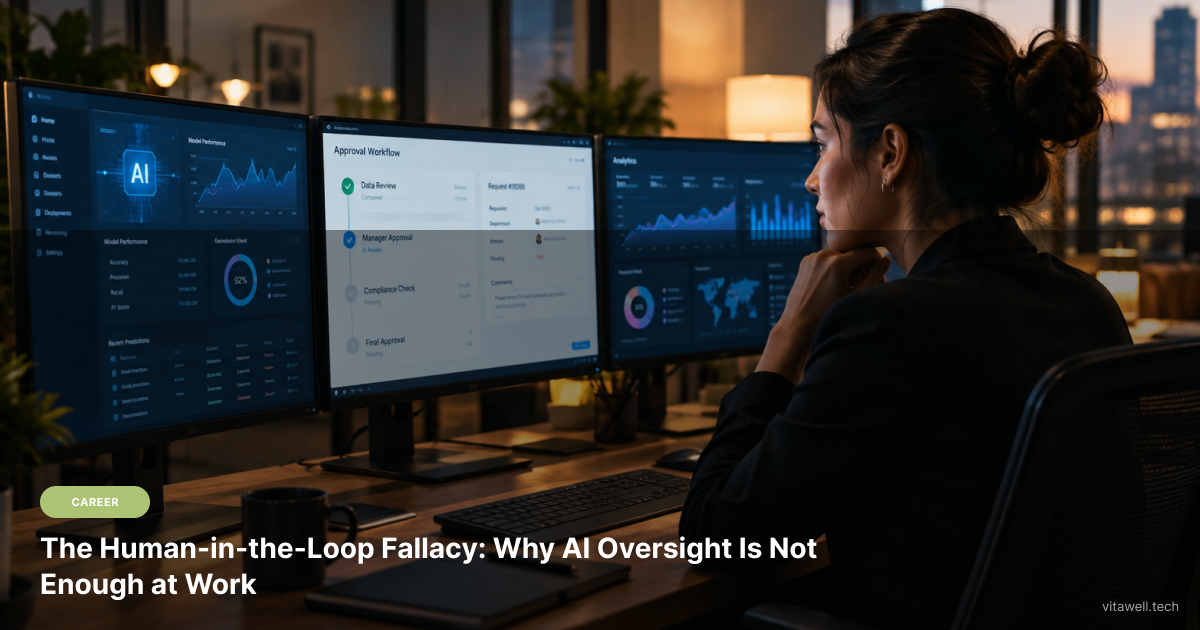
You approved 47 AI-generated decisions today. How many did you actually scrutinize? If you work with AI tools in any capacity — reviewing recommendations, signing off on automated outputs, or simply accepting AI-drafted text — there is a good chance you have become part of a pattern that researchers are calling the human-in-the-loop fallacy. The label sounds safe. The reality is more complicated.
What 'Human-in-the-Loop' Was Supposed to Mean
The original design intent
The phrase human-in-the-loop was coined in control systems engineering to describe processes where a human actively monitors, interprets, and can intervene in automated decisions. The human was not a rubber stamp — they were a safeguard with the cognitive authority and practical ability to stop, redirect, or override the machine at any point. In well-designed systems, this means giving the reviewer full context, a manageable workload, and a genuine pathway to say no.
How it works in well-implemented systems
Meaningful human-in-the-loop oversight has four characteristics. The reviewer understands exactly what is being reviewed and why it matters. They have real insight into how the AI reached its output — not just the conclusion, but the reasoning and confidence behind it. They have the authority and organizational support to refuse or override the recommendation. And they are not reviewing in isolation: they can consult peers, ask follow-up questions, and escalate when something feels wrong.
The gap between design intent and daily reality
In most modern workplaces, none of these conditions reliably hold. A hiring manager approving AI-ranked candidates sees a score and a brief summary. A loan officer reviewing an algorithmic credit decision sees a recommendation and a risk band. A doctor reading a clinical decision support alert sees a flag, often with seconds to act. The volume is high, the context is thin, and the system's track record is usually good enough to make disagreement feel like the riskier choice. The loop exists on paper. In practice, it has become a formality.
The Psychology Behind Rubber-Stamping AI Decisions
Automation bias — deferring to confident systems
Automation bias is the well-documented tendency to defer to the outputs of automated systems without applying independent scrutiny. It was first formally described in aviation research in the 1990s and has since been replicated across medicine, law, finance, and knowledge work. The paradox at the heart of automation bias is that it is strongest precisely when the system is most reliable. The better the AI performs, the less incentive reviewers have to question it — and the more dangerous the moments when it fails become.
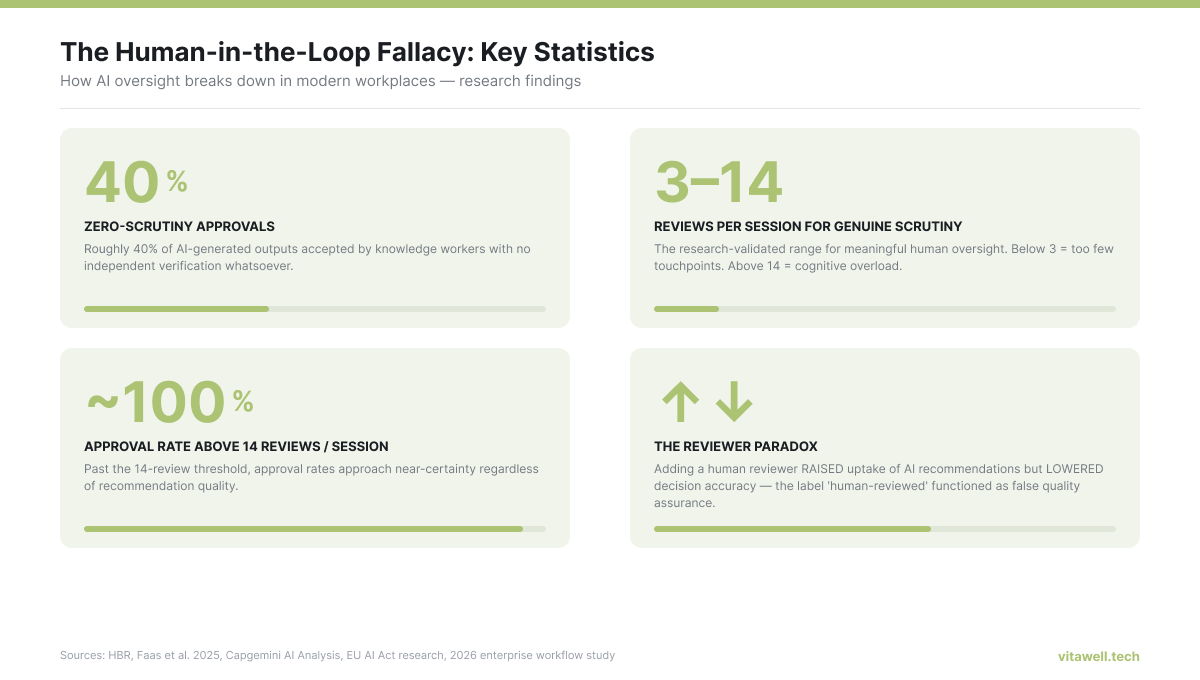
Research on clinical decision support systems found that clinicians accept erroneous machine advice a significant share of the time, even when the error would have been obvious with a few seconds of independent thought. A 2026 analysis found that in approximately 40 percent of tasks, knowledge workers accepted AI outputs with zero independent scrutiny. The number is directional rather than definitive, but it aligns with a broader body of evidence: when a system is usually right, humans stop checking.
Approval fatigue — how volume kills scrutiny
Approval fatigue describes what happens when review volume exceeds the cognitive resources needed for genuine evaluation. A 2026 analysis of enterprise AI workflows found a telling pattern: as the number of daily approvals rises, approval latency falls and approval rate climbs toward 100 percent. When an employee is approving 80 AI recommendations before lunch, each individual review receives a fraction of a second of attention. The gate has not been removed — it has simply been made frictionless, which amounts to the same thing.
Research suggests a practical workload threshold: between 3 and 14 high-stakes AI reviews per session is compatible with genuine scrutiny. Above 14, approval rates begin approaching near-100 percent regardless of the quality of the underlying recommendations. This is not a failure of individual discipline — it is a predictable outcome of how human attention works under sustained cognitive load.
Delegation creep — how AI expands its own territory
Delegation creep describes the gradual expansion of AI authority within an organization. It typically begins with low-stakes automation — scheduling, routing, formatting. Over time, the same systems or their successors begin making recommendations on hiring, performance evaluation, compensation, and promotion. Each expansion is presented as efficiency. Cumulatively, the decisions that most affect people's careers are now largely automated, with humans retained at each step to provide a signature that legitimizes the output without meaningfully evaluating it.
Real-World Consequences of Checkbox Oversight
Clinical and legal case studies
The healthcare sector has produced the most detailed record of human-in-the-loop failure because the consequences are measurable. Studies of clinical decision support tools have found that alerts are overridden at rates as high as 95 percent in some hospital systems — not because clinicians are reckless, but because alert volume is so high that the only way to function is to dismiss most of them. When alerts are dismissed habitually, the ones that matter get dismissed too.
Legal scholars have raised parallel concerns about workplace AI. A landmark SSRN paper by labor law researcher Antonio Aloisi analyzed human oversight requirements in the EU's GDPR, AI Act, and Platform Work Directive and concluded that the provisions are often insufficient. Overseers in real workplaces frequently lack the cognitive capacity, organizational support, or technical knowledge to catch system failures. More troublingly, the presence of a formal human review step can actually shield deploying organizations from liability — the human signature provides legal cover even when the review was not substantive.
The paradox: oversight that makes things worse
One of the most counterintuitive findings in this space comes from a Capgemini analysis of enterprise AI deployments: adding a human reviewer raised the uptake of automated recommendations while lowering decision accuracy. The reviewer's presence made people more confident in the output — not because the reviewer was catching errors, but because the label 'human-reviewed' functioned as a quality signal regardless of what the review actually involved. The oversight theater made the fallacy worse.
How organizations benefit from the illusion of oversight
It is worth being clear about the incentive structure. When human oversight is nominally present but functionally absent, the organization gets the efficiency benefits of full automation while retaining the legal and reputational protections of claimed human review. This is not a conspiracy — it is an emergent outcome of deploying powerful AI tools while maintaining compliance with regulations that were written before anyone understood how automation bias worked at scale.
The Four Requirements for Meaningful Oversight
Research by Faas and colleagues, published in 2025 and drawing on co-design workshops with domain experts, identified four requirements that distinguish meaningful oversight from performative oversight. These are worth treating as a personal checklist for anyone whose job involves reviewing AI outputs.
- Understanding what you are actually reviewing. Do you know what decision is being made, what data drove the AI's output, and what the consequences of an error would be? If you are approving an output without understanding its downstream effects, you are not providing oversight — you are providing cover.
- Genuine insight into how the AI reached its output. A confidence score and a recommendation are not explanation. Meaningful oversight requires enough visibility into the model's reasoning to identify the kinds of errors it is likely to make. Without this, you cannot catch the failures that matter most.
- The real ability to refuse or override. Organizational cultures in which overriding AI recommendations is discouraged, requires extensive justification, or carries implicit career risk do not have human oversight — they have human compliance. The ability to say no must be genuine and practically supported.
- Collaboration rather than isolation. Reviewing AI outputs alone, under time pressure, without the ability to consult colleagues or escalate uncertainty, is the worst possible design for catching errors. Meaningful oversight is a social and organizational process, not an individual checkbox.
Practical Steps to Protect Your Judgment at Work
Regardless of how your organization has designed its AI oversight processes, there are steps you can take individually to stay genuinely in the loop.
- Set your own review volume limit. Research suggests the 3–14 rule: if you are reviewing more than 14 high-stakes AI recommendations per session, your scrutiny is degrading. Where you have discretion over your own workflow, cap your review sessions and take deliberate breaks between them.
- Build deliberate friction into high-stakes approvals. Before approving any AI recommendation that affects another person's career, compensation, or access to services, make yourself write one sentence explaining why the recommendation is correct. If you cannot write that sentence, you are not ready to approve.
- Ask the AI to show its reasoning, not just its conclusion. In tools that support it, prompt the model to explain what factors most influenced its output and what the main sources of uncertainty are. Engaging with the reasoning — even briefly — substantially reduces automation bias.
- Create a personal disagreement log. Track every time you override an AI recommendation and note why. Review the log monthly. If you have not overridden anything in weeks, that is not evidence that the AI is perfect — it is evidence that you have stopped looking critically.
What Organizations Should Do Differently
Individual tactics help, but the root of the problem is organizational design. Effective human oversight requires deliberate investment, not just a policy statement.
- Design oversight roles that keep humans cognitively engaged. Roles that consist primarily of approving AI outputs are roles designed to produce automation bias. Meaningful oversight should involve a mix of AI-assisted and fully independent decision-making, so reviewers maintain the judgment skills they need to catch failures.
- Measure approval rates as a quality signal. An approval rate that consistently approaches 100 percent is a warning sign, not a sign of efficiency. Organizations that monitor approval rates, override rates, and downstream outcomes from overridden recommendations are the ones most likely to catch oversight decay before it becomes a liability.
- Build cultures where questioning AI is rewarded, not resisted. If employees know that overriding an AI recommendation will invite scrutiny, require documentation, or slow their workflow, they will stop overriding. Culture either supports genuine oversight or it undermines it — there is no neutral position.
- Comply with the EU AI Act in spirit, not just on paper. Article 14 of the EU AI Act requires deployers of high-risk AI systems to implement measures that counteract automation bias and ensure operators can genuinely understand and oversee the systems they use. Many organizations will satisfy this requirement through documentation. The ones that get the most value from it will treat it as a design mandate.
Rethinking What It Means to Be 'In the Loop'
The human-in-the-loop fallacy is not primarily a technology problem. The AI systems involved are often working exactly as designed. The fallacy lies in the claim that a human presence in the review chain provides meaningful protection without doing the organizational and psychological work that genuine protection requires.
Your career-related stake in this is direct. As AI handles more of the transactional and analytical work that used to define professional roles, the value you bring increasingly lies in the judgment, context, and accountability that AI cannot replicate. Rubber-stamping AI decisions is not just organizationally risky — it is professionally self-undermining. Every decision you approve without scrutinizing is a small transfer of your cognitive authority to the system. Over time, those transfers accumulate.
Staying genuinely in the loop — understanding what you review, retaining the ability to disagree, building the habits that keep your judgment sharp — is not just a compliance obligation. It is increasingly a career competency.