You're Not Too Sensitive: The Science of Emotional Intensity and How to Actually Use It
Most people who feel things deeply have heard some version of it: You're too sensitive. You take everything too personally. You need to toughen up. These messages tend to arrive early and they stick. Many emotionally sensitive people spend years ashamed of the way they experience the world. Here's what the science says: the coping strategies used to hide sensitivity are making things worse — and the thing you've been told to fix isn't broken.
What Does It Actually Mean to Be Emotionally Sensitive?
Defining Neuroticism in Plain Language
Psychologists use a specific term for what most people call emotional sensitivity: neuroticism. In the Big Five personality framework — the most rigorously validated model of human personality — neuroticism refers to how easily negative emotions are triggered and how long it takes to recover from them. A person with high neuroticism will feel the sting of a critical comment more sharply and carry it longer. This isn't weakness or immaturity. It's a different emotional setpoint — a personality dimension that appears in every major personality research framework across thousands of participants worldwide.
The Four Emotional Challenges Sensitive People Know Well
Emotional sensitivity creates predictable patterns of challenge that cluster around four core experiences:
- Anxiety that gets in the way of career advancement — avoiding important conversations or opportunities because the fear is too loud
- Sadness that drains motivation — minor setbacks hitting harder and lasting longer than they seem to for others
- Guilt that causes rumination — replaying interactions, taking responsibility for others' emotional states
- Frustration that creates relationship strain — reacting more strongly to interpersonal friction than feels proportionate
How Much of This Is Actually Your Fault?
The Genetics of Emotional Sensitivity
Here's one of the most important and least understood facts about emotional sensitivity: a significant portion of it is inherited. Multiple twin studies and genetics research consistently find that neuroticism is 30 to 50 percent heritable. Researchers have identified at least three sets of genes linked to highly sensitive person traits. Your emotional setpoint — how quickly you react, how intensely you feel, how long it takes to recover — is partly a function of biology, not a reflection of effort or willpower. Just as some people metabolize caffeine more slowly, some people are biologically predisposed to feel more deeply.
What the Science Says About the Remaining 50–70%
The non-genetic portion of emotional sensitivity is shaped by early childhood experiences, attachment patterns, and learned behaviors. Critically, the single most flexible element is not the feeling itself but the behavioral response to it. Telling someone to simply change how intensely they feel is not useful advice. Teaching them to change how they respond to intense emotions is where real transformation becomes possible.
The Paradox You Need to Know: Why Avoiding Emotions Makes Them Stronger
The Emotional Avoidance Trap
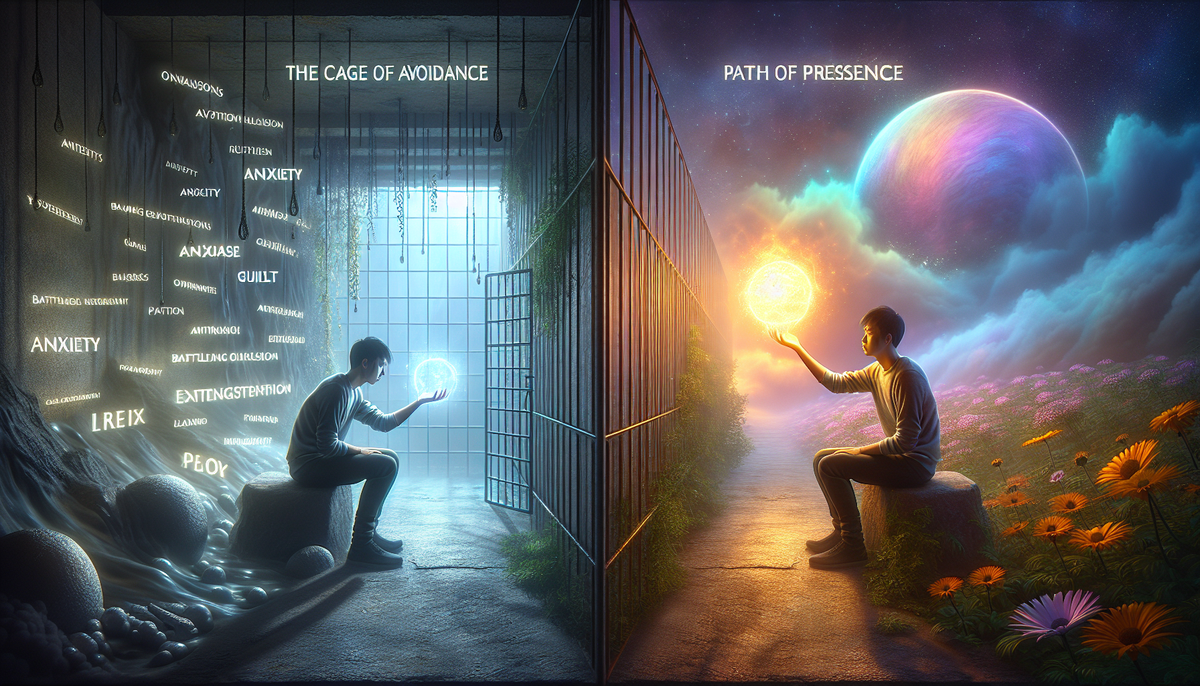
Here is the counterintuitive truth at the heart of emotional sensitivity: the more you try to suppress your emotions, the stronger they become. This is a well-documented psychological phenomenon. When people judge themselves for their emotional reactions, the natural response is avoidance — trying not to feel, distracting, suppressing, intellectualizing. Research on thought suppression shows that attempting to not think about something creates a paradoxical increase in the frequency of that thought. The same mechanism applies to emotions: the act of suppression draws the nervous system's attention directly to what you're trying to avoid.
What Experiential Avoidance Does Long-Term
In the short term, avoidance works — the feeling fades temporarily. This is why it becomes habitual. But research on experiential avoidance shows this short-term relief comes at a steep long-term cost. Chronic avoidance maintains and intensifies emotional distress over time, decreases pain tolerance and resilience, and contributes to anxiety and depression. The pattern is self-reinforcing: the more you avoid, the more threatening emotions feel, the more you need to avoid. Sensitive people who rely heavily on avoidance often report their sensitivity seems to get worse — which makes sense, because avoidance is the fuel keeping the cycle running.
How to Break the Cycle: Approaching Instead of Avoiding
The Core Principle from ACT, DBT, and Modern Emotion Science
Three of the most evidence-based psychological approaches — Acceptance and Commitment Therapy (ACT), Dialectical Behavior Therapy (DBT), and modern emotion regulation research — converge on the same principle: the path through difficult emotions is approach, not avoidance. ACT teaches making room for feelings rather than fighting them. DBT focuses on distress tolerance: the ability to endure intense experiences without making them worse. What this looks like in daily life: noticing the emotion, naming it accurately, and continuing with your life rather than organizing it around avoiding the emotion.
Practical Technique 1 — The 5-Minute Rule
When you feel anxiety about starting something — a difficult conversation, a task you've been dreading — start it immediately, for at least five minutes. Research shows that emotional intensity typically decreases significantly within minutes of engaging with the feared situation rather than avoiding it. The brain learns from direct experience faster than from reassurance. What this builds over time: not the absence of anxiety, but confidence in your ability to function while feeling anxious.
Practical Technique 2 — Label the Emotion Precisely
Research by psychologist Lisa Feldman Barrett on emotional granularity shows that the specificity with which you label an emotion directly affects its neural intensity. Instead of “I feel terrible,” try: “I feel embarrassed because I made a mistake in front of someone whose opinion I respect, and I'm worried they think less of me now.” The first activates a generalized stress response. The second activates a specific, processable circuit. More precise labeling leads to faster recovery and clearer decision-making.
Practical Technique 3 — Use Emotions as Data, Not Verdicts
Sensitive people often treat emotional reactions as verdicts — absolute truths about reality. A more accurate framework: emotions are signals carrying information. Anxiety signals: something matters here, attention is needed. Sadness signals: a loss occurred, processing is needed. Guilt signals: a value was crossed, reflection is invited. Frustration signals: a barrier exists between you and something important. When you treat emotions as data rather than verdicts, you stop trying to eliminate them and start extracting what they're offering.
The Hidden Advantages of Emotional Sensitivity
The fMRI Evidence for Empathy and Awareness
Brain imaging research shows that highly sensitive people exhibit substantially greater blood flow to brain regions associated with empathetic feeling compared to low-sensitivity individuals. This extends across multiple dimensions: affective empathy (feeling what others feel), cognitive empathy (understanding others' perspectives), emotional contagion (picking up on atmospheres), and prosocial behavior. The same neurological wiring that makes sensitive people more susceptible to overwhelm also makes them more attuned to others — a capacity that is genuinely rare and genuinely valuable.
Sensitivity as an Evolutionary Asset
Approximately 15 to 20 percent of people are highly sensitive, a proportion that has remained consistent across many species. Evolutionary psychology suggests this trait persisted because it serves critical social functions: early warning systems for threats, deep reading of group dynamics, creative problem-solving, and care of vulnerable community members. Today this translates to real-world strengths:
- Counseling, teaching, medicine, and social work — fields requiring deep empathy
- Creative work — writing, design, art — where depth of feeling fuels depth of expression
- Leadership and strategy — where nuanced reading of people and environments matters
- Caregiving and close relationships — where emotional attunement is irreplaceable
Reframing the Message You've Been Told
The problem was never being too sensitive. The problem, as research makes clear, is being sensitive and relying on avoidance as the primary coping strategy. Avoidance maintains sensitivity at its most overwhelming level while stripping away the benefits. The research-backed alternative: willingness to experience discomfort — allowing the feeling, naming it, staying present with it — paradoxically reduces emotional frequency and intensity over time. The transformation this enables is not from feeling everything to feeling less. It's from feeling deeply and being overwhelmed, to feeling deeply and staying functional. Those are not the same thing, and the difference between them is everything.
Conclusion
Your emotional sensitivity is not a character flaw awaiting correction. It is a trait rooted in biology, shaped by experience, and capable of being one of your greatest assets — if you learn to work with it rather than against it. The research is clear: suppression, avoidance, and self-judgment maintain sensitivity at its worst and prevent access to its best. Approaching emotions, labeling them precisely, and treating them as informative signals builds something that neither suppression nor toughening up ever could: the capacity to feel deeply and remain fully functional. The path out of overwhelm is not through numbness. It's through presence.
Sources
Psychology Today — You're Not Too Sensitive, Even If It Feels That Way