Why Most New-Year Goals Fail — and How to Design Better Ones for 2026
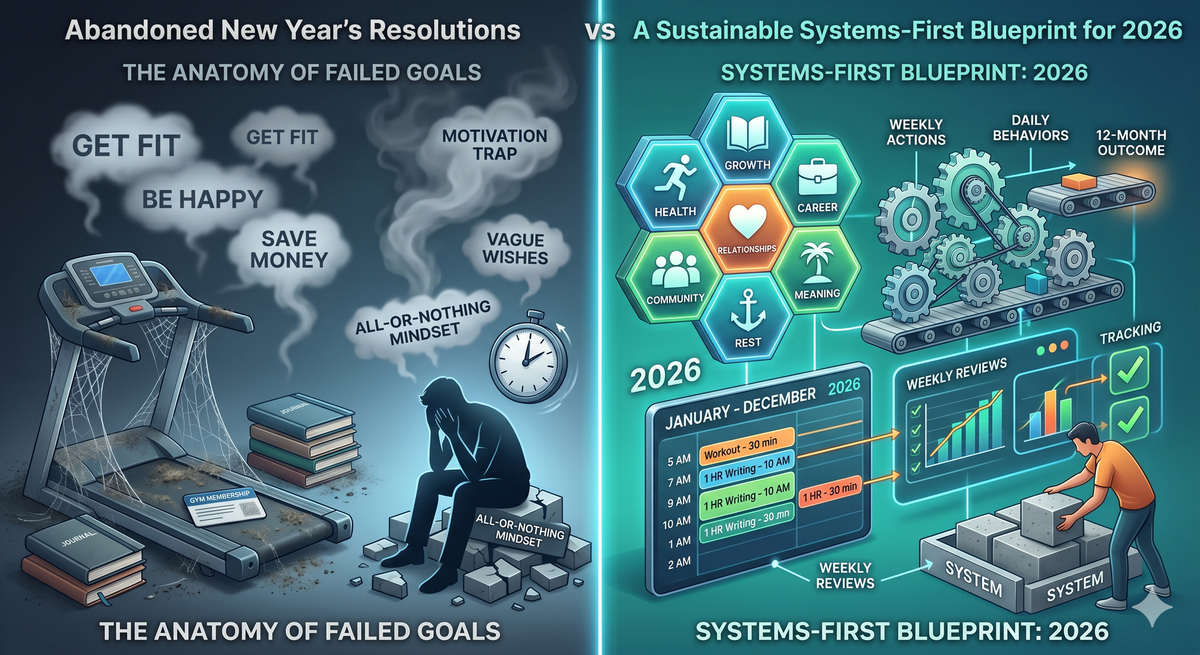
Every January, millions of people write down ambitious resolutions with genuine hope and excitement. By February, most of those promises lie abandoned, collecting dust alongside gym memberships and unopened journals. The statistics are sobering: research consistently shows that approximately 80 percent of New Year's resolutions fail by the second week of February. Yet year after year, we repeat the same cycle, wondering why our willpower seems to evaporate when we need it most.
The truth is, the problem isn't you. The problem is how most people approach goal setting in the first place. Most New-Year goals collapse not because we lack discipline or desire, but because they rely on motivation instead of systems. This article explains the real reasons goals fail — unclear priorities, unrealistic timelines, lack of tracking, and zero connection to daily behavior. More importantly, you'll learn how to design goals for 2026 that actually work by linking them to your calendar, breaking them into weekly actions, understanding which life areas need attention, and avoiding the all-or-nothing mindset that destroys progress.
This isn't about finding better willpower or summoning more motivation. It's about building a framework that honors your values and works with human psychology rather than against it.
The Anatomy of a Failed Goal
Why We Fail Before We Start
Before we can build better goals, we need to understand exactly why the traditional approach fails so spectacularly. The reasons go far deeper than simple laziness or lack of commitment. When you dissect a failed resolution, you'll typically find one or more fundamental design flaws that doomed it from the beginning.
The Motivation Trap: Relying on a Feeling That Never Lasts
Here's what happens in your brain when you set a New Year's resolution: dopamine floods your system. This neurotransmitter, often called the “feel-good chemical,” creates that familiar rush of excitement and possibility. You can practically see your future self — fitter, richer, happier. The vision is intoxicating.
But here's the catch: dopamine spikes with the idea of achievement, not the actual work required to get there. The moment you have to wake up at 5 AM for that workout, skip the dessert, or sit down to write that novel, the dopamine disappears. What felt effortless in your imagination becomes grinding work in reality.
This is the motivation trap. Motivation is not a reliable fuel source for long-term change because it's fundamentally a temporary emotional state. It fluctuates based on:
- Your sleep quality the night before
- Stress levels at work or home
- Weather and seasonal changes
- Social pressures and comparisons
- Physical health and energy levels
Building your entire goal strategy on motivation is like planning a cross-country road trip with a car that might or might not start each morning. You need something more dependable.
Vague Wishes vs. Clear Objectives
Consider these common resolutions: “Get in shape,” “Be happier,” “Save more money,” “Spend more time with family,” “Be more productive.” Notice something? None of these are actually goals. They're wishes — vague aspirations that sound good but provide zero direction for daily action. When your goal is “get in shape,” how do you know what to do tomorrow morning? How will you measure progress? How will you know when you've succeeded?
This vagueness is fatal because it creates decision fatigue, makes progress invisible, and allows endless procrastination. SMART goals — Specific, Measurable, Achievable, Relevant, and Time-bound — became popular precisely because they address this vagueness problem. However, even SMART goals fail if they don't connect to the deeper issues we'll explore next.
The All-or-Nothing Mindset
Perhaps the most destructive pattern in goal failure is the all-or-nothing mindset. This is the belief that goals must be pursued perfectly or not at all. It turns a single missed day into complete goal failure. It's a form of cognitive distortion called “black-and-white thinking,” where outcomes are either perfect success or total failure, with no middle ground. The irony is that setbacks are not only normal — they're inevitable.
No Connection to Your “Why”
Here's a truth that most goal-setting advice glosses over: goals that aren't linked to a deeper sense of meaning are the first to be abandoned when life gets difficult. Consider two people with the same surface-level goal of running a marathon. One is motivated by external validation, the other by a core value of family health. When training gets hard, the person with the intrinsic motivation connected to a life sphere that gives their existence meaning is the one who perseveres.
Designing Goals That Actually Work for 2026
A Systems-First Approach to Goal Setting
Now that we understand why traditional goal-setting fails, let's build a better framework. This approach treats goal design as an engineering problem — one with clear inputs, processes, and outputs that work with human psychology rather than against it.
Step 1: Connect to Your Core Spheres
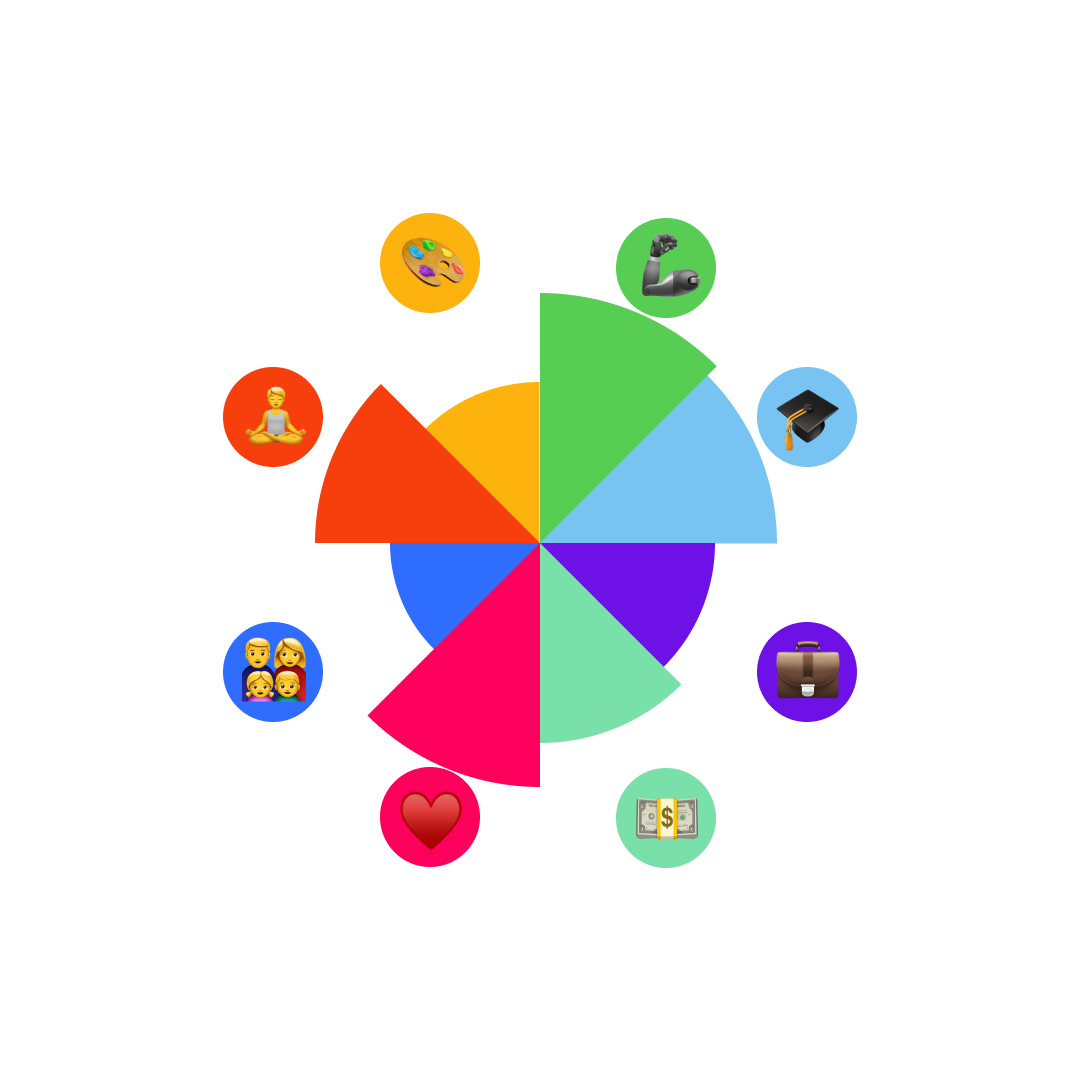
Before writing a single goal, you need to understand where that goal fits in your life. Most people's existence can be organized into eight interconnected life spheres:
- Health — fitness, body care, physical energy.
- Growth — skills, learning, self-development, new knowledge.
- Career — work, professional goals, ambition, performance.
- Finance — income, savings, investments, financial stability.
- Relationships — romantic relationships, partnership, emotional connection.
- Community — family, friends, social circle, support network.
- Meaning — inner world, values, purpose, spirituality, sense-making.
- Rest — hobbies, leisure, travel, recovery, recharging.
The “Meaning” sphere is particularly critical because it often acts as the anchor for all other goals. Before setting any goals for 2026, rate your current satisfaction in each of these eight spheres on a scale of 1 to 10. Your goals should primarily address the areas that need the most attention.
Step 2: Create Systems, Not Just Goals
This is the most important mindset shift you can make. Instead of setting finite endpoints, design systems — repeatable processes that, when followed consistently, produce the results you want as a natural byproduct. Goals give you a destination but no map; systems give you a map that leads inevitably to the destination. Author James Clear explains this beautifully: “You do not rise to the level of your goals. You fall to the level of your systems.”
Step 3: Break It Down into Weekly Actions
Large goals feel overwhelming. The solution is aggressive decomposition — breaking ambitious goals into weekly and daily actions so small they feel almost trivially easy.
- Define the 12-month outcome. Be precise. “Run a marathon in under 4.5 hours” is better than “run a marathon.”
- Identify the quarterly milestones. What needs to be true by the end of March, June, September, and December?
- Determine monthly targets. This creates 12 checkpoints throughout the year.
- Establish weekly actions. What specific actions must happen each week?
- Identify daily behaviors. What must happen every single day to support the weekly actions? (e.g., 7 hours of sleep, lay out running clothes).
This cascading structure ensures that your daily actions connect directly to your annual goals through a clear chain of logic.
Step 4: Link Your Goals to Your Calendar
Here's a rule that separates successful goal-achievers from perpetual dreamers: What gets scheduled gets done. Your goals must appear on your calendar as specific, time-blocked appointments. This creates commitment, prevents scheduling conflicts, and provides structure for decision-making. If your goals don't appear on your calendar, they're not priorities. They're wishes.
Tools for Sustainable Progress
Staying on Track When Motivation Fades
Even with perfect goal design, execution will get hard. This section provides tools to maintain momentum when your initial motivation is a distant memory.
The Power of Tracking
Tracking progress is not optional. It's a core component of sustainable behavior change. When you make progress visible, you trigger psychological rewards that fuel continued effort. Simple tracking methods include a paper calendar (“Don’t break the chain”), habit tracking apps, or a simple spreadsheet. The best tracking system is the one you'll actually use.
The Weekly Review: Your Goal-Setting GPS
A weekly review is a scheduled appointment with yourself to assess progress, troubleshoot problems, and plan the upcoming week. Think of it as recalibrating your GPS. A simple checklist includes: What did I accomplish? What didn’t happen? What obstacles arose? What adjustments are needed? What's the plan for next week? Protect this time fiercely.
Embracing Flexibility and “Good Enough”
To combat the all-or-nothing mindset, adopt a philosophy of flexibility and “good enough.” Progress is rarely linear. A 20-minute walk counts when you can't do a 45-minute run. Writing 100 words is better than writing zero. The research on habit formation is clear: consistency matters more than intensity. When you're tempted to skip an activity, ask yourself: “What's the minimum viable version of this?” Then do that minimum.
Conclusion
The difference between a failed resolution and a life-changing goal isn't willpower. It's design. The framework we've outlined takes a fundamentally different approach. First, connect goals to your core life spheres. Second, build systems rather than setting isolated endpoints. Third, break everything into weekly and daily actions. Fourth, link your goals to your calendar. Finally, use tools that sustain progress when motivation fades. As you prepare for 2026, resist the temptation to make the same resolutions in the same way. Instead, design goals that honor your values, fit into your daily life, and work with — not against — your human psychology. The meaningful life you want isn't built in grand, motivational moments. It's built in small, consistent actions, repeated over time, connected to what matters most to you.