Why Life Feels So Hard Right Now — and the Science-Backed Mindset Shifts That Actually Help
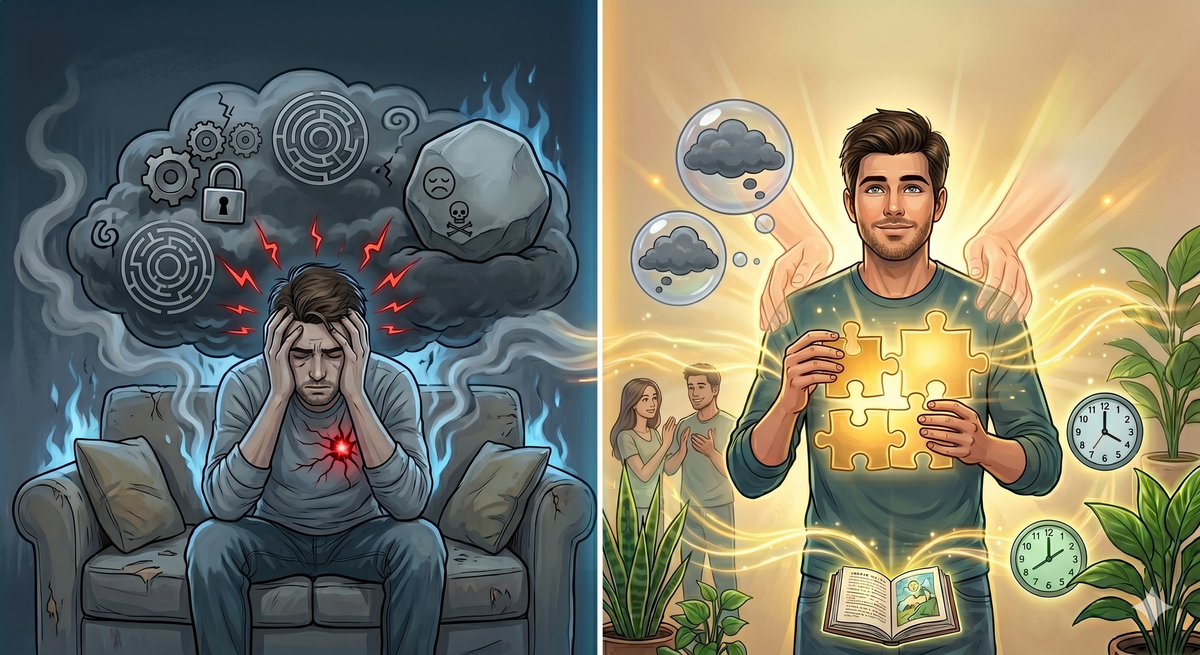
There are moments when life doesn’t just feel difficult — it feels impossible. Not the kind of hard that comes from a tough workout or a demanding project, but a deeper, heavier kind of hard, where even getting through the day feels like carrying something too heavy for too long. If you’ve felt this lately, you’re not broken. You’re human — and science actually has a lot to say about why this happens and what genuinely helps.
Why Does Life Feel So Hard? The Psychology of Difficulty
When Habits Stop Working
Psychologists describe difficulty as the experience of misalignment — when our existing habits, skills, and mental models no longer match the demands in front of us. Your brain, being a master of efficiency, defaults to familiar patterns whenever possible. It conserves energy by running on automatic. But when a new challenge arrives — one that doesn’t fit those patterns — the brain has to work harder, and that friction is what we experience as hard.
This is why the same task can feel effortless to one person and crushing to another. It’s not about intelligence or willpower. It’s about whether your current repertoire matches what the situation requires. When it doesn’t, the gap produces stress, self-doubt, and the persistent sense that something is wrong.
The 80–90% Rule: How Much of Your Stress Is Perception
One of the most transformative findings in stress research comes from psychologists Richard Lazarus and Susan Folkman, who developed cognitive appraisal theory. Their research showed that our stress response isn’t triggered by events themselves — it’s triggered by our interpretation of those events through two rapid mental appraisals: how threatening is this situation, and do I have the resources to cope with it?
Researchers now estimate that only about 10–20% of the stress associated with any given life event is truly uncontrollable and objectively concrete. The remaining 80–90% is shaped by our interpretation, our beliefs, and our perceived capacity to cope — all of which are open to change. That’s not a reason to blame yourself for suffering. It’s a reason to believe that working with your mindset can genuinely move the needle.
The Three Levels of Life’s Challenges
Not all difficulties are the same kind of hard. Research on stress and coping suggests they operate at three distinct levels — each requiring a different approach.
Task-Level Challenges: Short-Term Stress
These are the immediate, time-bound stressors: a difficult conversation, a deadline bearing down, a mistake that needs fixing. Task-level challenges are stressful but bounded. Self-regulation strategies — deep breathing, focused problem-solving, short recovery breaks — work well here. The discomfort is real, but it typically passes once the challenge is resolved.
Life Situation Challenges: Major Transitions and Chronic Stress
These are medium-term difficulties that restructure your life: losing a job, a relationship ending, grieving a loss, relocating to a new city. Life situation challenges don’t resolve quickly, and they often pile up. They require longer-term coping strategies — building support systems, adjusting goals rather than abandoning them, and accepting that adaptation takes time. Research consistently shows that people underestimate how long major transitions take to integrate psychologically.
Identity-Level Challenges: Systemic and Deeply Personal Stressors
These are the hardest category: challenges rooted in who you are and the world you live in. Chronic illness, discrimination, poverty, existential uncertainty — these cannot simply be thought away. They require meaning-making, community, and structural support that goes beyond individual coping. Acknowledging that some things are genuinely hard because the environment is hard — not because you’re failing — is itself a form of psychological clarity.
The Neuroscience of Why Mindset Matters
When you encounter a stressor, your amygdala fires rapidly, flooding your system with stress hormones and narrowing your attention to the perceived danger. But your prefrontal cortex — the region responsible for logic, planning, and perspective-taking — can intercept that signal and reinterpret it. This process is called cognitive reappraisal, and it activates the lateral prefrontal cortex and anterior cingulate cortex.
With consistent practice, the time it takes to shift from emotional reactivity to a broader perspective actually decreases. Reappraisal is a trainable skill. But there’s a critical caveat: reappraisal capacity is a biological resource that gets depleted by sleep deprivation, cognitive overload, and sustained emotional arousal. This explains why everything feels harder when you’re exhausted — it’s not that your problems got bigger. It’s that your brain’s capacity to manage them has been reduced.
Research also shows that people who view stress as a challenge rather than a threat show measurably different physiological responses: lower cortisol levels, relaxed blood vessels, and a heart rate that resembles excitement rather than fear. The same situation, filtered through a different lens, produces a fundamentally different body.
Mindset Shift #1: From Fixed to Growth
Stanford psychologist Carol Dweck’s decades of research produced one of the most replicated findings in modern psychology: the way you think about your capacity to grow determines how you respond to difficulty. People with a fixed mindset believe qualities like intelligence are static — when they fail, it feels like evidence of permanent inadequacy. People with a growth mindset believe ability is malleable — failure is feedback, not verdict.
Critically, growth mindset and self-compassion reinforce each other. People who lack self-compassion often default to fixed-mindset thinking because they can’t afford to fail. Self-compassion removes that threat, making it safer to try, learn, and grow.
How to practice growth mindset in difficult moments:
- Notice fixed-mindset self-talk: replace “I’m just not good at this” with “I haven’t figured this out yet.”
- Get curious about the gap — what specific skill or knowledge is actually missing?
- Identify one small action that moves toward competence rather than avoidance.
- After the challenge passes, ask what you actually learned — not just what happened.
Mindset Shift #2: From Avoidance to Acceptance (ACT)
Acceptance and Commitment Therapy (ACT) offers a fundamentally different approach to psychological pain. Rather than trying to eliminate uncomfortable thoughts and feelings, ACT teaches you to change your relationship with them. The theory begins with cognitive fusion — the tendency to treat thoughts as literal truths. When you think “I can’t handle this,” fusion means you experience it as fact. ACT’s defusion techniques teach you to notice: “I’m having the thought that I can’t handle this.” That small gap changes everything.
A 2025 meta-analysis confirmed that ACT significantly reduces negative automatic thoughts and emotional distress. A randomized controlled trial found that a six-week ACT program improved resilience, self-compassion, and psychological flexibility in adolescents. ACT doesn’t promise to make life easier. It promises to make you less at war with your life.
Three core ACT principles to carry into daily life:
- Accept discomfort as a natural part of meaningful living, not a sign that something has gone wrong.
- Defuse from unhelpful thoughts by noticing them as mental events rather than facts.
- Act on your values — what matters most to you — rather than waiting until you feel ready.
Mindset Shift #3: From Self-Criticism to Self-Compassion
When life feels hard, most of us turn inward — and not kindly. We criticize ourselves for struggling, for not being further along, for not handling it better. Research by Dr. Kristin Neff consistently shows this amplifies psychological suffering rather than resolving it. Self-compassion — responding to your difficulties with the kindness you’d offer a good friend — works through three interconnected components:
- Self-kindness: treating yourself with warmth rather than harsh judgment when you’re struggling.
- Common humanity: recognizing that suffering and imperfection are part of the shared human experience.
- Mindfulness: holding painful experiences with balanced awareness rather than over-identifying or suppressing them.
Research shows self-compassion is one of the strongest predictors of psychological well-being, buffers against ruminative self-criticism, and — critically — doesn’t make people complacent. People who are self-compassionate are actually more motivated to learn from mistakes, not less. A simple practice: when you notice self-critical thoughts, pause and ask: what would I say to a close friend going through exactly this?
Mindset Shift #4: Reframe the Stress Itself
Most of us have been taught that stress is bad. But the science is more nuanced. Research drawing on large-scale studies found that people who believed stress was harmful and experienced high stress had significantly higher mortality rates. But people who experienced high stress and did not believe it was harmful were among the healthiest in the study. The belief about stress mattered more than the stress itself.
When you shift from viewing a stressor as a threat to viewing it as a challenge, your body responds differently: blood vessels stay relaxed, cortisol drops, and your heart rate resembles excitement rather than fear. Here is a five-step reframing exercise to use in stressful moments:
- Pause. Take one slow breath to interrupt the automatic stress response cycle.
- Name the emotion specifically — “I feel anxious” is more actionable than “I feel bad.”
- Look for the legitimate challenge — what is this situation actually asking of you?
- Ask: what resources, skills, or support do you have available right now?
- Identify one specific action you can take in the next hour — not to solve everything, but to move forward.
Mindset Shift #5: Protect Your Reappraisal Capacity
None of the above works if your brain is running on empty. Because reappraisal capacity is a biological resource that gets depleted by chronic stress, sleep deprivation, and cognitive overload, one of the most powerful things you can do when life feels hard is to actively protect your brain’s ability to regulate itself. This is not self-indulgence — it is cognitive maintenance.
Research consistently identifies social support as the single strongest predictor of resilience across different types of adversity. Having even one or two people who genuinely see and support you buffers the psychological impact of difficulty in ways no individual practice can replicate. Six daily practices to protect your mental flexibility:
- Prioritize sleep — even one night of poor sleep measurably reduces prefrontal cortex function.
- Build in micro-recovery breaks during cognitively demanding days — ten minutes of genuine rest, not scrolling.
- Limit decision fatigue by routinizing low-stakes choices (meals, routines, clothing).
- Invest in your relationships — social connection isn’t a luxury when things are hard, it’s a resource.
- Move your body — even 20 minutes of walking reduces cortisol and improves cognitive flexibility.
- Practice gratitude — not to bypass pain, but to train attention toward what is still working.
A Quick Self-Check: What Kind of Hard Are You Facing?
Before choosing a coping strategy, it helps to identify what level of challenge you’re dealing with. If you’re facing a task-level challenge, focus on self-regulation techniques and breaking it into smaller steps. If you’re facing a life situation challenge, build your support network, adjust your timeline, and give yourself permission to adapt gradually. If you’re facing an identity-level challenge, seek community with others who share your experience, work toward meaning rather than resolution, and pursue professional or structural support — not just mindset tools.
A note that matters: some things are genuinely hard because the circumstances are genuinely hard. No amount of mindset work fully neutralizes poverty, discrimination, or serious illness. Acknowledging this is not weakness — it’s clarity about what kind of help you actually need.
Life Doesn’t Get Easier — You Get More Capable
The goal of every mindset shift in this article is not to make life feel easy. It’s to change your relationship with difficulty so that hard things become more navigable rather than more devastating. Growing from fixed to growth mindset. Moving from avoidance to acceptance. Trading self-criticism for self-compassion. Reframing stress as challenge. Protecting the mental capacity to do all of the above — these are not hacks or shortcuts. They are practices, built over time, that gradually expand what you can carry.
Science doesn’t promise us a life without difficulty. It offers something more honest and more durable: evidence that you can grow through it, that your brain is more adaptable than you think, and that the way you think about hard things genuinely shapes how hard they feel. Pick one shift. Practice it today. That’s where resilience begins.
Sources
Psychology Today — What Makes Life Feel Hard, and How to Cope