Stopping the Stall: Everyday Lessons from "The Nature of Procrastination: A Meta-Analytic and Theoretical Review of Quintessential Self-Regulatory Failure"
Have you ever spent an entire afternoon organizing your digital files, cleaning your kitchen, or scrolling through social media, just to avoid starting a major project? We have all been there. Most of us assume that this chronic delay is a sign of deep character flaws, profound laziness, or an agonizing fear of failure. However, an exhaustive review examining centuries of human behavior and hundreds of scientific studies reveals the biological and psychological mechanics of why we stall.
By looking at exactly how our brains weigh decisions and value time, we can finally stop fighting our own nature and start getting things done. Here is what the science says about the real roots of procrastination, and how you can hack your habits to beat it.
The Myth of the "Anxious Perfectionist"
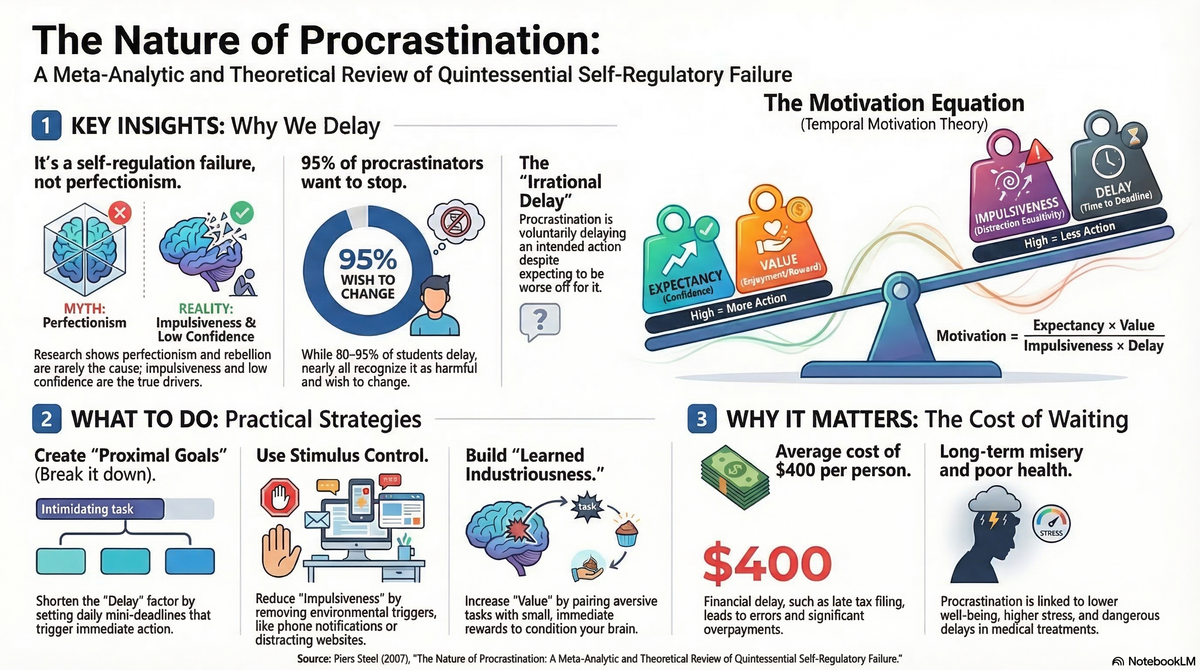
For years, popular psychology has suggested that people procrastinate because they are perfectionists who are terrified of making a mistake. However, the data completely debunks this myth. The research reveals that perfectionists actually tend to procrastinate less than the average person. Furthermore, general anxiety and neuroticism are barely connected to procrastination at all. When anxious people delay tasks, it is usually because they are impulsive, not because they are paralyzed by fear.
Practical Guidance:
- What to do: Forgive yourself. Recognize that putting things off doesn't mean you have deep-seated psychological anxiety or a fear of success.
- What not to do: Don't use "I am just a perfectionist" as a comforting excuse for why you haven't started your work.
- Habit to change: Stop trying to "calm your anxiety" before starting a task. Your delay is likely an issue of focus, not fear, so redirect your energy into simply taking the first step.
The "Right Now" Trap
The most powerful driver of procrastination is our brain's terrible sense of time. According to Temporal Motivation Theory, human beings naturally discount the value of a reward if it is far away in the future. Given the choice between a small, immediate reward (like watching a funny video) and a massive, distant reward (like getting a good grade at the end of the semester), our brains instinctively favor the immediate gratification. Procrastinators aren't lazy; they are simply highly impulsive and extremely susceptible to the temptations of the present moment.
Practical Guidance:
- What to do: Break massive, long-term projects into tiny, daily goals with immediate deadlines to trick your brain into feeling a sense of urgency.
- What not to do: Don't rely on willpower to fight off temptations when a deadline is still months away. Willpower almost always loses to immediate pleasure.
- Habit to change: Practice "stimulus control" by physically hiding your distractions. Close your email tabs, put your phone in another room, and make your temptations harder to access than your work.
The Power of Boredom
Sometimes the simplest explanation is the most accurate: we procrastinate because we simply hate the task. "Task aversiveness" is one of the strongest predictors of delay. If a task is frustrating, resentful, or—most importantly—boring, we will do almost anything to avoid it. Unfortunately, when our energy levels drop, tasks feel even more difficult and unpleasant, making us even more likely to stall.
Practical Guidance:
- What to do: Pair a miserable task with an immediate reward you love—a strategy known as "fusing". For example, only let yourself drink your favorite expensive coffee while you are doing your dreaded monthly budget.
- What not to do: Don't wait until you are exhausted at the end of the day to tackle your most boring chores.
- Decision to change: Automate or habitualize your most tedious tasks. If you do the same boring chore at the exact same time every week, it becomes an automatic reflex that requires zero decision-making energy.
The Crisis of Confidence
While perfectionism isn't the culprit, a lack of confidence absolutely is. The research shows that low "self-efficacy"—the belief that you lack the capability to successfully complete a task—strongly drives people to procrastinate. When we doubt our abilities, we often engage in "self-handicapping". By delaying our start until the absolute last minute, we protect our egos. If we fail, we can blame the lack of time rather than a lack of talent.
Practical Guidance:
- What to do: Build your confidence through "performance accomplishments." Prove to yourself that you are capable by tackling the easiest, most manageable part of a project first.
- What not to do: Don't start a daunting project by looking at the most complex, intimidating step, which will instantly crush your confidence and trigger avoidance.
- Habit to change: Stop judging your worth based on your output. When you separate your self-esteem from your work, you remove the ego-protecting need to self-handicap.
Summary for Life
The deep truth of human motivation boils down to a single, concrete life rule: To defeat procrastination, you must aggressively manage your environment by hiding present temptations, and actively pull distant deadlines into the immediate present.
Reflective Question: If you completely removed the distractions from your environment right now, would you still be putting off your biggest goal, or is your environment secretly making your decisions for you?
References
Steel, P. (2007). The nature of procrastination: A meta‑analytic and theoretical review of quintessential self‑regulatory failure. Psychological Bulletin, 133(1), 65–94.
DOI: https://doi.org/10.1037/0033‑2909.133.1.65