
Eating for a Second Chance: Why "Mediterranean Diet, Traditional Risk Factors, and the Rate of Cardiovascular Complications After Myocardial Infarction" is Your Ultimate Heart Guide
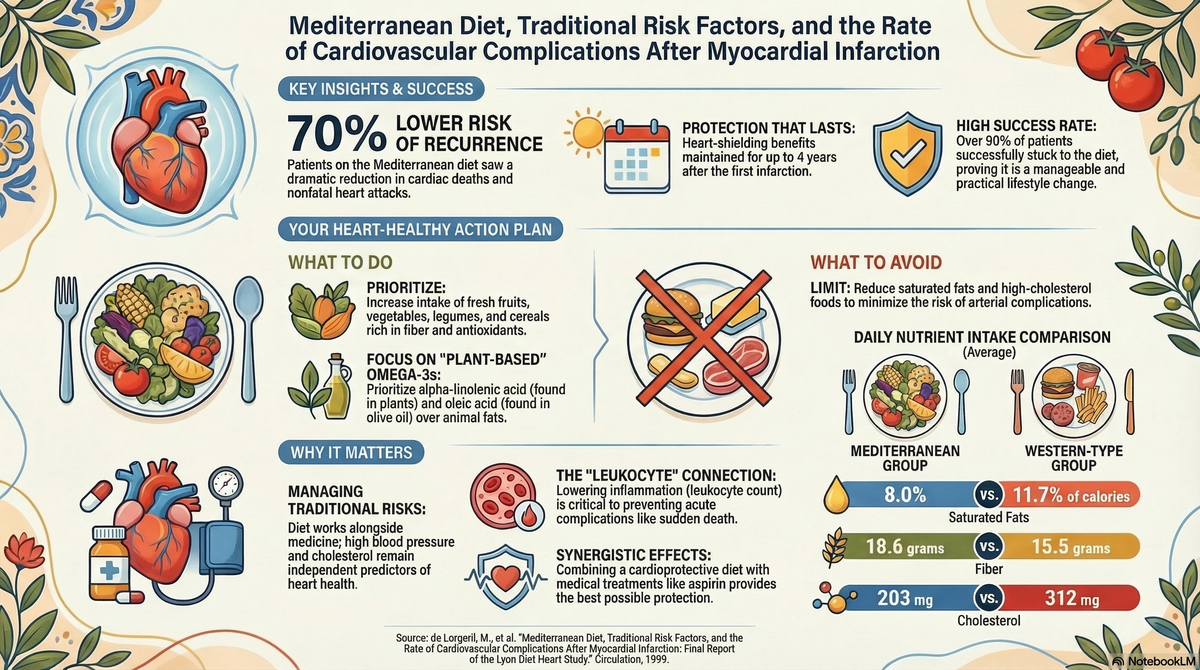
Surviving a heart attack is a life-altering wake-up call. Suddenly, every meal feels like a high-stakes decision, and the internet is flooded with confusing, contradictory advice about what to eat to protect your heart. Do you banish all fats? Do you eat only salads?
A landmark study, the Lyon Diet Heart Study, cut through this noise with a powerful message of hope. By tracking heart attack survivors over four years, researchers discovered that you don't have to eat bland, joyless meals to save your life. In fact, adopting a rich, flavorful Mediterranean-style diet can drastically reduce your chances of suffering another heart attack. Here is what the science says about protecting your heart without losing your love for food.
The Ultimate Shield: The Mediterranean Diet
The most striking finding from this research is just how powerfully the Mediterranean diet protects the cardiovascular system. Patients who followed a Mediterranean-style diet saw a massive reduction in their risk of a second heart attack, cardiac death, and other major heart complications compared to those eating a standard "prudent" Western diet. This protective effect wasn't just a short-term fluke; it was successfully maintained for up to four years after their first heart attack. By focusing on foods low in saturated fats and high in fresh fruits, vegetables, legumes, and whole grains, patients built a robust defense system for their hearts.
Practical Guidance:
- What to do: Transition your daily meals to a Mediterranean pattern, emphasizing fresh vegetables, beans, whole grains, and healthy fats.
- What not to do: Don't rely on the standard "Western" diet, even a seemingly prudent one, if you want maximum protection against future heart complications.
- Habit to change: Swap butter and heavy creams for healthy plant oils and increase your daily intake of fresh, fiber-rich fruits and vegetables.
The Silent Saboteurs: Blood Pressure and Cholesterol
While the Mediterranean diet is incredibly effective, it is not a magical cure-all that erases other health dangers. The study revealed that major traditional risk factors—specifically high blood pressure and high total cholesterol—remained significant, independent predictors of future heart problems. Every incremental increase in cholesterol or blood pressure still heightened the risk of a recurring cardiac event. This means that while a cardioprotective diet is the foundation of recovery, it does not alter the dangerous reality of uncontrolled blood pressure or high cholesterol.
Practical Guidance:
- What to do: Work closely with your doctor to actively monitor and manage your cholesterol levels and blood pressure.
- What not to do: Don't assume that eating a healthy diet gives you a "free pass" to ignore your cholesterol numbers or skip your blood pressure check-ups.
- Decision to change: Treat your recovery as a two-pronged approach: commit to the Mediterranean diet in the kitchen, and commit to medical management of your blood pressure and cholesterol in the doctor's office.
The Secret Ingredient: Alpha-Linolenic Acid (ALA)
Not all fats are created equal, and the researchers pinpointed one specific type of fat that acts as a superstar for heart recovery: alpha-linolenic acid (ALA). This is a type of plant-based omega-3 fatty acid. The study found that higher intakes of ALA were significantly associated with an improved prognosis and a lower risk of recurring heart issues. The Mediterranean diet tested in this study was intentionally rich in this specific nutrient, proving that adding the right kinds of fats is far more beneficial than just cutting out all fats.
Practical Guidance:
- What to do: Seek out dietary sources of alpha-linolenic acid, such as walnuts, flaxseeds, and certain vegetable oils, to boost your heart's defenses.
- What not to do: Don't adopt a "zero-fat" diet; your heart desperately needs healthy, protective fats like ALA to function optimally.
- Habit to change: Start using oils rich in alpha-linolenic and oleic acids for your cooking and salad dressings instead of relying on saturated animal fats.
A Sustainable Lifestyle, Not a Crash Diet
We often hear that changing dietary habits is too difficult and that most people simply give up. However, this study proved the exact opposite. Years after the trial began, the vast majority of the patients were still closely following the Mediterranean diet. Because the diet is gastronomically pleasing and easily adaptable to a busy lifestyle, it is highly sustainable for the long haul. Furthermore, the diet works perfectly alongside standard cardiovascular medications. For example, the use of daily aspirin provided an additional, independent protective effect alongside the food the patients ate.
Practical Guidance:
- What to do: Continue taking your prescribed heart medications, such as aspirin, as they work as an excellent team alongside your new dietary habits.
- What not to do: Don't treat this way of eating as a restrictive, short-term "diet" that you will eventually abandon.
- Habit to change: Focus on making the Mediterranean diet financially and practically feasible for your whole family, ensuring it becomes a permanent lifestyle shift rather than a temporary fix.
Summary for Life
The research leads to a powerful, concrete life rule: To protect your heart for the long term, build your lifestyle around the delicious, healthy fats and fresh foods of the Mediterranean diet, while remaining relentlessly vigilant about your blood pressure and cholesterol.
Reflective Question: If a flavorful, vegetable-and-healthy-oil-rich diet has the power to dramatically cut your risk of a heart attack, what small, delicious swap can you make on your dinner plate tonight?
References
de Lorgeril M., Salen P., Martin J.L., Monjaud I., Delaye J., Mamelle N.
“Mediterranean diet, traditional risk factors, and the rate of cardiovascular complications after myocardial infarction: final report of the Lyon Diet Heart Study.”
Circulation, 1999 DOI: 10.1161/01.cir.99.6.779