Eat Fat, Save Your Heart: The Science Behind "Primary Prevention of Cardiovascular Disease with a Mediterranean Diet Supplemented with Extra-Virgin Olive Oil or Nuts"
We have all stood in the grocery aisle debating whether to buy the "low-fat" version of our favorite salad dressing. For decades, we were taught that dietary fat was the ultimate enemy of a healthy heart, leading to a culture of calorie-counting and bland, fat-free meals. But what if the secret to avoiding a heart attack isn’t starving yourself of fats, but rather indulging in the right kinds?
A monumental research study completely flipped the script on cardiovascular health. It turns out that a rich, flavorful diet full of healthy fats is significantly better at protecting your heart than a standard low-fat diet. Here is what the science says about eating your way to a longer, healthier life without giving up the joy of food.
The Myth of the Low-Fat Diet
The most groundbreaking insight from this research is that simply cutting fat out of your diet is not the best way to prevent cardiovascular disease. When researchers compared a standard low-fat diet to a Mediterranean diet, the Mediterranean approach won by a landslide. People eating an "energy-unrestricted" Mediterranean diet—meaning they didn't have to obsessively count calories or limit how much they ate—had a significantly lower risk of suffering from a heart attack, stroke, or cardiovascular-related death. The lesson is clear: your heart needs high-quality nutrients, not just empty restrictions.
Practical Guidance:
- What to do: Focus on the quality and type of food you are eating, rather than just obsessing over the total number of calories or fat grams.
- What not to do: Don't rely on highly processed "low-fat" or "fat-free" diet foods under the assumption that they are automatically good for your heart.
- Habit to change: Stop treating all fats as the enemy. Give yourself permission to enjoy satisfying, nutrient-dense meals without the guilt of strict calorie counting.
The Magic of Olive Oil and Nuts
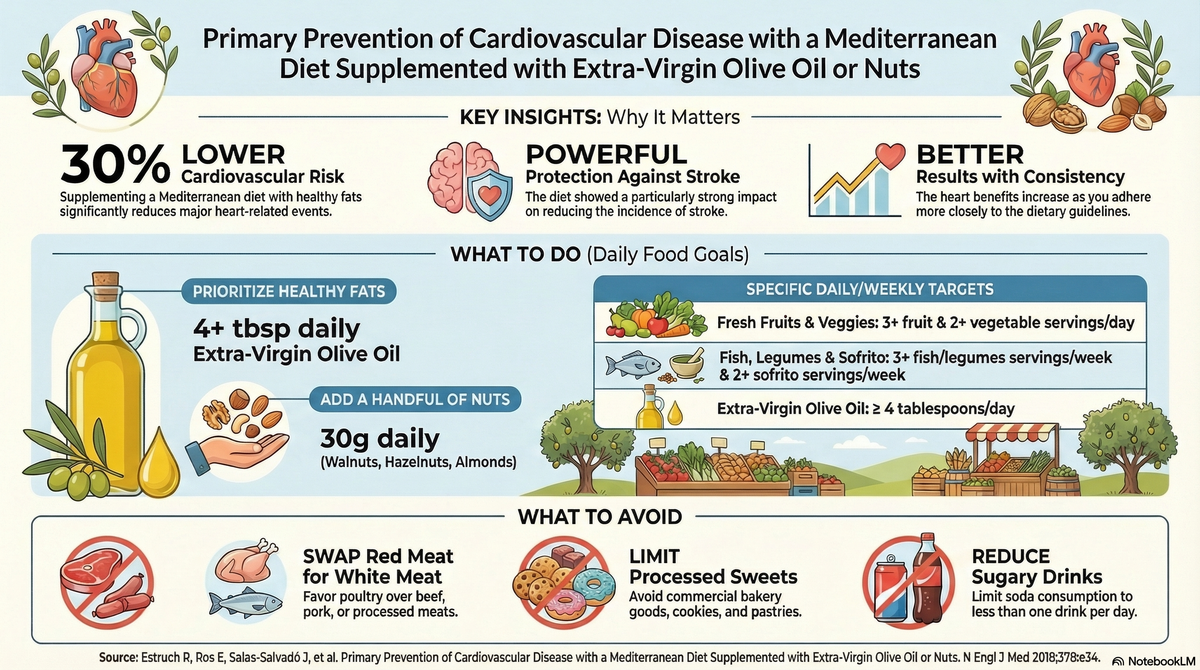
If the Mediterranean diet is the vehicle for heart health, extra-virgin olive oil and tree nuts are the engine. The research specifically highlighted that supplementing your daily meals with high amounts of these two ingredients provides massive cardiovascular protection. Extra-virgin olive oil is packed with powerful plant compounds called polyphenols, while mixed nuts (like walnuts, almonds, and hazelnuts) deliver essential healthy fats. These aren't just occasional treats; they are daily medical necessities for your heart.
Practical Guidance:
- What to do: Aim to consume about 4 tablespoons of extra-virgin olive oil every single day, using it for cooking, dressings, and even baking.
- What not to do: Do not use standard spread fats, butter, or refined vegetable oils, which do not offer the same heart-protecting benefits.
- Decision to change: Swap your afternoon potato chips or commercial baked goods for a daily handful (about 30 grams) of mixed walnuts, almonds, and hazelnuts.
Rebuilding Your Plate
Beyond olive oil and nuts, the Mediterranean pattern requires a broader shift in how you structure your meals. The diet heavily prioritizes fresh, whole foods from the earth and the sea, while aggressively minimizing processed junk and heavy meats. The goal is to flood your body with fiber, vitamins, and lean proteins that keep your blood vessels flexible and clear.
Practical Guidance:
- What to do: Eat at least three servings of fish or seafood and three servings of legumes (like beans and lentils) every single week.
- What not to do: Avoid sugary soda drinks completely, and limit red or processed meats (like bacon and sausages) to less than one serving a day.
- Habit to change: Make poultry (white meat) or fish your primary dinner proteins instead of red meat, and get in the habit of cooking with sofrito—a savory, slow-simmered sauce of tomatoes, onions, garlic, and olive oil—at least twice a week.
Summary for Life
The research points to a delicious and concrete life rule: To protect your heart, stop fearing fat and start actively drenching your plate in extra-virgin olive oil, snacking on nuts, and building your meals around fresh plants and fish.Reflective
Question: If preventing a stroke or a heart attack could be as simple as changing the oil you cook with and the snacks you keep in your pantry, what is stopping you from upgrading your kitchen today?
References
Estruch R., Ros E., Salas-Salvadó J., et al.
“Primary Prevention of Cardiovascular Disease with a Mediterranean Diet (Re-analysis).”
New England Journal of Medicine, 2018. DOI: 10.1056/NEJMoa1800389