Designing a Joyful Life: The Science Behind "Pursuing Happiness: The Architecture of Sustainable Change"
Most of us are on a constant quest for joy, assuming that if we just buy the right house, find the perfect partner, or make a little more money, we will finally be happy. But when we reach those milestones, the thrill often fades much faster than we expect, leaving us wondering if sustainable happiness is even possible. A groundbreaking framework reveals exactly what determines our long-term joy, proving that a huge portion of our well-being is actually entirely in our hands.
It turns out that sustainable happiness is not a myth, but you have to build it correctly. Here is what the science says about the architecture of joy and how you can take control of your mood.
The 50% Baseline: Your Genetic Set Point
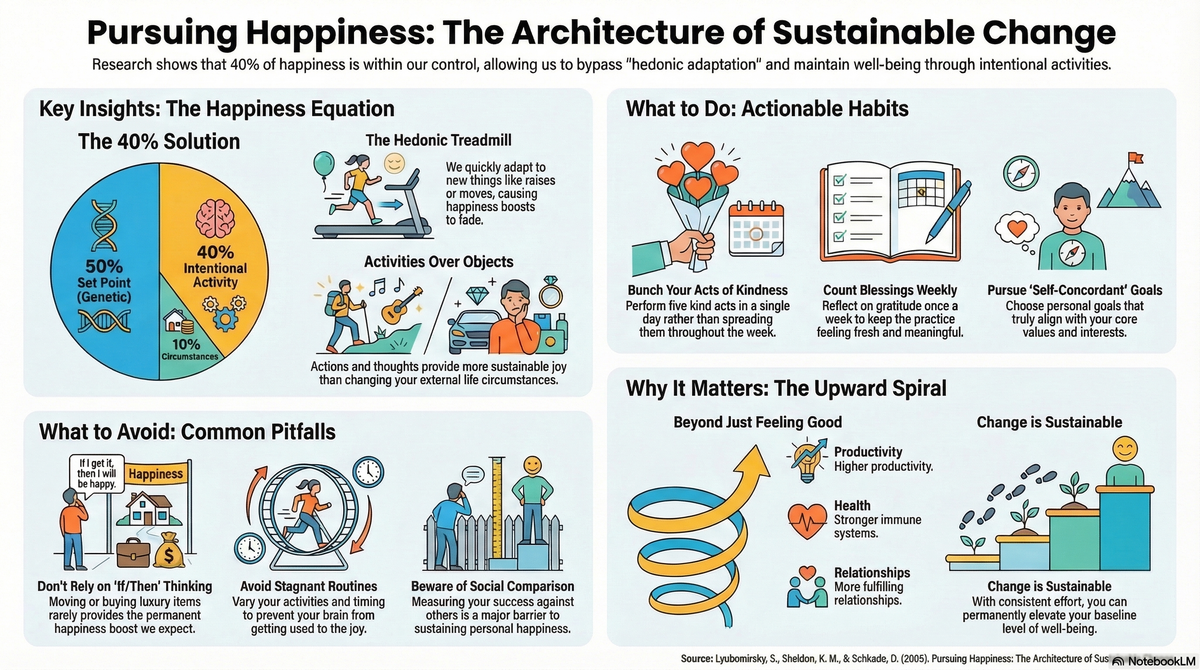
If you feel like you are naturally just a little more anxious or a little more cheerful than your friends, you are right. Researchers discovered that approximately 50% of our chronic happiness level is determined by our genetics. This creates a "set point" or a baseline that we naturally return to over time, regardless of what happens to us. This set point is rooted in our basic neurobiology and personality traits. It is fixed and highly stable, meaning you cannot permanently change your innate temperament. Understanding this frees us from the exhausting expectation that we are supposed to be ecstatic all the time.
Practical Guidance:
- What to do: Accept your natural baseline and give yourself grace; if you are not a naturally bubbly person, that is entirely okay and biologically normal.
- What not to do: Don't beat yourself up for not being as naturally cheerful as someone else, and do not try to fight your basic temperament.
- Habit to change: Stop wishing for a different personality and instead shift your energy toward the aspects of your life that you actually have the power to control.
The Circumstance Trap
We spend the vast majority of our time and money trying to improve our life circumstances—moving to sunnier states, chasing promotions, or buying better cars. Yet, shockingly, our circumstances only account for about 10% of our overall happiness. Why is this number so low? Because humans are masters of "hedonic adaptation". We rapidly get used to new, constant circumstances. Once the initial thrill of the new salary or the new city wears off, we quickly return to our genetic baseline. Relying on major life changes to make you permanently happy is like trying to walk up a down escalator.
Practical Guidance:
- What to do: Enjoy the positive upgrades in your life, but actively remind yourself to appreciate them so you don't take them for granted.
- What not to do: Don't sacrifice your daily well-being for the illusion that achieving a massive milestone (like making a certain amount of money) will permanently "fix" your life.
- Decision to change: Abandon the "I will be happy when..." mindset. Recognize that upgrading your circumstances is not the secret to long-term joy.
The 40% Solution: Intentional Activity
If 50% of our happiness is genetic and 10% relies on circumstances, where does the remaining 40% come from? It comes from intentional activity—the daily behaviors, thoughts, and goals we actively choose to pursue. This is the most promising avenue for creating sustainable happiness. Unlike a new house, which just sits there and becomes normal, activities are episodic and require our active engagement. Whether it is exercising, pursuing a meaningful goal, committing acts of kindness, or pausing to count your blessings, engaging in intentional effort directly counteracts adaptation and keeps joy fresh.
Practical Guidance:
- What to do: Actively schedule daily or weekly activities that require your effort and engagement, such as a hobby, a fitness routine, or a gratitude practice.
- What not to do: Don't wait for happiness to just passively "happen" to you. Joy requires you to act upon your environment, not just observe it.
- Habit to change: Treat your joy as a verb, not a noun. Build a habit of intentionally initiating positive activities even when you feel like you don't have the initial motivation.
Finding Your Fit and Keeping It Fresh
Not all activities will work for all people. The research emphasizes the importance of "person-activity fit". If you are an introvert, forcing yourself into massive social gatherings won't boost your mood, just as a nature-lover might hate running on an indoor treadmill. You must choose activities that align with your deep interests and values. Furthermore, to stop yourself from getting bored with your new habits, you must vary how and when you do them. A habit of initiating an activity is great, but executing it the exact same way every single day will eventually kill the joy.
Practical Guidance:
- What to do: Experiment with different happiness-boosting strategies until you find the ones that feel authentic and natural to your specific personality.
- What not to do: Don't blindly copy someone else's daily routine just because it works for them.
- Habit to change: Constantly inject variety into your positive habits. If you love running, change your route; if you practice gratitude, focus on different areas of your life each day to keep the practice deeply meaningful.
Summary for Life
The architecture of sustainable joy points to a concrete life rule: Because you quickly adapt to your circumstances, true happiness cannot be bought or achieved as a final destination; it must be continually generated through intentional, meaningful, and varied daily activities.
Reflective Question: Knowing that a massive 40% of your happiness is entirely in your control, what intentional, effortful activity will you choose to start today?
References
Lyubomirsky, S., Sheldon, K. M., & Schkade, D. Pursuing happiness: The architecture of sustainable change. Review of General Psychology, 2005. 9(2), 111–131.