Beyond Just Tired: How to Beat Workplace Exhaustion Based on "Understanding the burnout experience: recent research and its implications for psychiatry"
We have all had those mornings where hitting the snooze button feels like a matter of survival. You drag yourself to work, snap at a coworker over a minor issue, and stare at your screen feeling like absolutely nothing you do matters. Most of us brush this off as just being "tired" or needing a vacation. But what if a week on the beach isn’t going to fix the problem?
A comprehensive review of occupational psychology reveals that true burnout is a complex, multi-layered crisis that cannot be cured by a nap. By looking at decades of research, experts have unpacked the precise reasons why our jobs drain us and exactly what we can do to reclaim our professional lives. Here is what the science says about surviving the modern workplace.
Burnout is More Than Just Exhaustion
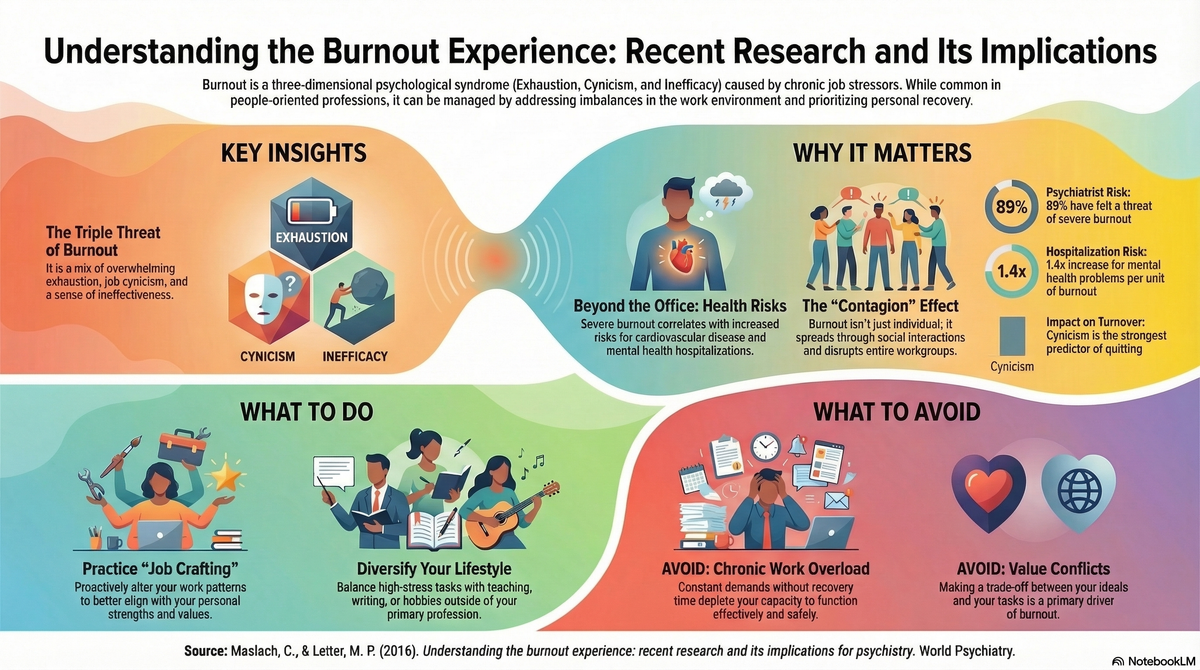
When we think of burnout, we usually picture pure physical and mental exhaustion. However, the research shows that equating burnout simply to "being tired" misses the bigger picture entirely. True burnout is a three-dimensional syndrome. It starts with overwhelming exhaustion, but it also includes deep cynicism (feeling detached and irritable toward people) and a profound sense of ineffectiveness (feeling like you are failing and your work has no value). If you treat burnout simply as a fatigue problem, you will miss the deeper crisis of meaning and values that is actually destroying your motivation.
Practical Guidance:
- What to do: Pay attention to your attitude, not just your energy levels. If you find yourself becoming increasingly cynical, irritable, or emotionally detached from your coworkers and clients, treat it as a major warning sign.
- What not to do: Don't assume that a long weekend or a vacation will cure your burnout if you are returning to a job where you feel completely useless and unappreciated.
- Habit to change: Stop calling every instance of fatigue "burnout." Differentiate between needing physical rest and needing to rebuild your sense of professional purpose.
The Six Mismatches That Steal Your Joy
Why do some jobs energize us while others crush our spirits? The research identifies six specific areas where a mismatch between the employee and the workplace breeds burnout: workload, control, reward, community, fairness, and values. While a heavy workload is the most obvious culprit, a lack of control is just as dangerous; when you have no say in how you do your job, your engagement plummets. Even more critically, if there is a fundamental conflict between your personal values and the company's actions, you will constantly feel forced to trade your integrity for a paycheck, rapidly accelerating burnout.
Practical Guidance:
- What to do: Audit your job using the six areas. Identify exactly where the biggest mismatch is happening (e.g., is it a lack of fairness, or a lack of reward?) so you can address the specific root cause.
- What not to do: Don't stay passive in a work environment that fundamentally violates your core personal values; the constant ethical trade-offs will drain you.
- Decision to change: Look for ways to increase your autonomy. Actively negotiate for more control over your daily tasks, schedule, or decision-making processes, as a sense of control is a powerful buffer against stress.
The Danger of "Contagious" Cynicism
Burnout is not just a personal failing; it is a highly social phenomenon. The research highlights that the quality of your relationships at work plays a massive role in your mental health. Furthermore, burnout can literally be "contagious." When people are burned out, they cause interpersonal conflicts, disrupt tasks, and spread their cynicism through everyday interactions, dragging the entire workgroup down with them. Negative social interactions, incivility, and aggressive colleagues actively drain your energy and distance you from your job.
Practical Guidance:
- What to do: Actively build and nurture a supportive, trusting network of colleagues at work to act as a shield against daily stressors.
- What not to do: Don't get sucked into toxic breakroom gossip or constant complaining sessions, as exposing yourself to chronic cynicism will quickly infect your own mindset.
- Habit to change: Be the circuit breaker for incivility. Practice resolving conflicts constructively and treating colleagues with fairness and respect to improve the overall "community" health of your workplace.
The Active Recovery Playbook
Because burnout is deeply tied to how we interact with our environment, passive resting is rarely enough to fix it. The researchers note that preventing and treating burnout requires proactive coping strategies. This includes changing work patterns to balance life, explicitly developing conflict-resolution and time-management skills, and prioritizing health and fitness. Additionally, building a more versatile lifestyle—such as pursuing hobbies, side projects, or outside relationships—prevents your entire identity from being tied to a single, stressful job. Finally, employees can engage in "job crafting," actively altering how they perform their duties to find better alignment and meaning.
Practical Guidance:
- What to do: Diversify your life. Invest serious time and energy into relationships and hobbies completely unrelated to your profession.
- What not to do: Don't wait for your boss or your company to fix your burnout for you. You must take active steps to manage your boundaries and coping skills.
- Habit to change: Shift from passive recovery (like mindless scrolling after work) to active recovery by scheduling time for physical fitness, learning new coping strategies, or reshaping how you approach your daily tasks.
Summary for Life
The deep truth of occupational psychology boils down to a single, concrete life rule: To survive the modern workplace, you must fiercely protect your sense of meaning and autonomy, recognizing that true burnout is cured not just by sleeping more, but by actively building a life and career that align with your deepest values.
Reflective Question: If you look at your current job, are you truly just overworked, or is a deeper mismatch in fairness, control, or values secretly draining your spirit?
References
Maslach, C., & Leiter, M. P. Understanding the burnout experience: Recent research and its implications for psychiatry. World Psychiatry, 2016 15(2), 103–111.